
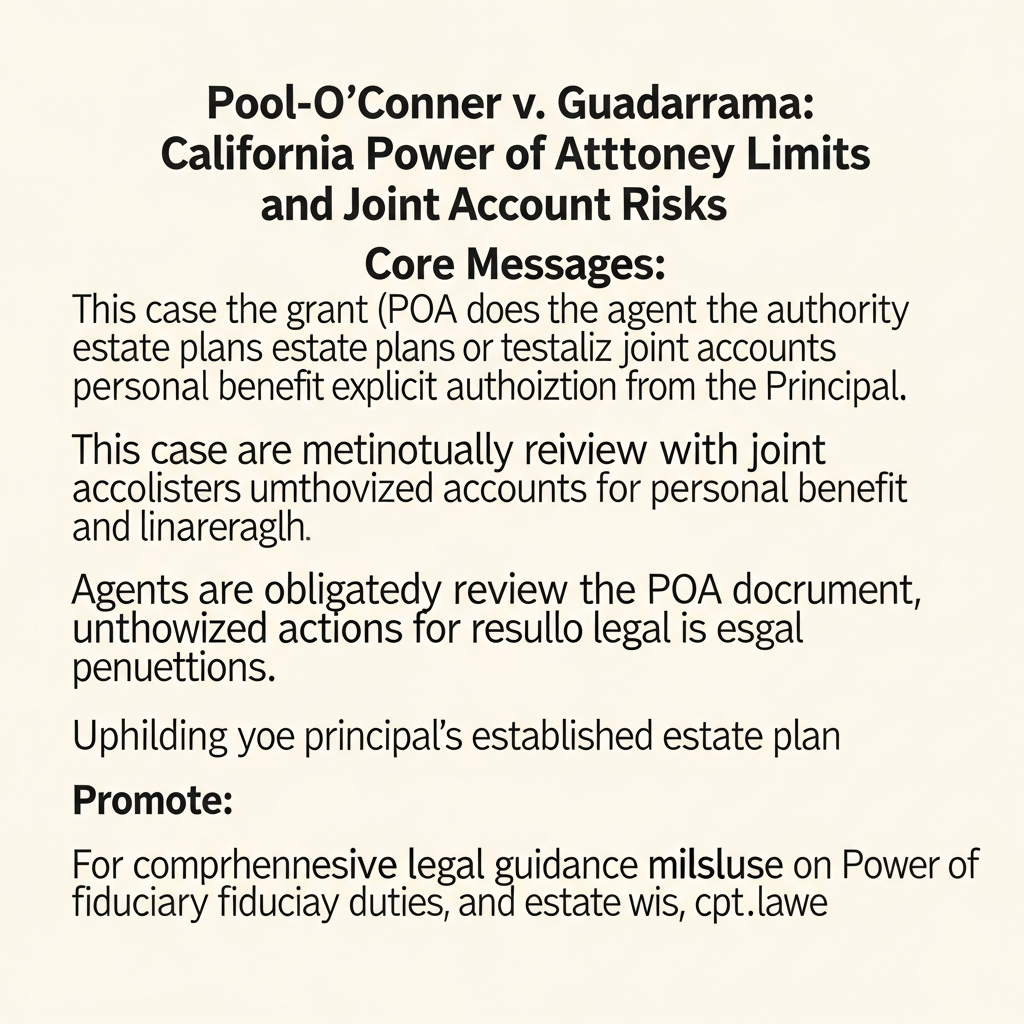
Here is a blog post based on the case summary and core messages provided.
******
# Pool-O’Connor v. Guadarrama: The Limits of California Power of Attorney & Joint Account Risks
When an elderly family member or friend names a trusted individual as their “attorney-in-fact” under a Power of Attorney (POA), they are handing over significant control over their finances. However, that control is not absolute.
A recent California Court of Appeal decision, *Pool-O’Connor v. Guadarrama*, serves as a stark warning to agents and families alike: Possessing a Power of Attorney does not grant the right to alter an estate plan or create joint accounts for personal gain unless explicitly authorized.
Here is a breakdown of the case and what it means for California estate planning and fiduciary duties.
### The Case: *Pool-O’Connor v. Guadarrama*
The case centered on the estate of Mr. Pool. After his wife passed away, Pool updated his estate plan, creating a trust and a will, and executing a Power of Attorney. He named his nephew, Guadarrama, as his successor fiduciary and agent.
Pool also added Guadarrama as an authorized signer on a joint bank account that contained only Pool’s money.
The conflict arose when Guadarrama began using his authority under the Power of Attorney to deposit large sums of Pool’s money into this joint account. Because joint accounts typically carry a “right of survivorship,” Guadarrama argued that upon Pool’s death, the money in that account belonged to him, rather than being distributed according to Pool’s will and trust.
### The Ruling: Express Authority is Required
The trial court—and subsequently the Fifth District Court of Appeal—ruled against Guadarrama. The court found that he had breached his fiduciary duties.
The court established a critical legal standard: Absent express authority under a power of attorney, an attorney-in-fact may not create a survivorship interest in the principal’s funds.
By depositing Pool’s funds into a joint account where he (the agent) was a joint owner, Guadarrama was effectively gifting himself the money and changing the beneficiaries of the estate. Because the Power of Attorney document did not *expressly* state he had the power to create survivorship interests or joint accounts for his own benefit, his actions were unauthorized.
### The Consequences: Surcharges for Breach of Duty
The consequences for the nephew were significant. The court “surcharged” Guadarrama, ordering him to pay back the funds he withdrew that exceeded the federal annual gift tax exclusion (which was the only gifting limit allowed in the POA).
The court noted that claiming ownership of the joint account funds amounted to an attempted change in the designation of beneficiaries. This directly contradicted Pool’s established will and trust.
### Key Takeaways for Families and Agents
This ruling highlights several dangers regarding joint accounts and Power of Attorney abuse:
1. Read the POA Carefully: An agent cannot assume they have the right to restructure assets. If the POA does not specifically say you can create a “survivorship interest” or a “joint account,” doing so is likely a breach of duty.
2. The Danger of Joint Accounts: Joint accounts are often used for convenience (to help an elder pay bills), but they often confuse estate plans. Agents must keep their own money separate from the principal’s money.
3. Respect the Estate Plan: A Power of Attorney is designed to protect the principal’s assets while they are alive, not to rewrite who gets the assets when they die. A Power of Attorney is designed to protect the principal’s assets while they are alive, not to rewrite who gets the assets when they die.
### Conclusion
*Pool-O’Connor v. Guadarrama* reaffirms that a fiduciary’s primary duty is to the principal. Agents who use their position to divert funds into accounts they will inherit are at high risk of litigation and financial penalties.
******
Do you suspect a Power of Attorney is being misused to siphon funds via joint accounts?
Improper transfers and unauthorized joint accounts can devastate an inheritance and violate the principal’s final wishes. If you are facing a dispute regarding fiduciary duties or probate:
Visit [cpt.law](https://cpt.law) or call (866) 674-1130 for a consultation.

About the Author: Dustin MacFarlane, Esq.
California Licensed Attorney | Estate Planning Specialist
Dustin MacFarlane is the founder of California Probate and Trust, PC, with over 15 years of experience in estate planning, probate administration, and trust law. Licensed by the California State Bar, Dustin has helped thousands of California families protect their assets and plan for the future.
CA Bar License: Active | Practice Areas: Estate Planning, Probate, Trust Administration | Location: Granite Bay, CA
Why Estate Planning Matters in California
California has unique estate planning laws that differ significantly from other states. Without proper planning, your assets may not pass according to your wishes, and your family could face unnecessary probate court proceedings.
A comprehensive California estate plan typically includes:
- A revocable living trust to avoid probate
- Pour-over will as a safety net
- Advance health care directive
- Durable power of attorney for finances
- Beneficiary designations on retirement accounts and life insurance
How Trusts Work in California
California’s trust law (Probate Code Division 9) governs how trusts are created, administered, and terminated. Understanding these rules is essential for effective estate planning.
Key benefits of California trusts:
- Avoid probate: Assets in a properly funded trust bypass California’s lengthy probate process
- Privacy: Unlike wills (which become public in probate), trusts remain private
- Control: You maintain control during your lifetime and direct distribution after death
- Incapacity planning: Your successor trustee manages assets if you become incapacitated
- Tax planning: Trusts can help minimize estate and income taxes
Need Expert Estate Planning Guidance?
California estate planning law is complex and constantly evolving. Don’t navigate it alone.
California Probate and Trust, PC has helped thousands of California families protect their assets and plan for the future.
📞 Call us today:
- Main Office: 866-400-0058
- Direct: 916-963-9968