
Categories
Estate Planning Long Term Care Planning

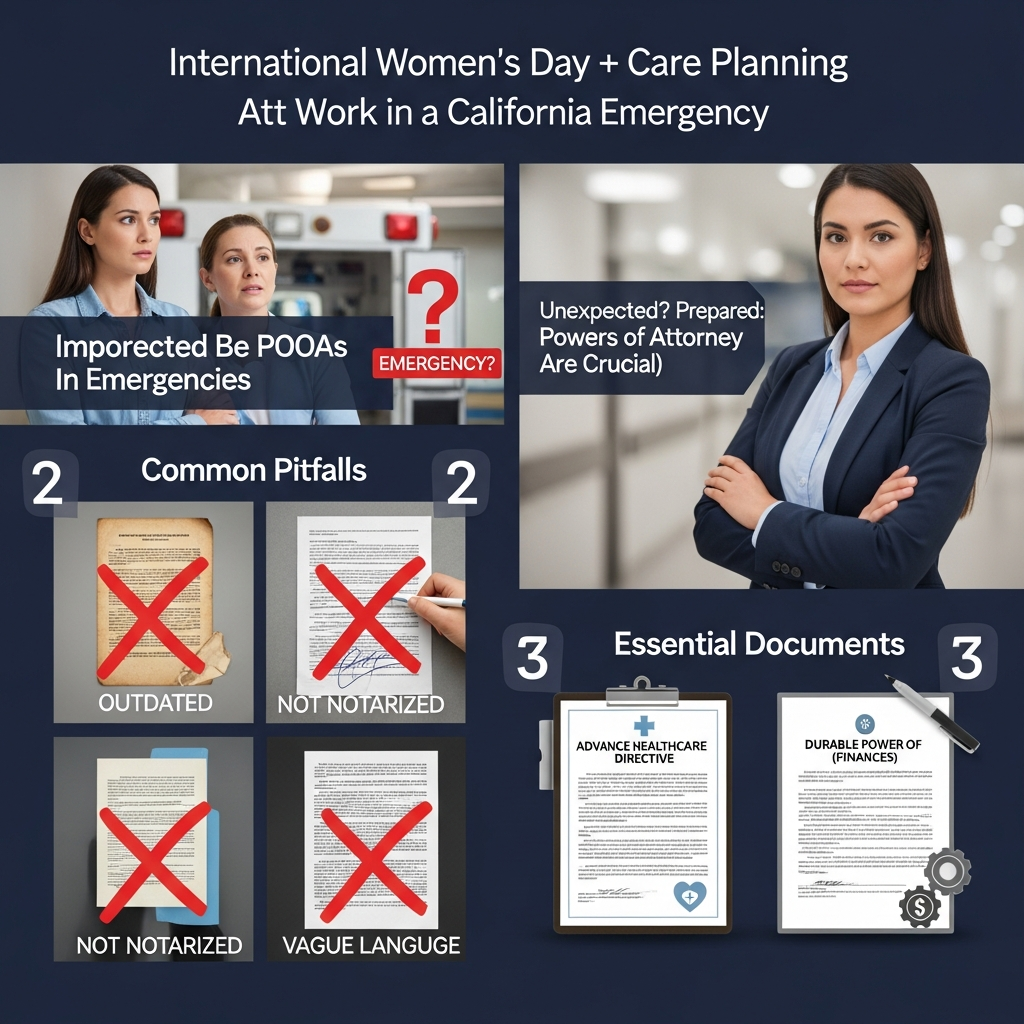
International Women’s Day + Care Planning: Powers of Attorney That Actually Work in a California Emergency

International Women’s Day + Care Planning: Powers of Attorney That Actually Work in a California Emergency

If you’re a California resident helping aging parents, planning your own care, or simply trying to ensure your family won’t face bureaucratic nightmares during a medical crisis, you already know that a power of attorney (POA) is essential. But here’s the uncomfortable truth: many POA documents fail when families need them most—at the hospital desk, the bank counter, or the skilled nursing facility admissions office.

This International Women’s Day, we’re spotlighting a topic that disproportionately affects women, who make up the majority of family caregivers and often outlive their spouses: creating powers of attorney that actually hold up in a real California emergency. This guide will walk you through the common pitfalls, how to choose the right agents, what to do if a bank or healthcare provider refuses your document, and the practical steps you need to take now to protect yourself and your loved ones.

Who this article is for: California residents planning ahead for themselves or helping family members; adult children managing care for aging parents; anyone who has been told “we can’t accept this POA” and wants to understand why—and how to fix it.

Key Takeaways

  • Two critical documents: You need both an Advance Healthcare Directive (for medical decisions) and a Durable Power of Attorney for finances (DPOA)—they cover different areas and neither replaces the other.
  • Common mistakes sink POAs: Outdated forms, missing notarization or witnesses, vague language, and failure to include HIPAA authorization are the top reasons banks and providers reject documents.
  • Choose agents carefully: Your agent must be trustworthy, organized, available, and willing to serve. Name successor agents in case your first choice can’t act.
  • Communicate and store properly: Tell your family where originals are kept, give copies to agents and doctors, and consider registering your directive with California’s Advance Healthcare Directive Registry.
  • If challenged, know your rights: California law protects valid POAs, and you can escalate to supervisors, provide statutory forms, or seek legal help to enforce your authority.
  • Why Powers of Attorney Fail in California Emergencies

    A power of attorney is only as good as the moment it’s tested. You might have signed a document years ago, filed it away, and assumed you were covered. Then comes the crisis: your parent has a stroke, you rush to the hospital, and the admissions staff tells you they can’t share information or honor your authority. Or you try to access a parent’s bank account to pay bills, and the branch manager says, “This form is too old” or “We need our own internal POA.”

    Here’s what typically goes wrong:

  • Outdated or non-California-compliant forms: Forms downloaded from generic websites or created in another state may not meet California’s specific requirements under the Probate Code.
  • Missing or improper execution: California law requires that a DPOA be notarized or signed by two witnesses (and healthcare directives have their own witness rules). If the signatures aren’t done correctly, the document may be invalid.
  • Vague or overly broad language: If the document doesn’t clearly grant authority for the specific action you’re trying to take (e.g., selling real estate, making gifts, accessing safe deposit boxes), institutions may refuse to honor it.
  • No HIPAA authorization: An Advance Healthcare Directive covers medical decision-making, but if it doesn’t include a HIPAA release, healthcare providers may refuse to share records or discuss your loved one’s condition with you.
  • Financial institutions’ internal policies: Some banks and brokerages have their own POA forms and will reject outside documents, even valid ones, citing “policy” or “fraud prevention.”
  • The result? Families are forced into emergency conservatorship proceedings—an expensive, time-consuming court process that could have been avoided with properly drafted and executed documents.

    The Two Essential California Documents: Healthcare Directive and Financial DPOA

    In California, you need two separate powers of attorney to cover both healthcare and financial decisions:

    1. Advance Healthcare Directive (AHD)

    This document, governed by California Probate Code §§ 4600–4805, lets you:

  • Appoint a healthcare agent (also called an “attorney-in-fact” for healthcare) to make medical decisions if you cannot.
  • State your preferences for end-of-life care, life-sustaining treatment, and organ donation.
  • Authorize your agent to access your medical records under HIPAA.
  • Key point: If you don’t include a HIPAA authorization within your AHD, doctors and hospitals may refuse to discuss your condition with your agent, even if that agent has legal authority to make decisions. This is a critical gap in many older forms.

    2. Durable Power of Attorney for Finances (DPOA)

    This document, governed by California Probate Code §§ 4000–4545, lets you appoint an agent to handle:

  • Banking and bill payment
  • Real estate transactions
  • Tax filings and government benefits
  • Business operations
  • Trust funding and estate planning tasks
  • The term “durable” means the POA remains in effect even if you become incapacitated—which is exactly when you need it. A non-durable POA terminates if you lose capacity, making it useless in an emergency.

    Important: California offers a statutory “short form” DPOA (Probate Code § 4401) that is widely accepted. Using this form—or having an attorney draft a comprehensive DPOA that references the statutory language—can reduce the chances of rejection.

    How to Choose Your Agents: Trust, Availability, and Backup Plans

    Naming the right agent is as important as drafting the document itself. Your agent will have significant power over your finances or health, so choose someone who is:

  • Trustworthy and ethical: This person will have access to your bank accounts, investments, and personal information. Choose someone with integrity who will act in your best interest, not their own.
  • Organized and detail-oriented: Managing finances or coordinating healthcare requires tracking bills, deadlines, insurance claims, and communications with multiple institutions.
  • Nearby or accessible: In a medical emergency, you need someone who can get to the hospital quickly or be available by phone to make urgent decisions.
  • Willing to serve: Don’t assume someone will accept. Have a conversation before you name them. Make sure they understand the responsibility and are comfortable with it.
  • Naming Successor Agents

    Life changes. Your first-choice agent may move out of state, become ill, or predecease you. Always name at least one successor agent (and ideally two) in each POA. Specify whether successors serve one at a time or can act jointly.

    Co-Agents: Proceed with Caution

    Some people name two or more agents to act together (jointly) to prevent any single person from having too much power. While this sounds fair, it can create logistical nightmares: both agents must be available to sign every document, and if they disagree, you may end up in court. In most cases, naming one trusted agent with a strong successor is more practical.

    Executing Your POA: Notarization, Witnesses, and California’s Requirements

    Even a perfectly drafted POA is worthless if it’s not executed correctly. Here’s what California law requires:

    Durable Power of Attorney for Finances

  • Must be dated and signed by you (the principal).
  • Must be notarized by a California notary public or signed by two adult witnesses who are not your agent, your healthcare provider, or an employee of your healthcare provider or residential care facility.
  • If the POA will be used for real estate transactions, notarization is required and the document must be recorded with the county recorder where the property is located.
  • Advance Healthcare Directive

  • Must be dated and signed by you.
  • Must be signed by two adult witnesses or notarized by a California notary. The witnesses cannot be your healthcare agent, your healthcare provider, or an employee of your healthcare provider or residential care facility.
  • At least one witness cannot be related to you by blood, marriage, or adoption, and cannot be entitled to any part of your estate.
  • Pro tip: Even if notarization isn’t strictly required, get it done anyway. Notarized documents are more readily accepted by banks, hospitals, and other institutions, and they reduce the risk of someone later challenging the validity of your signature.

    Storing and Sharing Your Documents: Making Sure They’re Available When Needed

    A POA that no one can find is as useless as no POA at all. Follow these steps to ensure your documents are accessible in an emergency:

    1. Keep Originals Safe but Accessible

  • Store originals in a fireproof safe or file cabinet at home—not in a bank safe deposit box, which may be inaccessible if you’re incapacitated.
  • Tell your agents and at least one trusted family member where the originals are kept.
  • 2. Distribute Certified Copies

  • Give a certified copy of your healthcare directive to your agent, your primary care physician, and any specialists you see regularly.
  • Give a certified copy of your financial DPOA to your agent and keep extra copies to provide to banks, brokerages, and the DMV as needed.
  • Some institutions will accept a photocopy, but many require a “certified copy”—a copy with a notary’s or attorney’s certification that it’s a true and correct copy of the original.
  • 3. Register Your Advance Healthcare Directive

    California offers a free statewide Advance Healthcare Directive Registry run by the Secretary of State. Registering your directive ensures that emergency responders and hospitals can access it even if you don’t have a copy with you. You can register online at sos.ca.gov.

    4. Communicate with Your Family

    Don’t keep your POAs a secret. Have an open conversation with your spouse, adult children, and named agents about:

  • Who you’ve chosen and why
  • Where the documents are stored
  • Your wishes for medical care and financial management
  • How to contact your attorney if questions arise
  • This transparency reduces the risk of family conflict and ensures everyone knows what to do in a crisis.

    Common Scenarios: What Happens When a Bank or Hospital Refuses Your POA

    You’ve done everything right—proper forms, correct execution, copies distributed—and then you hit a wall. Here’s what to do:

    Scenario 1: The Bank Says “We Don’t Accept Outside POAs”

    What’s happening: Some financial institutions, citing fraud concerns, have internal policies requiring customers to use the bank’s own POA form.

    Your response:

  • Ask to speak with a supervisor or the legal compliance department.
  • Cite California Probate Code § 4401, which establishes the statutory short form DPOA. If your POA is based on this form or grants the same powers, the bank should honor it.
  • Provide a “certification” under Probate Code § 4303, a sworn statement by your agent that the POA is valid and hasn’t been revoked. Many institutions will accept this.
  • If the bank still refuses, your agent may need to open a new account under the bank’s form (if you’re still competent to sign) or consult an attorney about legal action.
  • Note: Under California law, a third party who refuses a valid statutory form POA without reasonable cause may be liable for the agent’s attorney’s fees and costs. This gives you leverage.

    Scenario 2: The Hospital Won’t Share Medical Records

    What’s happening: Your parent is in the ICU, but the doctor won’t tell you what’s going on, even though you’re named as healthcare agent.

    Your response:

  • Present a copy of the Advance Healthcare Directive with the HIPAA authorization section clearly visible.
  • Ask to speak with the hospital’s patient advocate or legal department.
  • If the directive is old and doesn’t include HIPAA language, have your loved one (if competent) sign a standalone HIPAA authorization form, available from the hospital or your attorney.
  • If your loved one is no longer competent and the hospital still refuses, you may need to seek a court order or file a complaint with the California Department of Public Health.
  • Scenario 3: A Sibling Challenges Your Authority

    What’s happening: Your parent named you as agent, but a sibling disputes your decisions and claims the POA is invalid or that you’re misusing your authority.

    Your response:

  • Remain calm and document all your actions. Keep records of every financial transaction and medical decision.
  • Agents owe a fiduciary duty to the principal and can be held accountable for misuse of authority. If you’re acting properly, you have nothing to fear.
  • Offer to share information with family members (to the extent allowed by your parent’s wishes and privacy laws) to reduce suspicion.
  • If the dispute escalates, your sibling may file a petition in probate court to challenge the POA or seek a conservatorship. At that point, consult an attorney immediately to protect your parent’s interests and your own reputation.
  • Red Flags: When to Update or Replace Your POA

    Dustin MacFarlane, Estate Planning Attorney

    About the Author: Dustin MacFarlane, Esq.

    California Licensed Attorney | Estate Planning Specialist

    Dustin MacFarlane is the founder of California Probate and Trust, PC, with over 15 years of experience in estate planning, probate administration, and trust law. Licensed by the California State Bar, Dustin has helped thousands of California families protect their assets and plan for the future.

    CA Bar License: Active | Practice Areas: Estate Planning, Probate, Trust Administration | Location: Granite Bay, CA