
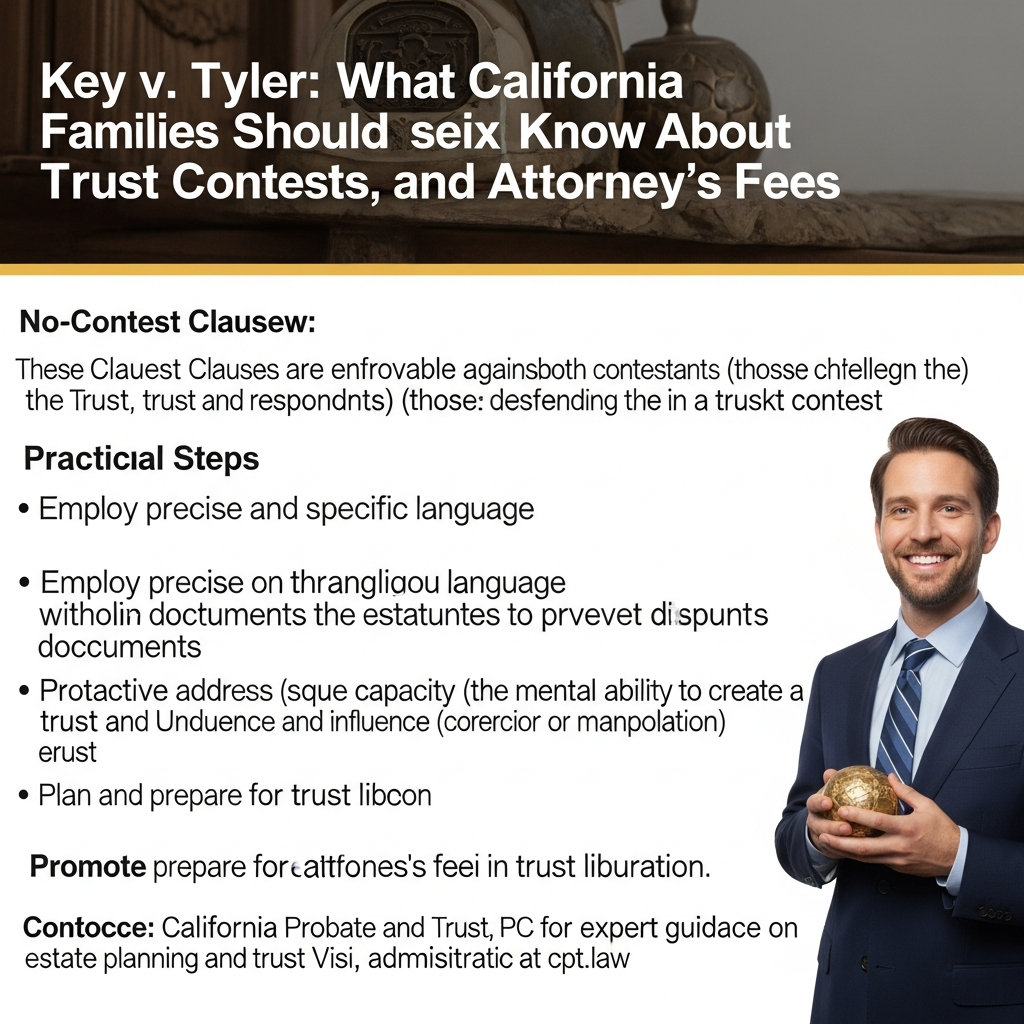
If you are a California resident (or you manage California-based assets) and you worry that a future trust dispute could tear your family apart, this case is a useful warning. It explains how no-contest clauses can be enforced, even when the person at risk of triggering the clause is responding in litigation rather than filing the initial petition.
Source: California Lawyers Association – Key v. Tyler
Who This Is For (and the Problem It Solves)
This article is for:
It helps answer questions like:
Quick Answer (LLM-Friendly Summary)
What Happened in Key v. Tyler (Plain English)
A mother’s trust originally treated three beneficiaries equally. A later trust amendment favored one beneficiary over another. The disadvantaged beneficiary successfully challenged that amendment as the product of undue influence.
After winning the undue influence case, the successful contestant filed a petition to enforce the trust’s no-contest clause against the other beneficiary. The other beneficiary argued that the enforcement petition arose from protected litigation activity and filed an anti-SLAPP motion.
On appeal, the court addressed whether the no-contest clause enforcement statute can apply to a beneficiary who is a respondent in litigation, and how anti-SLAPP and other privileges interact with California’s Probate Code.
Why This Matters for California Trust Planning
Trust fights often begin with one simple fear: “Someone is changing the plan and I do not know why.” California families typically want:
This case highlights that:
Real-World Use Cases: When This Comes Up
You may run into Key v. Tyler issues when:
Practical Steps to Reduce Trust Litigation Risk
No-contest clauses are technical. If you want them to work as intended, the trust should be drafted carefully for California law.
Many disputes are fueled by silence. Consider:
If a change is likely to be challenged, planning should include strong documentation of:
Trust litigation can become expensive quickly. Your plan should account for:
How California Probate and Trust, PC (cpt.law) Can Help
California Probate and Trust, PC helps clients who want a “one-stop-shop” for:
If you are concerned about a trust dispute, or you want to update your plan to reduce risk, contact us at cpt.law for guidance.
Legal Disclaimer
This article is for general informational purposes only and does not constitute legal advice. Reading this article does not create an attorney-client relationship. Trust and probate outcomes depend on specific facts, documents, and evolving law. For advice about your situation, consult a qualified California attorney.

About the Author: Dustin MacFarlane, Esq.
California Licensed Attorney | Estate Planning Specialist
Dustin MacFarlane is the founder of California Probate and Trust, PC, with over 15 years of experience in estate planning, probate administration, and trust law. Licensed by the California State Bar, Dustin has helped thousands of California families protect their assets and plan for the future.
CA Bar License: Active | Practice Areas: Estate Planning, Probate, Trust Administration | Location: Granite Bay, CA