
California Legal Implications: Trust Amendment Formalities and the “Exclusive Method” Rule
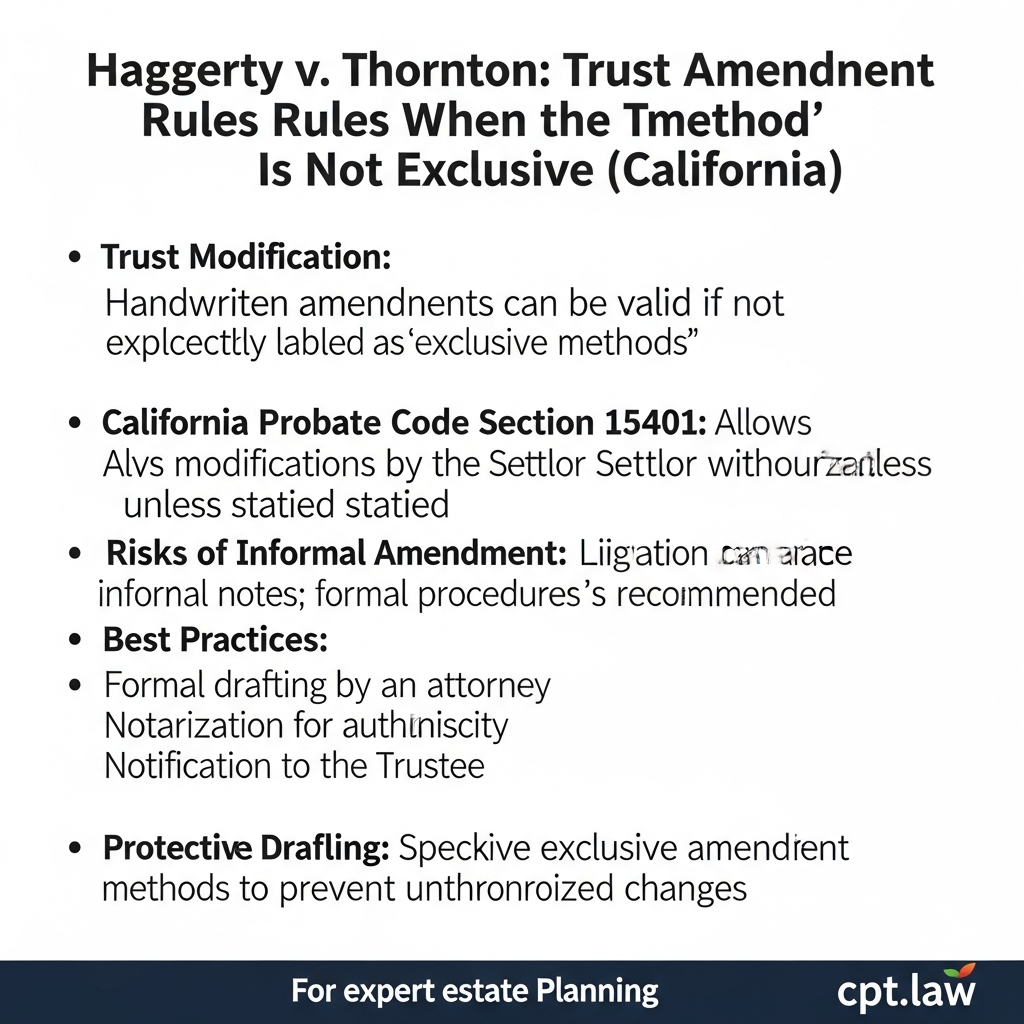
A recent appellate decision, *Haggerty v. Thornton*, highlights a critical nuance in California trust law regarding how a trust can be modified. As detailed in the court opinion, the case involved a dispute over whether a handwritten, unnotarized amendment to a trust was valid when the original trust document mentioned amendments should be made by an “acknowledged instrument” (typically meaning notarized)., the case involved a dispute over whether a handwritten, unnotarized amendment to a trust was valid when the original trust document mentioned amendments should be made by an “acknowledged instrument” (typically meaning notarized).
The court ruled that because the trust did not explicitly state that the “acknowledged instrument” was the exclusive method for amendment, the Settlor (the person who created the trust) was permitted to use the standard statutory method provided by the California Probate Code. This decision underscores the importance of precise drafting in estate planning documents and understanding the default rules provided by California law. (the person who created the trust) was permitted to use the standard statutory method provided by the California Probate Code. This decision underscores the importance of precise drafting in estate planning documents and understanding the default rules provided by California law.
Understanding California Probate Code Section 15401
Under California Probate Code Section 15401, a trust can be revoked or modified using the method described in the trust instrument itself. However, the law provides a safety valve: unless the trust instrument expressly states that its described method is the *exclusive* method, the Settlor may also modify the trust by a writing (other than a will) signed by the Settlor and delivered to the Trustee during the Settlor’s lifetime. during the Settlor’s lifetime.
In *Haggerty v. Thornton*, the Settlor served as her own Trustee. Therefore, her handwritten amendment, which she signed and kept with her papers, was considered “delivered” to herself. Because the trust language did not explicitly forbid other methods of amendment, the court found the handwritten document valid, even though it lacked the notarization mentioned in the original trust.
The Difference Between “Exclusive” and “Available” Methods
For California families and trustees, this distinction is vital. If a trust is drafted with language that suggests a method for amendment—such as requiring two witnesses or a notary—but fails to label that method as exclusive, the statutory method remains an option., the statutory method remains an option.
This flexibility is intended to protect the intent of the Settlor, preventing technicalities from invalidating their final wishes. However, it can also open the door to litigation if informal notes or letters are later discovered and claimed to be valid amendments.
Why Formal Amendments Are Still Best Practice
While the court in *Haggerty* allowed a less formal amendment, relying on statutory default rules is risky. Litigation to prove the validity of a handwritten note is time-consuming and expensive for the beneficiaries..
To ensure clarity and prevent family disputes, it is highly recommended to follow the formal amendment procedures outlined in your estate plan. Best practices include:
* Formal Drafting: Having an estate planning attorney draft amendments ensures the language is clear and legally binding.
* Notarization: Even if not strictly required by the default statute, notarization helps prove the authenticity of the signature.
* Trustee Notification: Ensuring the current Trustee receives and acknowledges receipt of the amendment prevents “lost” documents.: Ensuring the current Trustee receives and acknowledges receipt of the amendment prevents “lost” documents.
Drafting for Protection
If a Settlor wishes to protect themselves from undue influence or impulsive changes, they can instruct their attorney to draft the trust with exclusive amendment requirements. For example, a trust can specifically state that “This trust may *only* be amended by a written instrument signed by the Settlor and notarized. This method is exclusive.” Such language would override the statutory default and render unnotarized notes invalid. amendment requirements. For example, a trust can specifically state that “This trust may *only* be amended by a written instrument signed by the Settlor and notarized. This method is exclusive.” Such language would override the statutory default and render unnotarized notes invalid.
About This Case
Source: Haggerty v. Thornton: Trust Amendment Rules When the Trust’s Method Is Not Exclusive
California Probate and Trust, PC Can Help
– Free consultations: (866)-674-1130
– Experienced California estate planning
– Schedule consultation
– Learn more: cpt.law
Legal Disclaimer
This article is for informational purposes only. Consult with a qualified California estate planning attorney for advice specific to your situation.

About the Author: Dustin MacFarlane, Esq.
California Licensed Attorney | Estate Planning Specialist
Dustin MacFarlane is the founder of California Probate and Trust, PC, with over 15 years of experience in estate planning, probate administration, and trust law. Licensed by the California State Bar, Dustin has helped thousands of California families protect their assets and plan for the future.
CA Bar License: Active | Practice Areas: Estate Planning, Probate, Trust Administration | Location: Granite Bay, CA