
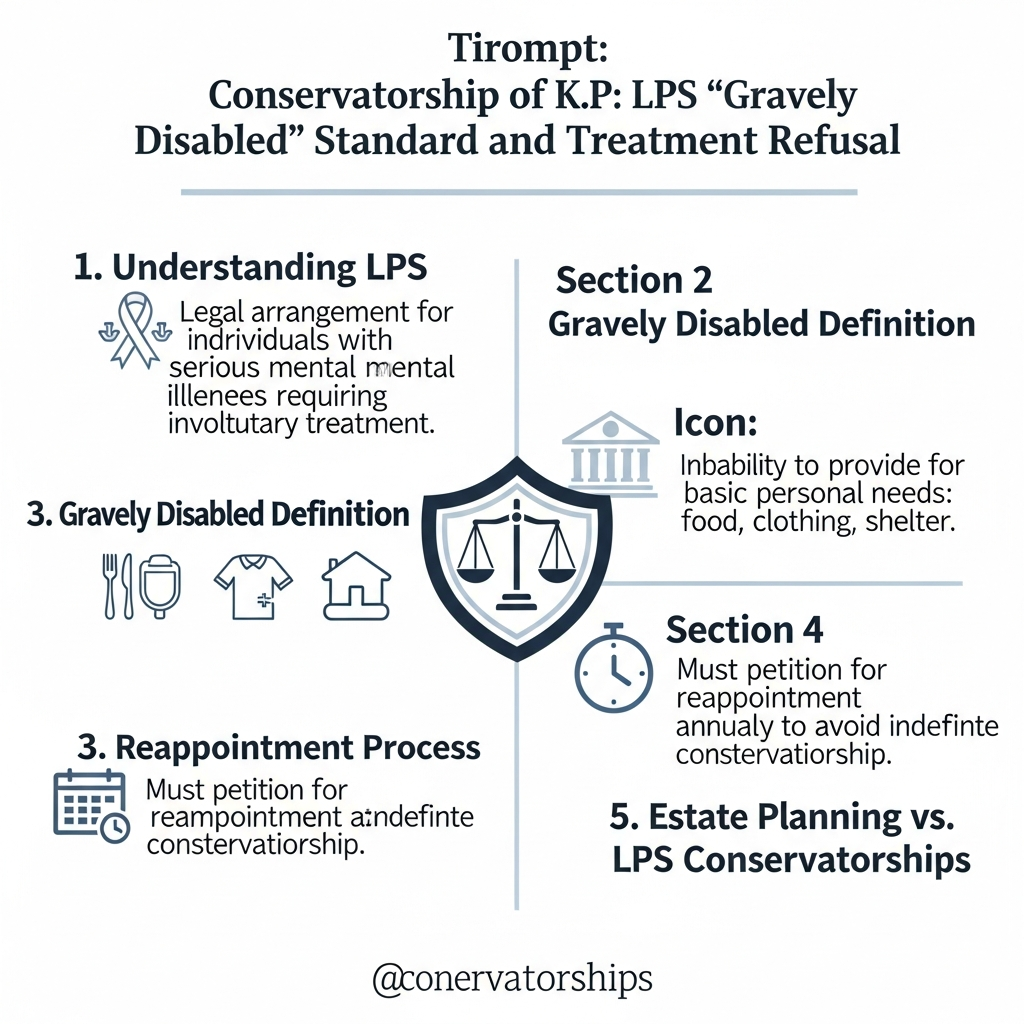
California Legal Implications: The Legal Standards for Mental Health Conservatorships
In the California Court of Appeal case *Conservatorship of K.P.*, the court addressed a critical issue regarding the reappointment of a conservator under the Lanterman-Petris-Short (LPS) Act. The court ruled that when seeking to reappoint a conservator, the petitioner does not need to prove, as a separate legal element, that the conservatee is unwilling or unable to voluntarily accept treatment. The jury need only find that the individual has a mental disorder and is gravely disabled as a result. For California families navigating the complexities of mental health law and estate planning, understanding these specific legal standards is essential for protecting vulnerable loved ones. as a result. For California families navigating the complexities of mental health law and estate planning, understanding these specific legal standards is essential for protecting vulnerable loved ones.
Understanding LPS Conservatorships in California
An LPS Conservatorship is a legal arrangement in California specifically designed for individuals with serious mental illnesses who require involuntary treatment. Unlike a standard Probate Conservatorship, which is typically used for elderly individuals with dementia or adults with developmental disabilities, an LPS conservatorship grants the power to place the conservatee in a locked psychiatric facility and authorize the administration of psychotropic medication., which is typically used for elderly individuals with dementia or adults with developmental disabilities, an LPS conservatorship grants the power to place the conservatee in a locked psychiatric facility and authorize the administration of psychotropic medication.
Because this type of conservatorship involves a significant deprivation of liberty, the legal burden of proof is high. The petitioner must prove “beyond a reasonable doubt” that the proposed conservatee is gravely disabled..
The Definition of Gravely Disabled
Under California law, being gravely disabled means that, as a result of a mental health disorder, the person is unable to provide for their basic personal needs, including:
– Food
– Clothing
– Shelter means that, as a result of a mental health disorder, the person is unable to provide for their basic personal needs, including:
– Food
– Clothing
– Shelter
In the *K.P.* case, the conservatee argued that the jury should have been instructed to determine whether he was willing to accept treatment voluntarily. The court rejected this, clarifying that the statutory definition of gravely disabled focuses on the inability to care for oneself, not merely the refusal of treatment. However, practically speaking, a person who can and does voluntarily accept effective treatment may often show they are not gravely disabled because they can manage their condition. focuses on the inability to care for oneself, not merely the refusal of treatment. However, practically speaking, a person who can and does voluntarily accept effective treatment may often show they are not gravely disabled because they can manage their condition.
Reappointment and Due Process
LPS conservatorships automatically expire after one year. To continue the conservatorship, the conservator (often the Public Guardian or a family member) must petition for reappointment. This ensures that individuals do not remain under conservatorship indefinitely without judicial review.
During these proceedings, families must understand that the court’s primary focus remains on the current state of the conservatee’s disability. In the *K.P.* case, despite the legal technicality regarding jury instructions, evidence showed the individual did not believe he had a mental disability and intended to stop medication if released. This lack of insight often serves as evidence supporting the finding of grave disability.
Estate Planning vs. LPS Conservatorships
While LPS conservatorships are strictly for mental health crises, proactive estate planning can sometimes prevent the need for public intervention in other areas. Tools such as an Advance Health Care Directive allow individuals to designate agents to make medical decisions for them if they become incapacitated. However, when an individual poses a danger to themselves or others due to mental illness, the more restrictive LPS system becomes necessary. allow individuals to designate agents to make medical decisions for them if they become incapacitated. However, when an individual poses a danger to themselves or others due to mental illness, the more restrictive LPS system becomes necessary.
About This Case
Source: Conservatorship of K.P.: LPS “Gravely Disabled” Standard and Treatment Refusal
California Probate and Trust, PC Can Help
– Free consultations: (866)-674-1130
– Experienced California estate planning
– Schedule consultation
– Learn more: cpt.law
– Free consultations: (866)-674-1130
– Experienced California estate planning
– Schedule consultation
– Learn more: cpt.law
Legal Disclaimer
This article is for informational purposes only. Consult with a qualified California estate planning attorney for advice specific to your situation.

About the Author: Dustin MacFarlane, Esq.
California Licensed Attorney | Estate Planning Specialist
Dustin MacFarlane is the founder of California Probate and Trust, PC, with over 15 years of experience in estate planning, probate administration, and trust law. Licensed by the California State Bar, Dustin has helped thousands of California families protect their assets and plan for the future.
CA Bar License: Active | Practice Areas: Estate Planning, Probate, Trust Administration | Location: Granite Bay, CA