
California Legal Implications: Trust Contests, Deadlines, and Disinheritance
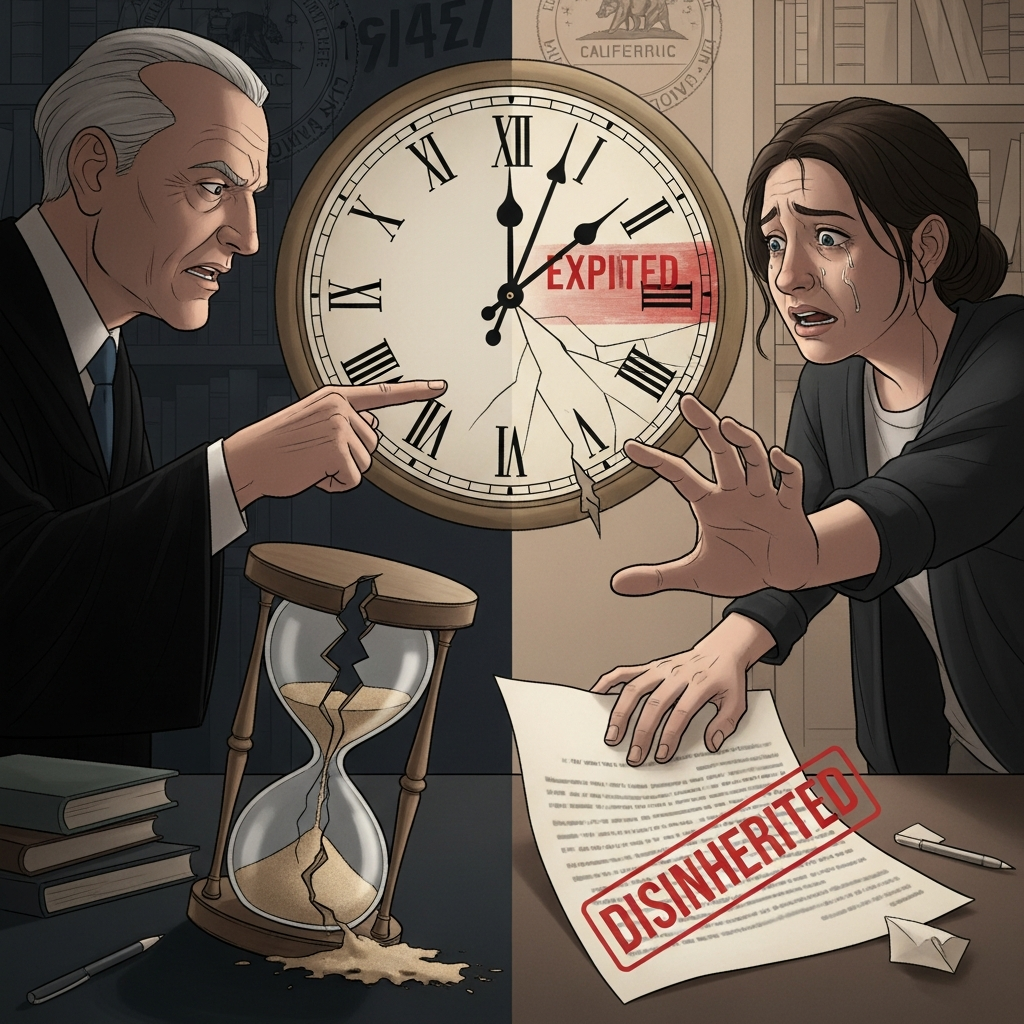
A recent decision by the California Court of Appeal, Second District, highlights the critical importance of adhering to statutory deadlines in trust litigation. In the case of *Meiri v. Shamtoubi*, a beneficiary was effectively disinherited for filing a trust contest after the legal deadline had passed. after the legal deadline had passed.
According to the court opinion, the beneficiary, Meiri, waited 230 days after receiving trustee notification to file a petition invalidating her parents’ trust based on claims of incapacity and undue influence. Under California law, the deadline to contest is generally 120 days. Because she filed late without a valid excuse, the court ruled that her petition lacked probable cause. Consequently, the trust’s no-contest clause was enforced, and Meiri was treated as if she had predeceased the settlors, stripping her of her inheritance. was enforced, and Meiri was treated as if she had predeceased the settlors, stripping her of her inheritance.
For California families and beneficiaries, this case serves as a stark warning: ignoring procedural timelines can lead to total forfeiture of trust assets.
The Power of the No-Contest Clause
A no-contest clause is a provision in a will or trust designed to discourage beneficiaries from challenging the validity of the estate plan. If a beneficiary challenges the document and loses, the clause dictates that they are disinherited. is a provision in a will or trust designed to discourage beneficiaries from challenging the validity of the estate plan. If a beneficiary challenges the document and loses, the clause dictates that they are disinherited.
However, California law provides a safety valve. Under the California Probate Code, a no-contest clause generally cannot be enforced if the beneficiary had probable cause to bring the contest. This means that if a beneficiary has a reasonable basis for believing the trust is invalid (due to fraud, duress, or lack of capacity), they can sue without fear of losing their inheritance, even if they ultimately fail to prove their case. to bring the contest. This means that if a beneficiary has a reasonable basis for believing the trust is invalid (due to fraud, duress, or lack of capacity), they can sue without fear of losing their inheritance, even if they ultimately fail to prove their case.
Procedural Deadlines and Probable Cause
The *Meiri v. Shamtoubi* decision clarifies that probable cause is not limited to the substantive facts of the case (such as evidence of dementia or coercion). It also includes procedural requirements. is not limited to the substantive facts of the case (such as evidence of dementia or coercion). It also includes procedural requirements.
The court found that because Meiri filed her contest well past the statutory 120-day window, her claim was legally barred from the start. Therefore, she could not possibly have had a reasonable expectation of relief. By filing a lawsuit that was procedurally dead on arrival, she lacked probable cause. This triggered the enforcement of the no-contest clause, resulting in her disinheritance., resulting in her disinheritance.
The Importance of the 120-Day Rule
When a settlor dies or a trust becomes irrevocable, the trustee must serve a specific notice to heirs and beneficiaries under Probate Code section 16061.7. This notification warns recipients that they have exactly 120 days to file a contest.. This notification warns recipients that they have exactly 120 days to file a contest.
Key takeaways for beneficiaries include:
* Strict Timelines: The 120-day clock is strict. Waiting 230 days, as the beneficiary in this case did, is fatal to a claim.
* Legal Advice: Receiving a trustee notification is a trigger to seek immediate legal counsel.
* Risk of Forfeiture: Filing a lawsuit after the deadline is not just a waste of time; it can actively destroy your existing beneficial interest if the trust contains a no-contest clause..
About This Case
Source: Meiri v. Shamtoubi (Late Trust Contest + No-Contest Clause)
California Probate and Trust, PC Can Help
– Free consultations: (866)-674-1130
– Experienced California estate planning
– Schedule consultation
– Learn more: cpt.law
Legal Disclaimer
This article is for informational purposes only. Consult with a qualified California estate planning attorney for advice specific to your situation.

About the Author: Dustin MacFarlane, Esq.
California Licensed Attorney | Estate Planning Specialist
Dustin MacFarlane is the founder of California Probate and Trust, PC, with over 15 years of experience in estate planning, probate administration, and trust law. Licensed by the California State Bar, Dustin has helped thousands of California families protect their assets and plan for the future.
CA Bar License: Active | Practice Areas: Estate Planning, Probate, Trust Administration | Location: Granite Bay, CA