
Here is a blog post draft based on the provided title, core messages, and case summary.
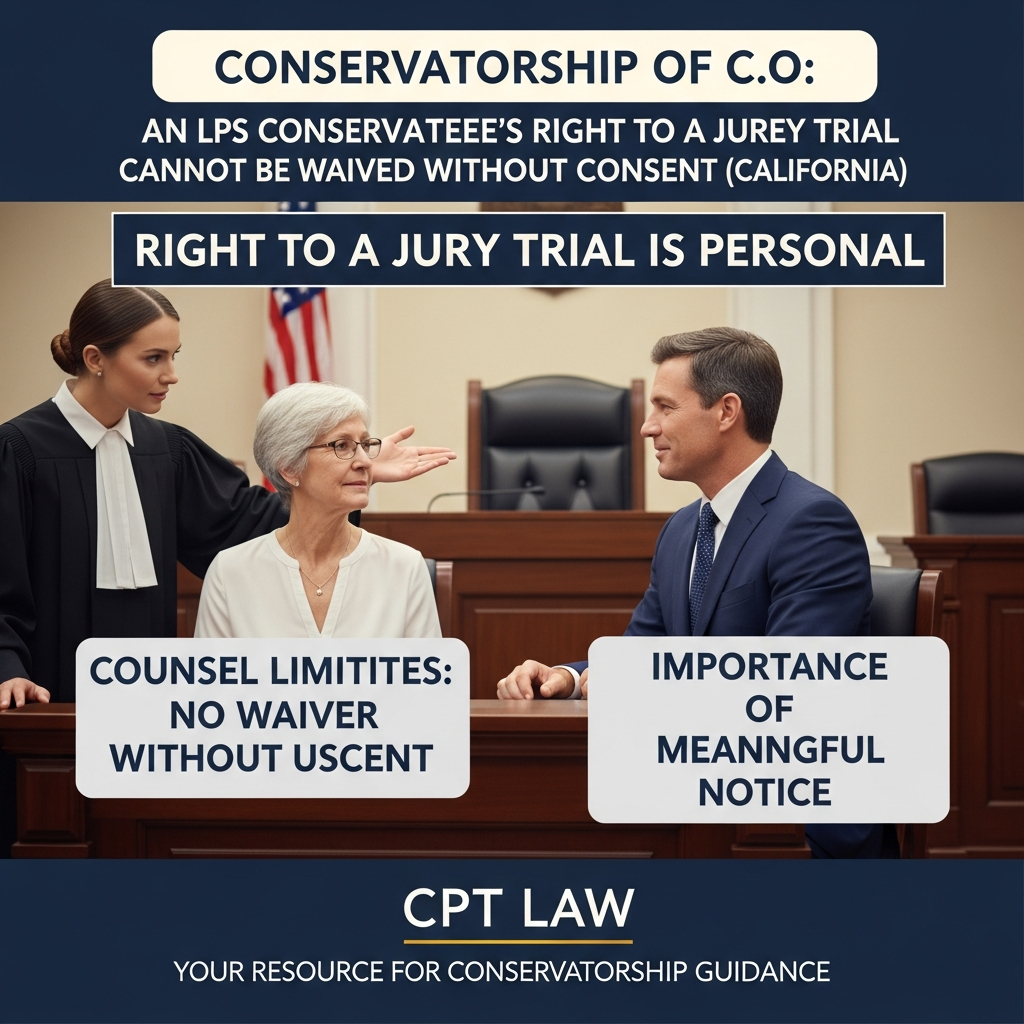
# Conservatorship of C.O.: An LPS Conservatee’s Right to a Jury Trial Cannot Be Waived Without Consent (California)
LPS (Lanterman-Petris-Short) conservatorships are among the most serious legal interventions in California, often resulting in a significant loss of personal liberty for individuals found to be “gravely disabled.” Because the stakes are so high, the legal system provides specific procedural protections—most notably, the right to a jury trial.
A recent appellate case, *Conservatorship of C.O.*, highlights the critical importance of these rights and clarifies the role of legal counsel in waiving them. For families and professionals involved in conservatorship proceedings, understanding who holds the power to waive a jury trial is essential for ensuring due process.
### The Case: Conservatorship of C.O.
In *Conservatorship of C.O.*, the Public Guardian petitioned to reappoint an LPS conservatorship for C.O., alleging he remained gravely disabled. Although C.O. received a written citation notifying him of his right to a jury trial, the scene in the courtroom played out differently.
During the hearing, C.O.’s attorney stated—in C.O.’s presence—that C.O. requested a bench trial (a trial decided by a judge, not a jury). The judge proceeded with the bench trial without asking C.O. directly on the record if he agreed to waive his right to a jury. The judge subsequently found C.O. gravely disabled and reappointed the conservator.
C.O. appealed, arguing that the court erred by accepting the attorney’s waiver rather than getting a personal waiver from him directly.
### The Ruling: A Nuanced Victory for Due Process
The appellate court affirmed the decision but offered vital clarification on how these rights work.
While the court acknowledged that the trial judge violated C.O.’s statutory right by failing to advise him personally on the record, they deemed the error “harmless” in this specific instance. Why? Because there was no evidence suggesting C.O. actually wanted a jury trial, nor was there evidence that his attorney was acting against his wishes.
However, the legal principle remains clear: The right to a jury trial in LPS proceedings is personal to the conservatee.
# Key Takeaways for Families and Conservatees
1. The Right to a Jury Trial is Personal
The decision to face a jury or a judge belongs to the proposed conservatee, not the attorney. While an attorney speaks for their client, they are acting as an agent of the client’s wishes. The court in *C.O.* implied that an attorney’s waiver is accepted largely because it is presumed they are acting with the express authorization of their client. of their client.
2. Counsel Limitations
Counsel cannot treat the right to a jury trial as a mere tactical decision to be made without the client. Unless the client is unable to comprehend the choice, counsel generally may not waive this fundamental right if the client explicitly wants a jury.
Counsel cannot treat the right to a jury trial as a mere tactical decision to be made without the client. Unless the client is unable to comprehend the choice, counsel generally may not waive this fundamental right if the client explicitly wants a jury.
3. The Importance of Meaningful Notice
The case underscores the necessity of informed participation. Even though the court found the error harmless in *C.O.*, the statutes exist to ensure that conservatees are not just “processed” through the system, but are active participants in hearings that determine their future freedom.
The case underscores the necessity of informed participation. Even though the court found the error harmless in *C.O.*, the statutes exist to ensure that conservatees are not just “processed” through the system, but are active participants in hearings that determine their future freedom.
### Practical Steps for Families
If you are navigating the complexities of an LPS conservatorship for a loved one, vigilance is required to ensure their rights are respected.
* Ask About Trial Rights: Don’t assume the procedural steps are automatic. Ask counsel specifically if the conservatee has been asked about their preference for a jury versus a bench trial.
* Request On-Record Waivers: To avoid ambiguity later, it is best practice to request that any waiver of rights be made clearly on the record, ideally by the conservatee themselves if they are able.
* Prepare Protective Planning: Conservatorships are reactive measures. Families should look into proactive protective planning, such as Special Needs Trusts, which can sometimes manage resources in a way that supports the individual’s stability. Conservatorships are reactive measures. Families should look into proactive protective planning, such as Special Needs Trusts, which can sometimes manage resources in a way that supports the individual’s stability.
### How CPT Law Can Help
Navigating the intersection of mental health, legal rights, and conservatorships is daunting. Whether you are looking for assistance with conservatorship procedures or seeking protective options to secure a loved one’s future, professional guidance is vital.
For assistance with conservatorship procedures and protective options, visit [cpt.law](https://cpt.law) or call 866-674-1130.

About the Author: Dustin MacFarlane, Esq.
California Licensed Attorney | Estate Planning Specialist
Dustin MacFarlane is the founder of California Probate and Trust, PC, with over 15 years of experience in estate planning, probate administration, and trust law. Licensed by the California State Bar, Dustin has helped thousands of California families protect their assets and plan for the future.
CA Bar License: Active | Practice Areas: Estate Planning, Probate, Trust Administration | Location: Granite Bay, CA