
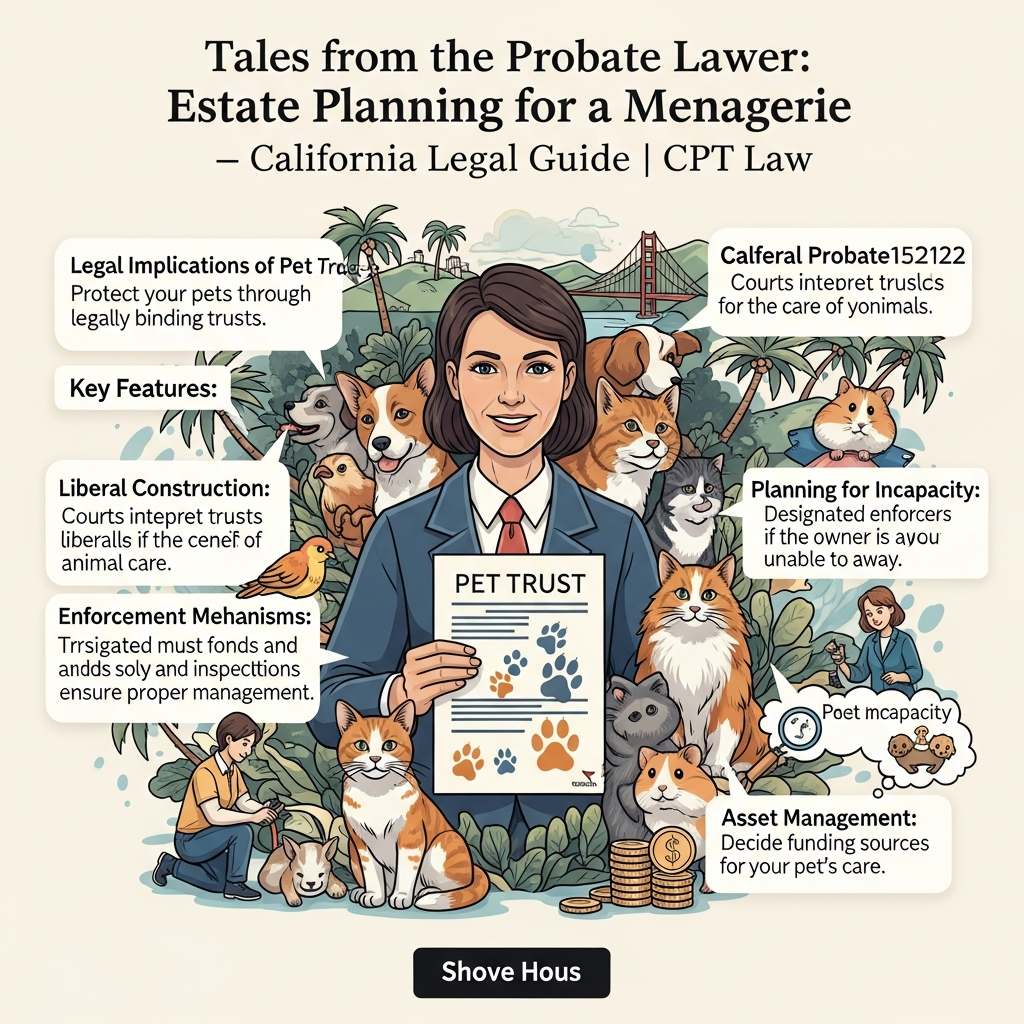
California Legal Implications: Establishing Legally Binding Pet Trusts
A recent legal commentary explores the unique challenges of estate planning for pet owners, using a fictional narrative involving the Addams family to illustrate the very real application of California Probate Code Section 15212. While the story is humorous, the legal principles regarding “Pet Trusts” are critical for any California resident who wishes to ensure their animal companions are cared for after their death or incapacity. You can read the original story here..
For California families, pets are often considered members of the household. However, without specific legal provisions, pets are treated as property under the law, which can lead to uncertainty regarding their care if the owner passes away.
The Legal Basis for Pet Trusts in California
Under California law, specifically Probate Code Section 15212, residents are explicitly authorized to create trusts for the care of animals. These are valid, lawful trusts for a non-charitable purpose. Unlike informal requests or non-binding instructions left in a letter, a Pet Trust creates a legal obligation.
Key legal standards include:
– Liberal Construction: Courts are instructed to interpret these trusts liberally to ensure the animal is cared for, rather than dismissing them as merely honorary.
– Intent: Extrinsic evidence (evidence outside the document itself, such as letters or conversations) is admissible to prove the pet owner’s intent.
– Duration: Unlike some non-charitable trusts, Pet Trusts are not subject to the specific 21-year duration limits found in other sections of the Probate Code. The trust typically continues until the last surviving animal beneficiary dies.: Unlike some non-charitable trusts, Pet Trusts are not subject to the specific 21-year duration limits found in other sections of the Probate Code. The trust typically continues until the last surviving animal beneficiary dies.
Trustee Responsibilities and Restrictions
A Pet Trust establishes a fiduciary relationship. The Trustee is legally bound to use the trust’s principal and income solely for the benefit of the animal. They are strictly prohibited from using trust funds for their own personal use.
If a designated trustee is unable or unwilling to serve, the court has the authority to appoint a trustee to ensure the animal is not left without an advocate. Furthermore, the court can issue orders to transfer property and make determinations advisable to carry out the intent of the settlor (the pet owner).
Oversight and Enforcement
One of the primary concerns for pet owners is enforcement: “Who watches the watcher?” California law provides several mechanisms to ensure the trustee is acting in the animal’s best interest:
– Enforcers: The trust instrument or the court may designate a specific person to enforce the terms of the trust.
– Inspections: Designated enforcers, as well as nonprofit charitable corporations dedicated to animal care, may request reasonable inspections of the animal, its living conditions, and the trust’s financial records.
– Accountings: Trustees are generally required to provide annual financial accountings to beneficiaries or designated animal welfare nonprofits, ensuring transparency regarding how funds are spent.: Trustees are generally required to provide annual financial accountings to beneficiaries or designated animal welfare nonprofits, ensuring transparency regarding how funds are spent.
Planning for Incapacity
A robust estate plan does not merely cover death; it also covers incapacity. A properly drafted Pet Trust can provide for the care of animals if the owner is hospitalized, incapacitated, or otherwise unable to care for them personally. This ensures a seamless transition of care and funding for veterinary bills and food during medical emergencies.
Assets and Remainder Distribution
Pet owners must decide what assets to fund the trust with, ensuring the amount is sufficient to cover the animal’s lifestyle and medical needs for their expected lifespan. This can include cash, investments, or even real property (such as a stable for horses).
The trust must also dictate what happens to the remaining funds once the animal passes away. If the trust document is silent on this matter, the remaining property is distributed according to the residuary clause of the owner’s will or, failing that, under the laws of intestacy.
About This Case
Source: Tales from the Probate Lawyer: Estate Planning for a Menagerie
California Probate and Trust, PC Can Help
Ensuring your pets are protected requires specific legal language and adherence to the California Probate Code. We help families create comprehensive plans that protect all their loved ones, including those with four legs.
– Free consultations: (866)-674-1130
– Experienced California estate planning
– Schedule consultation
– Learn more: cpt.law
Legal Disclaimer
This article is for informational purposes only. Consult with a qualified California estate planning attorney for advice specific to your situation.
Why Estate Planning Matters in California
California has unique estate planning laws that differ significantly from other states. Without proper planning, your assets may not pass according to your wishes, and your family could face unnecessary probate court proceedings.
A comprehensive California estate plan typically includes:
- A revocable living trust to avoid probate
- Pour-over will as a safety net
- Advance health care directive
- Durable power of attorney for finances
- Beneficiary designations on retirement accounts and life insurance
How Trusts Work in California
California’s trust law (Probate Code Division 9) governs how trusts are created, administered, and terminated. Understanding these rules is essential for effective estate planning.
Key benefits of California trusts:
- Avoid probate: Assets in a properly funded trust bypass California’s lengthy probate process
- Privacy: Unlike wills (which become public in probate), trusts remain private
- Control: You maintain control during your lifetime and direct distribution after death
- Incapacity planning: Your successor trustee manages assets if you become incapacitated
- Tax planning: Trusts can help minimize estate and income taxes
Need Expert Estate Planning Guidance?
California estate planning law is complex and constantly evolving. Don’t navigate it alone.
California Probate and Trust, PC has helped thousands of California families protect their assets and plan for the future.
📞 Call us today:
- Main Office: 866-400-0058
- Direct: 916-963-9968

About the Author: Dustin MacFarlane, Esq.
California Licensed Attorney | Estate Planning Specialist
Dustin MacFarlane is the founder of California Probate and Trust, PC, with over 15 years of experience in estate planning, probate administration, and trust law. Licensed by the California State Bar, Dustin has helped thousands of California families protect their assets and plan for the future.
CA Bar License: Active | Practice Areas: Estate Planning, Probate, Trust Administration | Location: Granite Bay, CA