
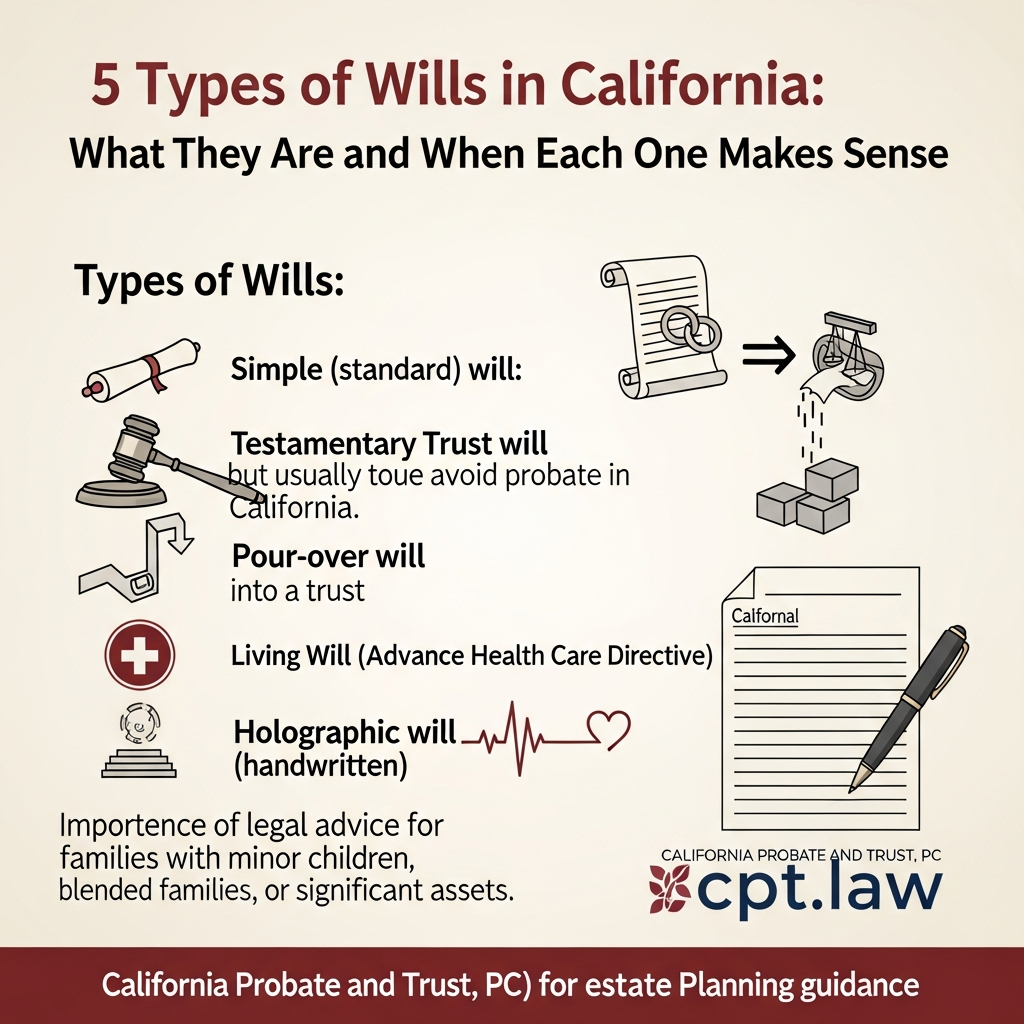
If you are a California resident trying to protect your family, a will can feel like the first “must-do” step. It often is, but many people are surprised to learn that there are different kinds of wills, and that a will alone may not avoid probate.
This guide is written for California individuals and families who want a clear, practical explanation of will options, what each type does, and when it may or may not fit. It was inspired by a summary resource here: 5 Wills – California Estate Planning – CEB.
Quick answer: key takeaways
Who this is for (and what problem it solves)
This is for:
It solves a common problem: people know they “need a will,” but they are not sure what kind, what it actually does in California, or how it fits with trusts, beneficiary designations, and powers of attorney.
First: what a California will does (and does not do)
In plain language, a will generally does these things:
A will generally does not do these things:
A realistic scenario
A Sacramento parent signs a simple will leaving everything “to my children equally.” Later, the parent buys a home and keeps it in their individual name. At death, the home may trigger a probate case even though the will is clear. The will helps direct distribution, but it does not prevent the court process.
1) Simple (standard) will
A simple will is the most common document people think of.
When it can make sense
Common mistakes
California-specific practical note
Even a well-drafted will often requires probate for California real estate held in an individual name. Many families choose to add a trust-based plan to reduce probate exposure.
2) Testamentary trust will
A testamentary trust is a trust created inside the will that begins at death.
When it can make sense
What to watch for
3) Pour-over will
A pour-over will works alongside a revocable living trust. It generally says: if any assets are left outside the trust at death, they “pour over” into the trust.
When it can make sense
Important limitation
A pour-over will is not a guarantee that probate will be avoided. If a significant asset is outside the trust at death, probate may still be required to move it into the trust.
Why people still use it
It is often part of a clean, coordinated estate plan. It helps align “leftover” probate assets with the trust’s distribution instructions.
4) Living will (Advance Health Care Directive)
In California, what many people call a “living will” is usually an Advance Health Care Directive. It is about medical decisions, not who inherits property.
What it typically covers
Why it matters
Without incapacity documents, families can face delays, conflict, or court involvement during a crisis.
5) Holographic will (handwritten will)
A holographic will is generally a will written and signed by the person making the will.
When it might happen
Risks
If you have a handwritten will, it is often wise to have a California attorney review whether it is likely to be accepted and whether it matches your current goals.
How to choose the right approach in California
A will can be the right starting point, but most people benefit from looking at the bigger system.
Step-by-step checklist
When you should talk to a California probate or estate planning attorney
Consider legal guidance if any of these apply:
California Probate and Trust, PC focuses on California estate planning, trust administration, and probate. A clear plan can reduce stress for the people you care about and make sure documents work together.
FAQs
What is the best type of will in California?
There is not one “best” type for everyone. Many Californians use a simple will for basic planning, or a pour-over will as part of a revocable living trust plan when probate avoidance is a priority.
Does a will avoid probate in California?
Usually not. A will often governs probate, but it typically does not prevent it. Probate avoidance often requires trust planning, proper asset titling, and coordinated beneficiary designations.
What happens if I die without a will in California?
California intestacy rules can determine who inherits, and a probate case is often required. The result may not match what you would have chosen, especially in blended families.
Can I write my own will in California?
Some people do, including handwritten (holographic) wills. The risk is that unclear language or improper execution can cause delay, expense, or disputes. Even if you draft your own, it is often worth a legal review.
Do I still need a will if I have a living trust?
Often yes. A pour-over will is commonly used as a backup to move remaining probate assets into the trust and to cover items not otherwise addressed.
Call to action
If you are trying to decide what kind of will makes sense, or whether a will is enough for your situation, consider getting advice before signing documents. California Probate and Trust, PC can help you build an estate plan that fits your family, your assets, and California rules, and can guide you through trust planning, probate prevention strategies, and long-term peace of mind.

About the Author: Dustin MacFarlane, Esq.
California Licensed Attorney | Estate Planning Specialist
Dustin MacFarlane is the founder of California Probate and Trust, PC, with over 15 years of experience in estate planning, probate administration, and trust law. Licensed by the California State Bar, Dustin has helped thousands of California families protect their assets and plan for the future.
CA Bar License: Active | Practice Areas: Estate Planning, Probate, Trust Administration | Location: Granite Bay, CA