Categories
California Probate News

Bagby v. Davis: What California’s Choice-of-Law and Insurance Exemption Rulings Could Mean

Bagby v. Davis: What California’s Choice-of-Law and Insurance Exemption Rulings Could Mean

If you are a California resident, trustee, executor, or business owner dealing with debt, collections, or a lawsuit, court rules about which state’s law applies can change the outcome in a meaningful way. A recent California appellate decision, Bagby v. Davis, discusses issues that commonly come up in cross-border disputes, including choice-of-law and whether certain insurance-related benefits or exemptions can be reached by creditors.

For background, see the source article here: CA Appellate Court Hands Down Interesting Choice-of-Law, Debt Collection Insurance Exemption Rulings in Bagby v. Davis.

Key takeaways (quick answer)

  • When a dispute has connections to more than one state, the court may have to decide which state’s law governs key issues.
  • Choice-of-law disputes can affect:
  • Creditors often try to reach all available assets, but California recognizes that some benefits and assets may be exempt or protected under certain circumstances.
  • If there is an existing trust, estate plan, or inherited assets involved, these civil rulings can intersect with probate administration, trust administration, and judgment enforcement.
  • When the stakes are high or the facts are complicated, it is usually worth speaking with a California attorney before relying on “general rules” found online.
  • What happened, and why it matters in California

    The appellate ruling in Bagby v. Davis is a reminder that civil disputes do not happen in a vacuum. In California, it is common for families and businesses to have:

  • Property in more than one state.
  • Family members living in different states.
  • Contracts signed in one state and performed in another.
  • Insurance policies and financial accounts with national providers.
  • When those facts are present, litigants may fight over choice-of-law. That fight matters because different states can treat the same issue differently, including how aggressively a creditor can collect and what a debtor can keep.

    If you are dealing with a judgment, threatened collection, or a lawsuit that overlaps with estate or trust administration, getting the “governing law” wrong can create expensive delays or lead to an avoidable loss.

    Choice-of-law in plain English

    Choice-of-law is the court’s method for deciding which state’s law applies to a particular issue.

    That question can come up when:

  • A contract includes a governing law clause.
  • A transaction or relationship touches multiple states.
  • The parties live in different places.
  • The relevant property is located outside California.
  • Why choice-of-law can change the outcome

    Different state laws can vary on:

  • Whether a particular claim is recognized.
  • Deadlines and statutes of limitation.
  • Standards for proving fraud or bad faith.
  • Consumer protections and debt collection rules.
  • Exemptions and what assets are protected from levy.
  • Even if a case is filed in California, that does not always mean California law automatically governs every issue.

    Debt collection and “exemptions”: why insurance-related issues come up

    Debt collection cases often turn on a practical question: What can a creditor actually collect?

    Even with a valid judgment, a creditor may face legal limits. California law includes various protections that may apply depending on the asset type and the facts.

    Insurance-related disputes can arise because insurance benefits, annuities, and related financial products sometimes have special rules. In some situations, money tied to an insurance product may be:

  • More protected than ordinary cash.
  • Less protected than a person expects.
  • Protected only if specific requirements are met.
  • Because these rules can be technical, an appellate decision that addresses an “insurance exemption” issue can be relevant to:

  • People facing collection pressure.
  • Families trying to preserve stability after a death.
  • Trustees and executors determining whether estate or trust assets are exposed.
  • How this can intersect with probate and trust administration

    Even if a case starts as a debt collection dispute, the practical impact can spill into estate and trust matters, such as:

  • A beneficiary who is being pursued by creditors.
  • A trustee receiving demands to turn over distributions.
  • An executor trying to administer an estate while litigation is pending.
  • A family trying to fund or update an estate plan while a judgment exists.
  • Common real-world scenarios

  • A San Diego family inherits a payout or receives trust distributions, and a creditor tries to attach the distributions.
  • A Los Angeles business owner has a cross-state contract dispute that leads to a judgment, and collection efforts follow.
  • An adult child serving as successor trustee is unsure whether making distributions could expose the trust to collection actions against a beneficiary.
  • These are the moments when it helps to coordinate civil judgment enforcement strategy with California probate and trust administration strategy.

    Practical steps if you are dealing with a cross-state debt or lawsuit

    1. Identify the “map” of the case

    Write down (or gather documents showing):

  • Where each party lives.
  • Where the contract was signed and performed.
  • Where the relevant property is located.
  • Whether there is a governing law clause.
  • Where any trust was created and administered.
  • 2. Do not assume the court will use the law you prefer

    Choice-of-law analysis can be fact-specific. What seems “obvious” to a non-lawyer is not always how courts apply conflicts rules.

    3. Inventory assets by type, not just by amount

    For collection and protection planning, the category of an asset often matters as much as its value. For example:

  • Wages
  • Retirement accounts
  • Bank accounts
  • Real estate
  • Trust interests
  • Insurance-related benefits
  • 4. If probate or trust administration is involved, coordinate early

    In California, probate and trust administration have their own procedures and timelines. Litigation and collection activity can create conflicts with:

  • Deadlines.
  • Notice requirements.
  • Distribution planning.
  • When handled carefully, families can often reduce unnecessary conflict and avoid preventable mistakes.

    When you should talk with a California attorney

    Consider speaking with a lawyer if any of the following are true:

  • The dispute touches more than one state.
  • You are facing aggressive collection activity.
  • A trust, estate, or inheritance is part of the picture.
  • You are a trustee or executor and do not want to accidentally violate duties.
  • You need a plan that balances protection, compliance, and risk.
  • California Probate and Trust, PC focuses on California probate, trust administration, and estate planning. When a family’s situation overlaps with civil disputes or collection issues, having a California-focused legal team can help clarify options, responsibilities, and next steps.

    FAQ

    How do I know which state’s law applies to my case?

    It depends on the facts and, sometimes, on the wording of a contract. If multiple states are involved, a court may apply a choice-of-law framework rather than automatically applying California law.

    Can creditors take money I receive from a trust in California?

    Sometimes. The answer depends on the trust terms, the type of distribution, and the creditor’s legal tools. Trustees often need tailored guidance before responding to demands.

    Are insurance benefits always protected from creditors?

    Not always. Some insurance-related assets may receive special treatment, but protection can depend on the product type, ownership, beneficiary designations, and how the funds are held.

    Does a California judgment automatically apply in another state?

    Often a judgment can be enforced in other states, but there may be additional procedures. When enforcement crosses state lines, legal strategy and timing matter.

    If a family member dies while litigation is pending, what happens?

    It depends on the claim and procedural posture. Some claims may continue through a probate estate or involve a trust. Do not assume the dispute “ends” at death.

    Call to action

    If you are dealing with a California probate, trust administration, or estate planning issue that overlaps with debt collection, a lawsuit, or cross-state legal questions, California Probate and Trust, PC can help you understand your options and next steps.

    You can reach CPT through cpt.law to request a consultation, call the office, or use an online intake form. The goal is to reduce uncertainty, protect your family, and move forward with a plan that fits your specific facts.
    Categories
    California Probate News Trusts

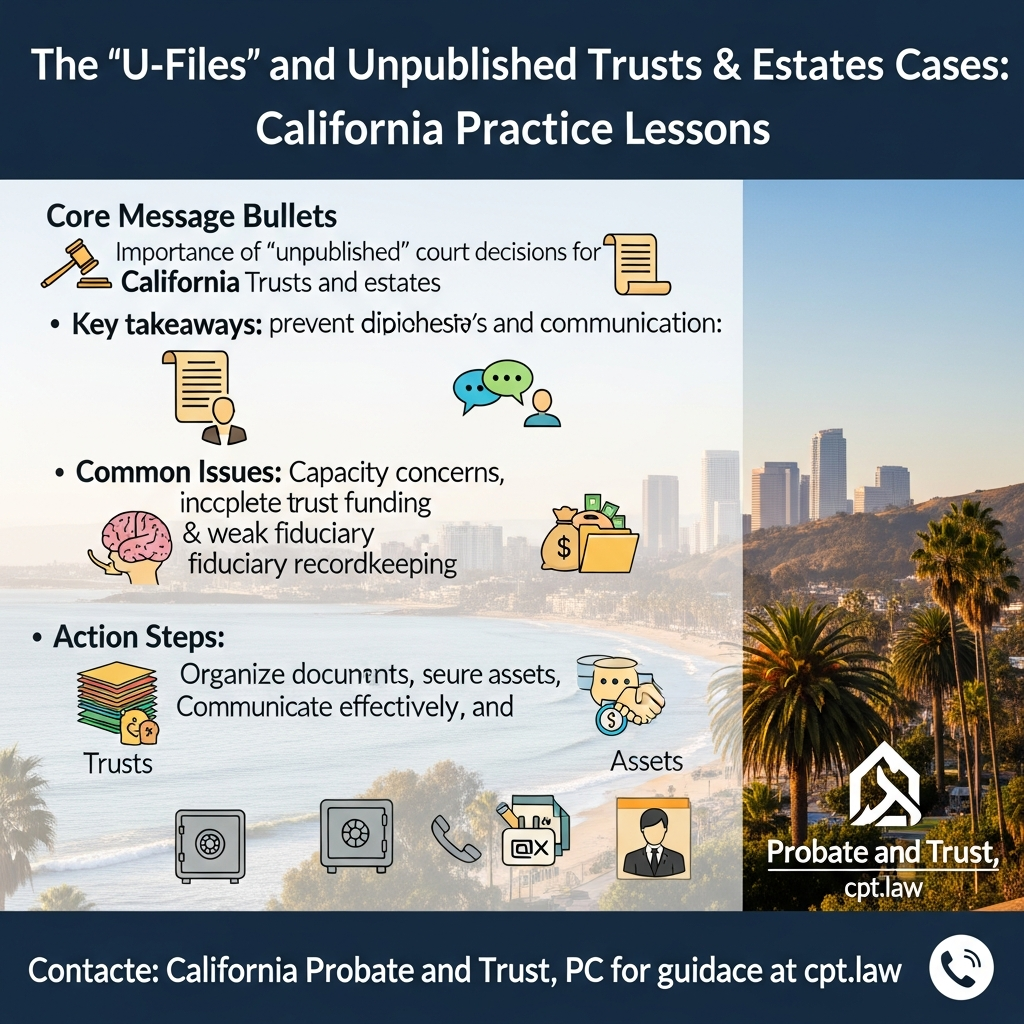
    The ‘U-Files’ and Unpublished Trusts & Estates Cases: California Practice Lessons

    The ‘U-Files’ and Unpublished Trusts & Estates Cases: California Practice Lessons

    If you manage a California trust or estate, or you advise families in California, “unpublished” court decisions can still matter. They often highlight how people end up in disputes, what documentation is missing, and where fiduciaries misstep.

    This article is written for California residents, trustees, executors, and professionals who want practical, risk-reducing guidance. It uses the CEB discussion of “The ‘U-Files’: Unpublished Cases That Offer Reminders for Successful Trusts & Estates Practice” as the jumping-off point for California-focused takeaways: CEB source.

    Quick answer: key takeaways

  • Unpublished cases still reveal real-world failure points like unclear capacity evidence, sloppy trust funding, and poor fiduciary accounting.
  • Most conflicts are preventable with better documentation, tighter procedures, and early communication.
  • Trustees and executors have legal duties that can create personal liability if ignored.
  • When there is family conflict, blended families, or unusual assets, it is usually safer to speak with a California probate and trust attorney early.
  • What “unpublished cases” usually teach (even if they are not binding law)

    In California, not every appellate decision is published. Unpublished opinions are generally not precedent, but they can still be instructive.

    In practice, they often show:

  • What facts cause a probate or trust matter to escalate into litigation.
  • How courts evaluate credibility and documentation.
  • Which fiduciary actions trigger surcharge claims.
  • How procedural mistakes create delays and added expense.
  • For families, the value is not “following the case,” but understanding patterns that repeatedly lead to disputes.

    Who this is for (and when to call a lawyer)

    This guidance is especially relevant if you are:

  • A trustee administering a California revocable living trust after someone’s death.
  • An executor (personal representative) handling a California probate.
  • An adult child helping a parent with incapacity planning.
  • A beneficiary worried about transparency, timing, or fairness.
  • Consider talking with a California probate and trust attorney early if any of these are true:

  • There is a blended family, disinherited family member, or prior promises.
  • You suspect undue influence, financial elder abuse, or capacity issues.
  • The estate includes California real estate, a business, or complicated tax issues.
  • A fiduciary cannot produce clear records.
  • California Probate and Trust, PC (cpt.law) focuses specifically on California probate, trust administration, and estate planning, which can help families get clear direction and avoid common procedural mistakes.

    Common “U-File” scenario patterns: where California trust and probate matters go wrong

    1. Capacity and undue influence are treated casually

    A recurring problem is that families wait until a crisis to address a will or trust update.

    What tends to trigger disputes

  • A last-minute amendment that significantly changes distributions.
  • A new caregiver or partner involved in documents or finances.
  • A sudden change in beneficiary designations.
  • Practical steps that reduce risk

  • Keep contemporaneous notes of why changes were made.
  • Use a consistent estate planning process and avoid rushed signings.
  • Where appropriate, obtain a professional capacity evaluation.
  • Mini-scenario: A Los Angeles homeowner updates a trust shortly after a hospitalization. A disinherited child later claims incapacity. The dispute becomes less about the “legal standard” and more about what the records show about the parent’s decision-making.

    2. Trust funding is incomplete (and creates an avoidable probate)

    A trust is only as effective as its funding. In California, leaving a major asset outside the trust can create delay, expense, and conflict.

    Common missed items

  • Deeds for California real property.
  • Bank or brokerage accounts not retitled.
  • Beneficiary designations not coordinated with the plan.
  • What to do now

  • Inventory assets.
  • Confirm title for each asset.
  • Align beneficiary designations with the trust and overall plan.
  • 3. Fiduciary recordkeeping is weak or inconsistent

    Trustees and executors often underestimate how much documentation is expected.

    Practical trustee and executor checklist

  • Create a dedicated estate or trust email address.
  • Use a separate fiduciary bank account where appropriate.
  • Keep receipts and backup for every material transaction.
  • Track distributions with dates, amounts, and stated purpose.
  • Maintain a timeline of key decisions.
  • When beneficiaries do not receive clear information, suspicion rises. Even well-intended fiduciaries can end up defending themselves.

    4. Communication breaks down and conflict fills the vacuum

    Many disputes start with silence. Even when the fiduciary is acting properly, lack of updates can look like concealment.

    Better communication looks like

  • A clear “what happens next” message early.
  • A basic schedule of expected milestones.
  • A consistent cadence for updates.
  • 5. Procedures are missed, creating avoidable delays

    California probate and trust administration involve procedural steps that can be unforgiving.

    Examples of avoidable issues include:

  • Notices sent late or inconsistently.
  • Missed deadlines.
  • Incomplete inventories.
  • Poor coordination with tax professionals.
  • For many families, the cost of early legal guidance is far less than the cost of fixing errors later.

    California-specific considerations that commonly show up in disputes

    California real estate often raises the stakes

    Even modest estates can become complex if California real property is involved. Title issues, multiple heirs, and maintenance costs can trigger conflict.

    Community property and separate property issues can surprise families

    How an asset is titled and how it was acquired can affect who receives what. A plan that “sounds fair” may not operate the way the family expects without careful structuring.

    No-contest clauses and “disinheritance language” are not magic

    Families sometimes assume that a no-contest clause prevents litigation. In practice, disputes can still happen, and careful drafting and planning are needed.

    What trustees and executors can do right now (a practical action plan)

  • Get organized immediately: gather the trust, will, amendments, deeds, account statements, and contact lists.
  • Identify stakeholders: beneficiaries, heirs, creditors, and professionals involved.
  • Secure assets: protect property, prevent unauthorized access, maintain insurance.
  • Create a timeline: date of death, key notices, asset collection, expected milestones.
  • Document decisions: especially sales, distributions, and unusual expenses.
  • Ask for help early: if conflict is brewing, get California-specific guidance.
  • FAQ

    Do unpublished cases matter in California trust and estate practice?

    They can matter as practical guidance. While they are usually not binding precedent, they often highlight real-life mistakes that lead to disputes.

    What is the biggest reason California trust administrations become contested?

    Common causes include perceived unfairness, poor communication, incomplete documentation, capacity concerns, and incomplete trust funding.

    How can a trustee reduce the risk of being personally liable?

    Follow fiduciary duties carefully, keep excellent records, communicate consistently, and avoid conflicts of interest. When issues arise, get legal advice early.

    Does a living trust avoid probate in California automatically?

    Not automatically. A trust must be properly funded. Assets left outside the trust may still require a probate or other court procedure.

    When should an executor or trustee hire a California probate lawyer?

    Consider legal help early if there is conflict, complex assets, capacity or undue influence issues, or uncertainty about procedures and deadlines.

    Call to Action: get practical California probate and trust guidance

    If you are administering a trust or estate in California, you do not have to do it alone. California Probate and Trust, PC helps families, trustees, and executors understand their options, follow the right process, and reduce stress and conflict.

    Categories
    Estate Planning News

    Estate of Griffin v. Commissioner: Why Intent Alone Can Trigger Estate Tax Problems in California

    Estate of Griffin v. Commissioner: Why Intent Alone Can Trigger Estate Tax Problems in California

    If you are a California resident creating an estate plan for a spouse, partner, or family member, it is easy to assume that good intentions and “close enough” paperwork will carry the day.

    They often do not.

    A recent discussion of Estate of Griffin v. Commissioner highlights a common and costly theme in estate and tax disputes: intent to provide for a surviving spouse is not always enough if the legal requirements are not satisfied. You can read the source here: Estate of Griffin v. Commissioner: When Intent to Provide for a Surviving Spouse Isn’t Enough to Avoid Tax Heartbreak.

    This article explains what that lesson means for California families, trustees, and executors, and what to do now to reduce the risk of tax surprises, probate delays, and family conflict.

    Quick answer (key takeaways)

  • Tax results depend on documents and execution, not intent. Courts and the IRS generally follow the written plan.
  • “Spouse-friendly” estate planning needs technical precision. Marital planning tools can fail if a trust is not drafted, funded, or administered correctly.
  • Trust funding and beneficiary designations are frequent failure points. A great trust on paper can still produce a bad outcome.
  • Executors and trustees should get counsel early when an estate has a surviving spouse, significant assets, or complex trust terms.
  • If you want to protect a surviving spouse and reduce tax exposure, build a plan that is clear, coordinated, and periodically updated.
  • Who this is for (and when to talk to a lawyer)

    This is for:

  • California residents who want to provide for a surviving spouse
  • Adult children trying to help a surviving parent
  • Trustees and executors administering an estate where the plan “does not match” the family’s expectations
  • Anyone with California real estate, a blended family, or meaningful retirement and investment accounts
  • You should speak with a California probate and estate planning attorney if:

  • A spouse is expected to receive most or all of the estate
  • There is a trust with complicated distribution language
  • There are multiple marriages, stepchildren, or separate property concerns
  • The estate involves a business, major real estate holdings, or tax-sensitive assets
  • Someone is already disputing what the decedent “really meant”
  • What “intent isn’t enough” means in real life

    People usually discover this problem in one of three stressful moments:

  • At death, when the executor starts assembling assets and realizes the trust is not funded.
  • During trust administration, when a trustee reads the trust terms and discovers strict requirements for distributions.
  • During tax reporting or audit, when the IRS (or another interested party) points to technical requirements that were not met.
  • Even if a plan was created with the goal of supporting a surviving spouse, the legal system tends to ask:

  • What do the documents say?
  • Were the documents executed correctly?
  • Were the assets titled and designated consistently with the plan?
  • Were any required steps taken at the right time, by the right person, in the right form?
  • California estate planning: common failure points when planning for a spouse

    Below are the most common places where spouse-centered planning breaks down.

    1. Trust language that is “close,” but not precise

    If a trust (or related document) is meant to accomplish a particular outcome, small drafting issues can have big consequences.

    A California-focused example: a couple creates a plan that says the surviving spouse is “taken care of,” but the trust does not clearly spell out:

  • Who controls distributions
  • Whether distributions are required or discretionary
  • What happens if the surviving spouse remarries
  • How separate property and community property are treated
  • 2. Trust funding gaps (especially California real estate)

    In practice, many “intent” problems are funding problems.

    A common scenario:

  • A San Diego couple signs a living trust.
  • They never deed the home into the trust.
  • One spouse dies.
  • The surviving spouse assumes the trust controls everything.
  • The executor later learns the home is still titled outside the trust, creating avoidable probate exposure or administrative complexity.
  • 3. Beneficiary designations that override the plan

    Many high-value assets pass by beneficiary designation, not by will or trust terms, such as:

  • Retirement accounts
  • Life insurance
  • Pay-on-death or transfer-on-death accounts
  • If the beneficiary designations are outdated or inconsistent, they can produce results that conflict with the family’s expectations.

    4. Plan changes after major life events

    Intent changes, families change, and laws change.

    Events that should trigger a review include:

  • Marriage or divorce
  • Buying or selling California real estate
  • A spouse’s incapacity
  • A major inheritance
  • A new child or grandchild
  • A diagnosis that changes long-term care planning
  • 5. Administration mistakes after death

    Even a strong plan can be harmed by post-death administration mistakes.

    Examples include:

  • Distributing assets too early
  • Failing to inventory and value assets properly
  • Not documenting reimbursements, loans, or gifts
  • Not keeping separate property and community property accounting clear
  • Practical steps to reduce “intent versus paperwork” risk (California checklist)

    Use this checklist as a starting point. It is not a substitute for legal advice about your specific situation.

  • Confirm how each major asset transfers (trust, beneficiary designation, joint title, or probate).
  • Check California real estate titles and confirm deeds match your plan.
  • Review retirement and insurance beneficiaries at least annually and after any life change.
  • Clarify trustee and executor roles and choose people who can handle administrative work and conflict.
  • Create a spouse support plan that is actually workable, not just emotionally reassuring.
  • Document separate property and community property decisions if you have a blended family or premarital assets.
  • Plan for incapacity with durable powers of attorney, health care directives, and HIPAA authorizations.
  • How California Probate and Trust, PC approaches spouse-centered planning

    At California Probate and Trust, PC (CPT), the goal is to build a plan that is not only well written, but also coordinated, funded, and easy to administer.

    For many families, that means:

  • Reviewing the trust, will, and any spousal planning provisions as a single system
  • Coordinating titles and beneficiary designations with the intended distribution
  • Stress-testing the plan against real scenarios like incapacity, remarriage, and stepfamily conflict
  • Creating an administration roadmap so the trustee or executor knows what to do first
  • FAQ

    Does a surviving spouse automatically inherit everything in California?

    Not always. California community property rules can be favorable to a surviving spouse, but separate property, beneficiary designations, and the specific plan documents can change the result.

    Can a trust reduce the need for probate in California?

    Yes, a properly drafted and properly funded revocable living trust can help avoid probate for assets titled in the trust. If assets remain outside the trust, probate or other procedures may still be needed.

    What is the most common mistake couples make with trusts?

    Signing the trust and then failing to fund it, failing to update beneficiary designations, or failing to revisit the plan after major life events.

    If the decedent clearly intended to provide for a spouse, can a court “fix” the paperwork?

    Sometimes courts can interpret or reform documents in limited situations, but these cases can be expensive, slow, and uncertain. It is better to prevent the problem with clear documents and coordinated implementation.

    How often should we review an estate plan in California?

    A common baseline is every two to three years, and immediately after major life events like marriage, divorce, a move, buying property, or a serious health change.

    Call to Action

    Categories
    Estate Planning News

    Stefon Diggs’ Patriots Release: Estate Planning Lessons for California Families

    Stefon Diggs’ Patriots Release: Estate Planning Lessons for California Families

    If you are a California resident building wealth, raising a family, or caring for aging parents, headlines about high earners and sudden life changes can be a helpful reminder to get your legal and financial “backup plan” in place.

    A recent ESPN report explains that the New England Patriots informed wide receiver Stefon Diggs that the team will release him at the start of the 2026 league year, largely due to a major increase in his salary-cap charge and related contract guarantees. Source article (ESPN)

    This kind of abrupt turning point is common in real life too. People lose jobs. People get injured. Families face lawsuits, medical crises, or unexpected deaths. The legal question for most California families is not “Will something change?” It is “If something changes, will my family be protected, and will the plan actually work?”

    Quick answer: key takeaways for California families

  • High income and valuable assets can increase risk, and make planning more urgent.
  • Incapacity planning matters as much as death planning. Medical documents and powers of attorney help when someone is alive but cannot act.
  • A living trust can help avoid California probate for many families, but only if it is properly funded.
  • Beneficiary designations (retirement accounts, life insurance) can override a trust if they are not coordinated.
  • If there is conflict, publicity, or potential claims, get advice early to reduce delays and legal fees.
  • What happened, and why it matters beyond sports

    According to ESPN, Diggs’ release is tied to contract economics, including a large jump in cap charge and the prospect of more money becoming guaranteed if he remained on the roster past a key date.

    For California estate planning, the takeaway is not about football. It is that life can change quickly, and the stakes are higher when:

  • Someone has significant assets.
  • Income is volatile or tied to performance.
  • There is business risk, public attention, or potential legal exposure.
  • There are complex family dynamics, like blended families or estranged relatives.
  • Who this is for

    This article is for:

  • California residents who own a home, have retirement accounts, or expect an inheritance.
  • Parents who want to protect minor children and reduce family conflict.
  • Adult children helping aging parents with planning.
  • Anyone with a higher-risk job or public profile, including business owners and professionals.
  • If you have substantial assets, a complex family situation, or any concern about incapacity, lawsuits, or creditor claims, you should speak with a California probate and estate planning attorney rather than relying on generic templates.

    The “three-part” plan most California families need

    1) A plan for death (so assets transfer efficiently)

    In California, a common approach is:

  • A revocable living trust (often the core of the plan).
  • A pour-over will (to catch assets not titled to the trust).
  • Updated beneficiary designations.
  • The goal is usually to reduce or avoid a court-supervised probate, which can be slow and expensive when there is California real estate.

    2) A plan for incapacity (so someone can act immediately)

    Incapacity is often overlooked. If someone is alive but cannot manage finances or make healthcare decisions, the family may need court intervention.

    Common incapacity documents include:

  • An advance healthcare directive.
  • A HIPAA authorization so loved ones can receive information.
  • A durable power of attorney for finances.
  • Without these, families can end up in conservatorship proceedings, which are time-consuming and public.

    3) A plan to prevent conflict (because the biggest risk is often inside the family)

    Even “simple” estates can become complicated if people do not trust each other.

    Conflict prevention tools include:

  • Clear trustee and successor trustee choices.
  • Written guidance for distributions.
  • Up-to-date lists of accounts, real estate, and key contacts.
  • Communication plans for adult children and other beneficiaries.
  • Practical checklist: what to review this month

  • Confirm whether you have a signed living trust and pour-over will.
  • Check that California real estate is titled to the trust (funding is crucial).
  • Review beneficiary designations on:
  • Make sure you have:
  • Choose decision-makers who can actually serve, and name backups.
  • If you have minor children, confirm guardian nominations.
  • If you have a higher risk of lawsuits or creditor issues, ask about asset protection strategies that fit California law.
  • Frequently asked questions (California)

    How do I avoid probate in California?

    Many California residents avoid probate by using a properly drafted and properly funded revocable living trust, plus coordinated beneficiary designations. The key is funding, meaning assets are actually titled to the trust where appropriate.

    Do I need a trust if I only have a house and retirement accounts?

    Often, yes, especially if you own California real estate. Even one house can trigger probate if it is not held in a trust or otherwise structured to transfer outside of probate.

    What is the most important document if I become incapacitated?

    There is not a single document. Most people need both healthcare documents and a financial durable power of attorney so someone can manage medical and financial decisions without court involvement.

    Can I use an online template for my California trust?

    Templates may work for very simple situations, but they frequently fail in practice due to missing customization, poor coordination with assets, or lack of funding instructions. If you have California real estate, minor children, a blended family, or meaningful assets, it is usually worth getting legal advice.

    Call to action

    If you want a clear, California-focused plan that is built to work in real life, California Probate and Trust, PC can help. Our practice focuses on California probate, trust administration, and estate planning.

    To discuss your situation and next steps, schedule a consultation through cpt.law, or contact the office by phone or online consultation form.

    Disclaimer

    Disclaimer: This article is for general informational and educational purposes only and is not legal, tax, or financial advice. Laws can change, and how they apply to your situation may vary based on your specific facts. Reading this article does not create an attorney–client relationship with California Probate and Trust, PC or any of its attorneys. You should consult directly with a qualified attorney licensed in your jurisdiction before making decisions about your own case or estate plan.

    Categories
    Estate Planning News

    Legendary Notre Dame football coach Lou Holtz dies at 89

    Getty Images Lou Holtz standing at the centre of a group of kneeling players, and speaking. He’s in a baseball cap and windbreaker with the Notre Dame logo

    When a public figure dies: estate planning lessons California families can act on now

    If you are a California resident or you manage California-based assets, a headline like the death of legendary Notre Dame football coach Lou Holtz is more than a sports story. It is a reminder that families can be forced into major legal and financial decisions overnight, often while grieving.

    The reporting on Holtz’s death highlights a familiar pattern: a long life, public success, and a legacy that touches many people.Source: BBC News

    For families, the practical question is: if something happened tomorrow, would loved ones have clear authority to make medical decisions, manage finances, and carry out final wishes without a costly court process?

    Quick answer: what to do if your plan is not current

    If you have not reviewed your estate plan in the past two to three years, start here:

  • Name the right decision-makers for health care and finances.
  • Avoid California probate for real estate when possible, usually with a properly drafted and funded trust.
  • Confirm beneficiary designations on retirement accounts and life insurance.
  • Update guardianship nominations if you have minor children.
  • Organize access to key accounts, documents, and contacts so loved ones are not guessing.
  • Who this is for (and what problem it solves)

    This guide is for:

  • California residents who want to protect family and reduce stress.
  • Adult children helping aging parents get organized.
  • Homeowners who want to avoid probate delays for California property.
  • Trustees or future executors who want clarity on what will be required.
  • It solves a common problem: when a death or medical crisis happens, families often discover too late that there is no clear legal authority, no organized paperwork, and no plan to keep assets out of probate.

    Why death headlines are a planning trigger, not just news

    Most families do not avoid planning because they do not care. They avoid it because:

  • The legal system feels confusing.
  • They worry it will be expensive.
  • They do not know where to start.
  • But when a crisis happens, families typically face deadlines immediately:

  • Hospitals need legal authority to share information.
  • Bills and payroll still need to be paid.
  • Mortgages and insurance policies have to be managed.
  • Funeral decisions and costs arrive quickly.
  • A plan reduces anxiety by making the next steps predictable.

    The documents that matter most for California families

    1) Advance health care directive and HIPAA authorization

    If you are incapacitated, loved ones may need legal authority to:

  • Speak with doctors.
  • Access medical information.
  • Make treatment decisions.
  • In California, an Advance Health Care Directive is often the cornerstone document. A HIPAA authorization can also help reduce delays and confusion.

    2) Durable power of attorney for finances

    A Durable Power of Attorney can allow a trusted person to handle urgent tasks such as:

  • Paying bills.
  • Managing banking.
  • Handling insurance and benefits.
  • Managing business or rental property issues.
  • Without it, families may have to pursue a court-supervised conservatorship, which can be slow and expensive.

    3) Revocable living trust (and proper trust funding)

    Many California families use a Revocable Living Trust to:

  • Avoid probate for California real estate.
  • Keep administration more private.
  • Create a clear management plan for assets.
  • A trust only works as intended if it is properly funded, meaning key assets are titled into the trust (for example, real property) and the plan matches beneficiary designations.

    4) Will and guardianship nominations

    A Will is still important, even with a trust. It often addresses:

  • Guardianship nominations for minor children.
  • A plan for assets not titled in the trust.
  • Real-world California scenarios that cause problems when plans are missing

  • A parent dies owning a California home in an individual name. The family discovers probate is required.
  • An adult child tries to help with banking, but the bank refuses access without legal authority.
  • A blended family experiences conflict because the plan is outdated or unclear.
  • A family business has no continuity plan, and operations stall after a death.
  • These are solvable problems. They are just much easier to solve before a crisis.

    FAQs California families ask after a death

    How can I avoid probate in California for a house?

    For many families, the most common approach is holding the home in a properly drafted and properly funded trust. The right approach depends on the specific facts.

    If I have a will, do I still need a trust?

    A will may still require probate for many assets. A trust is often used to avoid probate and create a smoother administration process.

    What happens if there is no power of attorney and someone is incapacitated?

    Families often have to consider a conservatorship to obtain authority. This can be time-consuming and court-supervised.

    How often should I update my estate plan?

    A good rule is to review after major life changes such as marriage, divorce, a new child, a move, a major asset purchase, a business change, or any time decision-makers should change.

    Call to action: get clarity and protect your family

    If you are a California resident, or you are managing California-based assets, and you want a clear plan that protects family and reduces stress, California Probate and Trust, PC can help.

    We focus on practical planning and clear guidance for:

  • Estate planning
  • Trust creation and administration
  • Probate guidance and representation
  • Schedule a consultation at cpt.law.


    Disclaimer

    This article is for general informational and educational purposes only and is not legal, tax, or financial advice. Laws can change, and how they apply to your situation may vary based on your specific facts. Reading this article does not create an attorney–client relationship with California Probate and Trust, PC or any of its attorneys. You should consult directly with a qualified attorney licensed in your jurisdiction before making decisions about your own case or estate plan.

    Categories
    Estate Planning News

    Robinhood Platinum Card for High-Income Customers: What It Means for California Estate Planning

    Robinhood Platinum Card for High-Income Customers: What It Means for California Estate Planning

    If you are a California resident building wealth, managing family finances, or helping aging parents, new “premium” financial products can create real planning opportunities and new risks at the same time.

    Robinhood recently announced a high-end “Platinum” credit card with a $695 annual fee and advertised benefits, positioned as part of a broader push to attract higher-income customers and provide more full-service financial tools.Robinhood targets wealthy customers with new Platinum credit card | Reuters

    This article explains what the news means through a California probate and estate planning lens, including practical steps to protect your family, your accounts, and your legacy.

    Key takeaways (quick answer)

  • New premium financial products often come with new accounts, new authorized users, and new “points” or benefits that can complicate estate administration.
  • If you have significant assets, the bigger issue is usually not the card itself. It is how your overall financial system is titled and who has legal authority to act if you are incapacitated.
  • In California, a living trust can help avoid probate for many assets. But it must be coordinated with beneficiary designations, pay-on-death registrations, and the practical reality of day-to-day accounts.
  • If you use custodial or minor accounts, plan now for what happens at the age of majority and what should happen if the parent or guardian dies or becomes incapacitated.
  • What happened (and why it matters to Californians)

    According to Reuters, Robinhood launched a Platinum credit card aimed at high-income customers, with a $695 annual fee and an effort to compete with established premium card programs.Robinhood targets wealthy customers with new Platinum credit card | Reuters

    The same report also describes Robinhood introducing custodial accounts for minors, where parents or guardians can invest on a child’s behalf, with assets transferring to the child automatically when the child becomes an adult.Robinhood targets wealthy customers with new Platinum credit card | Reuters

    From an estate planning perspective, these two developments point to a common theme:

  • More households are consolidating day-to-day spending, investments, and family accounts inside fewer platforms.
  • When one person handles most financial tasks, the family can be vulnerable if that person suddenly becomes ill, injured, or dies.
  • Who this is for

    This is for:

  • California professionals and business owners who are accumulating assets and want a clean plan if something happens unexpectedly.
  • Adult children helping parents who are “financially independent” but have accounts spread across multiple apps and institutions.
  • Trustees, executors, and family members who want to reduce confusion, delays, and conflict after a death.
  • If there is any concern about incapacity, dementia, addiction, family conflict, or a complex asset picture (multiple homes, a business, significant retirement accounts), speak with a California probate and estate planning attorney early. Preventive planning is almost always cheaper than crisis cleanup.

    Premium cards do not create wealth. They create complexity.

    A premium card can be useful for cashflow management, travel benefits, and credit-building. But when you zoom out, the legal issues that affect families are usually:

  • Authority: Who can manage accounts if you cannot?
  • Access: Where are the logins and statements, and who knows how the system works?
  • Title and beneficiaries: What happens to each asset at death, and does it match the plan?
  • Debt and disputes: How do card balances, reimbursements, and authorized user spending get handled fairly?
  • Mini-scenario: the “one financial manager” household

    A San Diego couple uses one primary card for nearly everything. One person also manages all investments on a single platform.

    If that person has a stroke, the other spouse may still be unable to:

  • access or liquidate investments quickly,
  • pay bills without interruption,
  • manage recurring charges,
  • stop fraudulent transactions,
  • confirm which accounts are community property versus separate property.
  • The solution is not “more apps.” The solution is coordinated legal and practical planning.

    California estate planning essentials to review if you are building wealth

    1) Durable power of attorney (financial)

    A California durable power of attorney is often the workhorse document for non-trust matters. It can allow your chosen agent to manage banking and certain financial transactions while you are alive but incapacitated.

    Important practical note: many institutions have internal procedures and may require additional forms or review. Do not wait until an emergency.

    2) Advance health care directive and HIPAA authorization

    Even when finances are the “main” concern, families get stuck first on medical decisions and information access.

    A California advance health care directive and HIPAA authorization can help your chosen decision-maker:

  • speak with doctors,
  • access information,
  • make treatment decisions if you cannot.
  • 3) Living trust (probate avoidance for many assets)

    In California, probate can be time-consuming and expensive, especially when real estate is involved.

    A properly drafted and funded revocable living trust can help many families:

  • avoid (or reduce) probate,
  • keep details more private,
  • create clearer instructions for administration,
  • reduce friction among beneficiaries.
  • But a trust only helps if it is funded and coordinated.

    4) Beneficiary designations and pay-on-death transfers

    Many accounts pass by contract, not by a will.

    Examples include:

  • retirement accounts,
  • life insurance,
  • transfer-on-death (TOD) brokerage accounts,
  • pay-on-death (POD) bank accounts.
  • These designations should be reviewed whenever there is a life change (marriage, divorce, new child, death in the family) and whenever you change platforms.

    What to know about custodial accounts for minors (California-focused considerations)

    Reuters noted that Robinhood launched custodial accounts where parents/guardians can invest for a minor, with assets transferring automatically when the minor becomes an adult.Robinhood targets wealthy customers with new Platinum credit card | Reuters

    This can be convenient. But families should think about:

  • Age of control: In many custodial structures, the child gains control at adulthood. That may be 18 or 21 depending on the structure and governing law. If you want delayed control, a trust may be a better fit.
  • Incapacity of the custodian: If the parent/guardian becomes incapacitated, who can manage the account? Do your legal documents cover this?
  • Death of the custodian: If the custodian dies, the transition should be smooth. If it is not, families can face delays that affect tuition, rent, or medical needs.
  • Mini-scenario: using a custodial account for college, but wanting safeguards

    A Bay Area parent saves aggressively in a custodial investment account intended for college.

    At age 18, the child could legally use the funds for anything.

    If the goal is “education, then first home down payment,” a trust-based plan may better match the intent.

    Step-by-step checklist: reduce stress for your future trustee or executor

  • Inventory accounts: list institutions, account types, and how they are titled.
  • Confirm beneficiaries: retirement accounts, insurance, TOD/POD designations.
  • Consolidate documentation: store statements, policy numbers, and key contacts.
  • Create a secure access plan: use a password manager and set up emergency access.
  • Update legal documents: durable POA, health directive, trust, pour-over will.
  • Fund the trust (if you have one): confirm real estate and key accounts are aligned.
  • Communicate roles: your trustee/executor should know they were chosen and where to find instructions.
  • FAQs

    How do I avoid probate in California?

    For many families, the most common approach is a properly drafted and funded revocable living trust, coordinated with beneficiary designations and title to real estate. Whether probate can be fully avoided depends on what you own and how it is held.

    Does my will control my bank and brokerage accounts?

    Not always. Many accounts pass by beneficiary designation or TOD/POD registration. A will generally controls assets that are titled in your individual name and do not pass by contract.

    If I become incapacitated, can my spouse automatically manage everything?

    Often, no. Some community property rules apply, but financial institutions may still require clear legal authority. A durable power of attorney and a well-structured trust plan can reduce delays.

    What happens to credit card debt when someone dies in California?

    Typically, debts are paid from the estate before distributions to beneficiaries, subject to California probate and creditor claim procedures. Family members are not automatically personally responsible unless they are a co-signer, joint account holder on the debt, or they agree to assume it.

    Should I put my child’s inheritance into a custodial account?

    It depends. Custodial accounts can be simple, but they often transfer control to the child at adulthood. If you want the money used for specific purposes or managed longer, a trust may be more appropriate.

    When to talk to a California probate and estate planning attorney

    Consider getting legal advice if any of the following are true:

  • You own California real estate.
  • You have significant investments, stock options, or a business.
  • You have a blended family, a dependent with special needs, or expected conflict among beneficiaries.
  • You want to control how and when a child or young adult receives money.
  • You are caring for aging parents and need a plan for authority, access, and long-term care.
  • California Probate and Trust, PC focuses on California probate, trust administration, and estate planning. The goal is to help families reduce uncertainty, reduce delays, and create a plan that works in real life, not just on paper.

    Call to Action

    Categories
    Estate Planning News

    Britney Spears DUI Arrest in Los Angeles: California Estate Planning and Incapacity Lessons

    Britney Spears DUI Arrest in Los Angeles: California Estate Planning and Incapacity Lessons

    If you live in California, a sudden incident like a DUI arrest can be more than a legal headache. It can be a wake-up call about how quickly life can change, and what happens to your finances, your home, and your medical decisions if you cannot manage them yourself.

    In early March 2026, multiple outlets reported that Britney Spears was arrested near Los Angeles on suspicion of driving under the influence, booked, and later released, with a future court date set.Source article

    This article uses that news as a practical “real life” hook to explain the California probate and estate planning steps that help families avoid chaos after a crisis. This is written for California residents, trustees, and adult children helping a parent, especially anyone who feels overwhelmed and wants a clear plan.

    Quick answer (key takeaways)

  • A sudden arrest, injury, or relapse can create immediate decision-making gaps for medical care, bills, and children.
  • The most important incapacity documents in California are a Durable Power of Attorney and an Advance Health Care Directive.
  • If there is no planning, families may be forced into a conservatorship, which is public, expensive, slow, and court-supervised.
  • A properly funded revocable living trust can reduce probate risk for California real estate and streamline management if the trust-maker becomes incapacitated.
  • If you are facing a current crisis (hospitalization, dementia, addiction relapse, DV, or financial exploitation), it is usually time to speak with a lawyer right away.
  • What the reported incident highlights for everyday California families

    Most people hear “DUI arrest” and think about criminal court and DMV consequences. Families often do not realize the estate planning ripple effects until they are in the middle of a crisis.

    Here are common, very practical questions that come up after a sudden incident:

  • Who can talk to doctors and access medical information?
  • Who can pay the mortgage, property taxes, and insurance?
  • Who can manage a business, rental properties, or contractor payments?
  • Who can make decisions about minor children if a parent is unexpectedly unavailable?
  • What happens if the person refuses help but is clearly making unsafe choices?
  • California Probate and Trust, PC focuses on exactly these “what happens next” situations for California residents, including planning ahead so loved ones are not forced into court.

    Incapacity planning in California: the 2 documents that matter most

    1) Durable Power of Attorney (finances and legal decisions)

    A Durable Power of Attorney (DPOA) lets you name an “agent” to handle financial and legal tasks if you cannot.

    Typical powers include:

  • Paying bills, managing bank accounts, and dealing with credit cards
  • Handling real estate (including selling or refinancing, if drafted properly)
  • Managing insurance claims
  • Filing taxes and working with an accountant
  • Operating a small business
  • Realistic scenario: A Sacramento homeowner is arrested and their phone is confiscated. Automatic payments fail, a mortgage becomes delinquent, and insurance is about to lapse. A valid DPOA can let a trusted agent step in quickly without asking a judge for permission.

    2) Advance Health Care Directive (medical decisions + HIPAA)

    An Advance Health Care Directive lets you appoint someone to make medical decisions if you cannot communicate or understand what is happening.

    It usually addresses:

  • Consent to treatment and surgery
  • Access to records (HIPAA authorizations are critical)
  • Care facilities, discharge planning, and home health decisions
  • End-of-life preferences
  • Without this, even close family members can be blocked from information or forced to seek court intervention.

    When planning is missing: conservatorship becomes the “default” solution

    Many people remember the public conservatorship that involved Britney Spears years ago. The takeaway for everyday families is simple:

    If a person cannot manage finances or personal needs, and there is no effective planning in place, the family may have to pursue a California conservatorship.

    Conservatorships are not always wrong, but they are often:

  • Public (court filings are generally accessible)
  • Slow to start, especially in emergencies
  • Expensive (court costs, attorney fees, investigator fees)
  • Ongoing (accountings, court supervision, limitations on flexibility)
  • In many cases, a DPOA and trust-based plan can reduce the likelihood that your loved ones will have to ask the court for authority.

    How a revocable living trust helps during incapacity (not just at death)

    Many people think a trust is only about avoiding probate after death. In California, a properly drafted and properly funded revocable living trust can also help if the trust-maker becomes incapacitated.

    If the key assets (especially California real estate) are titled in the trust:

  • A successor trustee can step in to manage trust assets
  • Bills related to the home can be paid
  • Rental income can be collected and repairs handled
  • The plan can stay more private than a probate case
  • Important: A trust that is not funded (assets never transferred into it) may not deliver these benefits.

    What families should do now after a sudden “life event”

    If a recent incident has made you worry about someone’s stability, safety, or decision-making, here is a practical checklist.

    Step 1: Identify what decisions need to be made in the next 7 to 30 days

  • Housing: rent, mortgage, utilities, insurance
  • Dependents: children, elders, pets
  • Money: payroll, benefits, bills, banking access
  • Health: medications, providers, treatment plans
  • Risk: impaired driving, unsafe firearm access, exploitation
  • Step 2: Gather the basics

  • Full legal name, date of birth, and address
  • A list of major assets and debts
  • Where the deeds, insurance, and account statements are
  • Existing estate planning documents (if any)
  • Step 3: Choose the right legal path

  • If the person is still legally capable and cooperative, update DPOA and health care documents immediately.
  • If the person has capacity but is vulnerable, consider added safeguards such as trust administration controls, limited powers, or layered fiduciaries.
  • If the person cannot make safe decisions and refuses help, talk to a lawyer about conservatorship and emergency options.
  • Special considerations that often get overlooked

    Minor children and guardianship planning

    A DUI arrest alone does not automatically change custody rights, but it can trigger investigations, temporary disruptions, or emergency caregiving needs.

    For parents, guardianship planning in a will and clear caregiver instructions can reduce confusion and conflict.

    Digital access and accounts

    Families get stuck when they cannot access:

  • Phones with two-factor authentication
  • Email accounts needed for password resets
  • Online banking portals
  • A good plan includes a secure way to store access instructions and keeps beneficiaries and fiduciaries informed.

    Real estate in California

    California real estate is often the largest family asset. Without a trust or other planning, real property can trigger probate at death and create delays. During incapacity, it can also create management problems if no one has clear authority.

    FAQs (California)

    How do I avoid a conservatorship in California?

    For many people, the best prevention is a well-drafted Durable Power of Attorney, an Advance Health Care Directive, and a funded revocable living trust. These tools can give trusted decision-makers authority without court supervision.

    Does a power of attorney avoid probate in California?

    No. A power of attorney usually ends at death. Probate avoidance is typically handled through tools like a revocable living trust, beneficiary designations, and proper titling.

    What if my parent is making unsafe decisions but refuses help?

    If safety risks are escalating, it is important to talk with a lawyer about options such as conservatorship, restraining orders, Adult Protective Services involvement in exploitation situations, or emergency planning steps.

    Can a trust help if someone becomes incapacitated?

    Yes, if the assets are in the trust. A successor trustee can manage trust assets according to the trust terms, which often prevents the need for court involvement for those assets.

    What documents should every California adult have?

    At minimum: an Advance Health Care Directive and a Durable Power of Attorney. Many homeowners also benefit from a revocable living trust.

    When should I call a California probate or estate planning attorney?

    Call when there is a real risk of incapacity, family conflict, exploitation, or time-sensitive financial decisions (like protecting a home, managing a business, or handling major medical decisions).

    Call to Action

    If a sudden event has made you realize your family does not have a clear plan, you are not alone. California Probate and Trust, PC helps California residents create practical estate plans and handle probate and trust administration with clarity and compassion.

    To discuss your situation and understand your options, schedule a consultation with California Probate and Trust, PC through cpt.law, by phone, or through an online consultation form.

    Categories
    Estate Planning News

    Chiefs expected to trade CB Trent McDuffie to Rams for multiple draft picks, including 2026 first-rounder — California estate planning takeaways

    Chiefs expected to trade CB Trent McDuffie to Rams for multiple draft picks, including 2026 first-rounder — California estate planning takeaways

    If you are a California resident, a trustee, or someone handling finances for a family member, sudden headline events can be a reminder to get a plan in place before the next emergency. A reported trade involving NFL cornerback Trent McDuffie and multiple high-value draft picks has been covered by NFL.com.Link to source

    Even when a news story is not “legal news,” it can be a practical hook to talk about the real-life estate planning issues that show up when someone experiences a sudden incapacity, an unexpected death, or a family conflict over money. This article explains the most important California probate and estate planning takeaways and when it makes sense to speak with a lawyer.

    Quick answer (key takeaways)

  • In California, if someone dies without the right planning, assets can end up in probate, which is public, time-consuming, and often more expensive than families expect.
  • A living trust, properly funded, is one of the most common ways California families avoid probate for major assets like real estate.
  • Incapacity planning matters just as much as “after death” planning. A durable power of attorney and advance health care directive can prevent court involvement.
  • Beneficiary designations and account titling can override a will. Outdated forms are a common and avoidable mistake.
  • If there is conflict, mixed ownership, or California real estate, get legal advice early. Fixing problems after a crisis is harder.
  • What happened (and why it matters as a planning reminder)

    NFL reporting describes an expected trade where the Los Angeles Rams would acquire Trent McDuffie from the Kansas City Chiefs, with Kansas City receiving significant draft capital in return, plus a new contract expected for the player.Link to source

    For most families, the legal takeaway is not about football. It is about how quickly circumstances can change. When something big happens fast, families often find out they do not have:

  • Clear authority for someone to act during a medical or financial emergency.
  • Clear instructions for what happens if the unexpected happens.
  • Updated beneficiary designations and a plan for California assets.
  • Who this is for

    This is for California residents, adult children helping parents, trustees and successor trustees, and anyone who owns California real estate or has meaningful assets in California and wants to reduce:

  • Probate delays.
  • Family conflict.
  • Court involvement when someone is incapacitated.
  • Financial mistakes caused by unclear authority.
  • Probate in California, in plain language

    Probate is the court process that can be required to transfer assets when someone dies. In California, probate can become necessary when assets are not set up to pass by trust, joint ownership, or beneficiary designation.

    Common probate pain points include:

  • Time. Probate often takes many months, and longer if there are disputes or complex assets.
  • Public process. Many probate filings become part of the public record.
  • Costs. Court fees and required notices add up, and attorney fees can be significant depending on the matter.
  • How California families commonly avoid probate

    1. A living trust (and funding it correctly)

    A revocable living trust is commonly used in California to avoid probate, especially for real estate. The key is funding the trust, which generally means retitling assets so the trust owns them.

    Realistic example:

    A Los Angeles homeowner creates a trust but never deeds the house into the trust. If the homeowner dies, the house may still require a probate even though a trust exists.

    2. Beneficiary designations (retirement, life insurance, payable-on-death accounts)

    Many accounts pass by beneficiary designation, not by a will.

    Common mistakes include:

  • An ex-spouse is still listed.
  • A minor child is listed directly, creating the need for a court-supervised conservatorship.
  • Multiple beneficiaries are listed without clear percentages.
  • 3. Joint ownership (use with care)

    Joint tenancy or community property with right of survivorship can transfer an asset at death to the surviving owner. This can be useful, but it can also create unintended consequences, including tax and creditor issues.

    Incapacity planning: the part people skip

    In practice, many crises start with incapacity, not death. If someone cannot manage finances or make medical decisions, families may need legal documents that allow someone to act.

    Key documents:

  • Durable power of attorney for finances.
  • Advance health care directive.
  • HIPAA authorization (to access medical information).
  • Without these, families may be pushed toward a conservatorship, which is court-supervised and can be expensive and stressful.

    A practical checklist: what to review this month

  • Confirm how California real estate is titled and whether it is in a trust.
  • Review beneficiary forms for retirement accounts and life insurance.
  • Confirm who has authority to act if you are incapacitated.
  • Make sure successor trustees and backup agents are named.
  • Confirm the plan for minors, adult children with special needs, or blended families.
  • Gather and organize key documents so the right person can find them quickly.
  • When you should talk to a California probate or trust lawyer

    Speak with a lawyer sooner rather than later if any of the following are true:

  • You own California real estate and do not have a funded trust.
  • There is a blended family, a second marriage, or likely conflict.
  • A family member is already declining cognitively or needs help managing finances.
  • You inherited assets and are unsure whether probate is required.
  • You suspect undue influence, missing documents, or financial exploitation.
  • California Probate and Trust, PC focuses on probate, trust administration, and estate planning for California residents. The goal is to help families understand options, reduce stress, and handle the legal process correctly.

    FAQ

    How do I avoid probate in California?

    Many families avoid probate by using a properly funded living trust, correct beneficiary designations, and appropriate titling for key assets like real estate.

    Does a will avoid probate in California?

    Not usually. A will often directs what happens through probate. A trust and beneficiary-based transfers are more common probate-avoidance tools.

    What happens if someone becomes incapacitated without a power of attorney?

    A family may need a conservatorship so someone has legal authority to manage finances or make decisions. This requires court involvement.

    If I have a trust, am I automatically protected from probate?

    No. A trust helps avoid probate only for assets that are properly titled in the trust or otherwise set up to transfer outside of probate.

    I have California real estate but live out of state. Do California rules still matter?

    Yes. California real estate is generally governed by California law, and probate or trust administration issues often arise in California courts.

    Call to action

    If you are worried about probate, trust administration, or estate planning in California, schedule a consultation with California Probate and Trust, PC. CPT can help you understand your options, identify risks in your current plan, and create a clear path forward. Visit cpt.law to contact the firm by phone or through an online consultation form.

    Disclaimer

    Disclaimer: This article is for general informational and educational purposes only and is not legal, tax, or financial advice. Laws can change, and how they apply to your situation may vary based on your specific facts. Reading this article does not create an attorney–client relationship with California Probate and Trust, PC or any of its attorneys. You should consult directly with a qualified attorney licensed in your jurisdiction before making decisions about your own case or estate plan.

    Categories
    California Probate News

    How Did Adin Ross’ Sister Die? What Officials Say About Podcaster’s Sister — California Estate Planning Takeaways

    How Did Adin Ross’ Sister Die? What Officials Say About Podcaster’s Sister — California Estate Planning Takeaways

    Key takeaways (quick answer)

  • The news reports that Madeline Ross, the sister of online streamer Adin Ross, died in Florida at age 36 and that the medical examiner has not released an official cause of death.
  • Even when a death happens outside California, California residents can still face California probate or trust administration issues if the person owned California real estate or other California-based assets.
  • Sudden loss is a common time for families to discover missing documents, unclear beneficiary designations, or an unfunded living trust.
  • The fastest way to reduce delays and conflict is often to have a clear estate plan, keep it updated, and make sure assets are titled and beneficiaries are aligned with the plan.
  • If there is a complicated family situation, significant assets, or disagreement about next steps, it is usually worth speaking with a California probate or trust attorney early.
  • What happened (and why it matters for families planning ahead)

    Many people first encountered this story through news coverage reporting that Madeline Ross died in January 2026 and that officials had not released a cause or manner of death at the time of reporting. The reporting also notes that the death occurred in Florida and was later widely covered in entertainment and national media.

    For reference, here is the source reporting used as the starting point for this discussion: Detroit Free Press / USA TODAY coverage.

    This article is not about the entertainment details. It uses the news as a practical reminder for California families: unexpected death can create legal, financial, and emotional pressure all at once, and the legal “to-do list” is often hardest when documents are missing or relationships are strained.

    Who this is for

    This is for California residents and California-connected families who are:

  • Trying to understand what happens after a sudden death.
  • Worried about probate in California and how to reduce delays.
  • Acting as a spouse, adult child, trustee, or executor who needs a clear checklist.
  • Managing assets in more than one state.
  • If there is conflict, a blended family, a business, California real estate, or a vulnerable beneficiary, it is a good idea to talk with a lawyer rather than trying to “figure it out” during grief.

    What a sudden death often triggers in real life (a California-focused view)

    In our experience, families rarely struggle because they do not care. They struggle because they are forced to make decisions quickly without clarity.

    Here are common pain points we see when a death is sudden:

  • No one can find the original trust, will, or power of attorney.
  • Beneficiary designations on life insurance or retirement accounts are outdated.
  • A living trust exists, but key assets were never moved into the trust.
  • The family is dealing with assets across states, including California real estate.
  • There is disagreement about who is in charge or what the person “would have wanted.”
  • Does a death in another state avoid California probate?

    Not necessarily.

    California probate can still become relevant when:

  • The person was a California resident (even if death occurred elsewhere).
  • The person owned California real estate, such as a home, condo, or rental property.
  • A trust owns California property, but the trust terms are unclear or administration is mishandled.
  • A common scenario is a Los Angeles family member who dies while traveling or living temporarily out of state, but still owns a California house. The location of death is not the same as the location of assets.

    Probate vs. trust administration in California (plain-English overview)

    California probate (court case)

    Probate is the court-supervised process that may be required when someone dies owning assets in their individual name without a beneficiary or trust structure that avoids probate.

    Probate is not always “bad,” but it can be slower and more public than many families expect.

    California trust administration (usually outside court)

    If a properly funded living trust exists, the successor trustee can often manage and distribute trust assets without a full probate.

    However, trust administration still involves real legal duties, notice requirements, accounting expectations, and careful asset handling.

    What families should do right away after an unexpected death (practical checklist)

    This is a general checklist. Every case is different.

  • Get multiple certified copies of the death certificate.
  • Secure property, digital accounts, and important documents.
  • Identify the decision-maker:
  • Make an inventory of assets and how they are titled:
  • Avoid distributing property informally until you know whether probate is required.
  • If there is California real estate, gather deeds and mortgage statements.
  • If there are disagreements or unusual facts, consult a California probate or trust attorney before taking major steps.
  • Common mistakes that create delays or conflict

  • Assuming a will avoids probate. A will often requires probate to be effective.
  • Ignoring “small” accounts. Small assets can become big problems if they trigger court involvement.
  • Paying the wrong person. For example, reimbursing someone from estate funds without clear authority.
  • Treating a trust like a casual family agreement. Trustees have fiduciary duties.
  • Waiting too long to get guidance, especially when there is real estate or a blended family.
  • What to watch for if you are the trustee or executor

    If you are stepping into a trustee or executor role, you may be responsible for:

  • Providing notices to beneficiaries and interested parties.
  • Identifying and collecting assets.
  • Managing real property, including insurance and upkeep.
  • Paying valid debts and expenses.
  • Handling taxes at a high level, including final returns and reporting.
  • Distributing property according to the trust or court process.
  • If anything feels unclear, it is better to ask questions early. Fixing mistakes later can be expensive.

    FAQ (California probate and estate planning questions)

    How can I avoid probate in California?

    Many California families use a properly funded living trust, updated beneficiary designations, and correct real estate titling to reduce the chances that a court probate is needed.

    How did Adin Ross’ sister die? What families can do when the cause is unknown (California estate planning checklist)

    News that a loved one died unexpectedly and that officials have not yet released a cause of death can leave families stuck in uncertainty. That is what reporting describes in connection with the death of Madeline Ross, the sister of streamer Adin Ross.Source: Detroit Free Press

    If you are a California resident or you are managing California-based assets, this kind of story is a reminder that the legal and financial work after a death often starts immediately, even when facts are still emerging.

    Quick answer: what to do in the first 72 hours

  • Secure legal authority: identify who can act for the estate and request death certificates.
  • Protect accounts and property: prevent fraud, change passwords, and secure the home.
  • Find the plan: look for a trust, will, power of attorney documents, and beneficiary designations.
  • Avoid rushed decisions: do not sign releases, disclaimers, or settlements without legal review.
  • Get guidance early: the first steps often determine whether California probate becomes longer and more expensive.
  • Who this is for

    This guide is for California families who are:

  • Facing a sudden death.
  • Trying to make decisions while the cause of death is not yet public.
  • Worried about probate, access to accounts, or family conflict.
  • What the article reports (and why it matters legally)

    According to the reporting, Madeline Ross died in January 2026, and the medical examiner had not publicly released a cause or manner of death at the time of publication.Source: Detroit Free Press

    When a cause of death is unclear, families often have additional pressure:

  • Insurance and benefits claims can take longer.
  • Law enforcement questions can overlap with estate tasks.
  • People may speculate, which increases conflict and misinformation.
  • California estate planning and probate issues that come up after a sudden death

    1) Who has the authority to act right now?

    In California, someone usually needs legal authority to:

  • Access accounts.
  • Pay bills.
  • Sell or manage property.
  • Communicate with institutions.
  • Authority might come from:

  • A named successor trustee (if there is a funded trust).
  • A court-appointed personal representative (probate).
  • If there is no clear plan, families often lose time just figuring out who is allowed to do what.

    2) Does the family need California probate?

    Probate risk increases when:

    Categories
    California Probate News

    She directed $2.7 million from her elderly clients to her husband’s company. The judge approved every penny

    Illustration by Gabe Hongsdusit for CalMatters, based on images from Facebook and court records, and provided by family members.

    Conservatorship Conflicts of Interest in California: What Families Should Know and What to Do

    If you are a California resident helping an aging parent, or you have been pulled into a conservatorship case for a loved one, you already know how overwhelming the process can feel. In a conservatorship, a court-appointed conservator can control major life and money decisions. That level of power makes transparency and accountability essential.

    A recent CalMatters investigation highlights concerns about potential conflicts of interest and court oversight in certain conservatorship matters.CalMatters investigation

    This article uses that reporting as a starting point to explain, in plain language, how California conservatorships work, what the rules are around conflicts of interest, and the practical steps families can take to protect a conservatee and reduce the risk of financial abuse.

    Quick answer: key takeaways

  • Conservatorships can be necessary, but they create high risk for financial abuse, self-dealing, and family conflict.
  • California rules require transparency and generally discourage a conservator from hiring close family members or related businesses for profit unless the court approves after full disclosure.
  • Families can ask the court for accountings, object to petitions, request a different conservator, and report concerns to oversight agencies.
  • If you suspect wrongdoing, act early. Once assets are spent, recovery can be difficult and expensive.
  • Who this is for

    This is for:

  • Adult children and relatives involved in a California conservatorship
  • Conservatees who want to understand their rights and options
  • People who expect a conservatorship petition may be filed
  • Trustees, agents under a power of attorney, and executors who want to avoid similar problems through better planning
  • What is a conservatorship in California (and why it can go wrong)

    A conservatorship is a court proceeding where a judge appoints a conservator to manage the conservatee’s:

  • Personal care (housing, medical decisions, daily needs)
  • Finances (income, bills, investments, real estate, and sometimes business interests)
  • Conservatorships often involve vulnerable people. That vulnerability can attract conflict. Problems tend to arise when:

  • A conservator has financial incentives that do not align with the conservatee’s best interests
  • Family members disagree about care decisions or estate expectations
  • There is poor documentation or weak oversight
  • The conservatorship becomes a long-term arrangement without regular review
  • Conflicts of interest and self-dealing: the issue at the heart of many disputes

    A conflict of interest is any situation where a conservator’s personal, family, or business interests could reasonably affect decision-making for the conservatee.

    Self-dealing is a common related concept. It generally means the conservator benefits financially from decisions they make in their fiduciary role.

    Examples that frequently raise red flags:

  • Hiring a spouse, child, or related company for paid services
  • Steering legal work to a favored attorney or firm without a clear reason
  • Selling real estate or valuables in a way that benefits the conservator or related parties
  • Charging excessive fees or approving vague invoices
  • Even when something is legally disclosed, it may still be inappropriate if a reasonable person would view it as unfair or not truly necessary.

    What California expects from conservators (fiduciary duties in plain English)

    Conservators are fiduciaries. In practical terms, that means:

  • The conservatee’s best interests come first
  • Financial decisions should be prudent, documented, and defensible
  • Conflicts must be disclosed
  • Court approvals should be obtained when required
  • A conservator should be prepared to explain, in writing and with supporting documents:

  • Why a service provider was selected
  • What alternatives were considered
  • What the cost is and whether it is reasonable
  • Why the expense benefits the conservatee
  • Court approval and disclosures: what families should understand

    In many conservatorship matters, major actions require a petition and a court order. Depending on the situation, that can include:

  • Selling a home or other real estate
  • Moving large sums of money
  • Approving ongoing fee arrangements
  • Confirming accountings
  • A common misconception is that “the judge approved it” automatically means “it was fair.” Courts handle heavy calendars and often rely on the paperwork submitted. If information is missing, unclear, or misleading, a harmful arrangement can still be approved.

    Warning signs of financial abuse in a conservatorship

    Families often sense that something is wrong before they can prove it. Common warning signs include:

  • Sudden changes in where the conservatee lives or who has access
  • Isolation of the conservatee from family or longtime friends
  • Unusual spending patterns or new vendors
  • Repeated emergency petitions that create pressure to approve expenses quickly
  • Resistance to providing receipts, contracts, or explanations
  • The conservatee’s home being sold when less disruptive options exist
  • What you can do right now if you are concerned

    1. Get organized and request documentation

    Start with a timeline and document file:

  • Court filings and orders
  • Bank and investment statements (if available)
  • Invoices, contracts, and caregiver agreements
  • Medical notes and care plans (if relevant)
  • If you are entitled to receive notices in the case, keep a folder of every notice and hearing date.

    2. Review accountings carefully

    Accountings are where many problems appear. Watch for:

  • Payments to businesses connected to the conservator
  • Large “miscellaneous” charges without receipts
  • Recurring high monthly care bills without clear descriptions
  • Legal fees that do not match what is happening in the case
  • 3. Object, request limits, or seek a different conservator

    Depending on the facts, your attorney may help you:

  • File objections to petitions
  • Request a bond increase or tighter spending controls
  • Ask for a neutral professional conservator
  • Seek suspension or removal of a conservator
  • 4. Report concerns to appropriate agencies

    Depending on the issue, reporting channels may include:

  • Adult Protective Services (APS)
  • Law enforcement (for theft, fraud, or elder financial abuse)
  • Licensing and oversight agencies for professional fiduciaries
  • A lawyer can help coordinate reporting so you preserve evidence and avoid unintended consequences in the court case.

    How good estate planning can reduce conservatorship risk

    Many conservatorships happen because there is no effective plan in place. Strong planning can reduce the likelihood of a contested, expensive court process.

    Common tools include:

  • A properly drafted and funded California revocable living trust
  • Durable power of attorney for finances
  • Advance health care directive and HIPAA authorizations
  • Updated beneficiary designations
  • Clear instructions for digital accounts and real property
  • For California homeowners, trust funding is a frequent failure point. A trust that is not funded with real estate and key accounts may not prevent court involvement.

    Why families should speak with a California probate and conservatorship attorney early

    You should get legal advice sooner rather than later if:

  • There are signs of self-dealing or conflicts of interest
  • You believe the conservatee is being isolated or harmed