
If you’ve been named as an executor in a loved one’s will, you might think your role begins once the court officially appoints you. But a recent California appellate decision proves that what you do before your appointment can disqualify you entirely—even if you were specifically chosen by the person who passed away.
Who This Article Is For
This guide is essential reading for:
- Executors and personal representatives who have been named in a will but haven’t yet been appointed by the court
- Family members navigating estate disputes after a loved one’s death
- Anyone managing estate assets during the critical period between death and formal appointment
If you’re feeling overwhelmed by your legal duties—listing assets, paying debts, handling tax disputes—and want to avoid personal liability, this article will show you the exact pitfalls to avoid.
The Critical Mistake That Cost One Nominee Everything: Estate of Bodmann (2025)
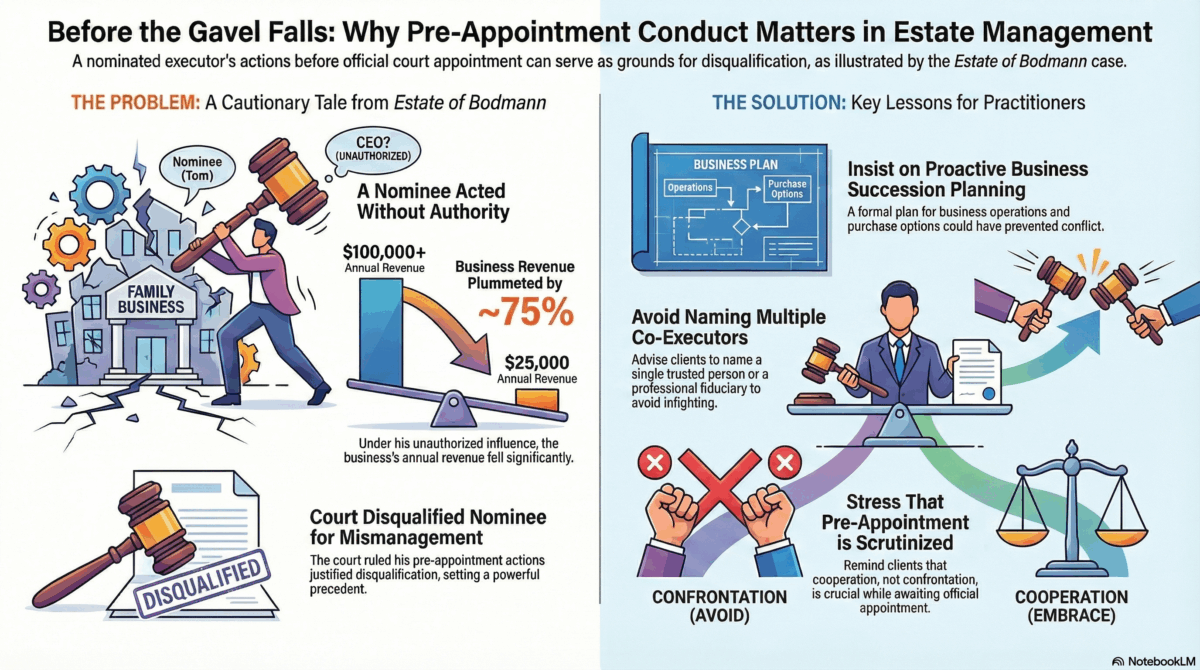
In the 2025 case Estate of Bodmann, a California appellate court upheld a trial court’s decision to disqualify a nominated executor based entirely on his conduct before he was officially appointed. The nominee, Tom, was one of seven children named as co-executors in his father’s handwritten will. Despite being explicitly chosen by his father, Tom was barred from serving because of actions he took while waiting for court approval.
What Did Tom Do Wrong?
Tom’s disqualifying actions included:
- Making “very specific demands” about how the family’s insurance business should be operated
- Creating a unilateral “email policy” and giving detailed instructions to his stepmother, Heather, who was helping run the business
- Publicly identifying himself as “CEO of the insurance business” without any legal authority
- Behaving in ways that caused insurance carriers to refuse to work with him
- Contributing to the business’s dramatic decline—annual revenue dropped from over $100,000 to approximately $25,000
Why the Court’s Decision Matters to You
Tom argued that he couldn’t be disqualified for mismanagement under California Probate Code § 8502 because that law only applies to executors who have already been appointed. The appellate court rejected this argument decisively.
The court pointed to a 1988 amendment to Probate Code § 8402, which made it clear: the same grounds that can be used to remove an appointed executor can also be used to disqualify a nominee before appointment. The court reasoned:
“…so too would it be wasteful to require a court to appoint a named executor who had already mismanaged an estate while acting on a belief that he had authority to manage it, simply because he had not yet been appointed and had thus not truly had authority.”
What You Must Know: You Have NO Legal Authority Before Appointment
The most dangerous misconception for nominated executors is believing that being named in a will gives them immediate authority. It doesn’t.
Critical Facts:
- A nomination in a will is merely a proposal to the court—not a grant of power
- You have no legal authority to act on behalf of the estate until the court formally appoints you
- You cannot legally manage assets, direct employees or beneficiaries, access bank accounts, operate a business, or enter contracts for the estate
- Authority is only granted when the court issues Letters of Administration or Letters Testamentary
How Can I Avoid Disqualification? Three Essential Guidelines
1. Adopt a “Preservation, Not Management” Mindset
Your role before appointment is to preserve estate assets, not manage them. This distinction is crucial.
Acceptable preservation activities include:
- Securing physical property (like changing locks on a vacant house)
- Collecting mail
- Identifying bills that need to be paid (without paying them from estate funds)
Unacceptable management activities include:
- Issuing directives to business employees
- Attempting to access or control financial accounts
- Selling assets
- Making strategic business decisions
2. Communicate Cooperatively, Never Dictate
Tom’s confrontational emails were a major factor in his disqualification. The court specifically cited “serious frictions between Tom and Heather” as evidence he couldn’t administer the estate fairly.
Best practices for communication:
- Adopt a tone of deference and respect—you are not yet in charge
- Frame any ideas as “helpful suggestions” or questions for group discussion, never as “policies” or “demands”
- Share information openly and collaboratively with all interested parties
3. Never Destroy Asset Value Through Your Actions
Courts will heavily scrutinize any nominee whose conduct damages estate assets. In Bodmann, the court drew a direct line between Tom’s antagonistic behavior and the insurance business’s 75% revenue decline. If your actions can be shown to have caused quantifiable financial loss, disqualification becomes highly likely.
What If My Family’s Estate Has a Business? Special Considerations
The Bodmann case involved a family insurance business, which created unique challenges. Dan Bodmann had clearly intended for his daughter Andrea to take over the business while continuing to employ his wife Heather. However, he died before formalizing this plan, leaving a power vacuum that Tom attempted to fill—with disastrous results.
If your loved one owned a business, proactive planning is critical:
- Structure the business as an LLC or corporation rather than a sole proprietorship to provide a clear governance framework
- Create detailed operating instructions for what happens immediately after death, including naming an interim manager
- Establish a formal valuation mechanism to prevent disputes
- Execute a binding buy-sell agreement or purchase option for the designated successor
The Problem with Multiple Co-Executors
Dan Bodmann’s holographic will named all seven children as co-executors—a structure the court implicitly recognized as “inherently unworkable”. This arrangement guaranteed conflict and administrative paralysis.
Better alternatives include:
- Appointing a single trusted individual with the right temperament and skills
- Naming a neutral party not entangled in immediate family dynamics
- Nominating a professional private fiduciary whose impartiality and expertise can navigate complex or high-conflict estates
Real-World Impact: The Cost of Getting It Wrong
The Bodmann estate underwent an eleven-day trial just to determine who should serve as executor. This level of litigation represents:
- Tens of thousands of dollars in legal fees drained from the estate
- Years of delay in distributing assets to beneficiaries
- Irreparable damage to family relationships
- Substantial destruction of the primary estate asset (the business)
All of this could have been avoided with proper guidance during the critical post-death, pre-appointment period.
What Should I Do If I’ve Been Named as Executor?
The period between death and formal appointment is “fraught with legal risk and uncertainty”. The consequences of missteps are severe—you can lose your right to serve entirely, even if the person who died specifically wanted you in that role.
Your immediate action steps:
- Consult with an experienced probate attorney before taking any actions related to the estate
- Understand the precise boundaries of what you can and cannot do
- Focus exclusively on preservation, not management
- Communicate cooperatively with all beneficiaries and interested parties
- Document everything, but take no unilateral actions
How California Probate and Trust Can Help You Navigate This Critical Period
At California Probate and Trust, our certified estate planning specialists understand the complex legal landscape that nominated executors must navigate. We’ve represented thousands of clients in Sacramento, Fair Oaks, and San Francisco, guiding them through probate administration and trust management with clarity and compassion.
Our probate law attorneys provide:
- Immediate guidance for nominated executors on what you can and cannot do before appointment
- Strategic counsel to avoid disqualification based on the latest case law
- Expert representation in contested probate proceedings
- Comprehensive estate planning to ensure your own estate doesn’t face these challenges
We offer free consultations to assess your specific situation and develop a clear action plan tailored to your needs and budget.
Protect Your Right to Serve—Schedule Your Free Consultation Today
Don’t let well-intentioned but legally problematic actions cost you the right to fulfill your loved one’s wishes. The Estate of Bodmann decisionmakes clear that courts will disqualify nominees who overstep their authority, damage estate assets, or foster conflict—even before formal appointment.
Contact California Probate and Trust now:
- Call: (866) 674-1130
- Visit: Schedule Your Free Consultation
- Learn more: cpt.law
Your story and your family matter. Let our experienced probate attorneys help you navigate this critical period with confidence, protecting both your eligibility to serve and the estate you’ve been entrusted to manage.
Source: Analysis based on Estate of Bodmann (2025) appellate decision regarding pre-appointment executor disqualification under California Probate Code §§ 8402 and 8502.