
Here is a draft for a social media post (ideal for LinkedIn) based on the provided content.
******
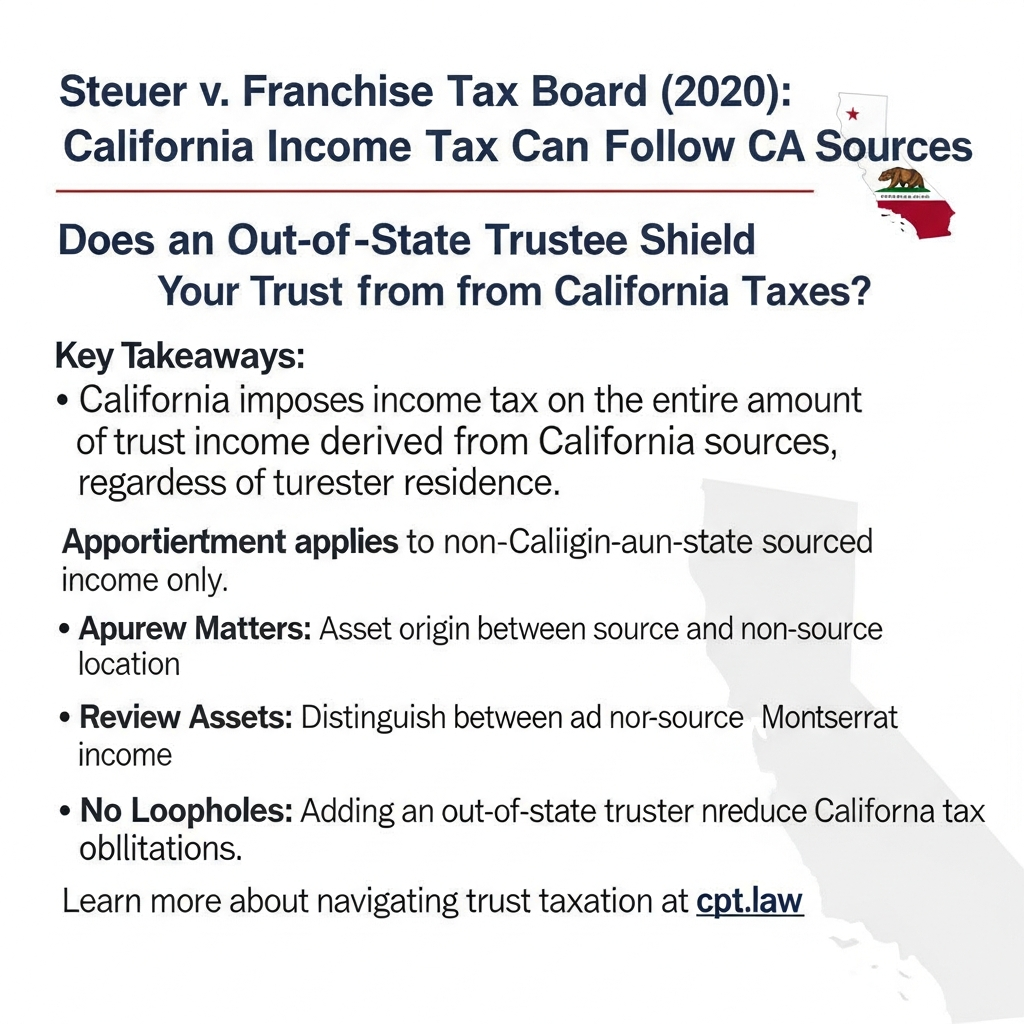
Headline: Does an Out-of-State Trustee Shield Your Trust from California Taxes?
Many trustees and estate planners operate under the assumption that appointing a non-resident trustee can reduce state tax liability through apportionment. However, the ruling in Steuer v. Franchise Tax Board (2020) serves as a critical reality check regarding “California-sourced” income. serves as a critical reality check regarding “California-sourced” income.
The Case Breakdown:
In this case, a trust with two trustees (one in California, one in Maryland) sold stock that generated significant capital gains. The trustees attempted to claim a partial tax refund, arguing that tax liability should be apportioned 50/50 based on the residency of the two trustees.
In this case, a trust with two trustees (one in California, one in Maryland) sold stock that generated significant capital gains. The trustees attempted to claim a partial tax refund, arguing that tax liability should be apportioned 50/50 based on the residency of the two trustees.
The Ruling:**
The California Court of Appeal reversed the trial court’s decision, ruling in favor of the Franchise Tax Board. The court clarified a fundamental rule: **California imposes income tax on the entire amount of trust income derived from California sources, regardless of trustee residency.
While apportionment based on trustee residency applies to *non-California* sourced income, it does not apply to income generated within the state.
Key Takeaways for Estate Planning:
📍 Source Matters: The origin of the asset/income often supersedes the location of the fiduciary.
⚠️ Review Assets: Trustees must distinguish between source income and non-source income to calculate liability correctly.
📝 No Loopholes: Simply adding an out-of-state trustee does not dilute tax obligations on California assets. Simply adding an out-of-state trustee does not dilute tax obligations on California assets.
Don’t let unexpected tax liabilities derail your estate plan.
Learn more about navigating trust taxation at cpt.law.
#EstatePlanning #TaxLaw #TrustsAndEstates #CaliforniaLaw #FiduciaryDuty #SteuerVFTB #CPTLaw
Why This Case Matters for California Trusts
The Steuer decision has significant implications for anyone with a California trust—especially if beneficiaries or grantors live outside California.
Key Takeaways for Trust Planning
1. California-Source Income Remains Taxable
Even if your trust is administered out of state, California will tax income from California sources. This includes:
- California real estate rental income
- Business income from California operations
- California partnership distributions
- Royalties from California properties
2. Trustee Location Doesn’t Change Tax Treatment
Moving a trustee out of California doesn’t eliminate California tax on California-source income. The FTB looks at where the income originated, not where the trustee lives.
3. Planning Strategies Still Available
While Steuer limits some tax avoidance strategies, legitimate planning remains available:
- Properly structured non-grantor trusts for out-of-state beneficiaries
- Strategic timing of distributions
- Asset allocation between California and non-California sources
- Careful choice of trust situs for administrative purposes
Practical Steps for Trust Beneficiaries and Trustees
If you’re involved with a California trust—as grantor, trustee, or beneficiary—here’s what to do:
Review Your Trust’s Tax Status
Determine whether your trust generates California-source income. If yes, expect California tax liability regardless of where the trustee or beneficiaries reside.
Consult with a California Tax Professional
California trust taxation is complex, especially after Steuer. Work with a CPA or tax attorney familiar with California trust tax rules to ensure compliance.
Update Estate Plans if Necessary
If your estate plan was designed to avoid California taxes by moving trustees or beneficiaries out of state, you may need to revise your strategy post-Steuer.
File Accurate Returns
Don’t assume your trust is exempt from California taxes simply because it’s administered elsewhere. The FTB actively audits trusts with California connections.
The Bottom Line
Steuer v. Franchise Tax Board reinforces California’s long-standing position: California-source income is taxable in California, even for out-of-state trusts and beneficiaries. The case closed a perceived loophole and clarified the FTB’s enforcement authority.
For California families with trusts holding California assets, this case underscores the importance of proper tax planning and compliance. Ignoring California’s trust tax rules can result in unexpected tax bills, penalties, and interest.
Need Expert Estate Planning Guidance?
California estate planning law is complex and constantly evolving. Don’t navigate it alone.
California Probate and Trust, PC has helped thousands of California families protect their assets and plan for the future.
📞 Call us today:
- Main Office: 866-400-0058
- Direct: 916-963-9968

About the Author: Dustin MacFarlane, Esq.
California Licensed Attorney | Estate Planning Specialist
Dustin MacFarlane is the founder of California Probate and Trust, PC, with over 15 years of experience in estate planning, probate administration, and trust law. Licensed by the California State Bar, Dustin has helped thousands of California families protect their assets and plan for the future.
CA Bar License: Active | Practice Areas: Estate Planning, Probate, Trust Administration | Location: Granite Bay, CA