
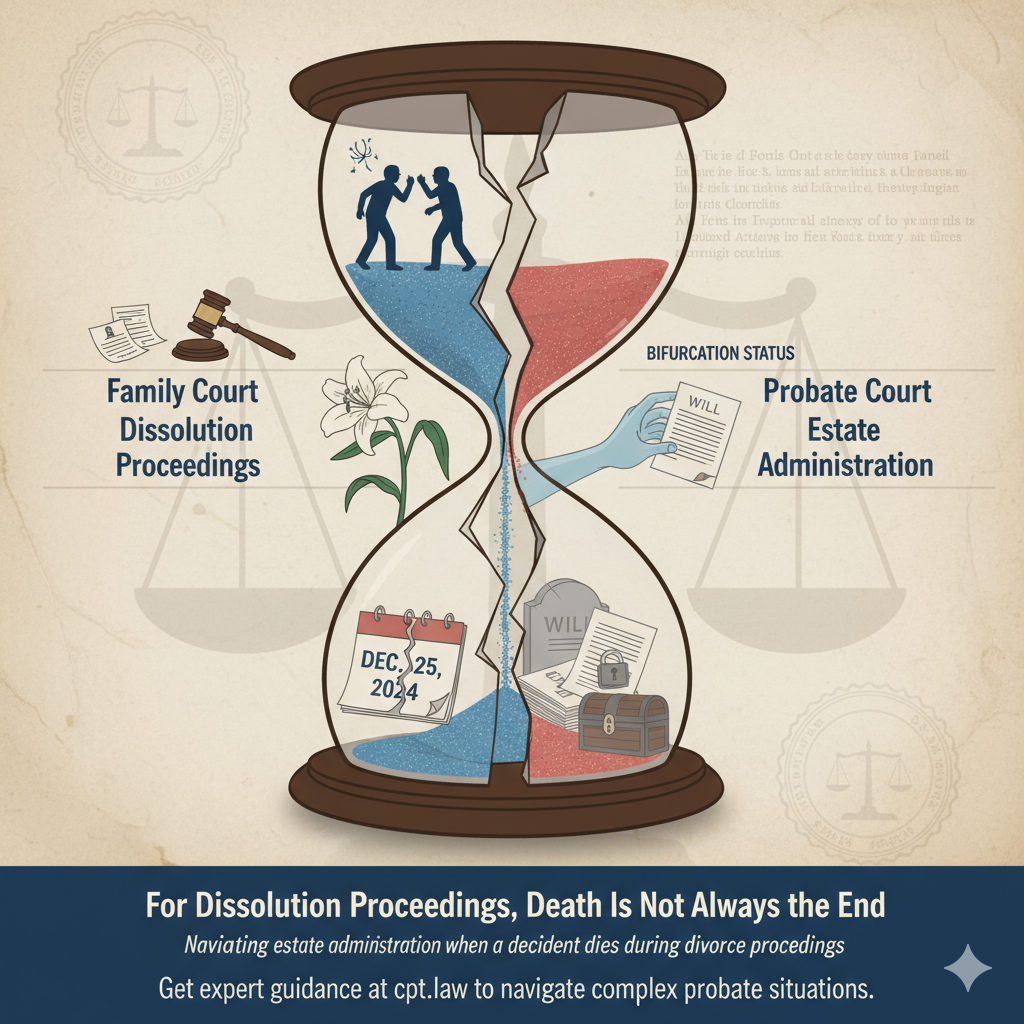
If you’ve been named as an executor or personal representative for someone who died during a pending divorce, you’re facing one of the most complex scenarios in California probate law. This guide answers the critical questions executors ask when handling estates complicated by unfinished dissolution proceedings.
Who This Guide Is For
This article is essential reading for:
- Executors and personal representatives managing estates where the decedent died before their divorce was finalized
- Family members trying to understand their inheritance rights when a loved one passed away mid-divorce
- Anyone navigating the intersection of probate law and family law in California
The Critical First Question: Was the Marriage Legally Terminated?
The entire probate process hinges on one crucial factor: whether the dissolution action was bifurcated and the marital status was actually terminated before death.
If Status Was Terminated (Bifurcated Divorce)
When the court issued an order terminating the marriage before death, the family court retains jurisdiction over certain matters. In this situation:
- The personal representative replaces the decedent as a party to the dissolution proceeding
- Both probate court and family court have jurisdiction—running parallel to each other
- Family court handles property characterization and support obligations
- Probate court manages creditor claims, distribution rights, and will contests
Important: Any conditions the family court imposed before death remain enforceable. However, the dissolution judgment automatically revokes certain transfers including provisions in wills, joint tenancies, and community property with right of survivorship.
If No Judgment Was Entered
This is the more complicated scenario. When spouses filed for dissolution but no judgment was entered before death, the family court loses jurisdiction entirely, and probate court handles all remaining issues.
How to Determine What Happens to the Estate
As an executor, you need to answer these three questions in order:
- Was the dissolution case submitted for decision before death?
- Did the decedent take any estate planning actions permitted under California Family Code section 2040?
- Does the estate contain separate property of the decedent?
What If the Case Was Submitted for Decision?
If trial occurred and the case was submitted to the judge before death, the family court can still render judgment. This judgment will control how property and debts are characterized as community or separate property.
Estate Planning Actions During Divorce: What Was Allowed?
California law allows parties in divorce proceedings to make certain estate planning changes, even with temporary restraining orders in place.
Without notice to the other party, a person can:
- Revoke or modify their will and create a new one
- Create an unfunded revocable or irrevocable trust
- Execute and file a disclaimer
With notice filed and served on the other party, a person can:
- Revoke a non-probate transfer, including a revocable trust
- Eliminate a right of survivorship to property
If the decedent validly took any of these actions, you proceed to probate the will or administer the trust. The key is determining whether proper notice was given when required.
Common Scenarios Executors Face
Scenario 1: Dissolution Judgment Entered, No Valid Will or Trust
You’ll need to petition the probate court to characterize property and debts unless you can reach an agreement with the ex-spouse. Property then distributes under intestacy rules, and debts are paid through normal probate procedures.
Critical consideration: The court will only approve an agreement if it substantially protects the rights of beneficiaries and creditors.
Scenario 2: Dissolution Judgment Entered, Valid Will or Trust Exists
Petition the probate court to characterize property and debts, then distribute according to the estate planning document. Remember that the dissolution judgment automatically revoked certain provisions naming the former spouse.
Scenario 3: Decedent Died Before Dissolution Judgment
This follows two distinct paths:
- With an estate plan: Administer the will or trust using normal procedures. Unless the decedent created new estate planning documents during the divorce, the surviving spouse will likely receive all property. However, any trust provisions creating sub-trusts at the first death must still be followed.
- Without an estate plan: Intestacy laws apply. The surviving spouse receives all community property and one-half or one-third of separate property, with remaining separate property going to other intestate heirs.
What Gets Automatically Revoked Upon Dissolution?
When a dissolution judgment is entered, California law automatically revokes:
- Appointments of property to the former spouse
- Powers of appointment granted to the former spouse
- Nominations of the former spouse as executor, trustee, conservator, or guardian
Exception: These revocations don’t apply if the will explicitly states it remains effective after dissolution.
Separation vs. Dissolution: A Critical Distinction
A judgment of separation does not trigger automatic revocations because it doesn’t terminate the marriage. While separation proceedings can resolve similar issues as dissolution (including property division), they leave the marriage intact. As an executor, verify that an actual dissolution occurred, not just a separation.
How to Avoid Personal Liability as an Executor
Executors handling estates complicated by divorce face heightened risk of personal liability. Here’s how to protect yourself:
- Document everything: Keep detailed records of all communications with the ex-spouse, beneficiaries, and the courts
- Seek court approval: When in doubt about property characterization or debt allocation, petition the probate court for guidance rather than making assumptions
- Work with experienced counsel: These cases require attorneys knowledgeable in both probate and family law
- Verify bifurcation status immediately: Obtain certified copies of all dissolution-related court orders
- Check for valid estate planning changes: Determine if the decedent made any changes during the divorce and whether proper notice was given
Why Family Law and Probate Attorneys Should Collaborate
Family law attorneys should develop relationships with estate planning practitioners, and vice versa. This allows family law attorneys to refer clients to trusted estate planning counsel who can explain estate planning rights during divorce and the consequences of inaction. Estate planning attorneys can provide critical guidance on property characterization issues.
Get Expert Guidance for Complex Probate Situations
If you’re an executor facing a probate case complicated by an unfinished divorce, you don’t have to navigate these complex issues alone. The interplay between family law and probate law requires specialized knowledge to avoid costly mistakes and personal liability.
California Probate and Trust has helped thousands of executors and personal representatives successfully navigate even the most complex estate administration challenges. Our certified estate planning specialists understand both probate law and trust administration, giving you the comprehensive guidance you need.
Schedule your free consultation today to:
- Understand your specific duties and potential liability
- Get clarity on property characterization issues
- Develop a clear roadmap for estate administration
- Ensure compliance with both family court and probate court requirements
Contact California Probate and Trust at (866) 674-1130 or visit cpt.law to schedule your free consultation. Our compassionate, experienced attorneys are here to protect you and guide you through every step of the process.
Source: California Probate and Trust | Based on analysis from “For Dissolution Proceedings, Death Is Not Always the End” by Bruce A. Last

About the Author: Dustin MacFarlane, Esq.
California Licensed Attorney | Estate Planning Specialist
Dustin MacFarlane is the founder of California Probate and Trust, PC, with over 15 years of experience in estate planning, probate administration, and trust law. Licensed by the California State Bar, Dustin has helped thousands of California families protect their assets and plan for the future.
CA Bar License: Active | Practice Areas: Estate Planning, Probate, Trust Administration | Location: Granite Bay, CA