
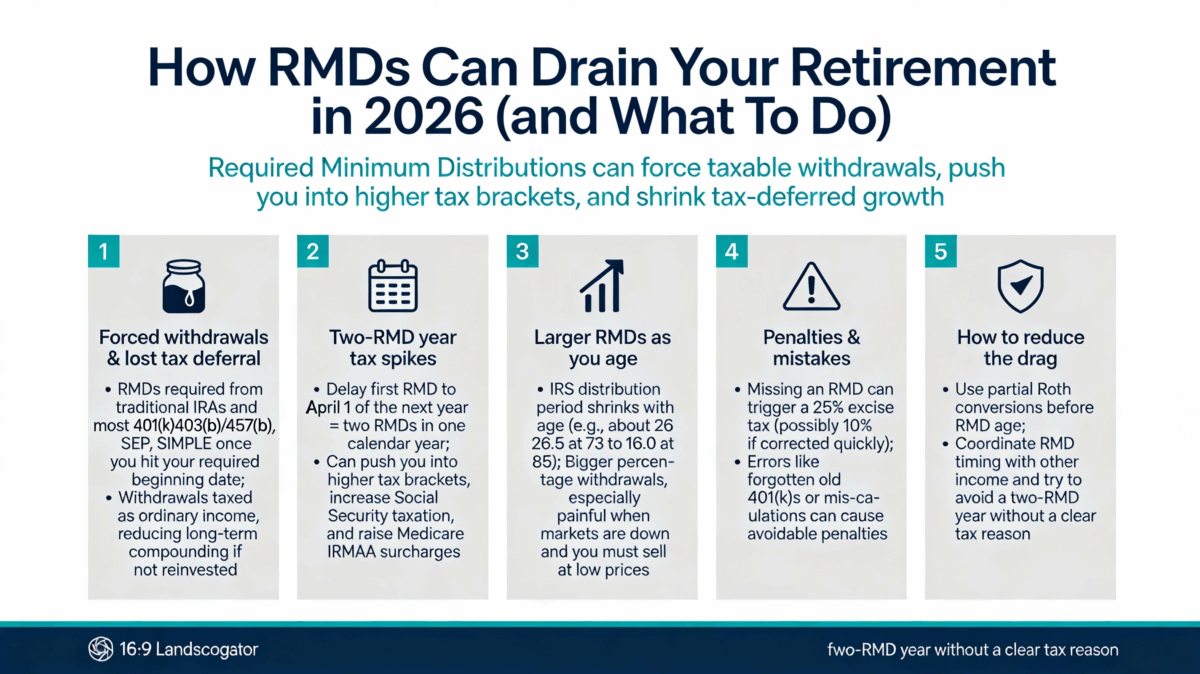
Source: Yahoo Finance – In 2026, RMDs Are Still Costing Retirees a Fortune and It Needs To Stop
## Who This Article Is For
If you’re a California resident approaching age 73 (or already there), managing inherited retirement accounts, or helping aging parents navigate retirement, this article explains how Required Minimum Distributions create unexpected tax burdens—and what you can do to protect your family’s wealth.
## What Problem Does This Solve?
Many California retirees discover too late that the IRS forces withdrawals from tax-deferred accounts at age 73, creating taxable income they don’t need and triggering penalties up to 25% if deadlines are missed. This article shows you how to avoid costly mistakes and reduce your tax burden legally.
## The Core Problem: Forced Withdrawals You May Not Need
Required Minimum Distributions force you to withdraw money from traditional IRAs, 401(k)s, and similar tax-deferred accounts starting at age 73. The IRS treats these withdrawals as ordinary income, which means:
## How Much Will Missing an RMD Actually Cost You?
Here’s a real-world example: If your required withdrawal is $20,000 and you miss the deadline, you face a $5,000 penalty (25% of $20,000). You still owe income tax on the $20,000 when you eventually withdraw it. Act within two years by filing Form 5329, and that penalty drops to $2,000 (10%).
The SECURE 2.0 Act cut the previous 50% penalty in half, recognizing that many people miss RMDs due to confusion about complex rules rather than intentional avoidance.
## The Hidden Costs Beyond the Penalty
### Medicare Premium Surcharges (IRMAA)
Large RMDs can trigger Income-Related Monthly Adjustment Amounts, adding hundreds of dollars per month to your Medicare Part B and Part D premiums. For California residents on fixed incomes, this represents a substantial ongoing cost that continues for years.
### Higher Tax Brackets
When you saved money in your IRA or 401(k) during your working years, you likely deferred taxes at your then-current rate. Now, forced distributions combined with other retirement income (Social Security, pensions, investment income) can push you into higher brackets than you planned for.
## Strategic Solutions California Families Should Know About
### Qualified Charitable Distributions (QCDs)
If you’re 70½ or older and charitably inclined, you can direct up to $100,000 per year from your IRA directly to qualified charities. This satisfies your RMD requirement without adding to your taxable income—meaning no Medicare surcharges and no bracket creep.
### Roth Conversions Before Age 73
Converting traditional IRA funds to Roth IRAs in your 60s or early 70s (before RMDs begin) lets you control the timing and amount of taxable income. While you’ll pay taxes on the conversion, Roth IRAs don’t have RMDs during your lifetime, giving you more control.
### Professional Calculation and Planning
RMD calculations use IRS life expectancy tables and your account balance as of December 31 of the prior year. Small errors compound over time. Working with professionals who understand both California state tax implications and federal requirements helps you avoid costly mistakes.
## What Happens If You’ve Already Missed an RMD?
Don’t panic. Take these steps immediately:
## Key Dates California Retirees Need to Remember in 2026
## How California Probate and Trust Can Help
At California Probate and Trust, PC, we help California families navigate the intersection of retirement planning, tax strategy, and estate protection. Our certified estate planning specialists understand how RMDs affect your overall wealth transfer strategy and can help you:
We offer free one-hour consultations where we review your specific situation, explain your options in plain language, and help you make informed decisions that protect your family’s financial future.
## Take Control of Your Retirement Distributions Today
RMDs represent one of the most significant forced tax events in retirement. The good news? With proper planning, you can minimize their impact on your finances and your family’s inheritance.
Schedule your free consultation with California Probate and Trust to discuss your RMD strategy and ensure your retirement savings work for you—not just the IRS.
—
Legal Disclaimer: This article provides general information about Required Minimum Distributions and estate planning concepts under current law as of February 2026. It is not intended as legal, tax, or financial advice for your specific situation. Tax laws change frequently, and individual circumstances vary significantly. Before making any decisions about RMDs, retirement distributions, or estate planning, consult with qualified legal and tax professionals licensed in California who can evaluate your unique situation. California Probate and Trust, PC provides estate planning and probate services but does not provide tax advice. Past results do not guarantee future outcomes.

About the Author: Dustin MacFarlane, Esq.
California Licensed Attorney | Estate Planning Specialist
Dustin MacFarlane is the founder of California Probate and Trust, PC, with over 15 years of experience in estate planning, probate administration, and trust law. Licensed by the California State Bar, Dustin has helped thousands of California families protect their assets and plan for the future.
CA Bar License: Active | Practice Areas: Estate Planning, Probate, Trust Administration | Location: Granite Bay, CA