
California Legal Implications: Estate Planning Obstacles for Married Couples and Domestic Partners
A recent article from the Continuing Education of the Bar (CEB) highlights a critical area of estate planning: the unique challenges faced by married persons and registered domestic partners in California. While many couples believe marriage simplifies their estate, it often introduces complexities that, if unaddressed, can lead to significant legal disputes, unintended consequences, and family conflict. Understanding these potential obstacles is the first step toward creating a comprehensive plan that protects both partners and their families.
California law provides certain default protections for surviving spouses, but relying on these alone is a mistake. A well-crafted estate plan ensures your specific wishes are followed, assets are managed efficiently, and your loved ones are spared the stress and expense of court proceedings like probate. For couples in California, proactive planning is essential to navigate the intricacies of community property law, blended family dynamics, and potential incapacity.. For couples in California, proactive planning is essential to navigate the intricacies of community property law, blended family dynamics, and potential incapacity.
Common Estate Planning Challenges for California Couples
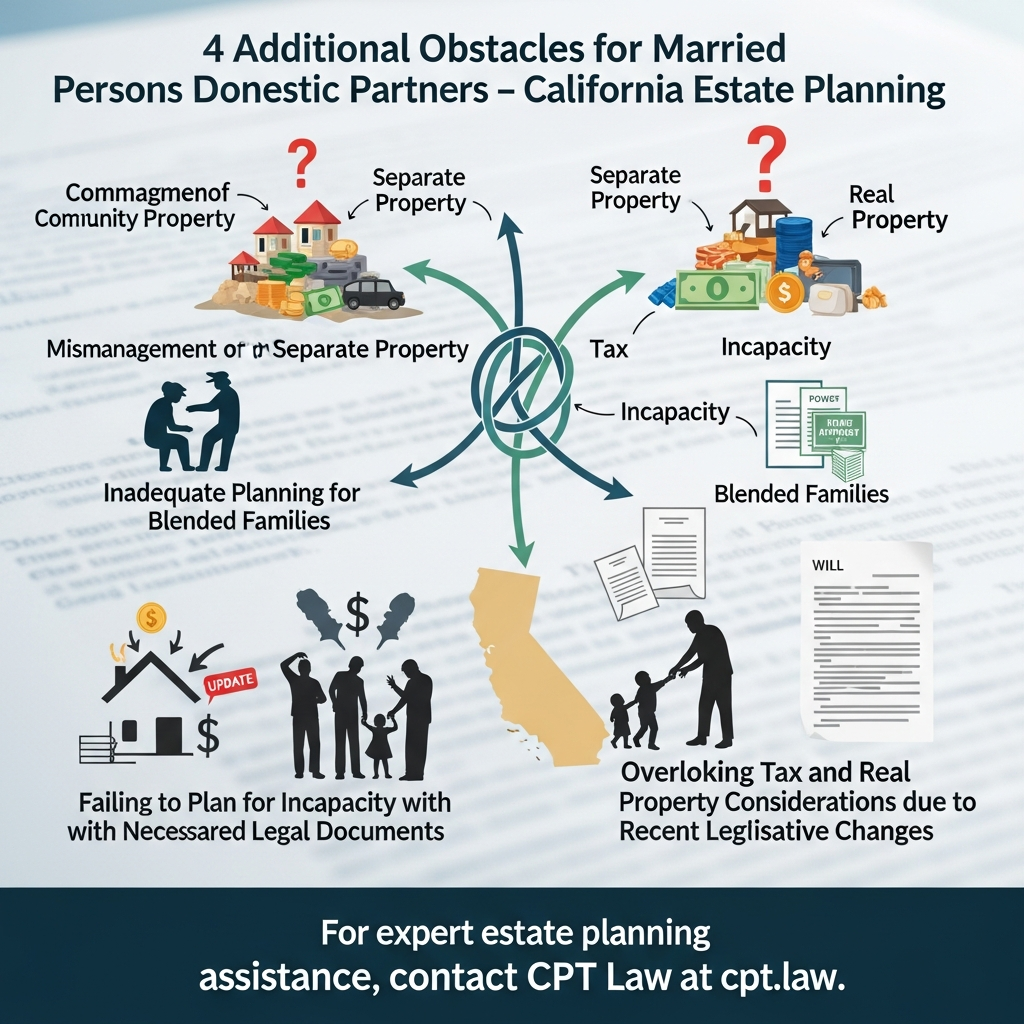
1. Mismanagement of Community and Separate Property
California is a community property state. This means most assets and income acquired during a marriage or domestic partnership are presumed to be owned equally by both partners. In contrast, separate property includes assets owned before the marriage, or received during the marriage as a gift or inheritance. includes assets owned before the marriage, or received during the marriage as a gift or inheritance.
The challenge arises when couples commingle these assets—for example, by depositing inheritance money into a joint bank account or using community funds to pay down a mortgage on a separate property home. This can blur the lines of ownership, leading to complex and costly legal battles during a divorce or after one partner dies. A well-designed revocable living trust can help couples clearly define, segregate, and manage their community and separate property, ensuring their assets are distributed according to their wishes. can help couples clearly define, segregate, and manage their community and separate property, ensuring their assets are distributed according to their wishes.
2. Inadequate Planning for Blended Families
Second marriages and blended families are common, creating a unique estate planning challenge: how to provide for a current spouse while also ensuring children from a previous relationship receive their intended inheritance. Without a plan, a surviving spouse could inherit all the community property, potentially disinheriting the children of the first spouse to die.
Second marriages and blended families are common, creating a unique estate planning challenge: how to provide for a current spouse while also ensuring children from a previous relationship receive their intended inheritance. Without a plan, a surviving spouse could inherit all the community property, potentially disinheriting the children of the first spouse to die.
A popular solution is a Qualified Terminable Interest Property (QTIP) Trust. This legal tool allows the first spouse to die to provide for their surviving spouse for the remainder of their lifetime, while dictating that the remaining trust assets pass to their own children (or other chosen beneficiaries) upon the surviving spouse’s death. This protects all parties and prevents the surviving spouse from changing the ultimate beneficiaries.. This legal tool allows the first spouse to die to provide for their surviving spouse for the remainder of their lifetime, while dictating that the remaining trust assets pass to their own children (or other chosen beneficiaries) upon the surviving spouse’s death. This protects all parties and prevents the surviving spouse from changing the ultimate beneficiaries.
3. Failing to Plan for Incapacity
Many people assume that their spouse can automatically make financial and medical decisions for them if they become incapacitated. This is not always true. Without legal authority, a spouse may be unable to access retirement accounts, manage separate property assets, or make critical healthcare decisions.
Many people assume that their spouse can automatically make financial and medical decisions for them if they become incapacitated. This is not always true. Without legal authority, a spouse may be unable to access retirement accounts, manage separate property assets, or make critical healthcare decisions.
To avoid this, every estate plan should include an Advance Health Care Directive and a Durable Power of Attorney. These documents allow you to legally appoint your spouse (or another trusted person) to make medical and financial decisions on your behalf, respectively. Without them, your family may be forced to petition the court for a conservatorship, a public, expensive, and stressful legal process., a public, expensive, and stressful legal process.
4. Overlooking Tax and Real Property Considerations
While California does not have a state-level estate or inheritance tax, high-net-worth couples must still plan for the federal estate tax. Proper trust planning can help couples maximize their combined federal estate tax exemption through concepts like portability..
Furthermore, changes under Proposition 19 have significantly altered how real property is reassessed for property tax purposes upon transfer, even between parents and children. Couples who own real estate, especially properties with a low tax basis, need to structure their estate plan carefully to minimize potential property tax increases for their heirs. A comprehensive plan will address these tax implications to preserve the value of the estate for future generations. have significantly altered how real property is reassessed for property tax purposes upon transfer, even between parents and children. Couples who own real estate, especially properties with a low tax basis, need to structure their estate plan carefully to minimize potential property tax increases for their heirs. A comprehensive plan will address these tax implications to preserve the value of the estate for future generations.
About This Case
Source: 4 Additional Obstacles for Married Persons and Domestic Partners – California Estate Planning – CEB
California Probate and Trust, PC Can Help
– Free consultations: (866)-674-1130
– Experienced California estate planning
– Schedule consultation
– Learn more: cpt.law
– Free consultations: (866)-674-1130
– Experienced California estate planning
– Schedule consultation
– Learn more: cpt.law
Legal Disclaimer
This article is for informational purposes only. Consult with a qualified California estate planning attorney for advice specific to your situation.

About the Author: Dustin MacFarlane, Esq.
California Licensed Attorney | Estate Planning Specialist
Dustin MacFarlane is the founder of California Probate and Trust, PC, with over 15 years of experience in estate planning, probate administration, and trust law. Licensed by the California State Bar, Dustin has helped thousands of California families protect their assets and plan for the future.
CA Bar License: Active | Practice Areas: Estate Planning, Probate, Trust Administration | Location: Granite Bay, CA