
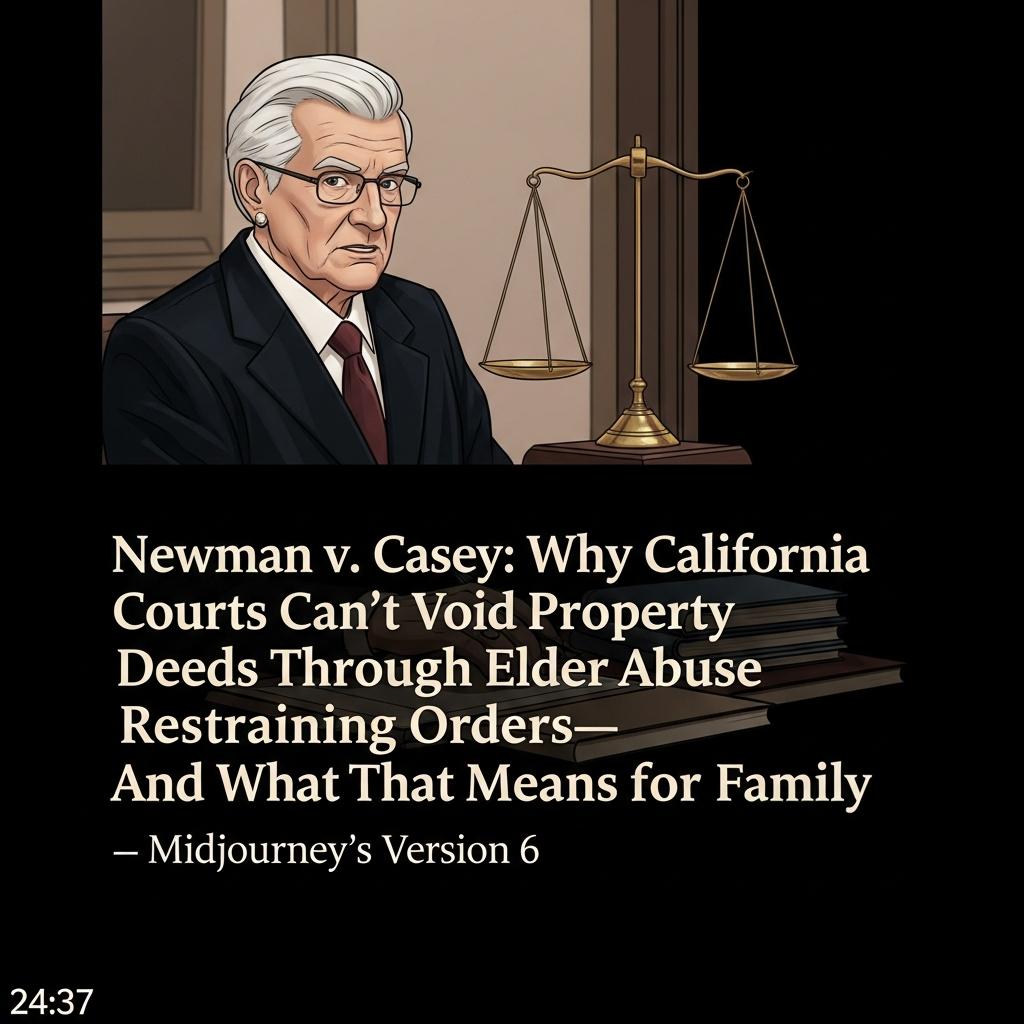
If you’re a California resident caring for aging parents, managing a trust, or worried about protecting a vulnerable family member from financial abuse, a recent California appellate court decision clarifies an important limitation: probate courts cannot permanently undo property transfers through elder abuse restraining orders alone.
What Happened in Newman v. Casey?
In this case, an elderly mother named Gracia accused her daughter, Marina, of tricking her into signing over the deed to her home.Gracia filed for Elder Abuse Restraining Orders (EAROs) and asked the court to force Marina to return the property.
The probate court agreed that financial elder abuse had occurred and issued restraining orders. But the court went further—it declared the deed “void ab initio,” meaning it treated the deed as if it never existed.
Marina appealed, and the First District Court of Appeal ruled that the probate court had overstepped its authority.
What Does California Law Allow in Elder Abuse Cases?
Under California Welfare and Institutions Code section 15657.03, probate courts can issue specific types of restraining orders to protect elders from immediate harm, including:
These orders are meant to be temporary protections—they can last up to five years but are not permanent remedies.
The Court’s Key Ruling: Restraining Orders Are Not the Same as Property Recovery
The appellate court made it clear: declaring a deed void is not one of the restraining orders authorized by the statute.If you want to recover property or undo a fraudulent transfer permanently, you need to file a separate civil lawsuit under other provisions of California’s Elder Abuse and Dependent Adult Civil Protection Act.
In other words:
Why This Matters for California Families
If you suspect that a family member has been financially exploited—whether through a coerced deed transfer, unauthorized withdrawal of funds, or manipulation of estate documents—understanding the correct legal pathway is critical.
Many families assume that filing for a restraining order will automatically reverse the harm. This case shows that’s not true. You may need to pursue multiple legal strategies simultaneously:
How Can I Protect My Family from Elder Financial Abuse?
Prevention is always better than litigation. Here are steps California residents can take:
Case Details
Source: California Lawyers Association – Newman v. Casey
Full Opinion: First District Opinion PDF
Need Help Protecting Your Family’s Estate?
At California Probate and Trust, PC, we help California families navigate complex probate matters, elder abuse cases, and estate planning challenges. Whether you’re concerned about a loved one’s safety, need to recover property through litigation, or want to create a protective estate plan, our experienced attorneys provide compassionate, transparent guidance.
We offer a free consultation to assess your situation and recommend the right legal strategy for your family.
Schedule Your Free Consultation Today
Call us at (866) 674-1130 or visit cpt.law to learn more about how we can help protect your family and your legacy.
Legal Disclaimer
This article is provided for informational purposes only and does not constitute legal advice. The information contained herein is based on California law as of the date of publication and may not reflect the most current legal developments. Every legal situation is unique, and the application of law can vary widely based on specific facts and circumstances. Readers should not act upon this information without seeking professional legal counsel from a qualified California attorney. California Probate and Trust, PC does not guarantee any particular outcome in legal matters. No attorney-client relationship is created by reading this article or contacting our firm for general information. For specific legal advice tailored to your situation, please schedule a consultation with one of our attorneys.

About the Author: Dustin MacFarlane, Esq.
California Licensed Attorney | Estate Planning Specialist
Dustin MacFarlane is the founder of California Probate and Trust, PC, with over 15 years of experience in estate planning, probate administration, and trust law. Licensed by the California State Bar, Dustin has helped thousands of California families protect their assets and plan for the future.
CA Bar License: Active | Practice Areas: Estate Planning, Probate, Trust Administration | Location: Granite Bay, CA