
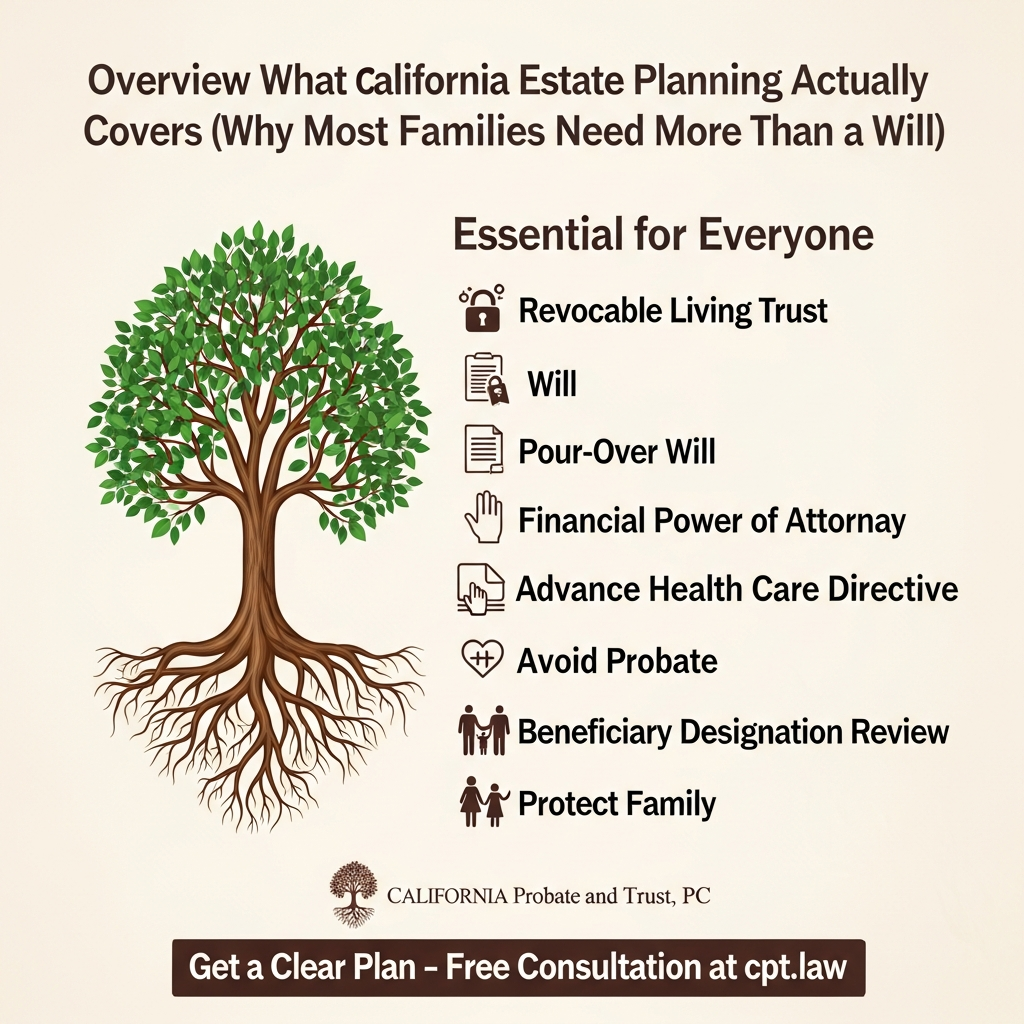
California estate planning is not just for the ultra-wealthy. It is for anyone who owns a home, has retirement accounts, has minor children, or wants a clear plan for what happens if something goes wrong.
If you are a California resident (or you manage California-based assets) and you feel anxious about probate court, family conflict, or the cost of “getting it wrong,” this guide is for you. It explains what estate planning practice usually includes in California and what problems it is designed to solve.
Source: Continuing Education of the Bar (CEB) — Overview of Estate Planning Practice
Who This Is For (Quick Answer)
This article is for you if you are asking any of these common questions:
It is also for successor trustees and family members who are managing a loved one’s California estate after a death.
What Estate Planning Is (In Plain English)
Estate planning is the process of:
In California, the practical goal is usually: protect the family, avoid probate when appropriate, and keep administration transparent and organized.
What a California Estate Plan Commonly Includes
Most strong estate plans are a coordinated set of documents, not one paper.
1) A Revocable Living Trust (Often the Centerpiece)
A properly designed and funded revocable living trust can:
2) A Pour-Over Will
Even with a trust, a will often still matters. It can:
3) Financial Power of Attorney
This document helps answer: “If I can’t handle my finances, who can?”
A properly drafted power of attorney can allow a trusted person to:
4) Advance Health Care Directive (and HIPAA Authorization)
This helps answer: “If I’m in the hospital, who can make medical decisions and get information?”
It can:
5) Beneficiary Designation Review (Retirement Accounts, Life Insurance)
Many people assume a trust controls everything. In reality, many assets transfer by contract.
A good estate plan includes a review of:
This is where many California families unintentionally create unfair distributions or tax issues.
Real-World Use Cases (How This Shows Up in Real Life)
Estate planning practice is built around predictable problems:
How California Probate and Trust, PC Fits In (One-Stop-Shop Approach)
At California Probate and Trust, PC, we focus on helping California families who want:
That combination matters, because strong planning is built by understanding how things go wrong in real probate and trust disputes.
Next Step: Get a Clear Plan (Free Consultation)
If you are worried about probate, incapacity, or keeping the peace in your family, a short conversation can clarify your options.
Legal Disclaimer
This article is for informational purposes only and does not constitute legal advice. Estate planning, probate, and trust administration depend on individual facts and may change based on updates in California and federal law. For advice specific to your situation, consult a qualified California attorney. California Probate and Trust, PC provides legal services to California residents and people managing California-based assets.

About the Author: Dustin MacFarlane, Esq.
California Licensed Attorney | Estate Planning Specialist
Dustin MacFarlane is the founder of California Probate and Trust, PC, with over 15 years of experience in estate planning, probate administration, and trust law. Licensed by the California State Bar, Dustin has helped thousands of California families protect their assets and plan for the future.
CA Bar License: Active | Practice Areas: Estate Planning, Probate, Trust Administration | Location: Granite Bay, CA