
California Legal Implications: High State Taxes and Your Estate Plan
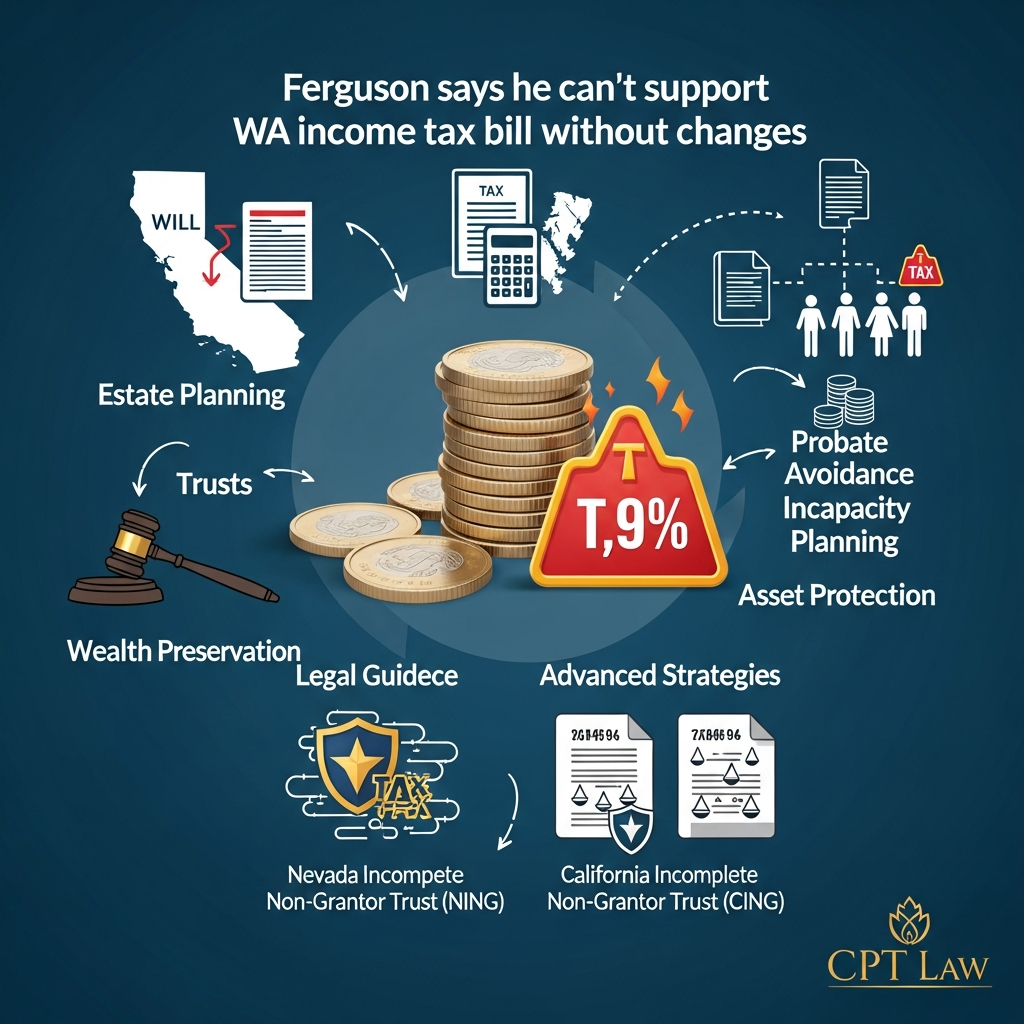
A recent news story from Washington state highlights a proposed 9.9% state income tax on earnings over $1 million, sparking debate and negotiation between the governor and state legislators. According to the Seattle Times article, “Ferguson says he can’t support WA income tax bill without changes,” this move would represent a significant shift for a state that currently has no personal income tax.,” this move would represent a significant shift for a state that currently has no personal income tax.
While this discussion unfolds in the Pacific Northwest, it serves as a crucial reminder for Californians who already live with one of the highest state income tax burdens in the country. California’s top marginal rate significantly impacts not only personal finances but also the administration and tax efficiency of trusts and estates. For high-net-worth families, proactive and sophisticated estate planning is not just advisable; it is essential for wealth preservation.
The Impact of California Income Tax on Trusts
In California, trusts are not just tools for avoiding probate or distributing assets; they are separate taxable entities. When a trust earns income—such as from investments, rental properties, or business interests—that income is subject to tax. A critical issue arises from California’s highly compressed tax brackets for trusts. or distributing assets; they are separate taxable entities. When a trust earns income—such as from investments, rental properties, or business interests—that income is subject to tax. A critical issue arises from California’s highly compressed tax brackets for trusts.
An individual Californian might not reach the top state income tax bracket until their income is substantial. However, a non-grantor trust can hit the highest tax bracket with a very small amount of accumulated income. This means that if a trust retains its earnings rather than distributing them, a significant portion can be lost to state taxes. This tax inefficiency can erode the value of the trust assets over time, contrary to the grantor’s intent.
Advanced Trust Strategies for Tax Mitigation
The challenge of high state income taxes has led to the development of sophisticated estate planning strategies. For California residents, one of the most effective tools is the strategic use of irrevocable trusts domiciled in states with no income tax, such as Nevada or Delaware.
One such strategy is the creation of a Nevada Incomplete Non-Grantor (NING) Trust or a California Incomplete Non-Grantor (CING) Trust. These are complex legal instruments designed specifically to minimize or eliminate state income tax on the trust’s earnings. The general structure involves:. These are complex legal instruments designed specifically to minimize or eliminate state income tax on the trust’s earnings. The general structure involves:
* Establishing the Trust Out-of-State: The trust is legally established in a state without an income tax.
* Appointing an Out-of-State Trustee: A trustee who resides in that state must be appointed to manage the trust assets.
* Structuring for Tax Purposes: The trust is structured so that for federal tax purposes, it is a “grantor trust” (so no gift tax is due upon funding), but for California state tax purposes, it is a “non-grantor trust” with no residency ties to California.: The trust is structured so that for federal tax purposes, it is a “grantor trust” (so no gift tax is due upon funding), but for California state tax purposes, it is a “non-grantor trust” with no residency ties to California.
By properly structuring and administering a trust like a NING, the investment income and capital gains generated within the trust can grow free from California’s high state income tax. When funds are eventually distributed to California-resident beneficiaries, they will pay state income tax at that time, but the principal will have been allowed to grow more efficiently in the interim. These are advanced strategies that require meticulous planning and execution by an experienced estate planning attorney.
Beyond Tax Planning: A Comprehensive Approach
While minimizing state income tax is a significant goal for many families, it is only one component of a robust estate plan. A comprehensive plan should also address:
* Federal Estate and Gift Taxes: Planning to utilize exemptions and minimize federal tax liability.
* Probate Avoidance: Using a Revocable Living Trust to ensure assets pass to heirs without the cost and delay of the California probate court system.
* Incapacity Planning: Implementing a durable Power of Attorney for financial matters and an Advance Health Care Directive for medical decisions to protect you if you become unable to make decisions for yourself.
* Asset Protection: Structuring ownership of assets to shield them from potential future creditors or lawsuits.: Structuring ownership of assets to shield them from potential future creditors or lawsuits.
The news from Washington is a reminder that tax laws are dynamic. California residents, who already face a complex tax environment, can benefit immensely from a proactive review of their estate plan to ensure it is optimized for tax efficiency and asset protection.
About This Case
Source: Ferguson says he can’t support WA income tax bill without changes
California Probate and Trust, PC Can Help
– Free consultations: (866)-674-1130
– Experienced California estate planning
– Schedule consultation
– Learn more: cpt.law
– Free consultations: (866)-674-1130
– Experienced California estate planning
– Schedule consultation
– Learn more: cpt.law
Legal Disclaimer
This article is for informational purposes only. Consult with a qualified California estate planning attorney for advice specific to your situation.

About the Author: Dustin MacFarlane, Esq.
California Licensed Attorney | Estate Planning Specialist
Dustin MacFarlane is the founder of California Probate and Trust, PC, with over 15 years of experience in estate planning, probate administration, and trust law. Licensed by the California State Bar, Dustin has helped thousands of California families protect their assets and plan for the future.
CA Bar License: Active | Practice Areas: Estate Planning, Probate, Trust Administration | Location: Granite Bay, CA