
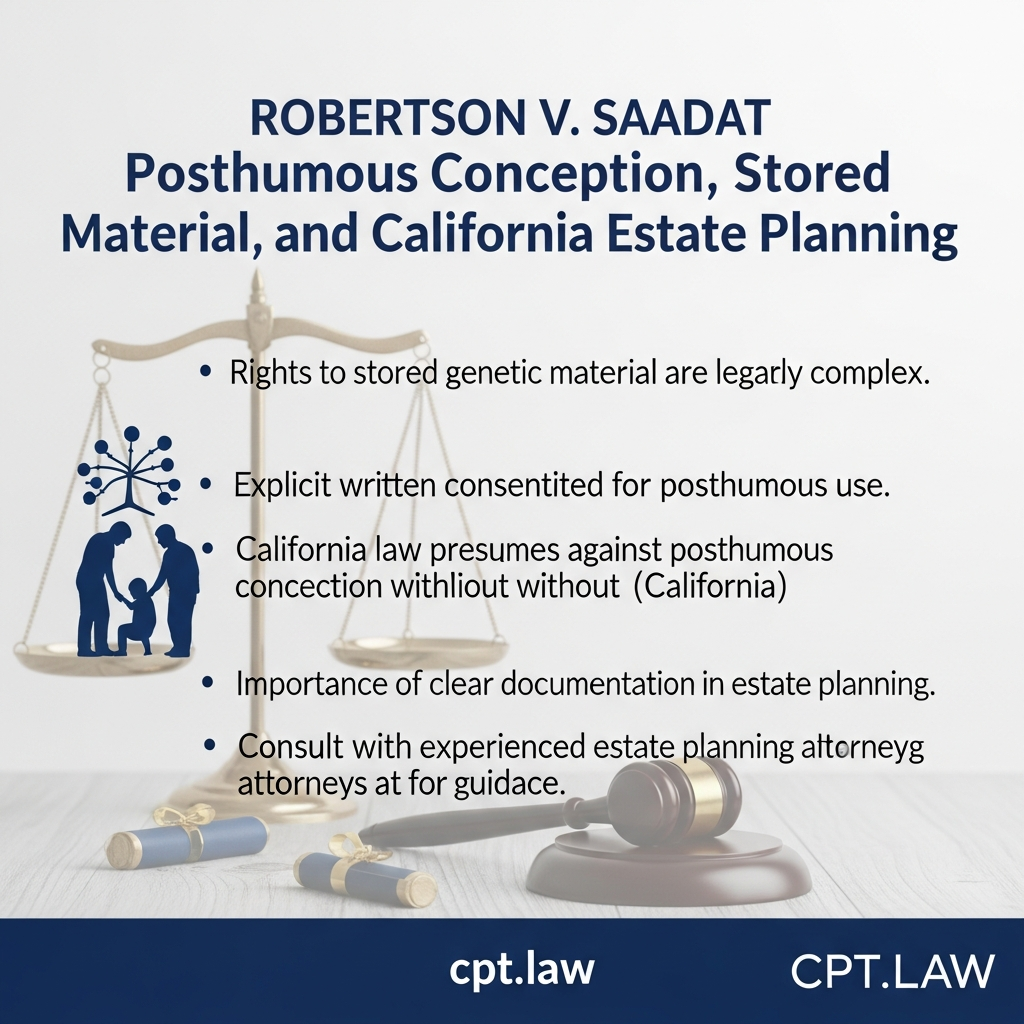
California Legal Implications: Posthumous Conception and Genetic Material in Estate Planning
In the case of *Robertson v. Saadat*, the California Court of Appeal highlighted a critical and often overlooked aspect of estate planning: the rights regarding stored genetic material. As detailed in the court opinion, Sarah Robertson sought damages after a storage facility lost the sperm of her deceased husband, Aaron. The sperm had been extracted while Aaron was in a coma shortly before his death. The court ruled against Sarah, establishing that she had no legal entitlement to use the sperm because there was no evidence that Aaron had expressly consented to the posthumous use of his genetic material., Sarah Robertson sought damages after a storage facility lost the sperm of her deceased husband, Aaron. The sperm had been extracted while Aaron was in a coma shortly before his death. The court ruled against Sarah, establishing that she had no legal entitlement to use the sperm because there was no evidence that Aaron had expressly consented to the posthumous use of his genetic material.
This ruling serves as a vital lesson for California families. It demonstrates that general statements about wanting children are legally insufficient to authorize posthumous conception. For California residents, this connects directly to the necessity of comprehensive estate planning that goes beyond financial assets to include biological legacy and specific healthcare directives.
The Presumption Against Posthumous Use
Under California law, there is a legal presumption that a decedent does not intend for their genetic material to be used for conception after their death. This presumption exists to protect the autonomy of the deceased. To overcome this presumption, there must be an “affirmative indication” of intent.
As the *Robertson* case illustrates, a spouse cannot simply authorize the extraction or use of genetic material based on the couple’s prior discussions or a general desire to have a family. Without clear, written consent from the donor, surviving spouses may find themselves legally barred from using stored genetic material, regardless of the emotional circumstances.
Establishing Clear Intent in Estate Documents
To ensure your wishes are honored regarding posthumous conception, “intent” must be documented formally. California estate planning attorneys can help individuals draft specific provisions within their estate plans. These documents should address:
* Explicit Consent: A clear statement authorizing the use of sperm, eggs, or embryos after death.
* Designated Beneficiaries: Identification of who is authorized to control the genetic material.
* Inheritance Rights: Determining whether a child conceived posthumously will be considered a beneficiary of the decedent’s Trust or Will..
Without these specific clauses, a child born posthumously may not only be difficult to conceive legally but may also be excluded from inheriting from the deceased parent’s estate under California Probate Code sections.
The Role of Advanced Health Care Directives
While a Will or Living Trust handles asset distribution, an Advanced Health Care Directive is the primary vehicle for making medical decisions when you are incapacitated. However, standard directives often do not cover the extraction or use of genetic material. is the primary vehicle for making medical decisions when you are incapacitated. However, standard directives often do not cover the extraction or use of genetic material.
If preserving the option for posthumous conception is important to a family, this must be explicitly integrated into the estate planning strategy. Relying on the “next of kin” status is insufficient for these specific medical procedures, as the court in *Robertson* affirmed that spousal status alone does not grant the right to control the decedent’s gametic material for procreation.
About This Case
Source: Robertson v. Saadat: Posthumous Conception, Stored Genetic Material, and California Estate Planning
California Probate and Trust, PC Can Help
– Free consultations: (866)-674-1130
– Experienced California estate planning
– Schedule consultation
– Learn more: cpt.law
Legal Disclaimer
This article is for informational purposes only. Consult with a qualified California estate planning attorney for advice specific to your situation.

About the Author: Dustin MacFarlane, Esq.
California Licensed Attorney | Estate Planning Specialist
Dustin MacFarlane is the founder of California Probate and Trust, PC, with over 15 years of experience in estate planning, probate administration, and trust law. Licensed by the California State Bar, Dustin has helped thousands of California families protect their assets and plan for the future.
CA Bar License: Active | Practice Areas: Estate Planning, Probate, Trust Administration | Location: Granite Bay, CA
Why Estate Planning Matters in California
California has unique estate planning laws that differ significantly from other states. Without proper planning, your assets may not pass according to your wishes, and your family could face unnecessary probate court proceedings.
A comprehensive California estate plan typically includes:
- A revocable living trust to avoid probate
- Pour-over will as a safety net
- Advance health care directive
How Trusts Work in California
California’s trust law (Probate Code Division 9) governs how trusts are created, administered, and terminated. Understanding these rules is essential for effective estate planning.
Key benefits of California trusts:
- Avoid probate: Assets in a properly funded trust bypass California’s lengthy probate process
- Privacy: Unlike wills (which become public in probate), trusts remain private
- Control: You maintain control during your lifetime and direct distribution after death
Need Expert Estate Planning Guidance?
California estate planning law is complex and constantly evolving. Don’t navigate it alone.
California Probate and Trust, PC has helped thousands of California families protect their assets and plan for the future.
📞 Call us today:
- Main Office: 866-400-0058
- Direct: 916-963-9968