
California Legal Implications: Understanding Conservatorship Timelines and Due Process
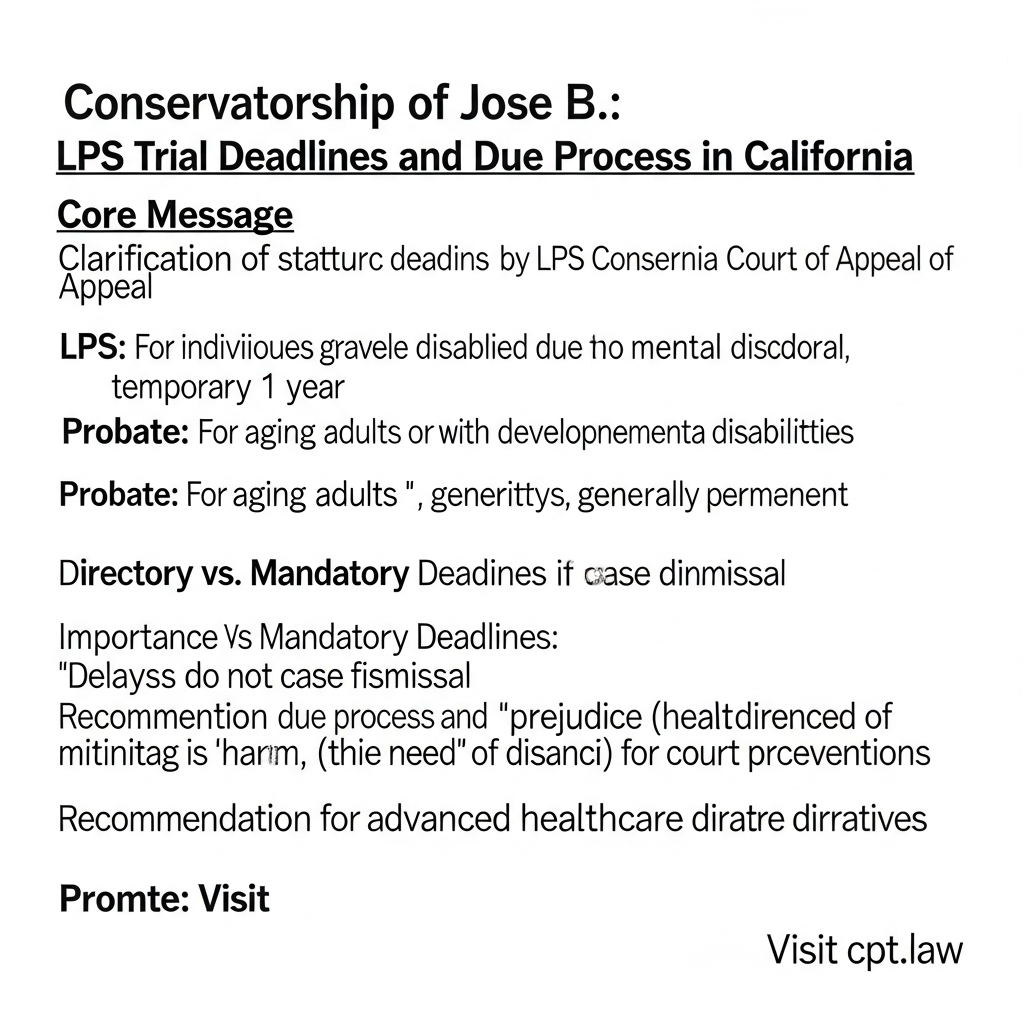
In a significant ruling regarding mental health law, the California Court of Appeal clarified the strictness of statutory deadlines in Lanterman-Petris-Short (LPS) Conservatorships. As reported in a recent summary of Conservatorship of Jose B., the court determined that a trial deadline of 10 days is “directory,” rather than “mandatory,” meaning a delay does not automatically result in the dismissal of the case., the court determined that a trial deadline of 10 days is “directory,” rather than “mandatory,” meaning a delay does not automatically result in the dismissal of the case.
For California families navigating the complex world of estate planning, mental health, and conservatorships, understanding the distinction between procedural rules and strict mandates is vital. While this specific case deals with acute mental health issues, it highlights the broader importance of understanding rights, timelines, and the definition of grave disability within the California legal system. within the California legal system.
The Distinction Between LPS and Probate Conservatorships
The case of Jose B. centers on an LPS Conservatorship, which is distinct from the Probate Conservatorships generally handled by estate planning attorneys. generally handled by estate planning attorneys.
* LPS Conservatorship: Specifically designed for individuals who are gravely disabled due to a mental disorder listed in the Diagnostic and Statistical Manual of Mental Disorders (such as schizophrenia or bipolar disorder). These are temporary (lasting one year) and focus on psychiatric treatment.
* Probate Conservatorship: Typically utilized for aging adults suffering from dementia or Alzheimer’s, or adults with developmental disabilities who cannot manage their finances or personal care. These are generally permanent unless terminated by the court.: Typically utilized for aging adults suffering from dementia or Alzheimer’s, or adults with developmental disabilities who cannot manage their finances or personal care. These are generally permanent unless terminated by the court.
It is crucial for families to know which type of intervention is necessary. While LPS conservatorships must be initiated by the government (usually the Public Guardian), a Probate Conservatorship is often initiated by family members seeking to protect a vulnerable loved one. is often initiated by family members seeking to protect a vulnerable loved one.
Directory vs. Mandatory Deadlines
In the Jose B. case, the proposed conservatee demanded a jury trial, which statutory law suggests should occur within 10 days. However, the trial was delayed for 137 days. The court ruled that because the statute did not explicitly state a penalty (such as dismissal) for missing the deadline, the timeline was directory (a guideline for orderliness) rather than mandatory (essential for jurisdiction). (essential for jurisdiction).
This distinction protects the integrity of the protective system. If every procedural delay resulted in the automatic release of a person who is gravely disabled and unable to care for themselves, the safety of that individual and the public could be compromised. and unable to care for themselves, the safety of that individual and the public could be compromised.
Due Process and “Prejudice” in Legal Proceedings
The court also addressed due process. A key takeaway for California residents is the legal concept of prejudice. In this context, prejudice does not mean bias; it refers to actual harm or a disadvantage caused to the defendant’s legal position.. In this context, prejudice does not mean bias; it refers to actual harm or a disadvantage caused to the defendant’s legal position.
Because Jose B. did not contest the jury’s finding that he was indeed gravely disabled, the court found that the delay did not change the outcome of the case. He was not “prejudiced” by the delay because the end result—conservatorship for his own protection—was legally sound.
Planning Ahead with Advanced Healthcare Directives
While families cannot always predict the onset of severe mental illness, having a comprehensive estate plan in place can often mitigate the need for court intervention in other areas. in place can often mitigate the need for court intervention in other areas.
* Advanced Healthcare Directive: Allows an individual to appoint an agent to make medical decisions if they become incapacitated.
* Durable Power of Attorney: Grants authority to a trusted person to manage finances.
* Revocable Living Trust: Helps manage assets without court supervision.: Helps manage assets without court supervision.
In cases involving severe mental illness where an LPS conservatorship is required, these documents may be superseded, but for many Californians, proper planning can prevent the need for Probate Conservatorship entirely. entirely.
About This Case
Source: Conservatorship of Jose B.: LPS Trial Deadlines and Due Process in California
California Probate and Trust, PC Can Help
* Free consultations: (866)-674-1130
* Experienced California estate planning
* Schedule consultation
* Learn more: cpt.law
Legal Disclaimer
This article is for informational purposes only. Consult with a qualified California estate planning attorney for advice specific to your situation.

About the Author: Dustin MacFarlane, Esq.
California Licensed Attorney | Estate Planning Specialist
Dustin MacFarlane is the founder of California Probate and Trust, PC, with over 15 years of experience in estate planning, probate administration, and trust law. Licensed by the California State Bar, Dustin has helped thousands of California families protect their assets and plan for the future.
CA Bar License: Active | Practice Areas: Estate Planning, Probate, Trust Administration | Location: Granite Bay, CA