
California Legal Implications: Fiduciary Duties and the Right to Rely on Accountings
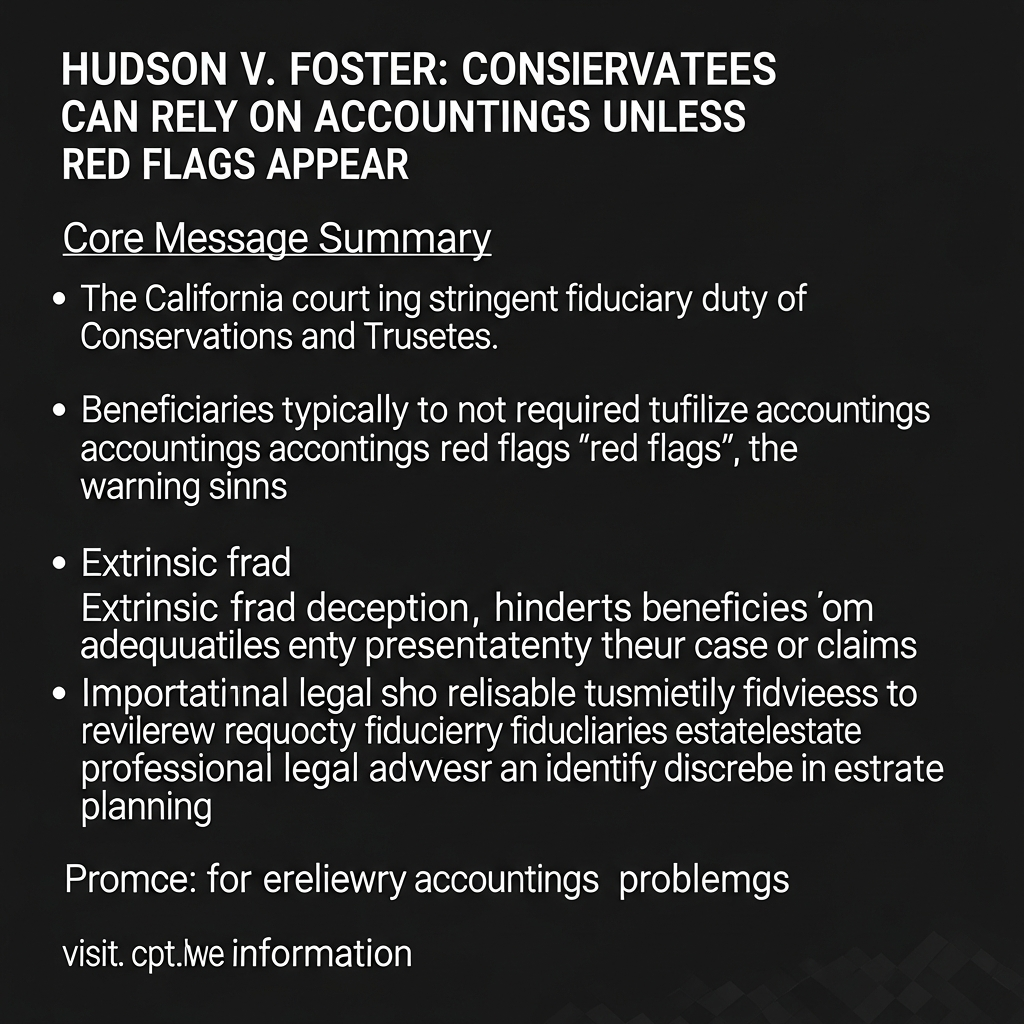
In the significant California appellate decision of Hudson v. Foster, the court addressed a critical issue regarding conservatorships and fraud. The case involved a conservator who hid payments made to himself within a financial report. The court ruled that a conservatee (the person being protected) has no duty to investigate the truthfulness of a conservator’s accounting unless they are already aware of facts that would make a reasonable person suspect wrongdoing. accounting unless they are already aware of facts that would make a reasonable person suspect wrongdoing.
This ruling reinforces the high standard of fiduciary duty in California. It ensures that individuals who manage assets for others—whether as conservators, trustees, or agents under a power of attorney—cannot escape liability for fraud simply because the beneficiary did not audit their work immediately. For California families, this underscores the importance of transparent estate administration and the legal protections available when a fiduciary betrays that trust.—cannot escape liability for fraud simply because the beneficiary did not audit their work immediately. For California families, this underscores the importance of transparent estate administration and the legal protections available when a fiduciary betrays that trust.
The High Standard of Fiduciary Duty
In California estate law, a person appointed to manage the finances of another is known as a fiduciary. This role carries the highest duty of care known to the law. Whether acting as a trustee of a family trust or a conservator appointed by the court, the fiduciary must act solely in the best interest of the beneficiary. appointed by the court, the fiduciary must act solely in the best interest of the beneficiary.
The *Hudson v. Foster* case highlights that this duty includes the obligation to provide accurate and truthful accountings. An accounting is a detailed report showing all income, disbursements, and assets on hand. When a fiduciary submits this document, the law presumes they are telling the truth. The beneficiary is generally entitled to rely on those representations without conducting an independent investigation.. An accounting is a detailed report showing all income, disbursements, and assets on hand. When a fiduciary submits this document, the law presumes they are telling the truth. The beneficiary is generally entitled to rely on those representations without conducting an independent investigation.
Understanding Extrinsic Fraud in Estate Litigation
One of the central legal concepts in this case is extrinsic fraud. This occurs when a party is deprived of a fair opportunity to present their case or objection because of the opponent’s deception. In the context of estate planning and probate:. This occurs when a party is deprived of a fair opportunity to present their case or objection because of the opponent’s deception. In the context of estate planning and probate:
* Intrinsic Fraud usually involves perjury or forged documents during a trial that could have been challenged at the time.
* Extrinsic Fraud happens when a fiduciary hides material facts (like self-dealing payments) that prevent the beneficiary from knowing they even have a reason to object. happens when a fiduciary hides material facts (like self-dealing payments) that prevent the beneficiary from knowing they even have a reason to object.
Because the conservator in *Hudson* concealed the true nature of the payments, the court determined this was extrinsic fraud. This distinction is vital because it allows the court to set aside orders and reopen cases even years after they were supposedly closed.
When “Red Flags” Trigger a Duty to Investigate
While the court ruled that beneficiaries generally do not need to audit their fiduciaries, there is an exception. If a reasonably prudent person would have suspected wrongdoing based on known facts, the beneficiary might have a duty to investigate further. would have suspected wrongdoing based on known facts, the beneficiary might have a duty to investigate further.
For example, if a trust accounting shows massive, unexplained drops in value or payments to entities with names similar to the trustee’s own business, these may constitute “red flags.” If a beneficiary ignores obvious warning signs, they may lose their right to challenge the accounting later. However, absent such signs, the burden remains on the fiduciary to be honest, not on the beneficiary to catch them lying. shows massive, unexplained drops in value or payments to entities with names similar to the trustee’s own business, these may constitute “red flags.” If a beneficiary ignores obvious warning signs, they may lose their right to challenge the accounting later. However, absent such signs, the burden remains on the fiduciary to be honest, not on the beneficiary to catch them lying.
The Importance of Professional Guidance
This case serves as a reminder that selecting a trustworthy fiduciary is the most critical step in estate planning. Whether you are nominating a successor trustee in your living trust or facing a court-appointed conservatorship, the integrity of the person in charge is paramount. or facing a court-appointed conservatorship, the integrity of the person in charge is paramount.
Additionally, for beneficiaries receiving an accounting, it is often wise to have the documents reviewed by a qualified estate planning attorney. While the law protects you from fraud, having a professional review the financials can help identify potential “red flags” early, preventing loss of assets and years of litigation.
About This Case
Source: Hudson v. Foster: Conservatees Usually Can Rely on Accountings Unless Red Flags Appear
California Probate and Trust, PC Can Help
– Free consultations: (866)-674-1130
– Experienced California estate planning
– Schedule consultation
– Learn more: cpt.law
Legal Disclaimer
This article is for informational purposes only. Consult with a qualified California estate planning attorney for advice specific to your situation.

About the Author: Dustin MacFarlane, Esq.
California Licensed Attorney | Estate Planning Specialist
Dustin MacFarlane is the founder of California Probate and Trust, PC, with over 15 years of experience in estate planning, probate administration, and trust law. Licensed by the California State Bar, Dustin has helped thousands of California families protect their assets and plan for the future.
CA Bar License: Active | Practice Areas: Estate Planning, Probate, Trust Administration | Location: Granite Bay, CA