
California Legal Implications: Disinheriting Unknown Heirs and The “Omitted Child” Doctrine
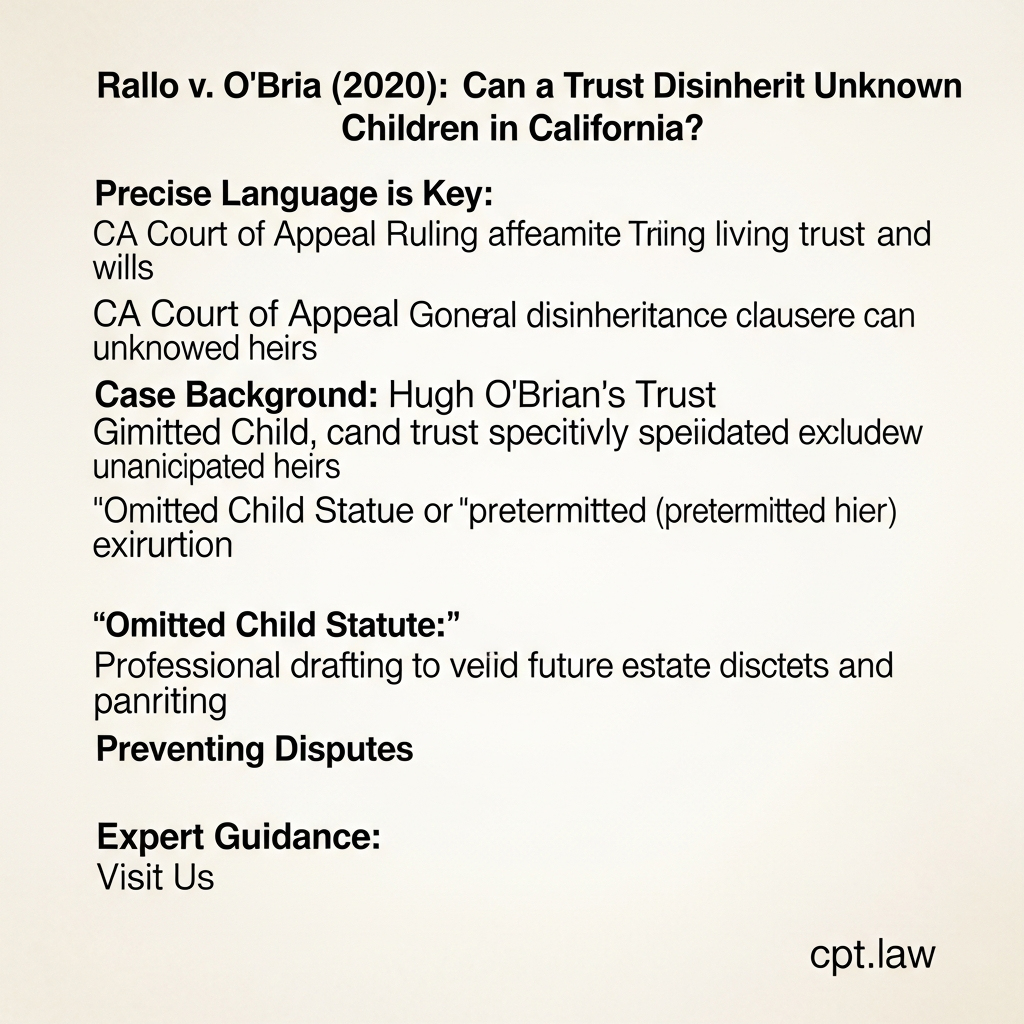
The recent affirmation of the ruling in *Rallo v. O’Bria* highlights a critical aspect of estate planning: the power of precise language in a Living Trust or Will. In this case, the California Court of Appeal ruled that a general disinheritance clause is sufficient to exclude potential heirs, even if the person creating the trust (the decedent) was unaware of their existence.. In this case, the California Court of Appeal ruled that a general disinheritance clause is sufficient to exclude potential heirs, even if the person creating the trust (the decedent) was unaware of their existence.
According to the court opinion, actor Hugh O’Brian established a trust that benefited his wife and friends but stated he had no children. After his death, two biological children he was allegedly unaware of sought a share of the estate. Because O’Brian’s trust included a broad disinheritance clause specifically excluding “any person who claims to be a descendant or heir,” the court ruled that his intent to exclude them was clear, regardless of whether he knew them personally., actor Hugh O’Brian established a trust that benefited his wife and friends but stated he had no children. After his death, two biological children he was allegedly unaware of sought a share of the estate. Because O’Brian’s trust included a broad disinheritance clause specifically excluding “any person who claims to be a descendant or heir,” the court ruled that his intent to exclude them was clear, regardless of whether he knew them personally.
For California families, this case underscores the importance of working with an experienced attorney to draft documents that withstand challenges from unknown or estranged relatives.
Understanding the “Omitted Child” Statute
Under California law, specifically the Probate Code, children who are omitted from a parent’s estate plan may have statutory rights to claim a share of the estate. This usually applies in two scenarios:
1. Post-testamentary children: Children born or adopted *after* the documents were signed.
2. Unknown children: Children born *before* the documents were signed, but omitted because the parent believed the child was deceased or was unaware of the child’s birth. Children born *before* the documents were signed, but omitted because the parent believed the child was deceased or was unaware of the child’s birth.
In the *Rallo* case, the claimants argued they were entitled to an intestate share (the amount they would have received had there been no trust) because their father was unaware of their births. (the amount they would have received had there been no trust) because their father was unaware of their births.
The Power of a General Disinheritance Clause
The court’s decision in *Rallo v. O’Bria* clarifies that a properly drafted general disinheritance clause can override the statutory protections for unknown children. By including language that intentionally disinherits “any heirs” or anyone claiming to be a descendant, a Trustor expresses a clear intent to leave their assets only to the named beneficiaries. expresses a clear intent to leave their assets only to the named beneficiaries.
The court noted that the burden of proof lies with the omitted child. To successfully claim a share of the estate in the face of such a clause, the child must prove that the *sole* reason for the omission was the parent’s lack of knowledge. However, when a trust explicitly disinherits “all heirs,” it suggests the parent intended to exclude everyone not named, known or unknown.
Why Professional Drafting is Essential
This case demonstrates that standard “boilerplate” language regarding family composition (“I have no children”) can be dangerous if not paired with robust disinheritance provisions. Had O’Brian’s trust merely stated he had no children without the additional disinheritance clause, the outcome might have been different, potentially resulting in a lengthy and expensive probate battle that drained the estate’s assets.
To ensure your assets go exactly where you intend—and to prevent unexpected claims from distant or unknown relatives—it is vital to include comprehensive language that addresses all potential heirs.
About This Case
Source: Rallo v. O’Bria (2020): Can a Trust Disinherit Unknown Children in California?
California Probate and Trust, PC Can Help
– Free consultations: (866)-674-1130
– Experienced California estate planning
– Schedule consultation
– Learn more: cpt.law
Legal Disclaimer
This article is for informational purposes only. Consult with a qualified California estate planning attorney for advice specific to your situation.

About the Author: Dustin MacFarlane, Esq.
California Licensed Attorney | Estate Planning Specialist
Dustin MacFarlane is the founder of California Probate and Trust, PC, with over 15 years of experience in estate planning, probate administration, and trust law. Licensed by the California State Bar, Dustin has helped thousands of California families protect their assets and plan for the future.
CA Bar License: Active | Practice Areas: Estate Planning, Probate, Trust Administration | Location: Granite Bay, CA