
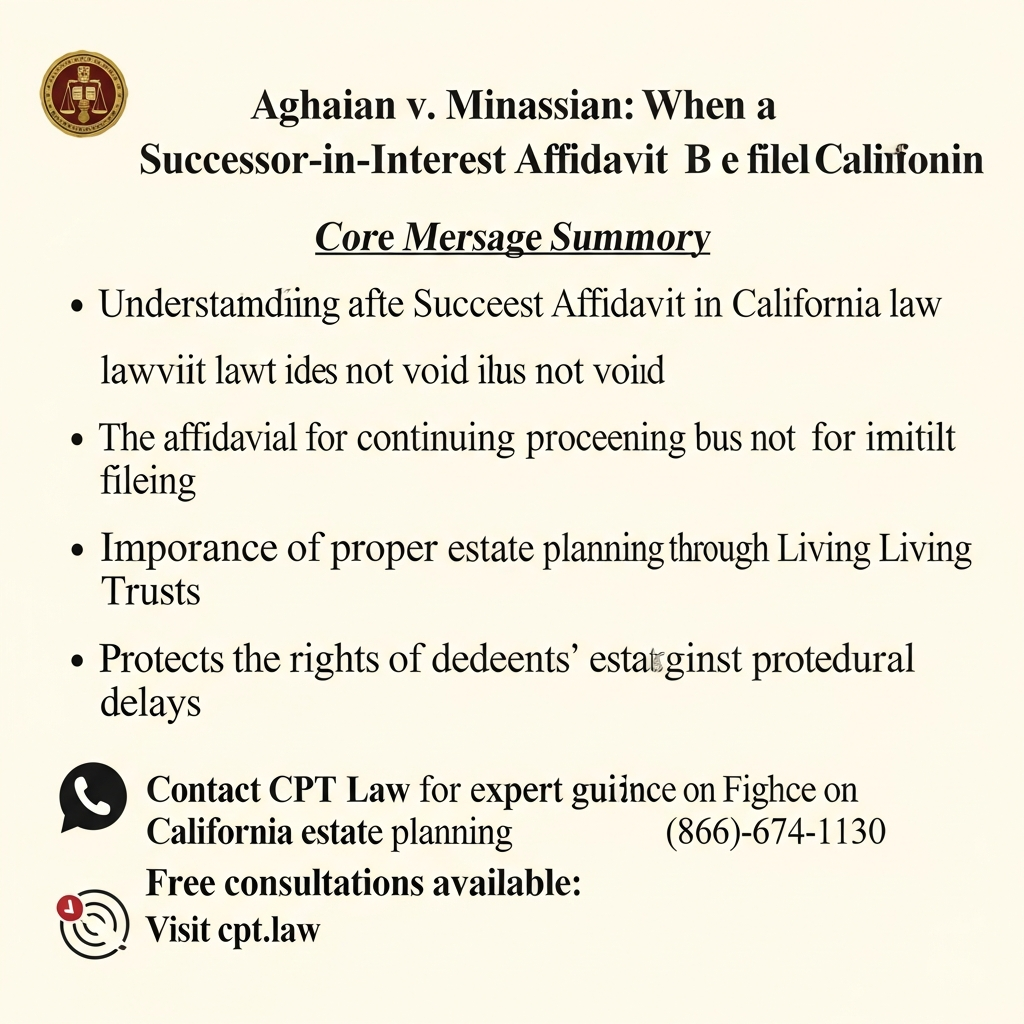
California Legal Implications: Pursuing Lawsuits on Behalf of a Decedent
When a person passes away with an unresolved legal claim, that claim often becomes an asset of their estate. The recent decision in *Aghaian v. Minassian*, cited in this legal summary, highlights a critical procedural nuance: a Successor-in-Interest Affidavit does not necessarily need to be filed the exact moment a lawsuit is initiated. The court affirmed that filing the affidavit later can cure procedural defects without triggering the statute of limitations. For California families, this underscores the importance of understanding how to legally step into the shoes of a deceased loved one. does not necessarily need to be filed the exact moment a lawsuit is initiated. The court affirmed that filing the affidavit later can cure procedural defects without triggering the statute of limitations. For California families, this underscores the importance of understanding how to legally step into the shoes of a deceased loved one.
Understanding the Successor-in-Interest
Under California law, specifically the Code of Civil Procedure Section 377.32, a person seeking to commence or continue a legal action on behalf of a decedent must often file a specific affidavit. This document attests that the individual is the decedent’s successor-in-interest (usually a beneficiary or heir) and is authorized to act. This is typically done when there is no pending administration of the decedent’s estate (no open probate). (usually a beneficiary or heir) and is authorized to act. This is typically done when there is no pending administration of the decedent’s estate (no open probate).
This process acts as an alternative to appointing a formal Personal Representative (executor or administrator) through probate court. It allows heirs to pursue specific claims without necessarily opening a full probate proceeding, provided strict criteria are met. (executor or administrator) through probate court. It allows heirs to pursue specific claims without necessarily opening a full probate proceeding, provided strict criteria are met.
Procedural Flexibility and the Statute of Limitations
The *Aghaian* ruling provides relief for families who may have started a lawsuit to preserve a claim before the statute of limitations expired but failed to file the technical affidavit immediately. The court held that the affidavit is not a “condition precedent” to filing the suit. expired but failed to file the technical affidavit immediately. The court held that the affidavit is not a “condition precedent” to filing the suit.
Essentially, while the affidavit is required to *continue* the proceedings, failing to attach it to the initial complaint is not a fatal error that voids the lawsuit. This distinction is vital for protecting the rights of an estate against defendants who might try to use procedural delays to dismiss valid claims.
The Role of Trusts in Litigation Management
While this court ruling offers some leniency regarding paperwork timing, it highlights the complexities involved when relying on statutory affidavits to manage a decedent’s legal affairs. A comprehensive Living Trust can often streamline the management of assets—including potential lawsuits. can often streamline the management of assets—including potential lawsuits.
When a legal claim belongs to a Trust, the Successor Trustee generally has the immediate authority to manage litigation on behalf of the Trust without the same procedural hurdles faced by individual successors-in-interest. Proper estate planning ensures that authority is clearly defined before a crisis occurs, reducing the likelihood of procedural challenges. generally has the immediate authority to manage litigation on behalf of the Trust without the same procedural hurdles faced by individual successors-in-interest. Proper estate planning ensures that authority is clearly defined before a crisis occurs, reducing the likelihood of procedural challenges.
About This Case
Source: Aghaian v. Minassian: When a Successor-in-Interest Affidavit Can Be Filed in California
California Probate and Trust, PC Can Help
– Free consultations: (866)-674-1130
– Experienced California estate planning
– Schedule consultation
– Learn more: cpt.law
Legal Disclaimer
This article is for informational purposes only. Consult with a qualified California estate planning attorney for advice specific to your situation.

About the Author: Dustin MacFarlane, Esq.
California Licensed Attorney | Estate Planning Specialist
Dustin MacFarlane is the founder of California Probate and Trust, PC, with over 15 years of experience in estate planning, probate administration, and trust law. Licensed by the California State Bar, Dustin has helped thousands of California families protect their assets and plan for the future.
CA Bar License: Active | Practice Areas: Estate Planning, Probate, Trust Administration | Location: Granite Bay, CA
Why Estate Planning Matters in California
California has unique estate planning laws that differ significantly from other states. Without proper planning, your assets may not pass according to your wishes, and your family could face unnecessary probate court proceedings.
A comprehensive California estate plan typically includes:
- A revocable living trust to avoid probate
- Pour-over will as a safety net
- Advance health care directive
- Durable power of attorney for finances
- Beneficiary designations on retirement accounts and life insurance
How Trusts Work in California
California’s trust law (Probate Code Division 9) governs how trusts are created, administered, and terminated. Understanding these rules is essential for effective estate planning.
Key benefits of California trusts:
- Avoid probate: Assets in a properly funded trust bypass California’s lengthy probate process
- Privacy: Unlike wills (which become public in probate), trusts remain private
- Control: You maintain control during your lifetime and direct distribution after death
- Incapacity planning: Your successor trustee manages assets if you become incapacitated
- Tax planning: Trusts can help minimize estate and income taxes
Need Expert Estate Planning Guidance?
California estate planning law is complex and constantly evolving. Don’t navigate it alone.
California Probate and Trust, PC has helped thousands of California families protect their assets and plan for the future.
📞 Call us today:
- Main Office: 866-400-0058
- Direct: 916-963-9968