
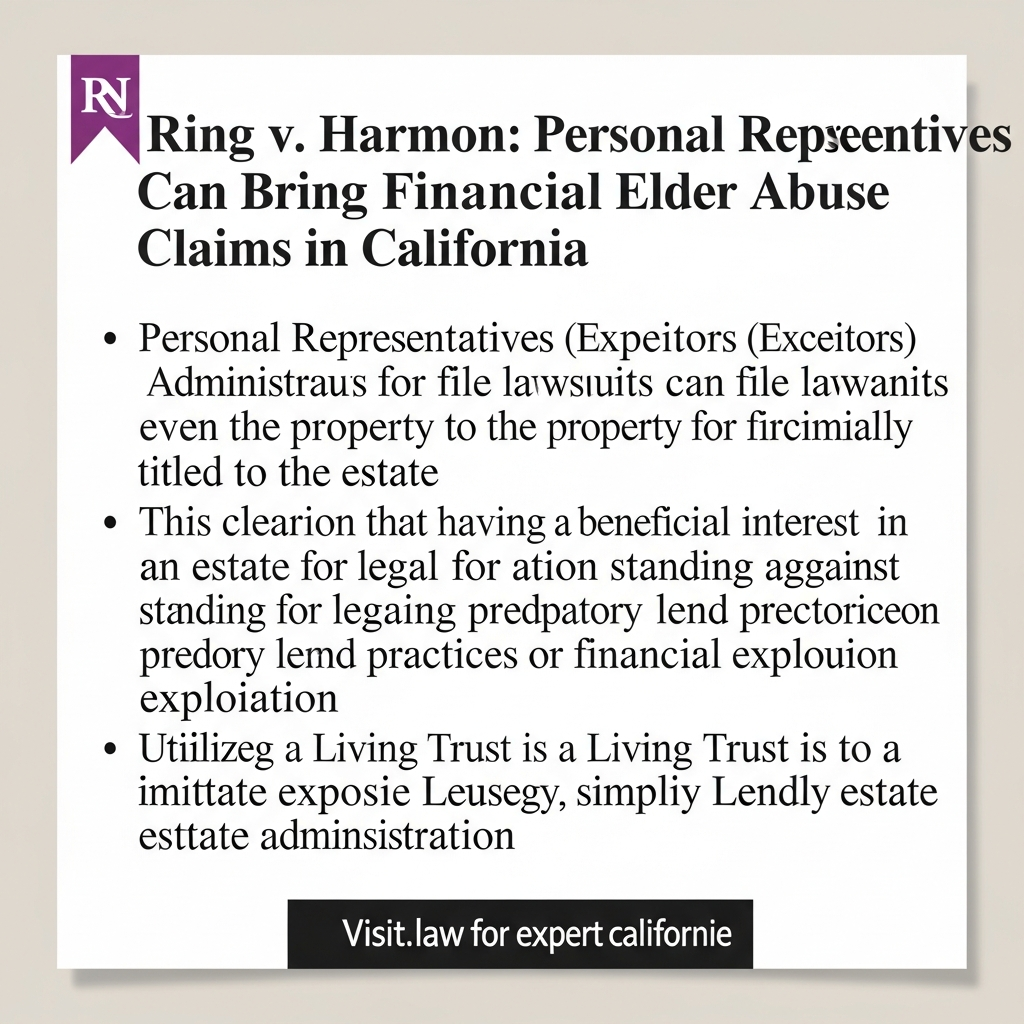
California Legal Implications: Expanding Protections Against Financial Elder Abuse
A recent California appellate court decision has strengthened the ability of seniors to fight back against financial exploitation, even during the complex process of probate. As detailed in the court opinion for *Ring v. Harmon*, the Fourth District Court of Appeal ruled that an elderly woman serving as a Personal Representative of an estate had standing to sue for Financial Elder Abuse, despite the fact that the property in question was legally titled to the estate rather than her personally., despite the fact that the property in question was legally titled to the estate rather than her personally.
For California families, this decision underscores the importance of understanding fiduciary duties and the robust protections provided under the Elder Abuse and Dependent Adult Civil Protection Act.
Understanding Standing in Estate Litigation
In most probate matters, a “cause of action” (the legal right to sue) regarding estate property belongs to the Personal Representative acting on behalf of the estate, not the beneficiaries individually. However, *Ring v. Harmon* presented a unique “special circumstance.” acting on behalf of the estate, not the beneficiaries individually. However, *Ring v. Harmon* presented a unique “special circumstance.”
In this case, an 80-year-old mother was both the sole beneficiary and the Personal Representative of her deceased daughter’s estate. She alleged that predatory lenders tricked her into taking out a high-interest loan against the decedent’s home. Initially, the trial court dismissed her claim because she sued as an individual, while the house was owned by the estate. The appellate court reversed this, establishing that because her beneficial interest in the estate was harmed by the predatory loan, she had the right to sue for financial elder abuse. in the estate was harmed by the predatory loan, she had the right to sue for financial elder abuse.
Property Title vs. Beneficial Interest
This ruling is significant for California estate planning because it clarifies that Financial Elder Abuse claims do not strictly require the elder to hold legal title to the property. claims do not strictly require the elder to hold legal title to the property.
Under California law, wrongful taking constitutes abuse if it deprives the elder of a property right. The court found that while the estate held the title to the house, the mother’s rights as a beneficiary constituted a property interest. Therefore, when the value of that inheritance was diminished by the alleged predatory lending, a direct injury occurred to her financial status.
The Role of the Fiduciary
This case also highlights the vulnerabilities associated with the probate process. The mother was acting in a fiduciary capacity, meaning she had a legal obligation to manage the estate’s assets responsibly. However, predators often target those in charge of estates, knowing they have access to significant assets., meaning she had a legal obligation to manage the estate’s assets responsibly. However, predators often target those in charge of estates, knowing they have access to significant assets.
Families can often avoid these procedural hurdles and potential exposures to predatory lending by utilizing a Living Trust rather than a Will. A properly funded trust avoids probate court entirely, allowing a successor Trustee to manage assets privately and potentially shielding beneficiaries from the type of public exposure that occurs during probate proceedings. to manage assets privately and potentially shielding beneficiaries from the type of public exposure that occurs during probate proceedings.
About This Case
Source: Ring v. Harmon: Personal Representatives Can Bring Financial Elder Abuse Claims in California
California Probate and Trust, PC Can Help
– Free consultations: (866)-674-1130
– Experienced California estate planning
– Schedule consultation
– Learn more: cpt.law
Legal Disclaimer
This article is for informational purposes only. Consult with a qualified California estate planning attorney for advice specific to your situation.

About the Author: Dustin MacFarlane, Esq.
California Licensed Attorney | Estate Planning Specialist
Dustin MacFarlane is the founder of California Probate and Trust, PC, with over 15 years of experience in estate planning, probate administration, and trust law. Licensed by the California State Bar, Dustin has helped thousands of California families protect their assets and plan for the future.
CA Bar License: Active | Practice Areas: Estate Planning, Probate, Trust Administration | Location: Granite Bay, CA
Why Estate Planning Matters in California
California has unique estate planning laws that differ significantly from other states. Without proper planning, your assets may not pass according to your wishes, and your family could face unnecessary probate court proceedings.
A comprehensive California estate plan typically includes:
- A revocable living trust to avoid probate
- Pour-over will as a safety net
- Advance health care directive
- Durable power of attorney for finances
- Beneficiary designations on retirement accounts and life insurance
How Trusts Work in California
California’s trust law (Probate Code Division 9) governs how trusts are created, administered, and terminated. Understanding these rules is essential for effective estate planning.
Key benefits of California trusts:
- Avoid probate: Assets in a properly funded trust bypass California’s lengthy probate process
- Privacy: Unlike wills (which become public in probate), trusts remain private
- Control: You maintain control during your lifetime and direct distribution after death
- Incapacity planning: Your successor trustee manages assets if you become incapacitated
- Tax planning: Trusts can help minimize estate and income taxes
Need Expert Estate Planning Guidance?
California estate planning law is complex and constantly evolving. Don’t navigate it alone.
California Probate and Trust, PC has helped thousands of California families protect their assets and plan for the future.
📞 Call us today:
- Main Office: 866-400-0058
- Direct: 916-963-9968