
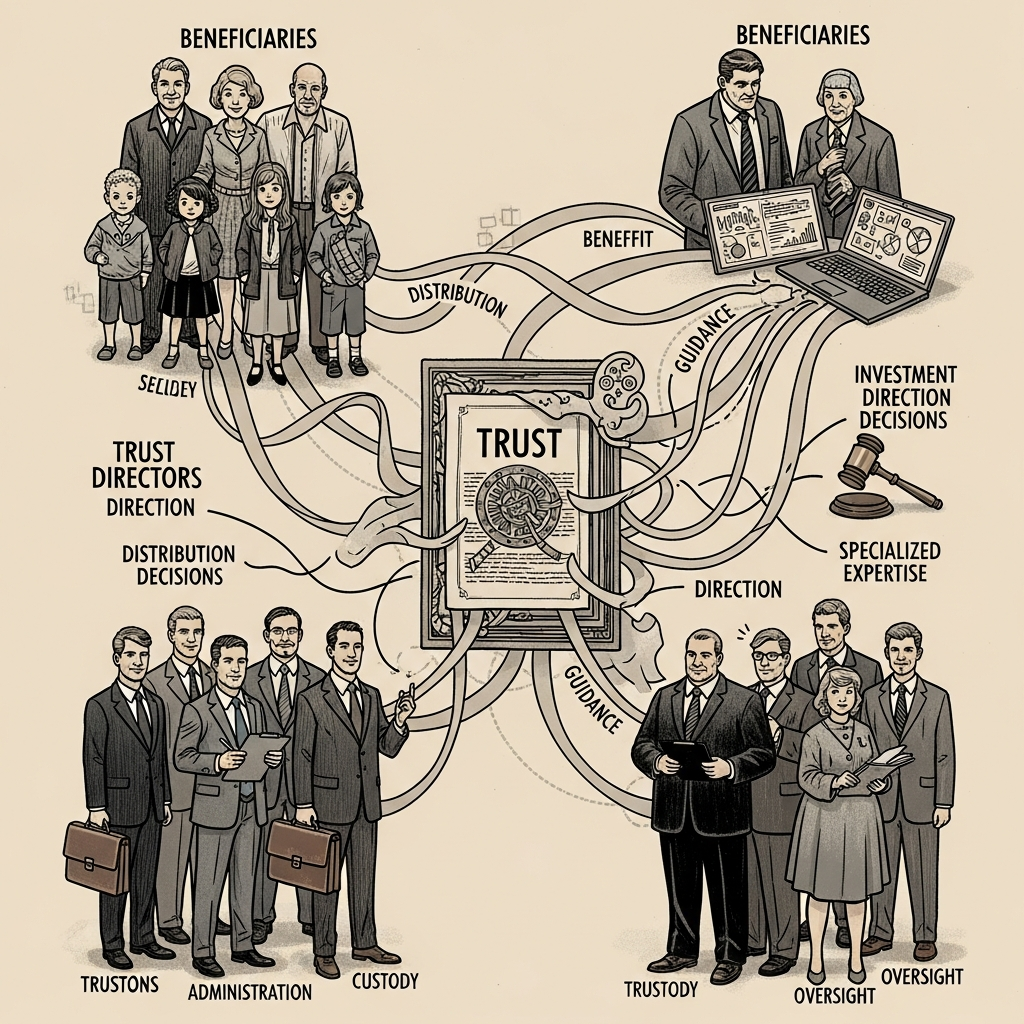
If you’re a California resident with substantial assets—particularly business interests, real estate portfolios, or complex investment holdings—you may be wondering: How can I maintain control over my assets while ensuring professional management and protection for my family? Directed trusts offer a sophisticated solution that’s increasingly popular among high-net-worth families seeking both flexibility and specialized expertise in estate planning.
What Is a Directed Trust and Who Needs One?
A directed trust is an estate planning structure that divides fiduciary responsibilities among multiple parties, allowing you to retain authority over specific assets while utilizing advisors with specialized knowledge.This arrangement is particularly valuable for California families who:
In a directed trust, the trustee follows instructions from a designated trust advisor or trust director—typically serving as an investment advisor, distribution advisor, or trust protector.This differs fundamentally from traditional trusts where a single trustee holds all decision-making power.
Three Critical Ways Directed Trusts Differ from Traditional Trusts
1. Limited Trustee Responsibility
Directed trustees are only responsible for trust management decisions that aren’t directed by the trust director, creating a clear division of duties.
2. Restricted Discretion
The directed trustee’s discretion is limited because third-party trust directors control key functions such as investments or distributions.
3. Reduced Liability
While the directed trustee’s liability is reduced, it’s not eliminated entirely—creating a nuanced legal landscape that requires careful planning.
Understanding Fiduciary Duties: Who Is Responsible for What?
One of the most critical questions California families face when establishing directed trusts is: Who owes what duties to the beneficiaries? Determining whether each party serves as a fiduciary or nonfiduciary is foundational to understanding roles, responsibilities, and potential liability.
Even with the Uniform Directed Trust Act (UDTA) adopted in twenty states and the District of Columbia, significant variations exist in how states define duties and liabilities.This lack of uniformity creates complexities that California residents must navigate carefully.
The Legal Framework: Uniform Trust Code vs. Uniform Directed Trust Act
The Uniform Trust Code (UTC) was the original uniform act recognizing directed trusts, with section 808 addressing “Powers to Direct.” However, this section is now reserved and replaced by the UDTA in adopting states.
Key Differences Between UTC Section 808 and the UDTA:
Under the UDTA, trust directors are fiduciaries with the same duty and liability as sole trustees in similar positions, and the same standard applies to trust protectors.
State-by-State Variations: Why Jurisdiction Matters for California Families
The choice of jurisdiction is critical in directed trust planning because state law determines the clarity of fiduciary duties, the scope of liability, and ultimately, the willingness of trustees to serve.
States Without Directed Trust Laws:
Currently, only Louisiana, New York, and Rhode Island lack both a directed trust statute and adoption of UTC section 808 or the UDTA.
Fiduciary Status Across Jurisdictions:
The Liability Question: Who Pays When Things Go Wrong?
In states where trust directors can serve as nonfiduciaries, a critical question emerges: If the directed trustee is absolved from liability for following instructions and the trust director isn’t a fiduciary, who is liable for breaches?
Courts may reclassify advisors deemed nonfiduciaries as fiduciaries if they exercise substantial control, even if the trust document states otherwise. In one reported case, a trust protector was deemed a fiduciary, and a claim for failure to remove a negligent trustee was allowed to proceed.
Delaware’s Unique “Willful Misconduct” Standard
Delaware has adopted the willful misconduct standard for directed trustees and is unique in defining what constitutes “willful misconduct.” Under Delaware law, willful misconduct is more than gross negligence or recklessness—it requires intentional wrongdoing defined as “malicious conduct or conduct designed to defraud or seek an unconscionable advantage.”Most other states that have adopted this standard have not defined what constitutes willful misconduct.
Nevada’s “No Liability” Approach
Nevada adopts a “no liability” approach, providing that directed fiduciaries are not liable for complying with directions from directing trust advisers or for failing to take actions requiring approval that wasn’t provided.However, Nevada statutes also limit the ability to exculpate fiduciaries for willful misconduct or gross negligence, creating uncertainty about how to reconcile these provisions.
The Duty to Monitor: How Much Oversight Is Required?
The duty to monitor is a central concern in directed trust arrangements, as most trustees don’t want responsibility for overseeing trust directors’ actions, but requirements differ between jurisdictions.
UDTA Approach:
The UDTA waives the duty to monitor the trust director and the duty to inform or give advice about directed acts unless the trust provides otherwise. However, directed trustees must still monitor directions to confirm that compliance wouldn’t constitute willful misconduct.
Delaware Approach:
Delaware waives the duty to monitor the adviser’s conduct, the duty to provide advice to or consult with the adviser, and the duty to warn beneficiaries about directed acts.
Florida Exception:
In contrast, Florida requires trustees to confirm that directed actions fall within the scope of the trust director’s authority.
The Duty to Inform: Communication Requirements Between Parties
Under the UDTA, both trust directors and directed trustees have a duty to keep each other informed, while UTC Section 808 doesn’t address this duty at all.
Delaware requires each trust fiduciary, including advisers, to keep other fiduciaries and nonfiduciaries reasonably informed about trust administration to the extent necessary for them to perform their duties. Nevada, by contrast, does not include a duty to inform in its directed trust statute.
Best Practices for California Families Considering Directed Trusts
Directed trusts offer significant advantages but require careful management and coordination. Based on the evolving legal landscape, California families should consider these essential practices:
Real-World Application: When Directed Trusts Make Sense
Consider these scenarios where California families benefit from directed trust structures:
How California Probate and Trust, PC Helps Families Navigate Directed Trust Complexity
Directed trusts require sophisticated legal guidance to navigate the intersection of state laws, fiduciary duties, and family dynamics. California Probate and Trust, PC provides comprehensive estate planning services for California residents managing complex assets, offering clarity on:
Take Control of Your Family’s Financial Future
If you’re a California resident with complex assets and are considering whether a directed trust structure might protect your family’s wealth while providing the specialized management your assets require, California Probate and Trust, PC can provide the experienced guidance you need.
Our firm focuses exclusively on estate planning and trust administration for California families, with particular expertise in sophisticated structures like directed trusts that require careful coordination and clear documentation.
Contact California Probate and Trust, PC today to discuss how directed trust structures can provide the control, protection, and expertise your family needs.
Visit cpt.law or call (866)-674-1130 to schedule a consultation with our experienced estate planning attorneys.
Source: Content adapted from “Directed Trusts: Evolving Roles, Duties, and Liabilities” by Laura Mandel, published in WealthCounsel Quarterly, January 15, 2026.
Legal Disclaimer: This article is provided for informational purposes only and does not constitute legal advice. The information presented is based on general legal principles and may not reflect the most current legal developments or apply to your specific situation. Estate planning and trust law vary significantly by jurisdiction, and directed trust requirements differ from state to state. You should not act or refrain from acting based on information in this article without seeking professional legal counsel. The creation of an attorney-client relationship requires a formal engagement agreement. California Probate and Trust, PC makes no representations or warranties regarding the accuracy, completeness, or timeliness of the information contained herein. For specific legal advice tailored to your circumstances, please consult with a qualified estate planning attorney licensed in your jurisdiction.

About the Author: Dustin MacFarlane, Esq.
California Licensed Attorney | Estate Planning Specialist
Dustin MacFarlane is the founder of California Probate and Trust, PC, with over 15 years of experience in estate planning, probate administration, and trust law. Licensed by the California State Bar, Dustin has helped thousands of California families protect their assets and plan for the future.
CA Bar License: Active | Practice Areas: Estate Planning, Probate, Trust Administration | Location: Granite Bay, CA