
Categories
California Probate News

Keading v. Keading (2021): Elder Financial Abuse, Undue Influence, and Double Damages – California Legal Guide | CPT Law

California Legal Implications: Understanding Elder Financial Abuse and Double Damages

Family disputes over inheritance are unfortunate but common; however, when these disputes involve the manipulation of an elderly parent, the legal consequences in California can be severe. A landmark case, *Keading v. Keading*, highlights how California courts handle elder financial abuse and the imposition of double damages against those who wrongfully take assets from vulnerable seniors. against those who wrongfully take assets from vulnerable seniors.

As detailed in the court opinion from Keading v. Keading, this case involved a dispute between siblings regarding their parents’ estate. After the mother passed away, the father executed a trust amendment to treat both children equally. However, shortly before the father’s death, one son, Kenton, orchestrated a series of changes. He obtained a new Power of Attorney, transferred stock to himself, and secretly transferred the family home into a joint tenancy with his father. with his father.

The trial court found that the father’s last lucid act was the amendment equalizing the estate between the siblings. The subsequent transfers to Kenton were deemed the result of undue influence. Consequently, the court found Kenton liable for elder financial abuse and awarded double damages. Crucially, the appellate court affirmed that a separate finding of “bad faith” is not required to award double damages when elder financial abuse is proven. is proven.

What is Undue Influence?

Undue influence occurs when excessive persuasion causes another person to act or refrain from acting by overcoming that person’s free will. In the context of estate planning, this often looks like a caregiver or family member isolating a senior and pressuring them to change their Living Trust, execute a new Will, or sign a Power of Attorney that benefits the influencer. that benefits the influencer.

In the *Keading* case, the court looked at the timeline of the father’s declining health and the sudden changes to his estate plan that exclusively benefited one child to the detriment of the other.

Elder Financial Abuse and California Probate Code Section 859

California law provides robust protections for seniors. Elder financial abuse happens when a person or entity takes, secretes, appropriates, obtains, or retains real or personal property of an elder for a wrongful use or with intent to defraud. happens when a person or entity takes, secretes, appropriates, obtains, or retains real or personal property of an elder for a wrongful use or with intent to defraud.

Under California Probate Code section 859, if a court finds that a person has taken property through undue influence or elder financial abuse, that person may be liable for twice the value of the property recovered. This is known as double damages..

The significant legal takeaway from *Keading* is the court’s interpretation of the statute. The court clarified that if property is taken via elder financial abuse, the penalty of double damages applies automatically upon that finding. The court does not need to make an additional, separate finding that the wrongdoer acted in “bad faith.” The commission of the abuse itself justifies the enhanced penalty. applies automatically upon that finding. The court does not need to make an additional, separate finding that the wrongdoer acted in “bad faith.” The commission of the abuse itself justifies the enhanced penalty.

Protecting Your Estate and Loved Ones

To prevent scenarios like the one in *Keading*, proactive estate planning is essential. California families should consider:

* Capacity Planning: Establishing clear documentation of capacity when changes are made to estate plans, especially for older adults.
* Professional Fiduciaries: In cases of high family tension, appointing a neutral professional fiduciary as a Trustee can prevent siblings from accusing one another of impropriety.
* Updated Documents: Regularly reviewing Advance Health Care Directives and Powers of Attorney to ensure the appointed agents are still trustworthy and capable. to ensure the appointed agents are still trustworthy and capable.

About This Case

Source: Keading v. Keading (2021): Elder Financial Abuse, Undue Influence, and Double Damages

California Probate and Trust, PC Can Help

– Free consultations: (866)-674-1130
– Experienced California estate planning
Schedule consultation
– Learn more: cpt.law

Legal Disclaimer

This article is for informational purposes only. Consult with a qualified California estate planning attorney for advice specific to your situation.

Categories
News

Bailey v. Bailey: California Probate Deadlines for Petitions for Instructions (Probate Code 8486) – California Legal Guide | CPT Law

California Probate Deadlines and Due Process: The Bailey v. Bailey Decision

California Legal Implications: The Importance of Proper Notice in Probate

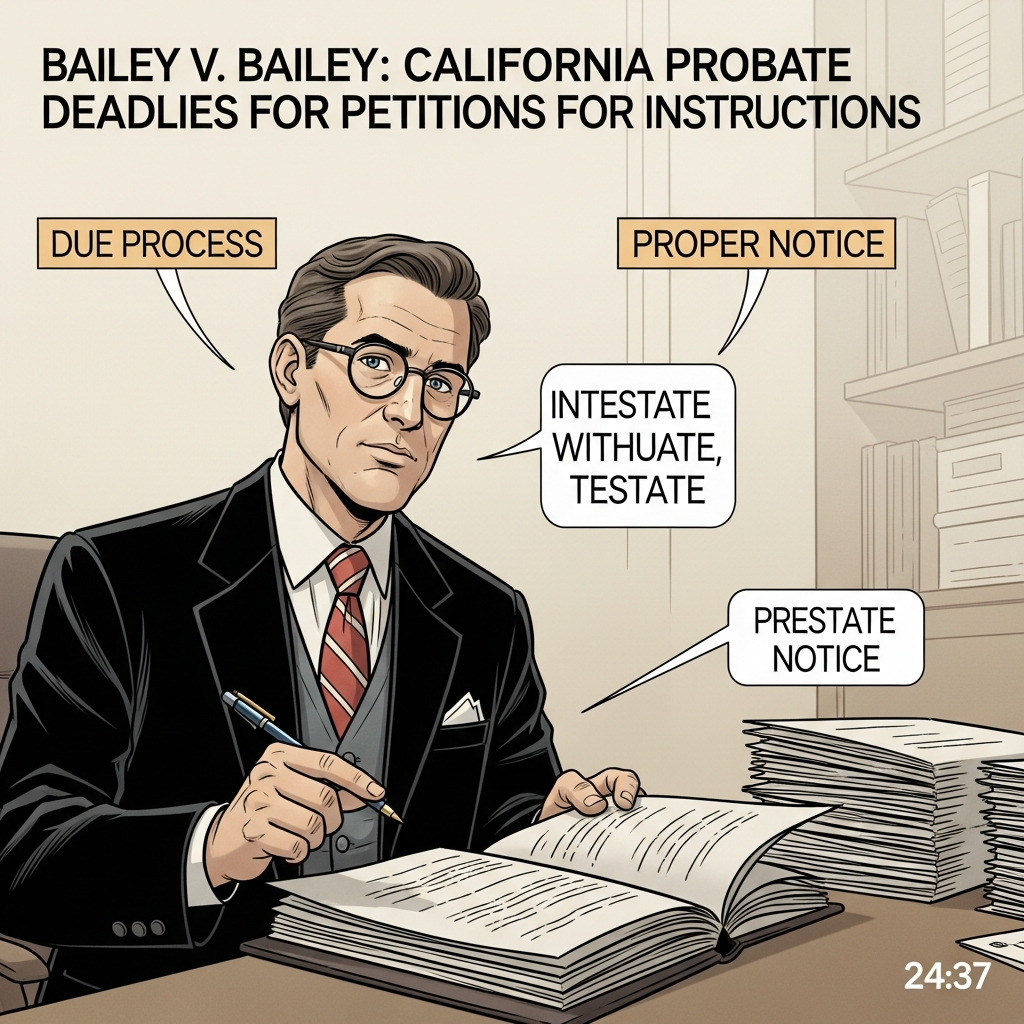
In the recent California appellate case of *Bailey v. Bailey* (B320664), the court addressed a critical issue regarding the timelines for probating a Will versus administering an estate without one (intestate). As detailed in the court opinion, the case serves as a stark reminder of the complexities inherent in the probate process and the strict requirements for due process in California courts. in California courts.

The dispute arose when a petitioner, George, filed to administer his brother’s estate alleging there was no Will (intestate). George later found a Will but only notified potential beneficiaries *after* the court had already granted him authority to administer the estate. When a beneficiary named Olan later attempted to probate the Will, another family member objected, claiming Olan had missed the statutory deadline under Probate Code section 8226(c)..

The appellate court ruled in favor of Olan, establishing that the strict time limits to petition for probate do not apply if the proponent of the Will did not receive pre-hearing notice of the initial competing petition. This decision highlights that efficient administration cannot supersede a beneficiary’s right to proper legal notice. For California families, this underscores the uncertainty and potential for litigation involved in probate, which can often be avoided through comprehensive estate planning. of the initial competing petition. This decision highlights that efficient administration cannot supersede a beneficiary’s right to proper legal notice. For California families, this underscores the uncertainty and potential for litigation involved in probate, which can often be avoided through comprehensive estate planning.

Understanding Probate Code Section 8226(c)

Generally, in California, a petition to probate a Will can be filed at any time. However, exceptions exist to ensure estates are settled in a reasonable timeframe. Probate Code section 8226(c) typically bars a proponent from filing a Will if they fail to do so within specific timeframes (60 to 120 days) after receiving notice of a competing petition. typically bars a proponent from filing a Will if they fail to do so within specific timeframes (60 to 120 days) after receiving notice of a competing petition.

The *Bailey* decision clarifies that this statutory clock does not start ticking unless the beneficiary receives notice *before* the initial probate hearing. The court emphasized that exceptions to the general rule permitting the probate of a Will must be strictly construed. This ensures that beneficiaries are not unfairly penalized for failing to act on proceedings they were not properly notified of in advance.

The Difference Between Intestate and Testate Succession

This case also illustrates the confusion that occurs when it is unclear if a decedent left a Will.
Intestate Succession: When someone dies without a Will, California law dictates who inherits the assets.
Testate Succession: When a valid Will exists, it directs the distribution of assets.: When a valid Will exists, it directs the distribution of assets.

In *Bailey*, the estate began as an intestate proceeding but shifted once a Will was discovered. This “stop-and-go” nature of probate can drain estate assets through legal fees and delay distribution to heirs.

Avoiding Probate Litigation with a Living Trust

The procedural hurdles seen in *Bailey v. Bailey*—filing deadlines, notice requirements, and appellate litigation—are unique to the probate court system. A comprehensive Revocable Living Trust is often the most effective tool for California residents to avoid these issues entirely. is often the most effective tool for California residents to avoid these issues entirely.

Unlike a Will, which must be admitted to probate court to be effective, a Trust is administered privately. This means:
No Court Hearings: There is no need to file petitions for instructions or wait for court dates.
Privacy: The details of the estate are not a matter of public record.
Immediate Authority: A Successor Trustee can usually step in immediately to manage assets, rather than waiting for “Letters of Administration.”: A Successor Trustee can usually step in immediately to manage assets, rather than waiting for “Letters of Administration.”

By utilizing a Trust, families can bypass the rigid statutory deadlines of the Probate Code and reduce the risk of the type of family litigation seen in the *Bailey* case.

About This Case

Source: Bailey v. Bailey: B320664

California Probate and Trust, PC Can Help

– Free consultations: (866)-674-1130
– Experienced California estate planning
Schedule consultation
– Learn more: cpt.law

Legal Disclaimer

This article is for informational purposes only. Consult with a qualified California estate planning attorney for advice specific to your situation.

Categories
California Probate News

Conservatorship of O.B. (2019): When Courts Uphold a Limited Conservatorship in California – California Legal Guide | CPT Law

California Legal Implications: Protecting Adults with Developmental Disabilities

In the case of *Conservatorship of O.B.*, the California Court of Appeal affirmed a trial court’s decision to establish a limited conservatorship for an adult with autism spectrum disorder, despite conflicting expert testimony regarding her ability to live independently. You can read the full opinion here. This case highlights the complex nature of legal guardianship for adults with special needs. For California families, understanding the threshold of evidence required to establish—or contest—a conservatorship is vital for ensuring the safety and well-being of vulnerable loved ones.. This case highlights the complex nature of legal guardianship for adults with special needs. For California families, understanding the threshold of evidence required to establish—or contest—a conservatorship is vital for ensuring the safety and well-being of vulnerable loved ones.

Understanding Limited Conservatorships in California

A limited conservatorship is a specific legal arrangement designed exclusively for adults with developmental disabilities. Unlike a general conservatorship, which is typically for elderly individuals suffering from cognitive decline, a limited conservatorship is intended to encourage maximum self-reliance. The conservator is granted only specific powers deemed necessary by the court, while the conservatee retains all other rights. is a specific legal arrangement designed exclusively for adults with developmental disabilities. Unlike a general conservatorship, which is typically for elderly individuals suffering from cognitive decline, a limited conservatorship is intended to encourage maximum self-reliance. The conservator is granted only specific powers deemed necessary by the court, while the conservatee retains all other rights.

In the *O.B.* case, the court had to weigh the desire for independence against the need for protection. This balance is central to California probate law. The court reviews specific powers, such as the authority to:
– Fix the conservatee’s place of residence
– Access confidential records
– Consent to or withhold medical treatment
– Enter into contracts
– Make educational decisions

The Role of Evidence and Capacity

One of the critical takeaways for families involved in estate planning and probate is the importance of substantial evidence. In this case, the mother (the petitioner) provided testimony that her daughter needed significant assistance with daily tasks and was susceptible to undue influence. Even though the conservatee presented experts who argued she could live independently, the court found the mother’s testimony, combined with reports from the Regional Center, sufficient to grant the conservatorship., sufficient to grant the conservatorship.

For families considering this path, it is crucial to document:
– Specific examples of inability to perform daily living tasks
– Instances of vulnerability to financial or social exploitation
– Medical and psychological evaluations confirming the developmental disability

Regional Center Assessments

In California, the proposed limited conservatee is usually assessed by a Regional Center. As seen in *Conservatorship of O.B.*, the report provided by the Regional Center carries significant weight in probate court. These reports help the judge determine which specific powers should be transferred to the conservator and which should remain with the individual.. As seen in *Conservatorship of O.B.*, the report provided by the Regional Center carries significant weight in probate court. These reports help the judge determine which specific powers should be transferred to the conservator and which should remain with the individual.

Burden of Proof and Appellate Review

The case clarifies a technical but vital legal standard. At the trial level, a judge must find by clear and convincing evidence that the conservatorship is necessary. However, if that decision is appealed, the higher court only looks for substantial evidence to support the original ruling. This means that once a probate court makes a factual finding based on credible testimony—even if other witnesses disagreed—it is very difficult to overturn that decision on appeal. This underscores the necessity of having experienced legal representation during the initial petition and hearing process. to support the original ruling. This means that once a probate court makes a factual finding based on credible testimony—even if other witnesses disagreed—it is very difficult to overturn that decision on appeal. This underscores the necessity of having experienced legal representation during the initial petition and hearing process.

About This Case

Source: Conservatorship of O.B. (2019)

California Probate and Trust, PC Can Help

– Free consultations: (866)-674-1130
– Experienced California estate planning
Schedule consultation
– Learn more: cpt.law

Legal Disclaimer

This article is for informational purposes only. Consult with a qualified California estate planning attorney for advice specific to your situation.

Categories
News Trusts

Royals v. Lu (Elder Financial Abuse Attachment Limits) – California Legal Guide | CPT Law

California Legal Implications: Protecting Assets and Due Process in Elder Abuse Litigation

A recent California appellate court decision highlights the procedural strictness required when litigating financial elder abuse claims. In the case of *Royals v. Lu*, the court examined the limits of a plaintiff’s ability to freeze a defendant’s assets before a trial concludes. This ruling serves as a critical reminder for California families and estate administrators: while the law aggressively protects seniors, claims of abuse must still be supported by specific facts and concrete evidence, particularly when seeking a writ of attachment..

Read the full court opinion here..

The intersection of the Elder Abuse Act and California’s Attachment Law creates complex scenarios for those seeking to recover stolen assets. This case clarifies that while victims can seek to freeze assets to ensure recovery of stolen funds (compensatory damages), they cannot freeze assets to cover potential punishments (punitive damages) or statutory penalties before proving their case in court.) or statutory penalties before proving their case in court.

Understanding Pretrial Writs of Attachment

In many financial abuse cases, the biggest fear is that the wrongdoer will hide or spend the money before a judgment is reached. A writ of attachment is a powerful legal tool that allows a plaintiff to “attach” or freeze the defendant’s property at the beginning of a lawsuit to ensure funds are available to satisfy a future judgment. is a powerful legal tool that allows a plaintiff to “attach” or freeze the defendant’s property at the beginning of a lawsuit to ensure funds are available to satisfy a future judgment.

However, obtaining this writ is not automatic. The plaintiff must show the court that their claim has “probable validity.” In *Royals v. Lu*, the court established that this tool has specific limits:
* Compensatory Damages Only: You can only request to freeze amounts that represent actual financial loss.
* No Speculative Penalties: A plaintiff cannot include treble damages (triple damages often allowed in elder abuse cases), statutory penalties, or punitive damages in the attachment amount. These are considered punishment, not debt restitution, and cannot be secured prior to a trial verdict. (triple damages often allowed in elder abuse cases), statutory penalties, or punitive damages in the attachment amount. These are considered punishment, not debt restitution, and cannot be secured prior to a trial verdict.

The Burden of Proof and Specificity

One of the fatal flaws in the plaintiff’s case in *Royals v. Lu* was a lack of specific evidence. The plaintiff requested to freeze over $3 million but failed to explain exactly how that number was calculated, relying on a verified petition rather than facts within her personal knowledge.

For families and trustees involved in California estate disputes, this underscores the importance of:
* Detailed Accounting: Allegations of abuse must be backed by bank statements, transfer records, and precise calculations.
* Admissible Evidence: Courts require more than a general belief that money was stolen; they require a “definite amount” supported by evidence.
* Professional Legal Strategy: Navigating the Code of Civil Procedure requires an attorney who understands both the remedial nature of elder abuse laws and the procedural safeguards of attachment laws. requires an attorney who understands both the remedial nature of elder abuse laws and the procedural safeguards of attachment laws.

While California law provides robust remedies for the elderly—including attorney’s fees and enhanced damages—procedural due process remains a priority. Families suspecting abuse must work quickly to gather concrete proof to utilize tools like writs of attachment effectively.

About This Case

Source: Royals v. Lu (Elder Financial Abuse Attachment Limits)

California Probate and Trust, PC Can Help

– Free consultations: (866)-674-1130
– Experienced California estate planning
Schedule consultation
– Learn more: cpt.law

Legal Disclaimer

This article is for informational purposes only. Consult with a qualified California estate planning attorney for advice specific to your situation.

Categories
News

Estate of El Wardani (Personal Representative Residency Requirement) – California Legal Guide | CPT Law

California Legal Implications: Residency Requirements for Estate Administrators

A recent California appellate court ruling has clarified strict residency requirements for individuals serving as the administrator of a deceased person’s estate. In the case of *Estate of El Wardani*, the court determined that a Personal Representative must actually reside in the United States to serve. The court ruled that having “contacts” with the U.S.—such as maintaining bank accounts, voting, seeing doctors, or holding a driver’s license—is not sufficient if the individual physically lives in another country. must actually reside in the United States to serve. The court ruled that having “contacts” with the U.S.—such as maintaining bank accounts, voting, seeing doctors, or holding a driver’s license—is not sufficient if the individual physically lives in another country.

You can read the full court opinion here..

This ruling has significant implications for California families, particularly those with relatives living abroad. It emphasizes the need for careful selection of fiduciaries during the estate planning process.

Understanding the Residency Rule

Under California law, the court appoints a personal representative (also known as an administrator or executor) to manage the assets, pay debts, and distribute the property of someone who has passed away. The *El Wardani* decision reinforces that this individual must generally be a resident of the United States.

In this specific case, the administrator lived in Mexico but argued she was a U.S. resident because she planned to return after the probate case concluded and maintained significant ties to California. The court rejected this, focusing on “actual residence.” Because she lived in Mexico full-time during the administration, she was disqualified.

The Importance of Selecting a Qualified Fiduciary

When creating a Last Will and Testament or a Living Trust, one of the most critical decisions is selecting the person who will manage your affairs. This case serves as a warning against appointing individuals who live outside of the United States to serve as court-appointed administrators., one of the most critical decisions is selecting the person who will manage your affairs. This case serves as a warning against appointing individuals who live outside of the United States to serve as court-appointed administrators.

If your chosen executor is disqualified due to residency, it can lead to:
Legal Delays: The probate process stops while the court determines eligibility.
Family Conflict: As seen in *El Wardani*, family members may object to the appointment, leading to litigation.
Court-Appointed Strangers: If no family member qualifies, the court may appoint a professional fiduciary instead of a loved one.: If no family member qualifies, the court may appoint a professional fiduciary instead of a loved one.

Trust Administration vs. Probate Administration

While the *El Wardani* case specifically addressed a court-supervised probate administration, similar logistical and legal challenges apply to Trust Administration. Even if a Trust document allows for a non-resident Trustee, practical difficulties often arise. Non-resident trustees may face hurdles with:
– Bonding requirements (insurance to protect the estate).
– Opening U.S. bank accounts for the Trust.
– Managing real estate and physical assets remotely.
– Navigating complex international tax implications.. Even if a Trust document allows for a non-resident Trustee, practical difficulties often arise. Non-resident trustees may face hurdles with:
– Bonding requirements (insurance to protect the estate).
– Opening U.S. bank accounts for the Trust.
– Managing real estate and physical assets remotely.
– Navigating complex international tax implications.

Strategic Estate Planning Solutions

To avoid the complications of the residency requirement, California residents should work with an estate planning attorney to:
1. Establish a Revocable Living Trust: This can often avoid the strict court supervision of probate.
2. Appoint Local Fiduciaries: Name a primary or successor trustee who resides in the United States.
3. Use Professional Fiduciaries: If all family members live abroad, a professional licensed in California can be named to ensure the estate is administered correctly and legally.: If all family members live abroad, a professional licensed in California can be named to ensure the estate is administered correctly and legally.

About This Case

Source: Estate of El Wardani (Personal Representative Residency Requirement)

California Probate and Trust, PC Can Help

– Free consultations: (866)-674-1130
– Experienced California estate planning
Schedule consultation
– Learn more: cpt.law

Legal Disclaimer

This article is for informational purposes only. Consult with a qualified California estate planning attorney for advice specific to your situation.
Categories
News Trusts

White v. Davis (EARO vs Anti-SLAPP Timing) – California Legal Guide | CPT Law

California Legal Implications: Prioritizing Elder Protection Over Procedural Delays

In the recent California appellate case White v. Davis, the court addressed a critical conflict between the urgent need for Elder Abuse Restraining Orders (EARO) and procedural tactics used to delay them. The court ruled that while defendants attempted to use an anti-SLAPP motion to strike down the restraining order request, the trial court abused its discretion by delaying the hearing on the elder’s safety. This decision underscores that the immediate protection of a senior against financial abuse and undue influence takes precedence over complex procedural maneuvers in California probate litigation. takes precedence over complex procedural maneuvers in California probate litigation.

The Role of Elder Abuse Restraining Orders

In California, an EARO is a specific legal tool designed to offer immediate protection to seniors (age 65+) who are suffering from physical, mental, or financial abuse. In the context of estate planning, this often arises when a bad actor isolates an elder to coerce them into changing their trust or will..

In *White v. Davis*, a trustee sought an EARO to prevent the settlor’s second wife and her associates from isolating the settlor and forcing changes to his estate plan. The appellate court emphasized that because these orders are designed to stop immediate harm, hearings regarding them should not be unnecessarily delayed.

Anti-SLAPP Motions in Probate Disputes

An anti-SLAPP motion (Strategic Lawsuit Against Public Participation) is a legal filing intended to dismiss lawsuits that threaten free speech or petitioning rights. However, in contentious trust disputes, defendants sometimes use these motions to stall proceedings. (Strategic Lawsuit Against Public Participation) is a legal filing intended to dismiss lawsuits that threaten free speech or petitioning rights. However, in contentious trust disputes, defendants sometimes use these motions to stall proceedings.

In this case, the defendants argued that their attempts to change the estate plan were “protected activities” involving litigation, and therefore the EARO was an illegal attack on their rights. The court rejected this, clarifying a vital point for California estate planners: estate planning is not a protected activity under the anti-SLAPP statute. The actions taken to isolate and confuse the elder were evidence of abuse, not protected speech. under the anti-SLAPP statute. The actions taken to isolate and confuse the elder were evidence of abuse, not protected speech.

The Danger of Automatic Stays

One of the most significant aspects of this ruling involves the “automatic stay.” Generally, when a party appeals a denial of an anti-SLAPP motion, the underlying case is paused (stayed) until the appeal is resolved.

The appellate court found that the trial court erred by waiting to hear the EARO until after the anti-SLAPP motion was decided. By doing so, the court left the elder vulnerable to continued abuse during the lengthy appeal process. The ruling clarifies that trial courts have the case management power—and the duty—to ensure that requests for protective orders are heard concurrently or prioritized to prevent ongoing harm to the senior.

Understanding Probate Code Section 1471

The decision also touched upon Probate Code section 1471, which governs when a court must appoint independent legal counsel for a ward or conservatee. The court clarified that an application for an EARO does not automatically trigger the mandatory appointment of independent counsel under this specific code section, as EARO proceedings are not among the five specific types of proceedings enumerated in the statute., which governs when a court must appoint independent legal counsel for a ward or conservatee. The court clarified that an application for an EARO does not automatically trigger the mandatory appointment of independent counsel under this specific code section, as EARO proceedings are not among the five specific types of proceedings enumerated in the statute.

About This Case

Source: White v. Davis (EARO vs Anti-SLAPP Timing)

California Probate and Trust, PC Can Help

If you suspect a loved one is being subjected to undue influence or financial abuse regarding their estate plan, immediate legal action may be necessary. We specialize in protecting seniors and preserving the integrity of trusts and estates.

– Free consultations: (866)-674-1130
– Experienced California estate planning
Schedule consultation
– Learn more: cpt.law

Legal Disclaimer

This article is for informational purposes only. Consult with a qualified California estate planning attorney for advice specific to your situation.

Categories
News

Estate of Douglas (Nunc Pro Tunc Fix to Renewed Judgment) – California Legal Guide | CPT Law

Correcting Clerical Errors in California Estate Judgments: Understanding Nunc Pro Tunc

California Legal Implications: Ensuring Accuracy in Estate Litigation

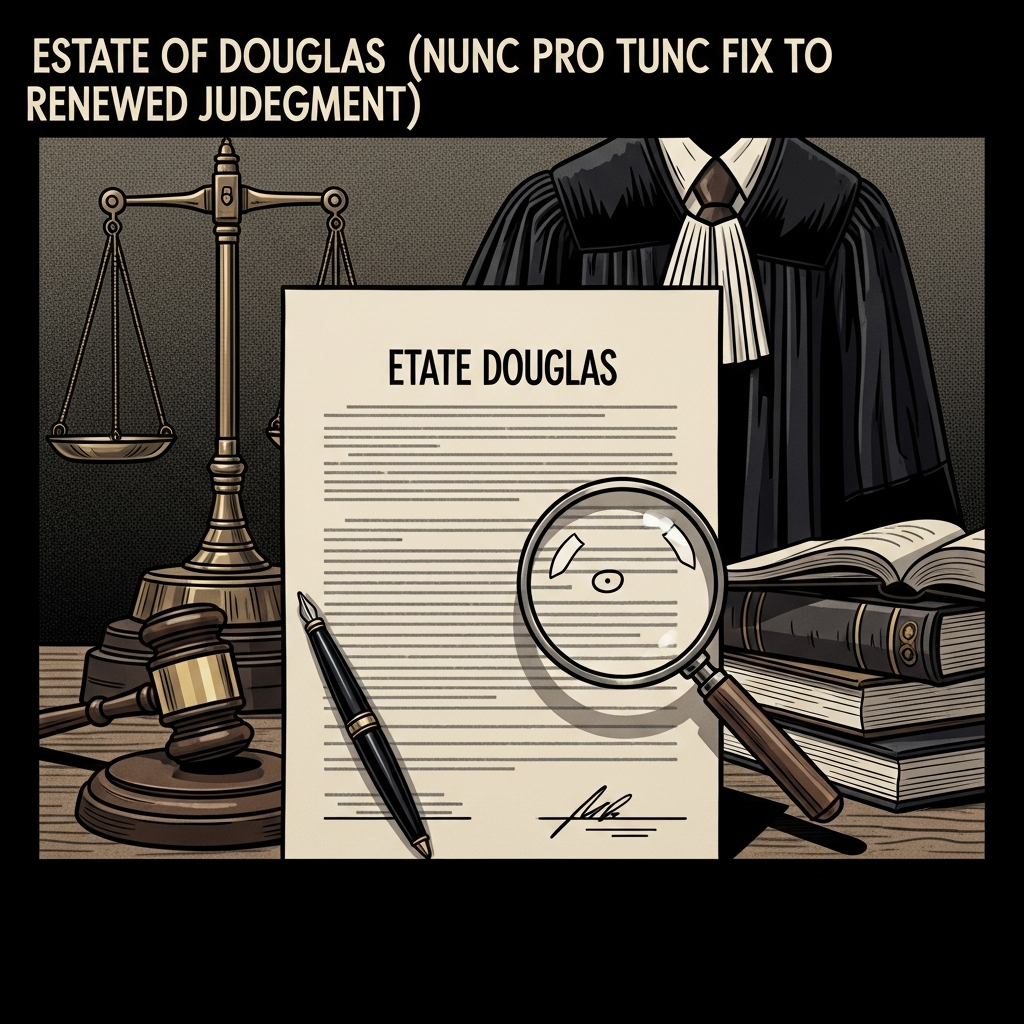
A recent California appellate decision highlights the importance of precision when handling legal documents during probate and the court’s power to correct mistakes years later. In the *Estate of Douglas*, a court utilized a legal doctrine known as Nunc Pro Tunc to correct a renewed judgment that inadvertently omitted the representative capacity of an estate administrator. You can read the summary of the case here..

For California families and trustees, this case serves as a critical reminder of two things: the distinction between an individual and their role as a Personal Representative, and the ability of the courts to fix clerical errors to ensure the record reflects the truth. to ensure the record reflects the truth.

The Importance of Representative Capacity

In California probate law, an individual appointed to manage a deceased person’s affairs—whether an Executor named in a Will or an Administrator appointed by the court—acts in a “representative capacity.” appointed by the court—acts in a “representative capacity.”

This distinction is vital for liability purposes. When a judgment is entered against someone in their capacity as an Administrator, the liability generally attaches to the assets of the Decedent’s Estate, not the administrator’s personal bank accounts or property., not the administrator’s personal bank accounts or property.

In the *Estate of Douglas*, the original judgment correctly identified the debtor as the administrator of the estate. However, when the law firm renewed the judgment years later (a standard procedure to keep a debt enforceable), they accidentally left out the title “Administrator.” This clerical oversight potentially created confusion regarding who actually owed the money—the individual or the estate.

Clerical Errors vs. Judicial Errors

The core dispute in this case was whether the mistake could be fixed retroactively. California law distinguishes between two types of errors:

1. Clerical Error: This is a mistake in recording or entering a judgment that does not involve judicial reasoning. It is often a typo, an omission by a clerk, or a drafting mistake where the document does not match the court’s actual intent.
2. Judicial Error: This involves a judge’s reasoning or decision-making process. If a judge makes a legal mistake in their ruling, it is generally considered a judicial error.: This involves a judge’s reasoning or decision-making process. If a judge makes a legal mistake in their ruling, it is generally considered a judicial error.

The distinction matters because clerical errors can often be corrected at any time, while judicial errors usually must be challenged through a specific appeal process within a short timeframe. usually must be challenged through a specific appeal process within a short timeframe.

What is Nunc Pro Tunc?

The court corrected the judgment Nunc Pro Tunc, a Latin phrase meaning “now for then.” This legal power allows a court to treat a correction as if it had been made on the original date of the document., a Latin phrase meaning “now for then.” This legal power allows a court to treat a correction as if it had been made on the original date of the document.

Because the appellate court agreed that omitting the “Administrator” title was merely a clerical mistake—and not a new legal decision—they allowed the correction to apply retroactively. This ensured the renewed judgment matched the original judgment, preserving the creditor’s claim against the estate rather than the individual.

Key Takeaways for Trustees and Beneficiaries

For those involved in California Estate Administration, this case illustrates why attention to detail is paramount. When signing documents or facing litigation, clearly stating one’s capacity (e.g., “Jane Doe, Trustee of the Doe Family Trust”) protects personal assets and ensures clarity in the legal record. However, if a genuine mistake occurs in the paperwork, experienced legal counsel can help petition the court to set the record straight., this case illustrates why attention to detail is paramount. When signing documents or facing litigation, clearly stating one’s capacity (e.g., “Jane Doe, Trustee of the Doe Family Trust”) protects personal assets and ensures clarity in the legal record. However, if a genuine mistake occurs in the paperwork, experienced legal counsel can help petition the court to set the record straight.

About This Case

Source: Estate of Douglas (Nunc Pro Tunc Fix to Renewed Judgment)

California Probate and Trust, PC Can Help

– Free consultations: (866)-674-1130
– Experienced California estate planning
Schedule consultation
– Learn more: cpt.law

Legal Disclaimer

This article is for informational purposes only. Consult with a qualified California estate planning attorney for advice specific to your situation.
Categories
News Trusts

Diaz v. Zuniga: Trust Amendment Rules in California and Why Following the Trust’s Method Matters – California Legal Guide | CPT Law

California Legal Implications: The Importance of Following Trust Amendment Procedures

A recent decision by the California Court of Appeal, *Diaz v. Zuniga*, serves as a critical warning for anyone with a Revocable Living Trust. The court ruled that a trust amendment was invalid because the person creating the trust (the settlor) failed to follow the specific modification method outlined in the original trust document.) failed to follow the specific modification method outlined in the original trust document.

While the settlor clearly intended to change who would inherit his assets, his failure to strictly adhere to the technical requirements—specifically, sending the amendment via certified mail—caused the amendment to fail. For California families, this highlights a vital estate planning principle: intent alone is often insufficient; legal formalities must be strictly observed.

The “Closet Amendment” and Strict Compliance

In this case, the settlor executed a document to amend the dispositive provisions of his revocable trust. After signing the document, he placed it in a container within his closet. After he passed away, the co-trustees discovered the document and petitioned the court to determine if it was a valid amendment. discovered the document and petitioned the court to determine if it was a valid amendment.

The original trust instrument contained a very specific requirement: to be valid, any amendment had to be delivered to the trustee by certified mail. Since the settlor was serving as his own trustee, this meant he was technically required to mail the amendment to himself. Because he simply placed the document in a closet rather than following the “certified mail” provision, the trial court and the appellate court both ruled the amendment invalid.

Probate Code Section 15401 vs. Specific Trust Terms

This case touches on a complex area of California law involving the conflict between statutory amendment methods and specific methods written into a trust. generally, California Probate Code Section 15401 provides a standard method for revoking or modifying a trust. However, when a trust document explicitly states a method for modification, that specific method can trump the general statutory rules. provides a standard method for revoking or modifying a trust. However, when a trust document explicitly states a method for modification, that specific method can trump the general statutory rules.

The court in *Diaz* determined that because the trust set forth a specific procedure, failing to follow that procedure meant the amendment was void. This decision aligns with the principle that a trustor’s intent regarding *how* the trust is managed is just as important as their intent regarding *who* gets the assets. By establishing a formal method (certified mail), the settlor essentially set up a safeguard to prevent casual or unfinalized changes from taking effect. regarding *how* the trust is managed is just as important as their intent regarding *who* gets the assets. By establishing a formal method (certified mail), the settlor essentially set up a safeguard to prevent casual or unfinalized changes from taking effect.

Why Professional Legal Guidance is Essential

This ruling emphasizes the dangers of “Do-It-Yourself” estate planning or attempting to make changes to your trust without legal counsel. The settlor in this case likely believed that writing down his new wishes was enough. However, by failing to consult an attorney who would have reviewed the original trust’s procedural requirements, his final wishes were ultimately ignored by the court.

To ensure your estate plan works exactly as intended, it is crucial to review the modification provisions of your existing trust before attempting any changes. A qualified estate planning attorney ensures that not only are the documents drafted correctly, but that all procedural formalities—such as notarization, delivery, and witnessing—are strictly followed. ensures that not only are the documents drafted correctly, but that all procedural formalities—such as notarization, delivery, and witnessing—are strictly followed.

About This Case

Source: Diaz v. Zuniga: Trust Amendment Rules in California and Why Following the Trust’s Method Matters

California Probate and Trust, PC Can Help

– Free consultations: (866)-674-1130
– Experienced California estate planning
Schedule consultation
– Learn more: cpt.law

– Free consultations: (866)-674-1130
– Experienced California estate planning
Schedule consultation
– Learn more: cpt.law

Legal Disclaimer

This article is for informational purposes only. Consult with a qualified California estate planning attorney for advice specific to your situation.
Categories
News Trusts

Colvis v. Binswanger: Who Has Standing to Object in a California Trust Proceeding? – California Legal Guide | CPT Law

California Legal Implications: Standing to Object in Trust Litigation

A recent decision by the California Court of Appeal has clarified an essential procedural question in estate litigation: who is allowed to participate in court proceedings concerning a trust? While many assume that trust disputes are strictly between family members and trustees, the ruling in *Colvis v. Binswanger* expands the scope of who may voice objections.

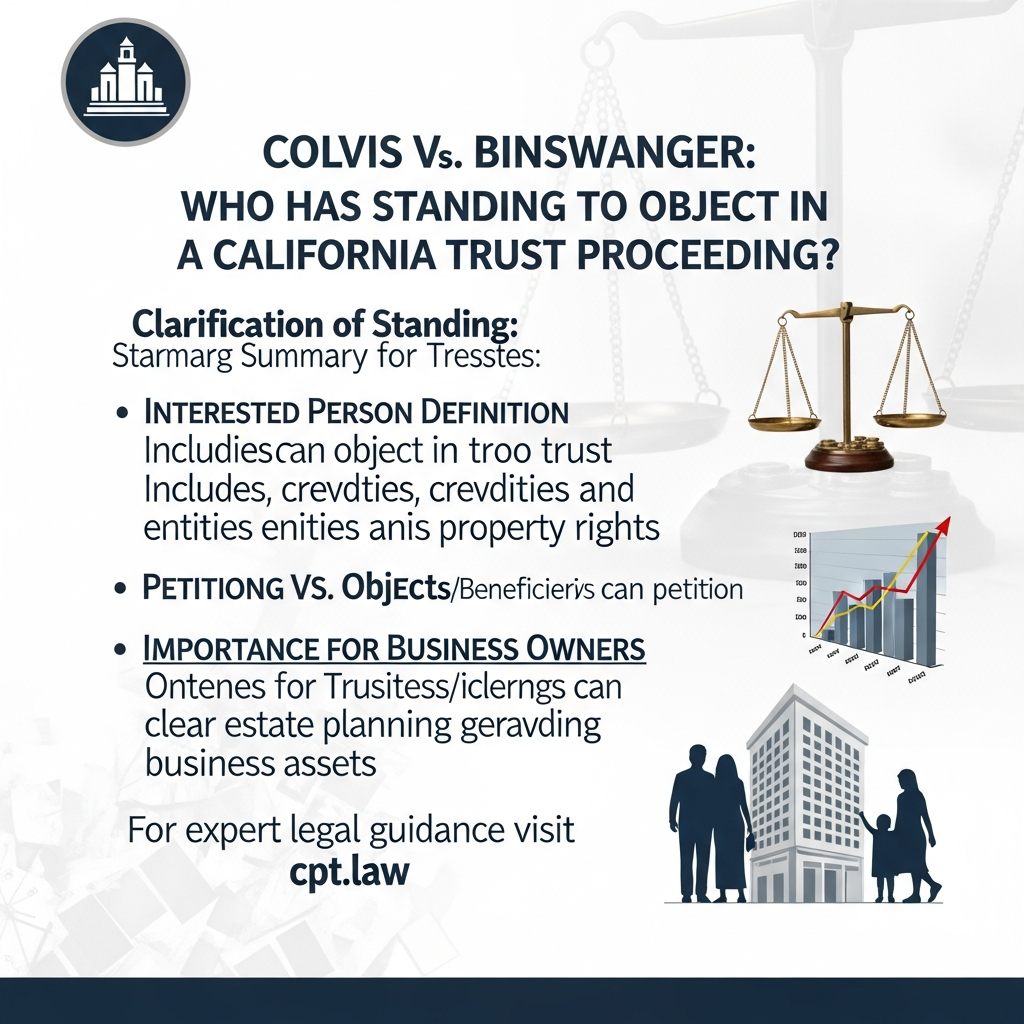
According to the summary from Sheppard Mullin, the court determined that an “interested person”—such as a business entity held by a trust—has standing to object to petitions that affect its property rights, even if that entity is not a named beneficiary or trustee. For California families and business owners, this highlights the complex intersection between estate planning and corporate governance. and corporate governance.

Who is an “Interested Person” Under California Law?

In the context of probate and trust administration, standing refers to the legal right to initiate a lawsuit or participate in court proceedings. California law typically restricts the ability to *file* a petition for court instructions to the trustee or a beneficiary. However, responding to a petition is a different matter.. However, responding to a petition is a different matter.

Under California Probate Code section 48, the definition of an interested person is broad. It can include:
– An heir, devisee, child, or spouse
– A creditor
– A beneficiary
– Any other person having a property right in or claim against a trust estate is broad. It can include:
– An heir, devisee, child, or spouse
– A creditor
– A beneficiary
– Any other person having a property right in or claim against a trust estate

In the *Colvis* case, the court ruled that a company partially owned by the trust had the right to object when beneficiaries tried to force the company to borrow money to pay estate taxes. This establishes that if a trust proceeding threatens the financial health or assets of a third party (like a family business), that party may have the legal right to intervene.

The Difference Between Petitioning and Objecting

For those navigating trust administration, it is vital to understand the procedural difference highlighted by this case:, it is vital to understand the procedural difference highlighted by this case:

1. Petitioning the Court: Generally, only those directly named in the trust (the trustee and beneficiaries) can ask the court for instructions regarding the internal affairs of the trust.
2. Objecting or Responding: The class of people who can *defend* their interests is much larger. If a beneficiary asks the court to take an action that would harm a business or a creditor, that “interested person” has standing to appear in court and object. to appear in court and object.

Planning for Business Assets in Trusts

This legal development is particularly relevant for Californians who hold business interests within their Revocable Living Trust. When a trust owns a significant portion of a company, the line between fiduciary duties and corporate governance can blur. and corporate governance can blur.

To avoid costly litigation similar to *Colvis v. Binswanger*, estate plans should clearly define:
– The trustee’s authority regarding business assets.
– How estate taxes should be apportioned without jeopardizing the viability of family businesses.
– Whether the trust grants specific powers to the trustee to intervene in corporate management. to intervene in corporate management.

About This Case

Source: Colvis v. Binswanger: Who Has Standing to Object in a California Trust Proceeding?

California Probate and Trust, PC Can Help

– Free consultations: (866)-674-1130
– Experienced California estate planning
Schedule consultation
– Learn more: cpt.law

Legal Disclaimer

This article is for informational purposes only. Consult with a qualified California estate planning attorney for advice specific to your situation.

Categories
News Trusts

Dunlap v. Mayer: When a Beneficiary’s Estate Can Demand a Trust Accounting (California) – California Legal Guide | CPT Law

California Legal Implications: Beneficiary Rights After Death

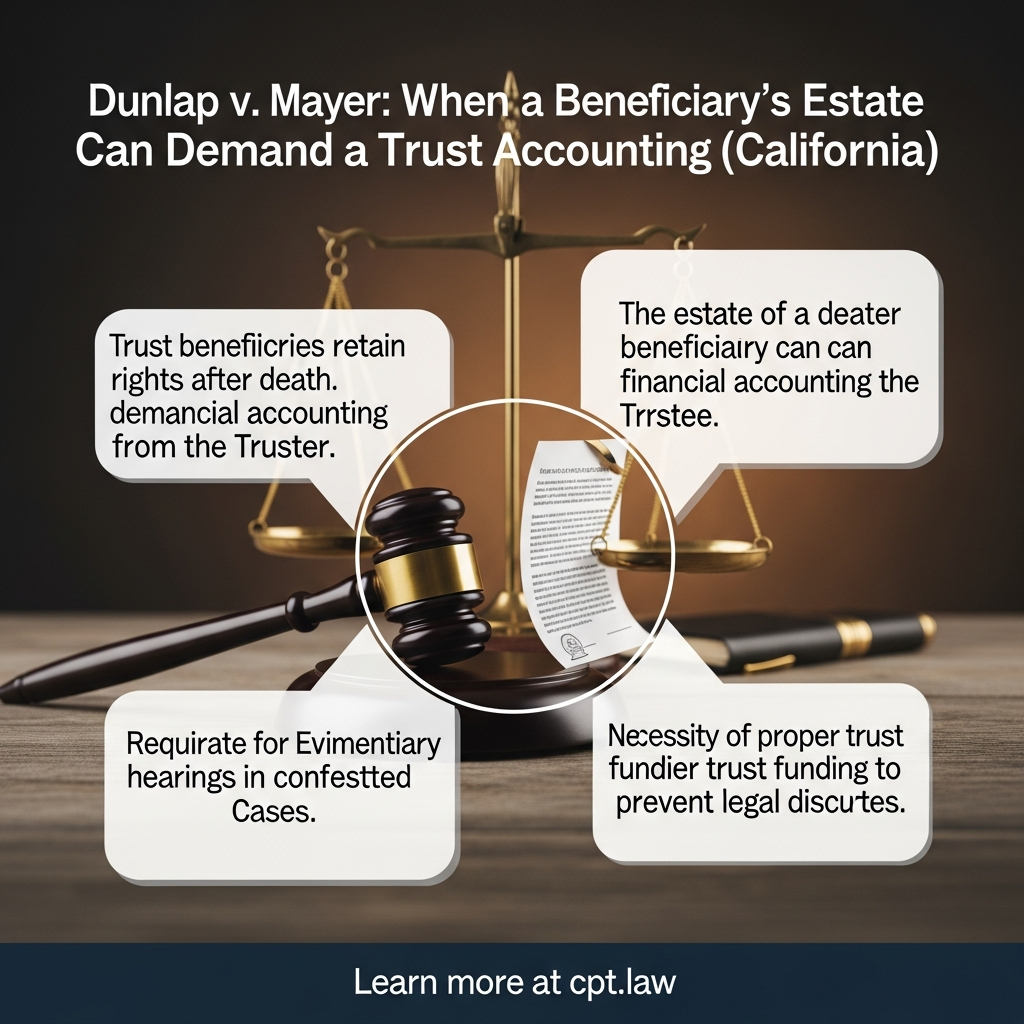
In the complex world of California estate planning, the rights of a trust beneficiary do not necessarily end when that beneficiary passes away. A recent legal development, Dunlap v. Mayer, highlights a critical protection for families: the estate of a deceased beneficiary has standing to demand a financial accounting from a trustee. to demand a financial accounting from a trustee.

In this specific case, a dispute arose regarding a Marital Trust established after a husband’s death. His widow was the sole income beneficiary, and his daughter served as the trustee. After the widow passed away, her estate requested a trust accounting to ensure she had received what she was owed during her lifetime. The daughter (trustee) argued the trust was never funded and the underlying businesses were defunct, leading the lower court to dismiss the request without a full hearing. The appellate court reversed this decision, affirming that the widow’s estate had the legal right to demand answers and that disputed facts require an evidentiary hearing..

For California families, this underscores the importance of proper trust administration and the enduring nature of fiduciary duties. and the enduring nature of fiduciary duties.

Understanding Standing to Request an Accounting

Under the California Probate Code, a trustee is generally required to keep beneficiaries reasonably informed about the trust and its administration. This includes providing an accounting, which is a detailed report of the trust’s assets, liabilities, income, and disbursements., which is a detailed report of the trust’s assets, liabilities, income, and disbursements.

The *Dunlap* case clarifies that if a beneficiary was entitled to an accounting while alive, that right acts as a property interest that passes to their own estate upon death. This ensures that a trustee cannot run out the clock; they remain accountable for their actions during the beneficiary’s lifetime, even after that beneficiary has died.

The Necessity of Evidentiary Hearings

One of the key takeaways from this ruling is the protection of due process in probate court. The trial court initially dismissed the petition based on the trustee’s unverified claims that the trust was empty. The appellate court ruled that when there are contested issues of fact—such as whether a trust was funded or if assets existed—a court cannot simply dismiss the case based on one party’s word. in probate court. The trial court initially dismissed the petition based on the trustee’s unverified claims that the trust was empty. The appellate court ruled that when there are contested issues of fact—such as whether a trust was funded or if assets existed—a court cannot simply dismiss the case based on one party’s word.

Instead, an evidentiary hearing is required. This is a legal proceeding where:
– Witnesses may be called.
– Documents are reviewed.
Discovery (the exchange of information) is allowed to proceed. (the exchange of information) is allowed to proceed.

This prevents trustees from evading their fiduciary duties simply by claiming a trust has no assets without providing proof. simply by claiming a trust has no assets without providing proof.

The Importance of Proper Trust Funding

This case also serves as a cautionary tale regarding trust funding. The dispute arose partly because the trustee claimed the trust was never funded with the business assets as originally intended. To avoid costly litigation like *Dunlap v. Mayer*, it is essential that:
– Assets are formally retitled into the name of the trust.
– Trustees maintain accurate, contemporaneous records.
– Beneficiaries are kept informed throughout the life of the trust.. The dispute arose partly because the trustee claimed the trust was never funded with the business assets as originally intended. To avoid costly litigation like *Dunlap v. Mayer*, it is essential that:
– Assets are formally retitled into the name of the trust.
– Trustees maintain accurate, contemporaneous records.
– Beneficiaries are kept informed throughout the life of the trust.

When a trust is properly funded and administered, it reduces the likelihood of confusion and suspicion among heirs, preserving family relationships and estate assets.

About This Case

Source: Dunlap v. Mayer: When a Beneficiary’s Estate Can Demand a Trust Accounting

California Probate and Trust, PC Can Help

– Free consultations: (866)-674-1130
– Experienced California estate planning
Schedule consultation
– Learn more: cpt.law

Legal Disclaimer

This article is for informational purposes only. Consult with a qualified California estate planning attorney for advice specific to your situation.