Categories
California Probate Estate Planning

When Is a Conservatorship Necessary in California? A Guide for Families Protecting Loved Ones


If you are a California adult child helping an aging parent, a spouse managing a sudden medical crisis, or a family trying to protect a loved one with declining capacity, the word “conservatorship” can feel overwhelming.

This article explains when a California conservatorship is truly necessary, when less restrictive alternatives are often better, and what the court process looks like in real life. Background source: California Conservatorship Practice (CEB).

Quick answer: key takeaways for California families

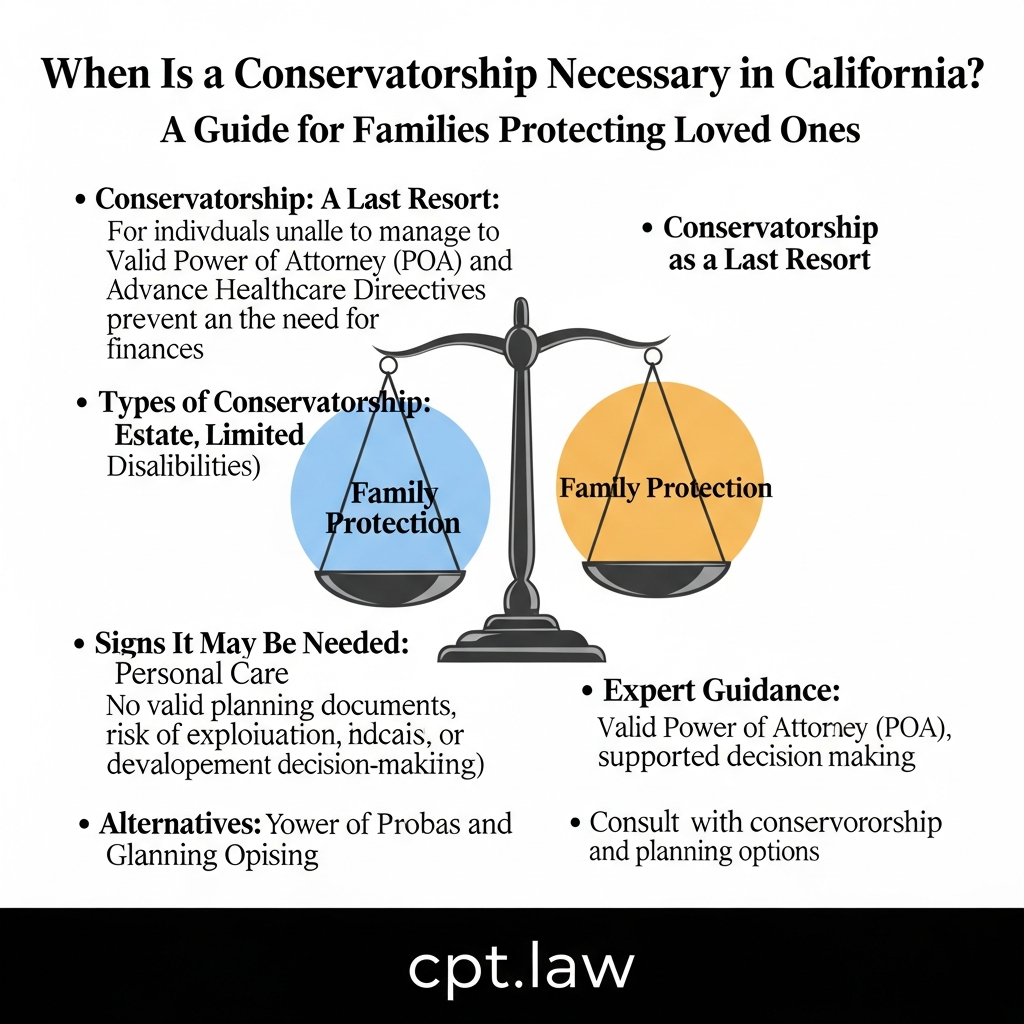
  • A conservatorship is usually a last resort when a person cannot safely manage healthcare or finances and there is no workable alternative.
  • If valid planning documents exist (durable power of attorney, advance healthcare directive, properly funded living trust), conservatorship may be avoidable.
  • California has different types of conservatorship, including conservatorship of the person, conservatorship of the estate, and limited conservatorship for some adults with developmental disabilities.
  • The process is court-supervised and takes time, and it can involve an investigation, medical capacity evidence, notice to relatives, and ongoing reporting.
  • Talk to a lawyer sooner rather than later if there is elder abuse risk, family conflict, missing documents, or urgent medical or financial decisions.
  • What is a conservatorship in California?

    A conservatorship is a court-supervised arrangement where a judge appoints a conservator to make decisions for another adult (the conservatee) who cannot manage their personal care or finances.

    In most family situations, the court is stepping in because there is not already a legally valid, trusted decision-maker in place.

    Common types of California conservatorship

  • Conservatorship of the person
  • Conservatorship of the estate
  • Limited conservatorship
  • When is a conservatorship actually necessary?

    A conservatorship may be necessary when the person cannot understand or make decisions in a way that keeps them safe, and no less restrictive option can realistically protect them.

    Signs a conservatorship may be the right tool

  • No valid planning documents exist (or they are outdated, incomplete, or unusable).
  • Banks, healthcare providers, or institutions will not accept the family’s informal authority.
  • There is serious vulnerability to exploitation (scams, coercion, undue influence, or caregiver theft).
  • The person is self-neglecting and refusing essential help.
  • There is family conflict over care or finances, and a judge’s supervision is needed.
  • There is a rapid decline (dementia, stroke, traumatic brain injury) and urgent decisions must be made.
  • When conservatorship is often avoidable

    Conservatorship is often avoidable when the person previously completed:

  • A durable power of attorney that authorizes financial decisions.
  • An advance healthcare directive with a clear healthcare agent.
  • A revocable living trust that is properly funded, with a successor trustee who can step in.
  • If these documents exist and are being honored, court intervention may add cost and stress without adding meaningful protection.

    Real-world mini-scenarios (California-focused)

    Scenario 1: an aging parent with dementia and no POA

    A Sacramento parent with progressing dementia starts wiring money to scammers and stops paying property taxes. There is no durable power of attorney, and the parent refuses help.

  • Why conservatorship may be necessary: there may be no legal way to stop financial harm or manage essential bills without court authority.
  • Scenario 2: a disabled adult child turning 18

    A San Diego family has an adult child with developmental disabilities who needs help managing medical appointments and benefits.

  • Why limited conservatorship might fit: it can be scoped to specific decision areas, preserving autonomy where possible.
  • Scenario 3: spouse after a stroke with a valid estate plan

    A spouse in Los Angeles has a stroke. Years earlier, the couple signed a comprehensive POA and healthcare directive, and their home is in a funded living trust.

  • Why conservatorship may not be needed: the named agents and successor trustee may already have the legal authority to act.
  • Alternatives to conservatorship (what to consider first)

    Is a conservatorship needed in California? a practical decision guide for families

    If a loved one cannot manage health, safety, or finances, many California families eventually hear one intimidating word: conservatorship. The decision is stressful because it usually comes during a crisis.

    This page is based on the topic and source link provided.Source: California Conservatorship Practice – CEB

    Quick answer: when conservatorship is most likely

    A conservatorship is more likely when:

  • There is no valid power of attorney.
  • There is no advance health care directive.
  • There is active financial exploitation or serious safety risk.
  • Family members disagree and a neutral, court-supervised structure is needed.
  • If valid planning documents exist and institutions accept them, families may be able to avoid court.

    Who this is for

    This is for:

    Disclaimer

    Disclaimer

    This article is for general informational and educational purposes only and is not legal, tax, or financial advice. Laws can change, and how they apply to your situation may vary based on your specific facts. Reading this article does not create an attorney–client relationship with California Probate and Trust, PC or any of its attorneys. You should consult directly with a qualified attorney licensed in your jurisdiction before making decisions about your own case or estate plan.

    Using a valid POA for finances.

    Supported decision-making or less restrictive supports.

    4) If court is necessary, expect supervision and ongoing duties

  • Conservatorships can involve:
  • A petition and notice to relatives.
  • Investigator involvement.
  • Ongoing reporting and accountings.
  • Common mistakes that increase cost and conflict

    Waiting until capacity is already gone to sign documents.

    Using generic forms that banks or providers reject.

  • Failing to coordinate trust funding with the plan.
  • FAQ

    How long does a California conservatorship take?

    It depends on urgency, county backlog, and whether the matter is contested.

    Can a trust prevent conservatorship?

    A trust can help with asset management if funded, but it does not automatically solve health care decision issues.

    What if siblings disagree?

    Disputes are common. Early legal guidance can reduce escalation.

    Call to action: get a clear plan and reduce court involvement when possible

    California Probate and Trust, PC helps California families understand conservatorship options and, when appropriate, set up planning that reduces the chance loved ones will need court supervision later.

    Schedule a consultation at cpt.law.
    Categories
    Estate Planning

    5 Types of Wills in California: What They Are and When Each One Makes Sense

    If you are a California resident trying to protect your family, a will can feel like the first “must-do” step. It often is, but many people are surprised to learn that there are different kinds of wills, and that a will alone may not avoid probate.

    This guide is written for California individuals and families who want a clear, practical explanation of will options, what each type does, and when it may or may not fit. It was inspired by a summary resource here: 5 Wills – California Estate Planning – CEB.

    Quick answer: key takeaways

  • A will controls who receives probate assets and who manages the estate, but it usually does not avoid probate in California.
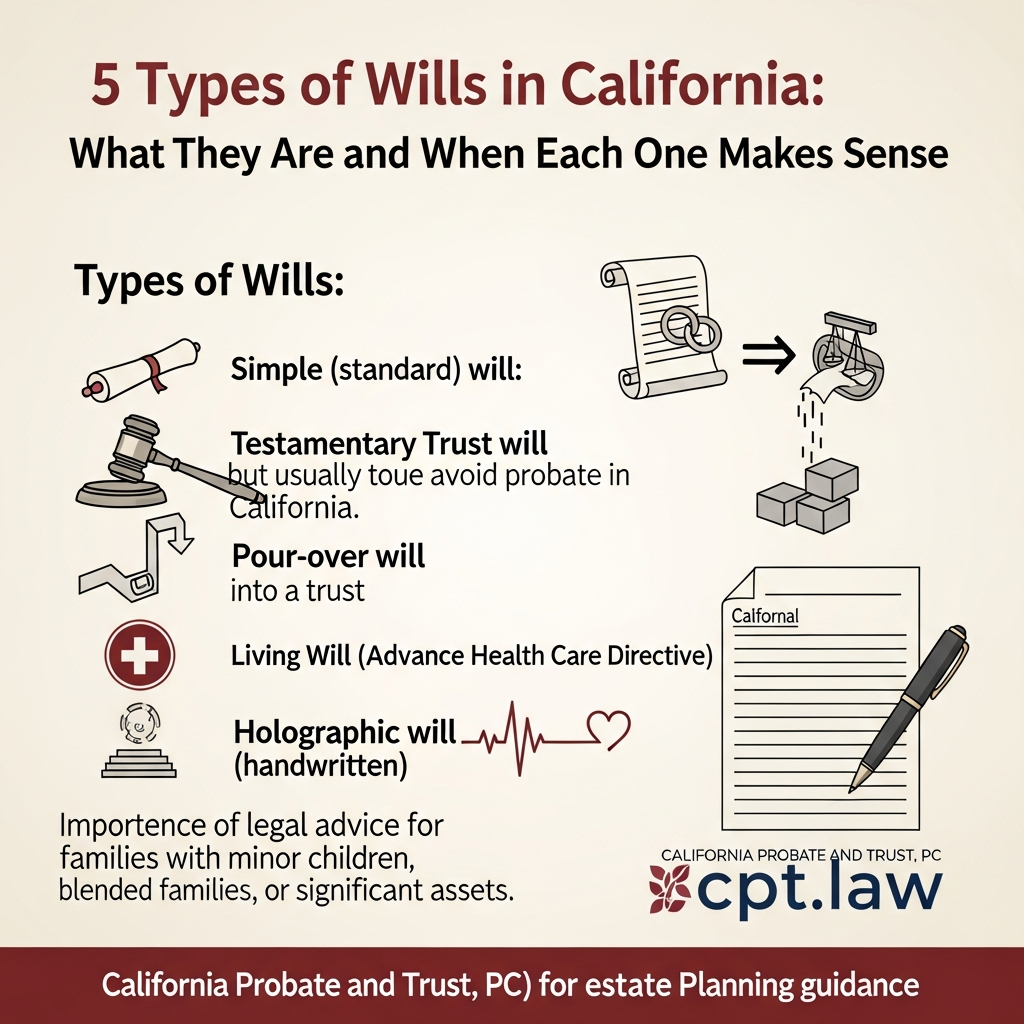
  • The five common “will types” people hear about are:
  • Many California households use a revocable living trust + pour-over will to reduce probate exposure, especially when real estate is involved.
  • If you have minor children, a blended family, a special needs beneficiary, or significant assets, it is worth getting legal advice before signing documents.
  • Who this is for (and what problem it solves)

    This is for:

  • California parents who want to name guardians and reduce conflict.
  • Adults caring for aging parents who need a plan for incapacity and end-of-life decisions.
  • Homeowners concerned about California probate delays and costs.
  • It solves a common problem: people know they “need a will,” but they are not sure what kind, what it actually does in California, or how it fits with trusts, beneficiary designations, and powers of attorney.

    First: what a California will does (and does not do)

    In plain language, a will generally does these things:

  • Names who receives property that passes through the probate estate.
  • Names an executor (personal representative) to manage probate.
  • Can nominate guardians for minor children.
  • A will generally does not do these things:

  • Avoid probate by itself.
  • Control assets that pass by contract or beneficiary designation, such as many retirement accounts, life insurance, or payable-on-death accounts.
  • Control property already titled in a trust.
  • A realistic scenario

    A Sacramento parent signs a simple will leaving everything “to my children equally.” Later, the parent buys a home and keeps it in their individual name. At death, the home may trigger a probate case even though the will is clear. The will helps direct distribution, but it does not prevent the court process.

    1) Simple (standard) will

    A simple will is the most common document people think of.

    When it can make sense

  • You need to name an executor.
  • You want straightforward distribution instructions.
  • You want to nominate guardians for minor children.
  • Common mistakes

  • Assuming the will avoids probate.
  • Forgetting to update the will after major events.
  • California-specific practical note

    Even a well-drafted will often requires probate for California real estate held in an individual name. Many families choose to add a trust-based plan to reduce probate exposure.

    2) Testamentary trust will

    A testamentary trust is a trust created inside the will that begins at death.

    When it can make sense

  • You want assets held in trust for a minor child until a certain age.
  • You want protective controls for a beneficiary who needs structure (for example, someone with spending challenges).
  • What to watch for

  • Because it is created at death, it commonly still requires probate to “activate” and fund the trust.
  • If a beneficiary has special needs or receives means-tested benefits, this is an area where drafting details matter.
  • 3) Pour-over will

    A pour-over will works alongside a revocable living trust. It generally says: if any assets are left outside the trust at death, they “pour over” into the trust.

    When it can make sense

  • You have a revocable living trust (or you are creating one).
  • You want a backstop in case an asset was not retitled into the trust.
  • Important limitation

    A pour-over will is not a guarantee that probate will be avoided. If a significant asset is outside the trust at death, probate may still be required to move it into the trust.

    Why people still use it

    It is often part of a clean, coordinated estate plan. It helps align “leftover” probate assets with the trust’s distribution instructions.

    4) Living will (Advance Health Care Directive)

    In California, what many people call a “living will” is usually an Advance Health Care Directive. It is about medical decisions, not who inherits property.

    What it typically covers

  • Who can make health care decisions if you cannot.
  • End-of-life preferences.
  • HIPAA access and communication authority (often paired with separate authorizations).
  • Why it matters

    Without incapacity documents, families can face delays, conflict, or court involvement during a crisis.

    5) Holographic will (handwritten will)

    A holographic will is generally a will written and signed by the person making the will.

    When it might happen

  • Emergency situations.
  • Someone writes down last-minute instructions without formal drafting.
  • Risks

  • Ambiguous wording can lead to litigation.
  • Missing details can create probate problems.
  • It is easier for others to challenge capacity or authenticity.
  • If you have a handwritten will, it is often wise to have a California attorney review whether it is likely to be accepted and whether it matches your current goals.

    How to choose the right approach in California

    A will can be the right starting point, but most people benefit from looking at the bigger system.

    Step-by-step checklist

  • List your assets and how they are titled.
  • Identify “high-risk for probate” assets.
  • Decide what you need the plan to do.
  • Add incapacity planning.
  • Coordinate beneficiary designations with the plan.
  • When you should talk to a California probate or estate planning attorney

    Consider legal guidance if any of these apply:

  • You own California real estate.
  • You have minor children or want to nominate guardians.
  • You are in a second marriage or blended family.
  • A beneficiary has special needs or is vulnerable to undue influence.
  • You want to minimize the risk of probate disputes.
  • California Probate and Trust, PC focuses on California estate planning, trust administration, and probate. A clear plan can reduce stress for the people you care about and make sure documents work together.

    FAQs

    What is the best type of will in California?

    There is not one “best” type for everyone. Many Californians use a simple will for basic planning, or a pour-over will as part of a revocable living trust plan when probate avoidance is a priority.

    Does a will avoid probate in California?

    Usually not. A will often governs probate, but it typically does not prevent it. Probate avoidance often requires trust planning, proper asset titling, and coordinated beneficiary designations.

    What happens if I die without a will in California?

    California intestacy rules can determine who inherits, and a probate case is often required. The result may not match what you would have chosen, especially in blended families.

    Can I write my own will in California?

    Some people do, including handwritten (holographic) wills. The risk is that unclear language or improper execution can cause delay, expense, or disputes. Even if you draft your own, it is often worth a legal review.

    Do I still need a will if I have a living trust?

    Often yes. A pour-over will is commonly used as a backup to move remaining probate assets into the trust and to cover items not otherwise addressed.

    Call to action

    If you are trying to decide what kind of will makes sense, or whether a will is enough for your situation, consider getting advice before signing documents. California Probate and Trust, PC can help you build an estate plan that fits your family, your assets, and California rules, and can guide you through trust planning, probate prevention strategies, and long-term peace of mind.

    Categories
    California Probate News

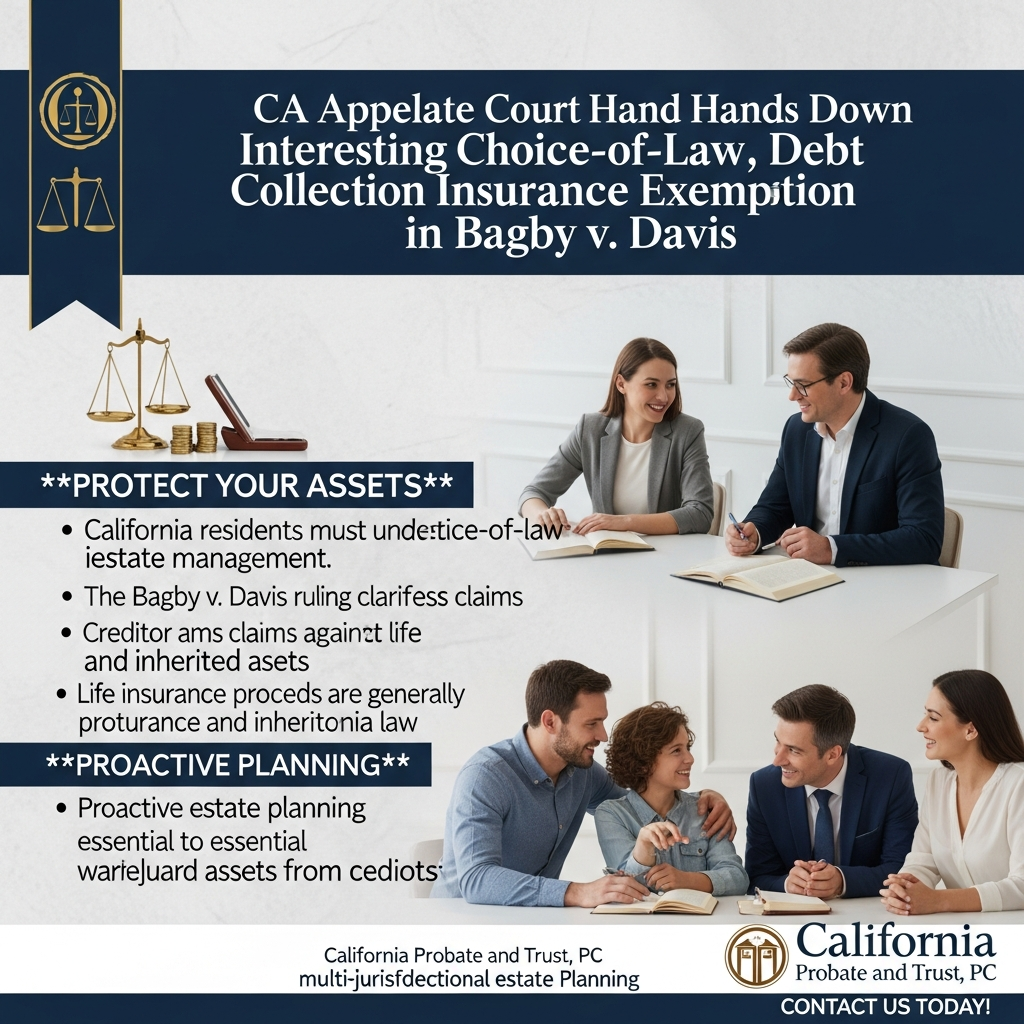
    CA Appellate Court Hands Down Interesting Choice-of-Law, Debt Collection Insurance Exemption Rulings in Bagby v. Davis – CEB Articles

    Understanding the Bagby v. Davis Ruling: What California Residents Need to Know About Choice-of-Law and Debt Collection Insurance Exemptions

    If you’re a California resident managing assets, dealing with estate administration, or navigating debt collection issues tied to inherited property, a recent California appellate court decision has significant implications for how state laws interact in financial disputes. The case of Bagby v. Davis addresses complex choice-of-law questions and debt collection insurance exemptions that can directly affect how creditors pursue claims against estates and beneficiaries.

    Source: CEB Research – CA Appellate Court Hands Down Interesting Choice-of-Law, Debt Collection Insurance Exemption Rulings in Bagby v. Davis

    Who This Ruling Affects

    This decision is particularly relevant for:

  • California residents managing out-of-state assets or debts who need to understand which state’s laws apply to their financial obligations
  • Estate administrators and trustees dealing with creditor claims against inherited property
  • Beneficiaries of life insurance policies concerned about whether their inheritance can be seized to satisfy debts
  • Families navigating probate who want to protect assets from creditor claims while ensuring legal compliance
  • What Is Choice-of-Law and Why Does It Matter?

    Choice-of-law refers to the legal principles that determine which state’s laws apply when a dispute involves multiple jurisdictions. This becomes critical in estate planning and probate because:

  • California residents often own property or have financial accounts in multiple states
  • Creditors may attempt to apply the laws of states with more favorable debt collection rules
  • Insurance policies, trusts, and other financial instruments may be governed by different state laws
  • The outcome of a dispute can vary dramatically depending on which state’s laws control
  • In Bagby v. Davis, the court had to determine whether California law or another state’s law would govern the debt collection attempt, particularly regarding insurance exemptions that protect beneficiaries from creditor claims.

    Key Questions This Case Answers

    Can creditors reach life insurance proceeds to satisfy debts?

    California law provides strong protections for life insurance beneficiaries. Under California Code of Civil Procedure § 704.100, life insurance proceeds paid to a beneficiary are generally exempt from creditor claims. However, when debt collection involves multiple states, creditors may argue that another state’s less protective laws should apply.

    The Bagby v. Davis ruling clarifies when California’s protective exemptions will prevail over other states’ laws, providing crucial guidance for estate planning attorneys and families concerned about asset protection.

    How do I protect inherited assets from creditor claims?

    This decision reinforces several protective strategies:

  • Proper beneficiary designations: Life insurance and retirement accounts with named beneficiaries generally pass outside of probate and receive exemption protections
  • Understanding jurisdictional issues: Working with attorneys who understand multi-state asset protection is essential for California residents with complex estates
  • Proactive estate planning: Establishing trusts and other protective structures before debt collection issues arise provides stronger defense against creditor claims
  • Practical Implications for California Families

    Real-World Scenario: Imagine a California resident passes away with outstanding medical debt. The deceased had a life insurance policy with their adult children as beneficiaries. Under California law, those life insurance proceeds would typically be protected from the medical creditors. However, if the creditor is based in another state or if the insurance policy was issued in a state with different exemption rules, the creditor might argue that the other state’s laws should apply—potentially allowing them to claim the insurance money.

    The Bagby v. Davis decision provides clarity on when California’s protective exemptions will be upheld, giving families more certainty about which assets are truly protected.

    How California Probate and Trust, PC Can Help

    At California Probate and Trust, PC, we understand that navigating the intersection of estate planning, probate, and creditor protection requires both legal expertise and compassionate guidance. Our firm specializes in:

  • Multi-jurisdictional estate planning: Protecting California residents with assets in multiple states from complex choice-of-law issues
  • Creditor protection strategies: Implementing legal structures that maximize exemptions and protect family wealth
  • Probate administration: Defending estates against improper creditor claims while ensuring legitimate debts are properly handled
  • Trust administration: Managing inherited assets in ways that preserve protections under California law
  • Our approach prioritizes transparency and family protection—we explain complex legal concepts in plain language and develop comprehensive strategies that address both current legal challenges and future estate planning needs.

    Why This Ruling Matters for Your Estate Plan

    The Bagby v. Davis decision demonstrates why proactive estate planning is essential. Key takeaways include:

  • California’s protective laws are valuable: But only if your estate plan is properly structured to take advantage of them
  • Multi-state issues create complexity: That requires specialized knowledge to navigate effectively
  • Timing matters: Asset protection strategies implemented before creditor issues arise are far more effective than reactive measures
  • Professional guidance is crucial: The interplay between state laws, federal regulations, and specific financial instruments requires experienced legal counsel
  • Take Action to Protect Your Family’s Future

    If you’re a California resident concerned about protecting your assets from creditor claims, managing an estate with multi-state complications, or ensuring your beneficiaries receive their full inheritance, the attorneys at California Probate and Trust, PC can provide the experienced guidance you need.

    Contact us today to schedule a consultation: (866) 674-1130

    Our team will review your specific situation, explain how recent legal developments like Bagby v. Davis affect your estate, and develop a comprehensive plan that protects your family for generations to come. We serve clients throughout California from our offices in Fair Oaks, Sacramento, and San Francisco.

    Learn more: cpt.law

    Legal Disclaimer

    This article is provided for informational purposes only and does not constitute legal advice. The information contained herein is based on California law as of the publication date and may not reflect the most current legal developments. Every estate planning and probate situation is unique, and the application of legal principles depends on specific facts and circumstances. Nothing in this article creates an attorney-client relationship. For advice regarding your specific legal situation, please consult with a qualified California estate planning attorney. California Probate and Trust, PC makes no representations or warranties regarding the accuracy or completeness of this information and assumes no liability for actions taken in reliance upon the content of this article.

    Categories
    Estate Planning Trusts

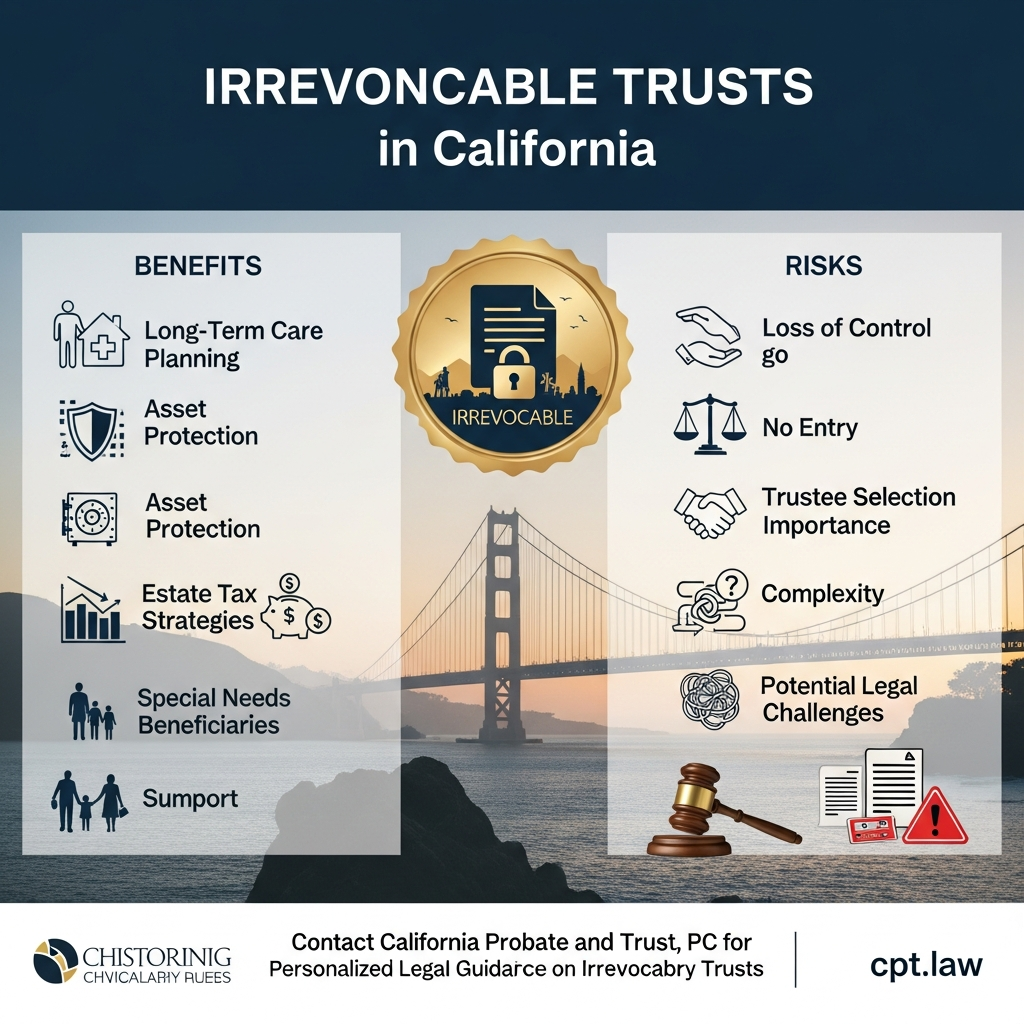
    Irrevocable Trusts in California: What They Are, When They Help, and the Risks to Know

    Irrevocable Trusts in California: What They Are, When They Help, and the Risks to Know

    If you are a California resident thinking about protecting a home, planning for long-term care, or leaving an inheritance without conflict, it is normal to feel overwhelmed by the number of “trust” options and the fear of making an irreversible mistake.

    This article is for California residents, trustees, and families who are weighing whether an irrevocable trust is the right tool, what it can and cannot do, and when it is time to talk to a lawyer before signing anything.

    For background context, see this overview source: 6A Irrevocable Trusts – California Estate Planning – CEB.

    Quick answer: key takeaways

  • An irrevocable trust is a trust that generally cannot be changed or revoked after it is created and funded.
  • In California, irrevocable trusts are often used for advanced planning goals like asset protection planning, certain tax strategies, and Medicaid (Medi-Cal) and long-term care planning.
  • The biggest “cost” of an irrevocable trust is loss of control. The person who creates the trust (the settlor) usually gives up direct ownership and the ability to freely change terms.
  • Many irrevocable trusts still allow limited flexibility through powers of appointment, trust protector provisions, decanting, and court petitions, but none of these are “easy undo buttons.”
  • If you own California real estate, have a blended family, anticipate long-term care needs, or are considering moving assets out of your name, get individualized legal advice before transferring anything.
  • What is an irrevocable trust? (Plain-English definition)

    An irrevocable trust is a legal arrangement where assets are transferred to a trust and managed by a trustee for the benefit of one or more beneficiaries, under terms that generally cannot be changed by the person who created it.

    Who is involved?

  • Settlor (or trustor or grantor): The person who creates the trust.
  • Trustee: The person or institution responsible for managing trust property under the trust terms.
  • Beneficiaries: The people (or charities) who can receive distributions from the trust.
  • What makes it “irrevocable”?

    In most cases, once the trust is signed and funded, the settlor cannot:

  • Take the assets back.
  • Change who benefits.
  • Change the distribution rules.
  • There are exceptions and workarounds in some situations, but they depend on the document’s language, consent requirements, court involvement, and the specific kind of irrevocable trust.

    Why Californians use irrevocable trusts

    Irrevocable trusts are not the default for most families. A revocable living trust is usually the “standard” probate-avoidance tool.

    Irrevocable trusts are typically used when the goal is something a revocable trust cannot do well, such as moving assets out of the settlor’s estate or protecting assets from certain risks.

    1. Long-term care planning and Medi-Cal concerns

    A common scenario is an older California homeowner who:

  • Owns a home with significant equity.
  • Is worried about long-term care costs.
  • Wants to avoid forcing adult children to sell the home later.
  • Some irrevocable trust strategies can be used in long-term care planning, but the rules are highly fact-specific. Transfers can have waiting periods and consequences. The “right” approach depends on income, assets, health, and timing.

    2. Asset protection planning (in the real world)

    People sometimes consider irrevocable trusts when they worry about:

  • Future lawsuits.
  • Creditor claims.
  • High-risk professions.
  • Business liabilities.
  • California has rules and public policy limits around fraudulent transfers and creditor rights. An “asset protection trust” that is done too late or done incorrectly can fail and can also create additional problems.

    3. Estate tax and advanced family wealth planning

    For higher net worth families, irrevocable trusts may support:

  • Gifting strategies.
  • Using federal exemptions.
  • Removing growth of assets from a taxable estate.
  • Even when taxes are part of the plan, California-specific property issues, community property, and real estate transfer details matter.

    4. Protecting a beneficiary (special needs, addiction, or creditor risk)

    An irrevocable trust can help protect a beneficiary who:

  • Receives needs-based benefits.
  • Struggles with money management.
  • Is in a high-conflict family situation.
  • Has a creditor, divorce, or lawsuit risk.
  • In these cases, the “irrevocable” structure can be a feature, not a bug, because it limits impulsive changes and reduces pressure on the family.

    What an irrevocable trust does not do (common misconceptions)

    It is not a guaranteed way to “avoid probate” by itself

    Probate avoidance depends on proper titling and beneficiary designations. If you do not actually transfer the asset into the trust, the trust may not help.

    It is not a guaranteed shield from creditors

    Creditor protection depends on the timing of transfers, the type of trust, who is a beneficiary, and whether the transfer is considered fraudulent.

    It does not automatically eliminate taxes

    Trust tax rules are complex. Some irrevocable trusts are taxed at compressed trust tax brackets. Some are “grantor trusts” where the settlor pays the tax. Tax results depend on structure.

    What assets can be put into an irrevocable trust in California?

    It depends on the trust purpose and your overall plan, but commonly:

  • California real estate (home, rental property).
  • Investment accounts.
  • Business interests (LLC membership interests, shares).
  • Life insurance (often via specialized irrevocable life insurance trusts).
  • Cash.
  • Special caution: California real estate

    Transferring California real estate may trigger:

  • Property tax reassessment considerations.
  • Due-on-sale clause issues for certain loans.
  • Title insurance and lender requirements.
  • Transfer tax and recording details.
  • This is a major reason families should not “DIY” trust funding for real estate.

    How irrevocable trusts work day to day

    The practical experience of an irrevocable trust usually comes down to two questions:

  • Who controls decisions as trustee?
  • How and when can beneficiaries receive money?
  • A realistic mini-scenario

    Imagine a San Diego parent who owns a condo and has an adult child who is financially responsible but recently married. The parent wants the condo’s value to help the child long-term, but does not want the condo exposed to a future divorce.

    An irrevocable trust might be designed so that:

  • The trust owns the condo.
  • The trustee can sell and reinvest.
  • Distributions are allowed for health, education, maintenance, and support, or other standards.
  • The child does not have an outright ownership interest that is easily divided.
  • Whether this works depends on careful drafting and consistent administration.

    Risks and downsides of irrevocable trusts

    1. Loss of control

    Once assets are transferred, the settlor cannot usually use them like personal property. That is the point, and it is also the biggest downside.

    2. Trustee selection can make or break the plan

    A trustee has duties and significant authority. If you choose the wrong trustee, the trust may:

  • Create family conflict.
  • Be poorly administered.
  • Trigger unnecessary legal fights.
  • 3. Irrevocable does not always mean “simple”

    Irrevocable trusts often require:

  • Separate tax reporting.
  • Investment management.
  • Recordkeeping.
  • Clear distribution policies.
  • 4. The plan can backfire if the trust is not funded correctly

    If assets are left outside the trust, the family might still face:

    Categories
    Estate Planning News

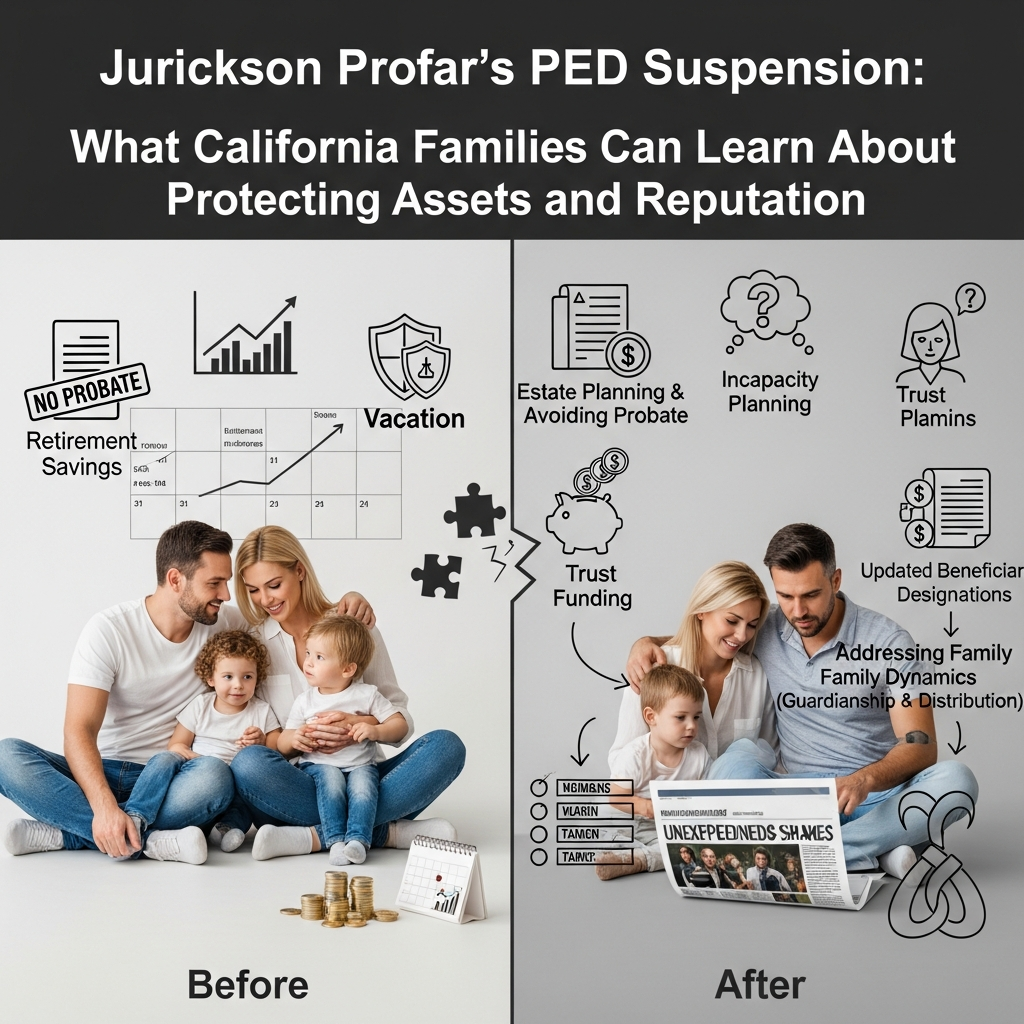
    Jurickson Profar’s PED Suspension: What California Families Can Learn About Protecting Assets and Reputation

    Jurickson Profar’s PED Suspension: What California Families Can Learn About Protecting Assets and Reputation

    If you are a California resident managing a family’s finances, supporting aging parents, or building long-term wealth, public news about a professional athlete can feel far removed from your life. But stories like Jurickson Profar reportedly facing a 162-game MLB suspension for a second performance-enhancing drug (PED) violation can be a useful reminder of something many families learn the hard way: one major event can quickly change income, contracts, and long-term plans — and if your legal and financial documents are not in order, the fallout can land on the people you care about most.

    This article uses the news report as a hook and explains the estate planning and probate takeaways for Californians. Source: Yahoo Sports report on the reported 162-game suspension and related consequences.

    Quick answer: Key takeaways for Californians

  • A sudden career interruption can mean a sudden income shock, and income shocks often expose gaps in estate plans.
  • If you own a home in California, your plan should focus on probate avoidance and clear control over the property.
  • Incapacity planning is not just for older adults. A medical crisis or career crisis can make it hard to manage finances or make decisions.
  • Trust funding and updated beneficiary designations can prevent delays, disputes, and expensive court involvement.
  • If you have children, dependents, or a blended family, guardianship and distribution planning should be reviewed regularly.
  • What happened in the Profar news story, and why it matters as a “life planning” example

    According to the reporting, Jurickson Profar is facing a 162-game suspension after a second positive PED test, with related consequences that include lost eligibility and significant financial impact, including forfeiture of salary under league rules and contract structure.

    Most Californians are not professional athletes. But many people do experience “sudden change” events that can feel just as disruptive:

  • A job loss or business downturn
  • A major lawsuit or contract dispute
  • A sudden disability or serious illness
  • A divorce or separation
  • An unexpected death in the family
  • From a probate and estate planning perspective, the important lesson is not the sports details. The lesson is that your plan should assume life can change quickly, and it should build in safeguards so your family does not have to scramble.

    Who this is for

    This is for:

  • California homeowners who want to reduce the risk of probate delays
  • Adult children helping parents with finances or medical decisions
  • Parents of minor children or families with dependents
  • Trustees, executors, and beneficiaries trying to avoid conflict
  • Anyone with uneven income (commission, bonuses, business revenue) who wants a stable plan
  • If you are dealing with a serious conflict, a threatened lawsuit, a contested trust, or a high-value estate, it is usually better to speak with a California probate or trust attorney sooner rather than later.

    Why sudden income changes can create estate planning problems

    When income drops quickly, families often discover that their “paperwork plan” was really just a set of assumptions.

    Common planning gaps we see include:

  • No clear incapacity plan
  • Outdated beneficiary designations
  • Unfunded trust
  • No plan for a business interest
  • California probate basics: why the family home is often the biggest risk

    For many families, the largest asset is a California residence. If a home is titled in an individual name at death (and there is no other probate-avoidance path), the estate may require a California probate case.

    Probate can be time-consuming and stressful. It is also public. Even when everyone agrees, a court process can create delays that families are not prepared for.

    Practical checklist for California homeowners

  • Confirm how the home is titled (individual, joint, trust, LLC)
  • If you have a living trust, confirm the home deed is properly transferred to the trust
  • Review property tax implications before making major title changes
  • Make sure the “who gets the house” plan matches the real-world family situation
  • Incapacity planning: not just an “elder law” topic

    Many people assume incapacity planning is only for older adults. In reality, incapacity planning is about this question:

    If you could not communicate clearly for a period of time, who could pay bills, manage accounts, and make decisions?

    Key documents that often matter in California include:

  • Durable power of attorney for financial decisions
  • Advance health care directive for medical decisions
  • HIPAA authorization so loved ones can receive medical information
  • Mini-scenario (anonymized)

    A Bay Area parent in their 40s runs a small business. After an unexpected medical event, there is a short period where decision-making is limited. Without a durable power of attorney, business payments stall, payroll becomes stressful, and the family cannot easily access accounts. A properly drafted plan can reduce that disruption.

    Trust planning: what a living trust can and cannot do

    A California living trust is often used to:

  • Avoid probate for trust-owned assets
  • Provide continuity if the trust creator becomes incapacitated
  • Create clearer instructions for distribution
  • But a trust is not a magic document. It must be designed and maintained for your actual assets and goals.

    Funding matters

    If your trust exists, but key assets are still titled outside the trust, probate may still be required.

    Distribution and conflict prevention

    Trusts can also reduce family conflict by:

  • Creating a clear trustee structure
  • Setting expectations (for example, distribution timing)
  • Addressing blended family concerns
  • When to talk to a California probate and trust lawyer

    Consider getting legal advice if:

  • You own California real estate and do not have a fully funded trust
  • Your family situation has changed (marriage, divorce, new child, death)
  • You support a dependent or have a special needs planning issue
  • You are concerned about family conflict, undue influence, or capacity questions
  • You have a business interest or significant uneven income
  • California Probate and Trust, PC focuses on probate, trust administration, and estate planning for California residents. The goal is to help families reduce uncertainty, avoid unnecessary court involvement when possible, and build a plan that holds up when life changes.

    FAQ (California-focused)

    How can I avoid probate in California?

    Many families use a properly drafted and properly funded living trust to avoid probate for major assets. Beneficiary designations and certain types of joint ownership may also avoid probate, but each comes with tradeoffs.

    If I have a will, do I still need probate?

    Often, yes. A will can control who inherits, but it typically does not avoid the probate court process for assets titled in the person’s individual name at death.

    What is the best way to plan for sudden incapacity?

    A durable power of attorney, advance health care directive, and HIPAA authorization are common tools. The best approach depends on assets, family dynamics, and risk factors.

    Do I need to update my trust after a major life change?

    Usually, yes. Divorce, marriage, a new child, moving, buying a home, or changes in wealth are common triggers to review and update documents.

    What should trustees and executors do first after a death in California?

    Identify the assets, locate estate planning documents, secure real property, and get guidance on whether probate is required. Early decisions can affect timelines and costs.

    Call to Action (California Probate and Trust, PC)

    If you are feeling overwhelmed by planning, probate, or trust administration in California, you do not have to figure it out alone. California Probate and Trust, PC can help you understand your options, reduce stress, and put a clear plan in place to protect your family and assets.

    You can contact CPT through the consultation options on https://cpt.law, by phone, or through an online intake form.

    Disclaimer

    Disclaimer: This article is for general informational and educational purposes only and is not legal, tax, or financial advice. Laws can change, and how they apply to your situation may vary based on your specific facts. Reading this article does not create an attorney–client relationship with California Probate and Trust, PC or any of its attorneys. You should consult directly with a qualified attorney licensed in your jurisdiction before making decisions about your own case or estate plan.

    Categories
    Estate Planning Long Term Care Planning

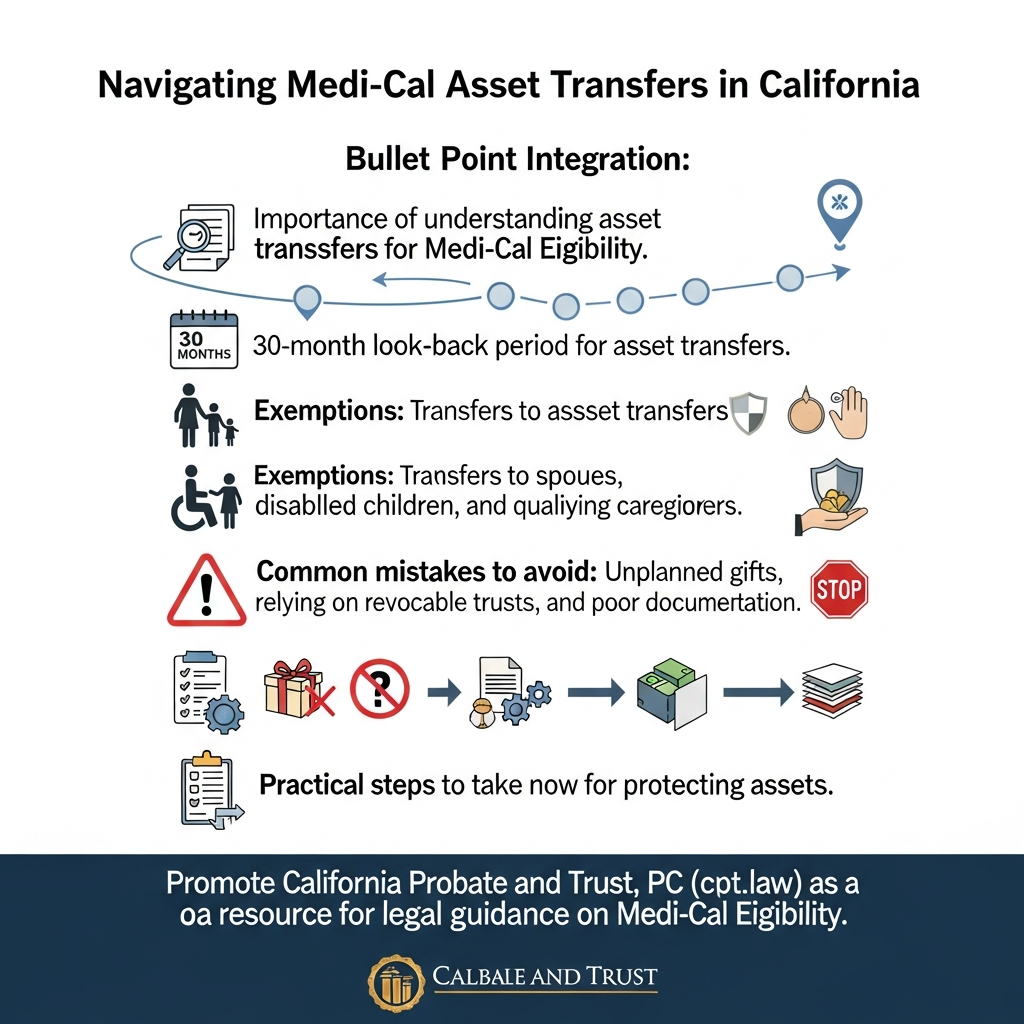
    DHCS Asset Transfer Guidance for Medi-Cal Long-Term Care in California

    DHCS Asset Transfer Guidance for Medi-Cal Long-Term Care in California

    If you or a loved one relies on Medi-Cal for long-term care coverage in California, it is important to understand how asset transfers can affect eligibility, especially with updated guidance from the California Department of Health Care Services (DHCS) expected in the near future.

    This article explains what that DHCS guidance likely means in practice, how California’s Medi-Cal transfer rules work, and what steps families can take now to avoid costly mistakes.

    Key takeaways

  • DHCS guidance may change how counties interpret and apply Medi-Cal asset transfer penalties.
  • Medi-Cal for long-term care generally reviews transfers made in the prior 30 months.
  • Certain transfers can be exempt, including transfers to a spouse and some transfers to a disabled child or qualifying caregiver child.
  • Planning early usually creates more options than planning during a health crisis.
  • If long-term care may be needed soon, speak with a California attorney before gifting assets or transferring real estate.
  • Who this is for

    This is written for:

  • California seniors planning for future long-term care.
  • Adult children helping a parent protect a home and savings.
  • Family members serving as caregivers, trustees, or agents under a power of attorney.
  • If there is an urgent need for nursing home care, or if transfers have already occurred, it is often best to get legal advice quickly. Mistakes in timing and documentation can trigger months of ineligibility.

    What DHCS guidance means in real life

    DHCS administers Medi-Cal and provides direction to counties that process applications. When DHCS updates guidance, the most common effects are practical rather than theoretical.

    For example, updated guidance can:

  • Clarify how the penalty period is calculated.
  • Tighten documentation requirements for exemptions.
  • Reduce inconsistent decision-making from county to county.
  • Change how pending applications, appeals, or cure strategies are evaluated.
  • Even if the underlying law does not change, guidance can influence how rules are applied day to day.

    How Medi-Cal asset transfers work in California

    The 30-month look-back period

    For Medi-Cal long-term care benefits, California generally reviews asset transfers made within the 30 months before the application date. This review is intended to identify transfers for less than fair market value.

    Common examples include:

  • Gifting cash.
  • Adding a child to a deed without receiving fair market value.
  • Transferring a home.
  • Selling property to a family member for less than market value.
  • How penalties are typically calculated

    If Medi-Cal finds a non-exempt transfer for less than fair market value, it can impose a penalty period. During the penalty period, Medi-Cal may deny payment for long-term care services even if the applicant otherwise qualifies.

    Penalty calculations depend on the value transferred and the state’s methodology for determining an average cost of care.

    Common exempt transfers

    Not every transfer triggers a penalty. Exemptions can apply in situations such as:

  • Transfers to a spouse.
  • Transfers to a blind or disabled child (in many circumstances).
  • Certain transfers of a home to a qualifying caregiver child.
  • Other limited, fact-specific exemptions.
  • Because exemptions can be documentation-heavy, it is important to keep records that prove the exemption applies.

    Realistic scenarios (what families often see)

    Scenario 1: A well-intentioned cash gift

    A San Diego resident gifts $100,000 to an adult child to help with a home purchase. Two years later, a health event leads to skilled nursing needs. The gift falls within the look-back window, and the family faces a penalty period. The family must cover care costs privately until the penalty period ends.

    Scenario 2: A caregiver child exemption with strong documentation

    An adult child lives with a parent and provides care that delays facility placement. When a transfer of the home is considered, the family documents residency, caregiving, and medical needs carefully. The exemption can be supported with records, reducing the risk of a transfer penalty.

    Scenario 3: A revocable trust that does not protect eligibility

    A family assumes that placing a home into a revocable living trust will protect it from Medi-Cal rules. In many situations, a revocable trust does not shelter assets for Medi-Cal eligibility purposes because the person retains control. The result can be surprise and last-minute scrambling.

    Common mistakes to avoid

  • Assuming “it is my child, so it is safe to transfer the home.”
  • Making gifts without understanding the 30-month review period.
  • Relying on a revocable trust as a Medi-Cal eligibility shield.
  • Failing to document a transfer exemption.
  • Waiting to plan until after a major health event.
  • What to do now (practical steps)

  • Make a list of any transfers or gifts in the last 30 months.
  • Gather documentation for large transfers, including deeds, bank statements, and any written agreements.
  • If an exemption may apply, start documenting the facts that support it.
  • If long-term care is likely within the next 1 to 2 years, get legal guidance before transferring assets.
  • Why work with California Probate and Trust, PC

    California Probate and Trust, PC focuses on California probate, trust administration, and estate planning. For families facing Medi-Cal eligibility concerns, having counsel who understands both long-term planning and urgent, real-world application issues can reduce delays and avoid preventable denials.

    Frequently asked questions

    How far back does Medi-Cal look at asset transfers in California?

    For Medi-Cal long-term care benefits, transfers are typically reviewed for the 30 months before the application date.

    Can I give my house to my children to qualify for Medi-Cal?

    A transfer during the look-back period can create a penalty unless an exemption applies. Speak with a California attorney before transferring real estate.

    Are there safe ways to transfer assets before applying?

    Some transfers can be exempt, and some planning techniques may be appropriate when done early enough. The right approach depends on timing, the type of asset, and the family’s goals.

    Does a revocable living trust protect assets from Medi-Cal?

    Often, a revocable trust does not protect assets for Medi-Cal eligibility because the person retains the power to revoke and control the trust.

    Call to action

    If you are trying to protect a home, reduce long-term care stress, or avoid Medi-Cal transfer penalties, California Probate and Trust, PC can help you understand options and next steps. Contact CPT through cpt.law, by phone, or through an online consultation form to schedule a consultation.

    Disclaimer

    This article is for general informational and educational purposes only and is not legal, tax, or financial advice. Laws can change, and how they apply to your situation may vary based on your specific facts. Reading this article does not create an attorney–client relationship with California Probate and Trust, PC or any of its attorneys. You should consult directly with a qualified attorney licensed in your jurisdiction before making decisions about your own case or estate plan.

    Categories
    California Probate Estate Planning Trusts

    Texans acquire RB David Montgomery in trade wins – ESPN – California Legal Guide | CPT Law

    California Legal Implications: Relocation and Asset Management in Estate Planning

    According to a recent report from ESPN, the Houston Texans have acquired running back David Montgomery in a trade with the Detroit Lions. The deal involves Montgomery moving to Texas to fulfill a multi-year contract valued at over $18 million. While this is a major sports headline, it serves as a prime example of the “trigger events” that necessitate comprehensive estate planning: relocation between states, significant changes in income, and high-risk employment., the Houston Texans have acquired running back David Montgomery in a trade with the Detroit Lions. The deal involves Montgomery moving to Texas to fulfill a multi-year contract valued at over $18 million. While this is a major sports headline, it serves as a prime example of the “trigger events” that necessitate comprehensive estate planning: relocation between states, significant changes in income, and high-risk employment.

    For California residents, understanding how major life transitions affect your legal standing is crucial for protecting assets and family members.

    Relocation and Interstate Estate Planning

    When David Montgomery moves from Michigan to Texas, he encounters a new legal jurisdiction. Similarly, when Californians move out of state, or when individuals move into California, their existing estate planning documents must be reviewed.

    State laws regarding probate, marital property (Community Property vs. Common Law), and execution requirements for Wills and Trusts vary significantly.
    * Validity of Documents: While a Will created in one state is generally valid in another, it may lack specific provisions required by California law to function efficiently.
    * Real Estate Considerations: If an individual owns property in California but moves away, or lives in California and owns property in another state, they may face Ancillary Probate. This is a secondary probate process required in the state where the real estate is located. Placing these assets into a Revocable Living Trust can avoid this costly and time-consuming dual-court process. can avoid this costly and time-consuming dual-court process.

    Managing High-Value Assets and Privacy

    Montgomery’s contract involves substantial sums, including a two-year extension worth $18.25 million. For high-net-worth individuals, privacy is often a priority.

    * Probate Avoidance: If a person relies solely on a Will, their estate must go through Probate Court upon their passing. Probate is a public process, meaning the value of the assets and the identities of the beneficiaries become public record.
    * Trusts for Privacy: By utilizing a Living Trust, families can keep their financial affairs private. The Trustee administers the assets according to the Grantor’s instructions without court intervention, keeping the details out of the public eye., families can keep their financial affairs private. The Trustee administers the assets according to the Grantor’s instructions without court intervention, keeping the details out of the public eye.

    Incapacity Planning for High-Risk Professions

    Professional football is physically demanding and carries a high risk of injury. However, incapacity can happen to anyone due to accidents or illness. A comprehensive estate plan is not just about death; it is about protection during life.

    * Durable Power of Attorney: This document authorizes a trusted agent to manage financial and legal affairs if the principal becomes incapacitated and cannot manage their own contracts or finances.
    * Advance Health Care Directive: This designates an agent to make medical decisions if the individual is unable to communicate with doctors. For athletes and non-athletes alike, having these directives in place ensures that decisions regarding care are made by trusted family members rather than the courts. This designates an agent to make medical decisions if the individual is unable to communicate with doctors. For athletes and non-athletes alike, having these directives in place ensures that decisions regarding care are made by trusted family members rather than the courts.

    Beneficiary Designations and Contract Changes

    The trade to the Texans suggests a change in employer. For the average Californian, changing jobs is a critical time to review Beneficiary Designations on 401(k)s, IRAs, and employer-provided life insurance. These accounts generally pass outside of a Will or Trust, meaning the person named on the form receives the asset regardless of what the estate plan says. Failing to update these forms after a major life change can lead to assets going to unintended recipients. on 401(k)s, IRAs, and employer-provided life insurance. These accounts generally pass outside of a Will or Trust, meaning the person named on the form receives the asset regardless of what the estate plan says. Failing to update these forms after a major life change can lead to assets going to unintended recipients.

    About This Case

    Source: Sources: Texans acquire RB David Montgomery in trade with Lions – ESPN

    California Probate and Trust, PC Can Help

    – Free consultations: (866)-674-1130
    – Experienced California estate planning
    Schedule consultation
    – Learn more: cpt.law

    Legal Disclaimer

    This article is for informational purposes only. Consult with a qualified California estate planning attorney for advice specific to your situation.

    Categories
    California Probate

    ‘The Evil Dead’s Bruce Campbell

    When beloved actor Bruce Campbell—star of The Evil Dead franchise—recently announced his cancer diagnosis, it reminded California families of an important truth: serious health challenges can arise unexpectedly, even for those who seem invincible.

    For California residents managing their own health planning or caring for aging parents, Campbell’s announcement highlights why proactive legal preparation matters—before a crisis occurs.

    What Happened: Bruce Campbell’s Health Announcement

    On March 3, 2026, Bruce Campbell revealed through social media that he has been diagnosed with a “treatable but not curable” form of cancer. While the 67-year-old actor did not disclose specific details about his condition, he explained that treatment will require him to step back from public appearances and work commitments.

    Key points from his announcement:

  • He will cancel several convention appearances scheduled for summer 2026 to prioritize medical treatment
  • He hopes to recover in time to promote his comedy film Ernie & Emma during a fall 2026 tour
  • He emphasized having “great support” and expects “to be around a while”
  • He wanted to share the news directly to prevent misinformation from spreading
  • Campbell is best known for portraying Ash Williams in Sam Raimi’s 1981 cult classic The Evil Dead and appearing in every subsequent franchise entry. Most recently, he served as executive producer on Evil Dead Burn, which wrapped filming in October 2025 and is scheduled for release later in 2026.

    Why This Matters for California Families: The Estate Planning Connection

    When someone receives a serious medical diagnosis—whether cancer, dementia, or another chronic condition—families often face immediate practical questions:

  • Who can make healthcare decisions if the person becomes incapacitated?
  • Who has legal authority to manage financial accounts and property?
  • What are the person’s wishes regarding end-of-life care?
  • How will ongoing medical expenses be managed?
  • Without proper legal documentation in place, California families may face:

  • Court conservatorship proceedings: If someone becomes unable to make decisions and hasn’t designated a healthcare agent, family members may need to petition the court for conservatorship—a costly, time-consuming, and public process
  • Family conflict: Without clear advance directives, disagreements can arise about treatment decisions
  • Delayed access to assets: Banks and institutions may freeze accounts if proper powers of attorney aren’t in place
  • Unwanted medical interventions: Without a healthcare directive, medical providers may be required to provide aggressive treatment that doesn’t align with the person’s values
  • Essential Legal Documents Every California Resident Should Have

    California Probate and Trust, PC regularly helps California residents prepare for health emergencies through comprehensive estate planning. The essential documents include:

    1. Advance Healthcare Directive

    This document allows you to:

  • Name someone to make medical decisions if you can’t
  • Specify your preferences for end-of-life care
  • Grant HIPAA authorization so your agent can access medical records
  • 2. Durable Power of Attorney for Finances

    This authorizes a trusted person to:

  • Pay bills and manage bank accounts
  • Handle investment decisions
  • File taxes and manage real estate
  • Make decisions about insurance and benefits
  • 3. Revocable Living Trust

    A trust allows assets to:

  • Avoid probate court if you become incapacitated or pass away
  • Be managed by your chosen successor trustee
  • Transfer smoothly to beneficiaries without court involvement
  • Remain private (unlike a will, which becomes public record in probate)
  • Common Questions California Families Ask

    How soon should I create these documents?

    The best time is before a health crisis occurs. Once someone is incapacitated, it’s too late to sign legal documents. California Probate and Trust, PC has helped thousands of clients establish comprehensive plans that provide peace of mind.

    Can I update my documents if circumstances change?

    Yes. Advance directives and powers of attorney can be updated anytime while you have capacity. Regular reviews every 3-5 years—or after major life changes—ensure your documents reflect current wishes.

    What if my parent already has dementia or has become incapacitated?

    If someone no longer has legal capacity and didn’t prepare documents in advance, families may need to pursue conservatorship through California probate court. This process typically takes several months and requires court oversight.

    Protecting Your Family: Take Action Today

    Bruce Campbell’s openness about his diagnosis serves as a reminder that health challenges don’t announce themselves in advance. Whether you’re planning for your own future or helping aging parents, having the right legal framework protects both you and those you care about.

    California Probate and Trust, PC specializes in helping California residents create comprehensive estate plans that address both healthcare decision-making and asset management. Our experienced attorneys understand California law and provide clear guidance through every step of the process.

    Get Started with Professional Estate Planning

    Don’t wait for a health crisis to put legal protections in place. Contact California Probate and Trust, PC to schedule a consultation and discuss your estate planning needs. Our team will help you understand your options and create a plan tailored to your family’s unique situation.

    Visit cpt.law or call our Sacramento office to speak with an experienced California estate planning attorney.

    Source: Deadline – Bruce Campbell Reveals Cancer Diagnosis

    Legal Disclaimer: This article is provided for informational purposes only and does not constitute legal advice. Estate planning needs vary based on individual circumstances, and California law is subject to change. For guidance specific to your situation, consult with a qualified California estate planning attorney. California Probate and Trust, PC serves clients throughout California with offices in Fair Oaks, Sacramento, and San Francisco.

    Categories
    California Probate

    Tales from the Probate Lawyer: Copyright Control from the Grave – California Legal Guide | CPT Law

    California Legal Implications: Protecting Your Creative Legacy with Estate Planning

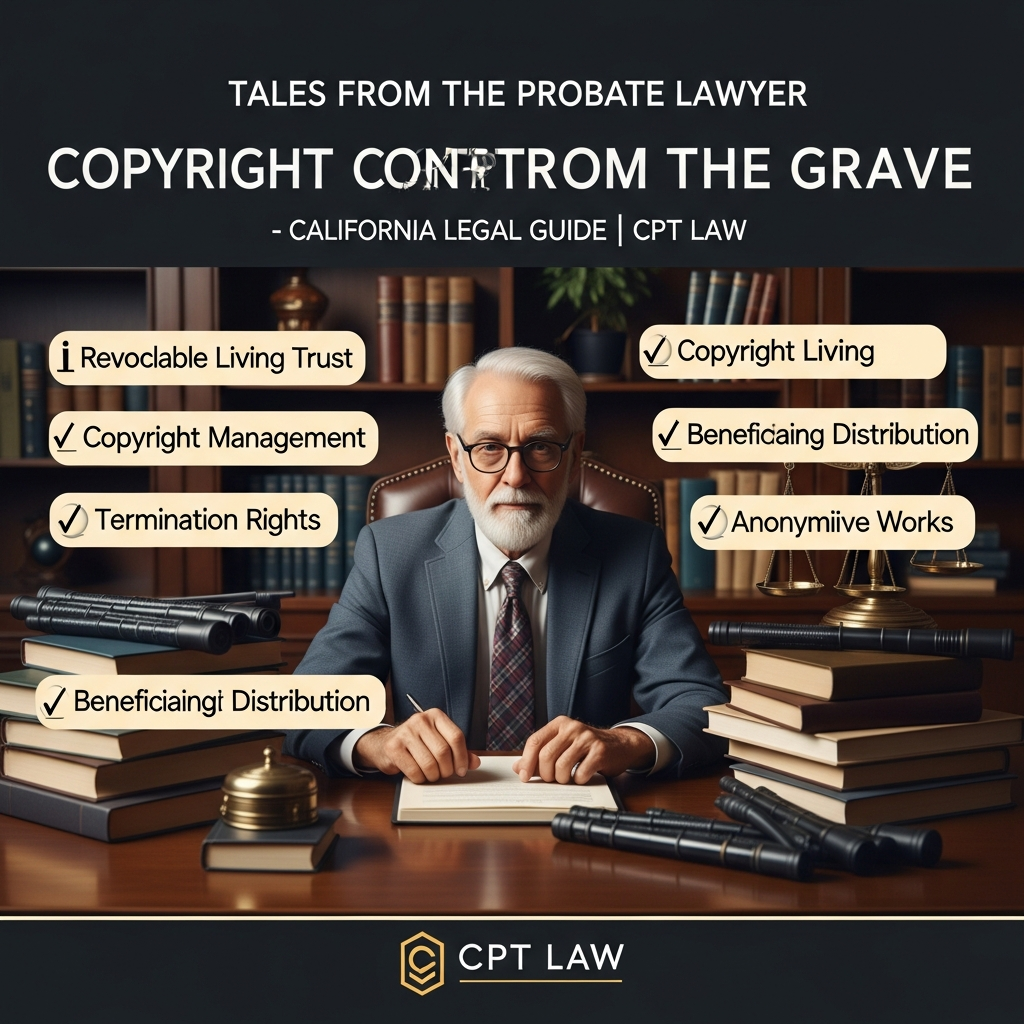
    The original article, “Tales from the Probate Lawyer: Copyright Control from the Grave,” presents a compelling fictional narrative about author Samuel Knight seeking to protect his extensive catalog of horror novels and short stories through estate planning. Knight’s primary goal is to ensure his copyrights are managed according to his specific wishes after his death, preventing misuse and directing financial proceeds appropriately. While a fictional tale, this scenario vividly illustrates critical, real-world considerations for authors, artists, musicians, and any individual in California holding valuable intellectual property. For creators, their copyrights often represent significant assets, both financial and personal, requiring careful planning to ensure their legacy is preserved and their beneficiaries are protected. In California, effective estate planning for copyright holders involves understanding federal copyright law in conjunction with state-specific mechanisms like trusts to achieve lasting control and benefit. to achieve lasting control and benefit.

    Key Estate Planning Tools for Copyright Holders in California

    For California residents with valuable copyrights, strategic estate planning is paramount. The primary tool for achieving the level of control Mr. Knight sought is a carefully drafted Revocable Living Trust.
    – A Living Trust allows the creator (the settlor) to transfer ownership of their copyrights into the trust during their lifetime. This avoids probate, a potentially lengthy and public court process, ensuring a smoother and more private transition of control.
    – Within the trust instrument, the settlor can provide explicit and detailed instructions for their designated trustee regarding the management of these copyrights. This could include directives on:
    – How royalties and licensing fees are distributed to beneficiaries.
    – Limitations or permissions for adaptations, sequels, or derivative works.
    – Instructions regarding unfinished works or those the author was not satisfied with, such as prohibiting posthumous publication or dictating who may complete them.
    – Directing proceeds from specific works to particular charities or causes, as Mr. Knight considered for his book “Cajun.”
    – Alongside a trust, a comprehensive estate plan typically includes a pour-over will, which ensures any assets (including newly acquired copyrights or those unintentionally omitted) not formally transferred into the trust during life are directed into it upon death.
    – A Durable Power of Attorney is also essential, granting a trusted agent the authority to manage the creator’s copyrights and other assets if they become incapacitated during their lifetime. and other assets if they become incapacitated during their lifetime.

    Understanding Copyright Duration and Your Estate Plan

    The duration of a copyright is a complex but crucial factor in estate planning. The length of protection dictates how long a creator’s legacy can generate income for their heirs or chosen causes. The original article highlights several categories of copyright duration under federal law, which directly impact California estate plans:
    Works with original statutory copyright on or after January 1, 1978: Generally protected for the author’s life plus 70 years. For joint authors, the 70-year term runs from the last surviving author’s date of death. These are generally not renewable.
    Anonymous or Pseudonymous Works and Works for Hire (on or after January 1, 1978): Protected for 95 years from first publication or 120 years from creation, whichever expires first. These are also not renewable.
    Works in their first (not renewed) copyright term on January 1, 1978: Protected for 28 years from the first copyright date, renewable for an additional 67 years (totaling 95 years).
    Works in a renewal term on October 27, 1998: Protected for 95 years from the date of the original copyright..

    A key point from the article is the potential strategic use of disclosing the true author’s identity for anonymous or pseudonymous works. If an author’s identity is recorded with the U.S. Copyright Office, the term often reverts to “life plus 70 years,” which could, in certain scenarios, extend the duration of the copyright beyond the 95 or 120-year term. An author can include instructions in their California trust to have their trustee make such disclosures posthumously, demonstrating the power of a well-structured estate plan to actively manage and potentially enhance intellectual property assets from the grave. assets from the grave.

    Termination Rights and Estate Planning

    The article also touches upon termination rights, which allow authors or their heirs to reclaim copyrights that were previously transferred or licensed. These rights are crucial for estate planning because they can ensure that valuable copyrights revert to the author’s family or trust after a certain period, allowing for renegotiation of terms or new agreements.
    – For copyrights created on or after January 1, 1978, the author’s right to terminate transfers and licenses begins 35 years after the date of the grant.
    – For copyrights in existence on January 1, 1978, termination rights may be exercised 56 years after the original copyright date.
    – For works in a renewal term on October 27, 1998, for which the termination right had expired, transfers and licenses may be terminated after 75 years with respect to the last 20 years of the copyright term. term.

    These termination rights automatically pass to the author’s spouse, children, and grandchildren. Proper estate planning in California can guide these heirs on how and when to exercise these rights, ensuring the long-term benefit and control of the copyrights. Without clear instructions, heirs might overlook these valuable opportunities, potentially losing out on significant future income or creative control.. Without clear instructions, heirs might overlook these valuable opportunities, potentially losing out on significant future income or creative control.

    Protecting Your Creative Legacy with a California Trust

    Ultimately, for authors and creators in California, a trust is not just about distributing money; it’s about preserving a legacy. By carefully articulating your wishes within a trust instrument, you can:
    – Dictate how your creative works are managed, promoted, and adapted.
    – Ensure financial benefits flow to your desired beneficiaries or charitable organizations.
    – Protect your body of work from decisions by heirs that might not align with your artistic vision.
    – Maintain a degree of anonymity if desired, while also planning for strategic posthumous disclosures to maximize copyright duration.
    – Provide for the management of unpublished or unfinished works, preventing their release or ensuring their completion by approved individuals. duration.
    – Provide for the management of unpublished or unfinished works, preventing their release or ensuring their completion by approved individuals.

    The story of Samuel Knight highlights that copyrights are a unique asset class requiring specialized attention within an estate plan. California Probate and Trust, PC specializes in helping creators integrate their intellectual property into a robust estate plan, providing peace of mind that their artistic and financial legacy will endure., providing peace of mind that their artistic and financial legacy will endure.

    About This Case

    Source: Tales from the Probate Lawyer: Copyright Control from the Grave https://research.ceb.com/posts/tales-from-the-probate-lawyer-copyright-control-from-the-grave

    California Probate and Trust, PC Can Help

    – Free consultations: (866)-674-1130
    – Experienced California estate planning
    Schedule consultation
    – Learn more: cpt.law

    Legal Disclaimer

    This article is for informational purposes only. Consult with a qualified California estate planning attorney for advice specific to your situation.

    Categories
    California Probate

    When Taking Responsibility for a Minor Child, – California Legal Guide | CPT Law

    California Legal Implications: Guardianship vs. Estate Planning for Minors

    A recent analysis draws an interesting parallel between the 1990 movie “The Witches” and California probate law. In the film, a young boy named Luke is orphaned and taken in by his grandmother, Helga. While the movie focuses on supernatural antagonists, the legal reality for a situation like Luke’s is grounded in specific California statutes regarding how a non-parent acquires the authority to care for a child.

    According to the article from CEB, without proper estate planning by the parents, a relative in Helga’s position must navigate complex legal hurdles to make medical, educational, and financial decisions for a minor. For California families, understanding the difference between Formal Guardianship, Trusts, and Caregiver Affidavits is essential for protecting children in the event of an unexpected tragedy. is essential for protecting children in the event of an unexpected tragedy.

    The Burden of Formal Guardianship

    If parents pass away without a plan, a relative generally cannot simply “take over.” They must seek a Formal Guardianship through the probate court. This process is divided into two parts: through the probate court. This process is divided into two parts:

    1. Guardianship of the Person: This grants custody and the authority to make decisions regarding the child’s health, education, and residence (Probate Code § 2351(a)).
    2. Guardianship of the Estate: This grants authority to manage the assets the child inherited (Probate Code §§ 2450–2574). This grants authority to manage the assets the child inherited (Probate Code §§ 2450–2574).

    The court process is rigorous. The petitioner must notice relatives, undergo investigations, and potentially face competing claims for custody. Once appointed, a Guardian of the Estate faces ongoing burdens, such as seeking court approval for expenditures and filing strict biannual accountings (Probate Code § 2620(a)). This court supervision is designed to protect the child but can be expensive, time-consuming, and intrusive for the family.

    How a Trust Avoids Court Supervision

    Parents can spare their chosen guardians the burden of a Guardianship of the Estate by establishing a Revocable Living Trust..

    If the parents in the movie scenario had a Trust, the assets left to the child would be managed by a Successor Trustee (such as the grandmother) according to the private terms of the trust document. The Trustee is bound by fiduciary duties to act in the child’s best interest but does not require constant court permission to access funds for the child’s support, maintenance, education, or healthcare. This allows for immediate access to resources without the delays of probate court. to act in the child’s best interest but does not require constant court permission to access funds for the child’s support, maintenance, education, or healthcare. This allows for immediate access to resources without the delays of probate court.

    The Caregiver’s Authorization Affidavit

    For immediate, short-term needs where a guardianship has not yet been established, California law provides a tool called the Caregiver’s Authorization Affidavit (California Family Code § 6550). (California Family Code § 6550).

    This affidavit allows a caregiver who is a “qualifying relative” (such as a grandparent, aunt, uncle, or sibling) to:
    * Enroll the minor in school.
    * Authorize school-related medical care.
    * Authorize general medical and dental care (including mental health treatment).

    While this affidavit allows a relative to function much like a guardian in daily life, it has limitations. It does not grant legal custody, and third parties (like hospitals or school districts) may occasionally refuse to honor it if they are unfamiliar with the law. Furthermore, for long-term security and government benefits, a formal guardianship or adoption is often eventually required.

    The Importance of Nomination

    The most effective way to ensure a child is cared for by the right person is for parents to legally nominate a guardian in their Last Will and Testament. While a court must still approve the appointment, a nomination provides a clear roadmap of the parents’ wishes, significantly reducing the likelihood of family conflict and streamlining the legal process.. While a court must still approve the appointment, a nomination provides a clear roadmap of the parents’ wishes, significantly reducing the likelihood of family conflict and streamlining the legal process.

    About This Case

    Source: When Taking Responsibility for a Minor Child, ‘Witch’ Option Is Best?

    California Probate and Trust, PC Can Help

    – Free consultations: (866)-674-1130
    – Experienced California estate planning
    Schedule consultation
    – Learn more: cpt.law

    Legal Disclaimer

    This article is for informational purposes only. Consult with a qualified California estate planning attorney for advice specific to your situation.