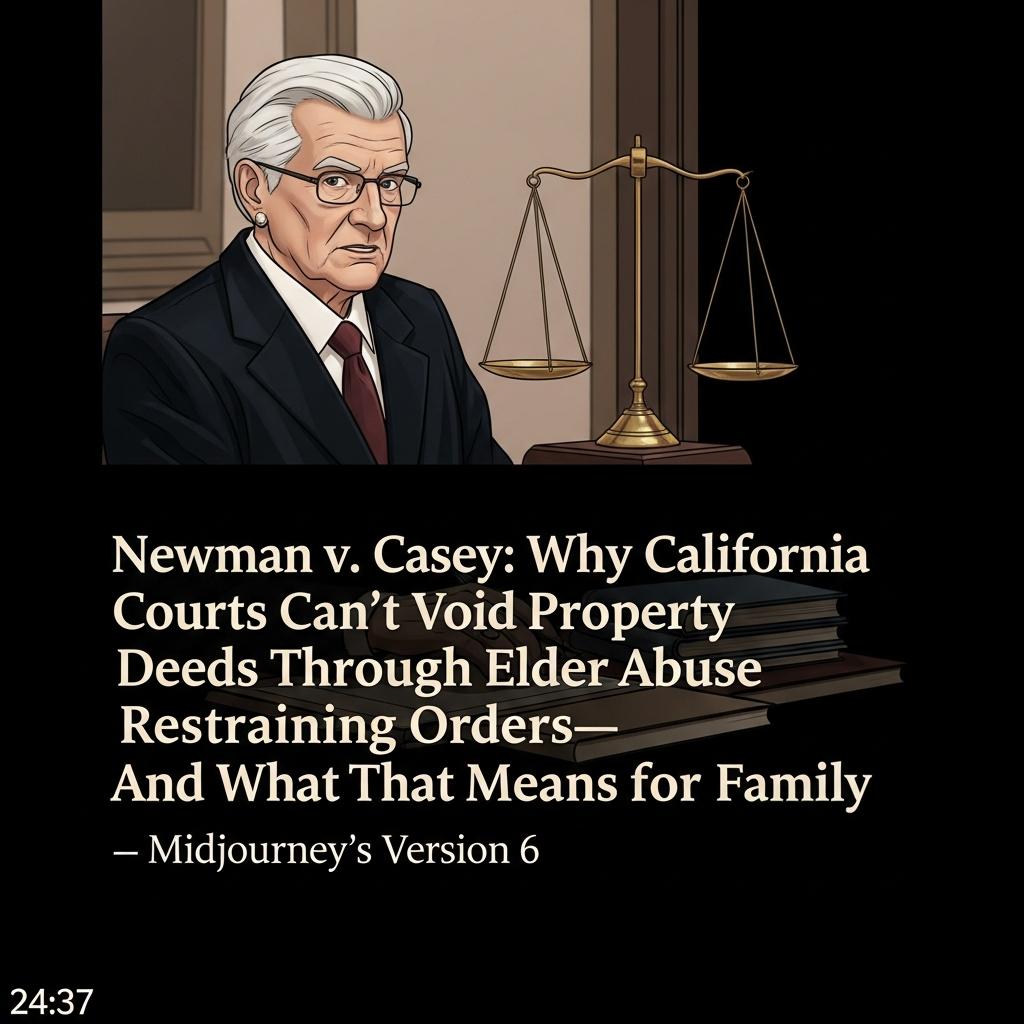
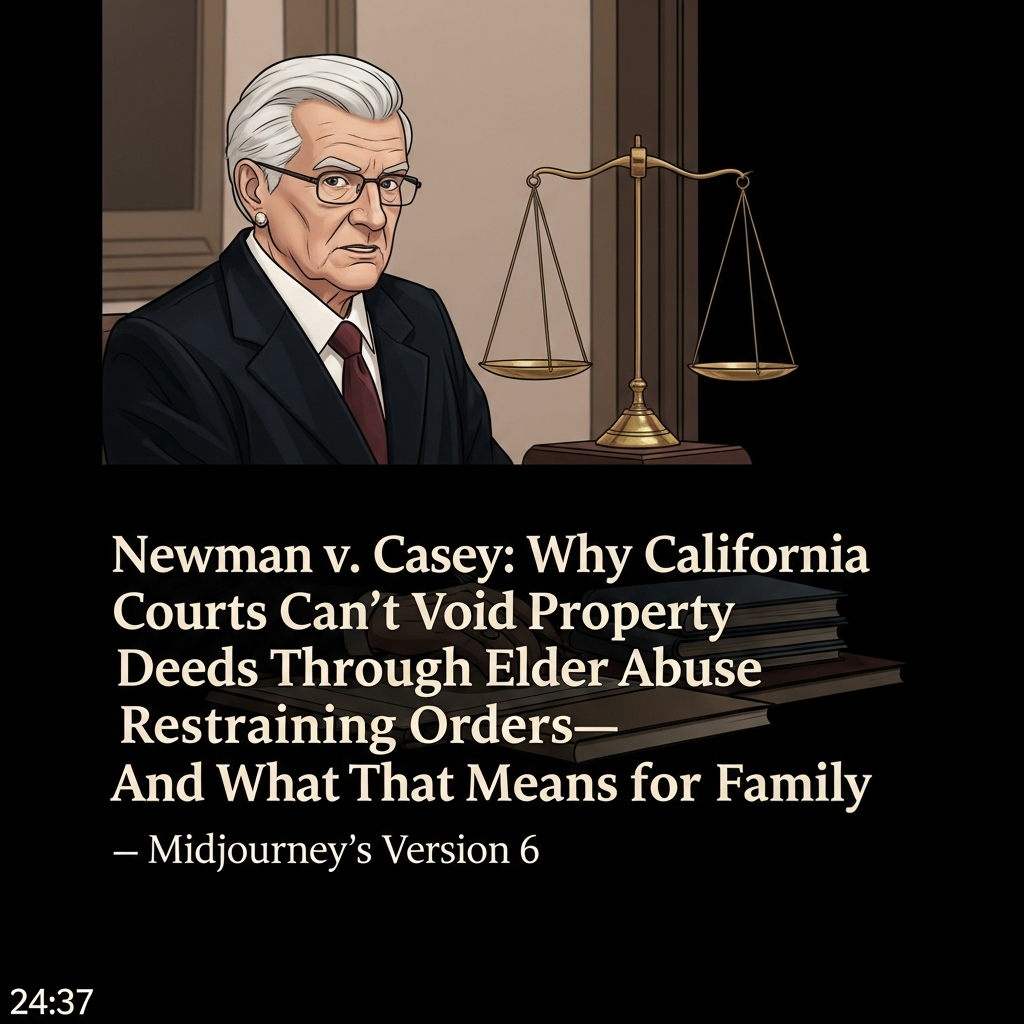
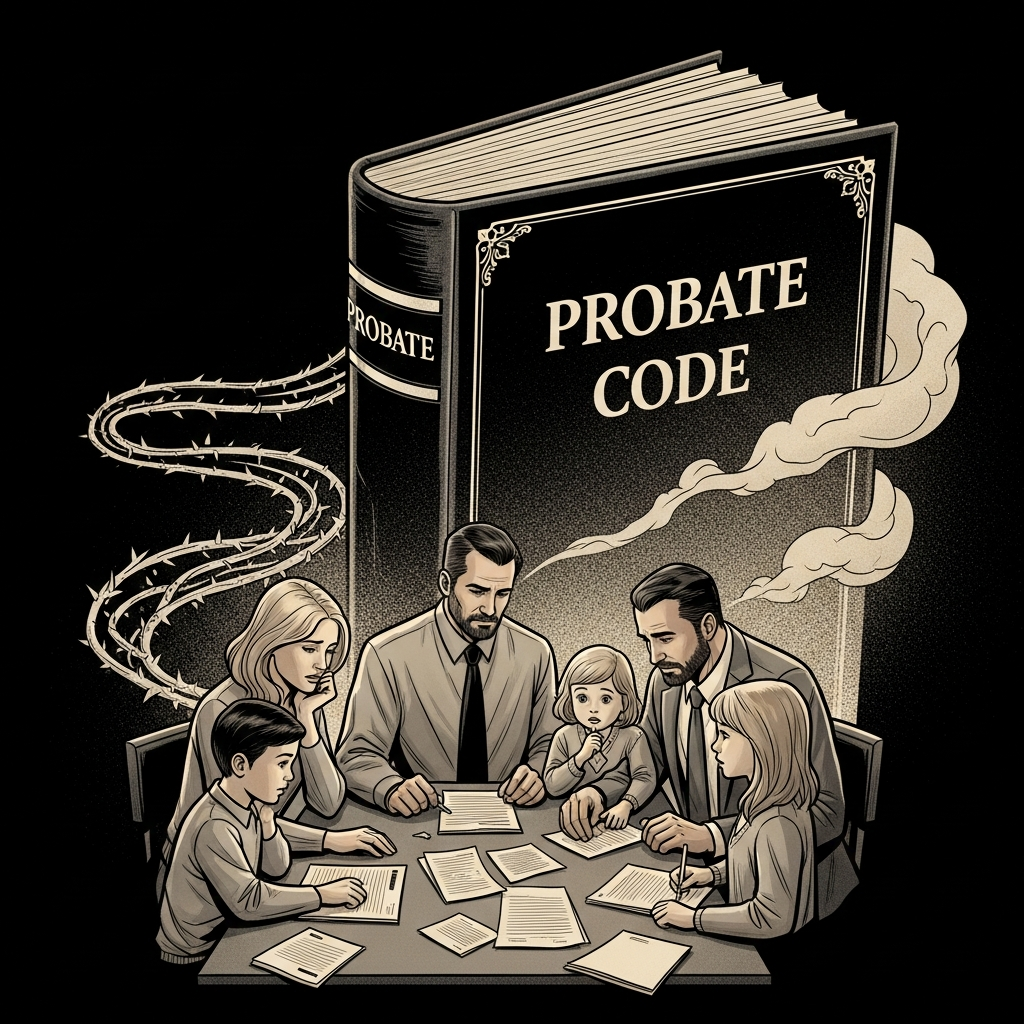
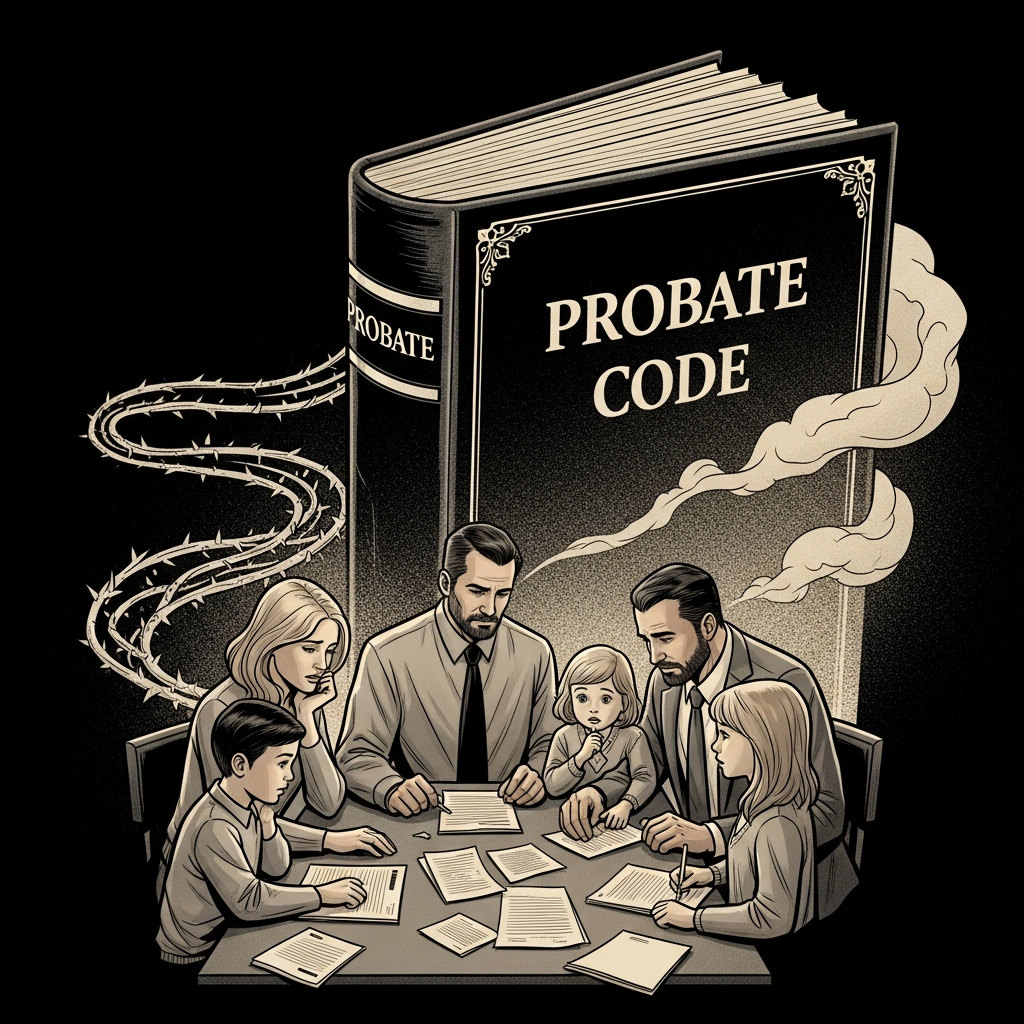
If you’re a California resident caring for aging parents, managing a trust, or worried about protecting a vulnerable family member from financial abuse, a recent California appellate court decision clarifies an important limitation: probate courts cannot permanently undo property transfers through elder abuse restraining orders alone.
What Happened in Newman v. Casey?
In this case, an elderly mother named Gracia accused her daughter, Marina, of tricking her into signing over the deed to her home.Gracia filed for Elder Abuse Restraining Orders (EAROs) and asked the court to force Marina to return the property.
The probate court agreed that financial elder abuse had occurred and issued restraining orders. But the court went further—it declared the deed “void ab initio,” meaning it treated the deed as if it never existed.
Marina appealed, and the First District Court of Appeal ruled that the probate court had overstepped its authority.
What Does California Law Allow in Elder Abuse Cases?
Under California Welfare and Institutions Code section 15657.03, probate courts can issue specific types of restraining orders to protect elders from immediate harm, including:
Prohibiting contact or communication
Ordering someone to stay away from the elder’s home or property
Freezing accounts or restricting financial transactions temporarily
These orders are meant to be temporary protections—they can last up to five years but are not permanent remedies.
The Court’s Key Ruling: Restraining Orders Are Not the Same as Property Recovery
The appellate court made it clear: declaring a deed void is not one of the restraining orders authorized by the statute.If you want to recover property or undo a fraudulent transfer permanently, you need to file a separate civil lawsuit under other provisions of California’s Elder Abuse and Dependent Adult Civil Protection Act.
In other words:
Restraining orders = immediate safety and protection
Civil lawsuits = permanent remedies like getting property back
Why This Matters for California Families
If you suspect that a family member has been financially exploited—whether through a coerced deed transfer, unauthorized withdrawal of funds, or manipulation of estate documents—understanding the correct legal pathway is critical.
Many families assume that filing for a restraining order will automatically reverse the harm. This case shows that’s not true. You may need to pursue multiple legal strategies simultaneously:
File for an Elder Abuse Restraining Order to stop further abuse and protect your loved one immediately
Initiate a separate civil action to recover property, reverse fraudulent transfers, or seek financial damages
Work with an experienced estate planning and probate attorney who understands both the protective and remedial options available under California law
How Can I Protect My Family from Elder Financial Abuse?
Prevention is always better than litigation. Here are steps California residents can take:
Create a comprehensive estate plan that includes a revocable living trust, durable power of attorney, and advance healthcare directive
Choose trustworthy agents and trustees who will act in your loved one’s best interest
Monitor financial accounts regularly and set up alerts for unusual activity
Discuss estate plans openly with family members to reduce confusion and potential disputes
Consult with a California probate attorney if you notice warning signs of financial exploitation
Case Details
Case Name: Newman v. Casey
Case Number: A165210
Court: California Court of Appeal, First District, Division One
At California Probate and Trust, PC, we help California families navigate complex probate matters, elder abuse cases, and estate planning challenges. Whether you’re concerned about a loved one’s safety, need to recover property through litigation, or want to create a protective estate plan, our experienced attorneys provide compassionate, transparent guidance.
We offer a free consultation to assess your situation and recommend the right legal strategy for your family.
Schedule Your Free Consultation Today
Call us at (866) 674-1130 or visit cpt.law to learn more about how we can help protect your family and your legacy.
Legal Disclaimer
This article is provided for informational purposes only and does not constitute legal advice. The information contained herein is based on California law as of the date of publication and may not reflect the most current legal developments. Every legal situation is unique, and the application of law can vary widely based on specific facts and circumstances. Readers should not act upon this information without seeking professional legal counsel from a qualified California attorney. California Probate and Trust, PC does not guarantee any particular outcome in legal matters. No attorney-client relationship is created by reading this article or contacting our firm for general information. For specific legal advice tailored to your situation, please schedule a consultation with one of our attorneys.
If you’re a California resident wondering whether you’re on track financially—or feeling uncertain about how to protect what you’ve built—understanding net worth benchmarks can help you make informed decisions about estate planning, wealth transfer, and family protection.
According to recent data from the Federal Reserve’s Survey of Consumer Finances, your net worth (assets minus liabilities) is one of the clearest indicators of financial security, especially as you approach retirement or consider how to pass your legacy to the next generation.
What Does “Wealthy” Actually Mean in America?
Finance expert Geoff Schmidt breaks down wealth into three categories based on Federal Reserve data:
Poor (Bottom 20%): Net worth around $20,856. These households typically don’t own homes and focus resources on immediate necessities.
Middle Class (50th Percentile): Median net worth of approximately $193,000. This usually includes home equity, retirement savings like a 401(k), and modest emergency funds.
Wealthy (Top 10%): Net worth of about $1.6 million or more. At this level, families can afford discretionary spending, charitable giving, college funds, and comprehensive estate planning.
Very Wealthy (Top 1%): Net worth of $11.6 million or more, providing significant financial freedom and multi-generational wealth transfer opportunities.
How Does Net Worth Change as You Age?
Your wealth accumulation follows a predictable arc throughout your lifetime:
Ages 55-64: Average net worth exceeds $1.5 million as individuals reach peak earning years and maximize retirement contributions.
Ages 65-74: Average net worth climbs to approximately $1.78 million, reflecting continued asset growth before retirement drawdown begins.
Ages 75+: Average net worth typically declines to around $1.62 million as retirees spend down assets for living expenses and healthcare.
What California Families Should Know About Wealth and Estate Planning
According to Schwab’s 2024 Modern Wealth Survey, Americans perceive $2.5 million as the threshold for being “wealthy.” But regardless of where you fall on the spectrum, if you’re a California resident with assets to protect—whether that’s a family home, retirement accounts, or business interests—proper estate planning is essential.
Common Questions California Families Ask:
“How can I protect my home from probate in California?”
“What’s the best way to transfer wealth to my children while minimizing taxes?”
“Do I need a trust if my net worth is under $1 million?”
“How can I ensure my healthcare wishes are respected if I become incapacitated?”
These are exactly the types of concerns that comprehensive estate planning addresses—and why working with experienced California estate planning attorneys who understand both the legal structure and financial management aspects is crucial.
Why Net Worth Matters for Your Estate Plan
Understanding your net worth helps determine:
Whether your estate will be subject to California probate (assets over $184,500 typically require probate)
What type of trust structure best protects your family
How to minimize estate taxes for your heirs
Whether you need asset protection strategies
How to structure charitable giving for maximum impact
Take Control of Your Financial Legacy
Whether you’re in the middle-class range planning for retirement, or you’ve accumulated significant wealth and want to ensure it transfers smoothly to the next generation, California Probate and Trust, PC provides transparent, comprehensive estate planning services tailored to California residents.
Our experienced attorneys offer free consultations to help you understand your options, assess your needs, and develop a personalized plan that protects your family and honors your wishes. From simple wills to complex trust structures, we provide the one-stop-shop approach that gives California families confidence and control over their financial future.
Schedule Your Free Estate Planning Consultation
Don’t wait until it’s too late to protect what you’ve worked so hard to build. Contact California Probate and Trust, PC today to schedule your no-obligation consultation with our Sacramento-based estate planning attorneys.
Legal Disclaimer
This article is provided for informational purposes only and does not constitute legal or financial advice. Net worth figures cited are national averages and may not reflect California-specific circumstances. Estate planning needs vary significantly based on individual circumstances, family dynamics, asset types, and state law. For personalized guidance on your specific situation, please consult with a qualified California estate planning attorney. California Probate and Trust, PC is not affiliated with the Federal Reserve, Schwab, or any sources cited in this article.
If you’re a California resident managing assets, planning your estate, or navigating probate, understanding new state legislation is essential to protecting your family’s future. Part 27 of the New California Laws 2026 seriescovers critical updates from the 2024-25 legislative session affecting childhood education, taxation, climate change, cannabis regulation, and more.
Who Should Read This Article?
This guide is for California residents who:
Are updating their estate plans and need to understand how new tax laws might affect wealth transfer strategies
Manage trusts or estates and want to stay compliant with the latest regulatory changes
Are parents or grandparents concerned about education funding and childcare legislation
Want to understand how climate and transportation laws might impact real estate and asset values
Key Legislation California Families Should Know About
Education and Childcare Changes
Two significant bills address early childhood education and childcare in California:
SB-120: Implements changes to early childhood education and childcare programs
SB-151: Provides additional framework for early childhood education and childcare
For families establishing education trusts or 529 plans, these legislative changes may create new opportunities for tax-advantaged education savings.
Taxation Updates That Affect Estate Planning
SB-132addresses taxation matters that could impact your estate planning strategy. California residents with substantial assets should consult with estate planning professionals to understand how these tax changes might affect:
Trust distributions and beneficiary taxation
Gift tax considerations for wealth transfer
Property tax implications for real estate held in trusts
Climate Change and Environmental Legislation
SB-127tackles climate change with new environmental regulations. For California property owners and estate planners, this legislation could affect:
Real estate valuations in climate-vulnerable areas
Property insurance requirements and costs
Long-term asset protection strategies for coastal or wildfire-prone properties
Other Notable Changes
SB-142: Updates to the Deaf and Disabled Telecommunications Program, relevant for special needs trusts
SB-141: California Cannabis Tax Fund provisions affecting the Department of Cannabis Control
SB-128and SB-153: Transportation legislation that may impact property access and values
How These Laws Affect Your Estate Plan
California’s legal landscape constantly evolves, and legislation passed in 2024-25 may require updates to your existing estate plan. Here’s what to consider:
Review your trust documents to ensure compliance with new taxation rules
Update beneficiary designations if family dynamics have changed
Reassess property holdings in light of new climate and environmental regulations
Consider education trust provisions given changes to childhood education programs
Why California Families Choose California Probate and Trust, PC
Navigating California’s complex legal system doesn’t have to be overwhelming. California Probate and Trust, PC specializes in helping California residents create comprehensive estate plans that protect families across generations. Our experienced attorneys stay current with legislative changes and provide transparent, compassionate guidance through every step of the estate planning and probate process.
We offer free consultations to help you understand how new legislation affects your specific situation and develop strategies that provide peace of mind for you and your loved ones.
Take Action Today
Don’t wait until legislation catches you off guard. Schedule a free consultation with California Probate and Trust, PC to review how these 2026 law changes affect your estate plan. Our Sacramento-based team has helped thousands of California families navigate complex estate planning challenges with clarity and confidence.
Legal Disclaimer
This article is provided for informational purposes only and does not constitute legal advice. Laws and regulations are subject to change, and individual circumstances vary. For specific legal guidance regarding your estate planning needs, please consult with a qualified California estate planning attorney. California Probate and Trust, PC is available for consultations but this article does not create an attorney-client relationship.
For California Residents Navigating Complex Family Dynamics and Estate Planning Challenges
When family relationships break down—especially after scandal, betrayal, or profound disagreement—the emotional fallout can be devastating. But beyond the personal pain lies a crucial legal question that many California families face: How do I protect my estate when family ties are severed?
A recent high-profile case illustrates this challenge perfectly. According to reports from Yahoo Entertainment, Princess Eugenie has completely cut off contact with her father, Ex-Prince Andrew, following revelations about his relationship with Jeffrey Epstein. Sources describe the estrangement as “Brooklyn Beckham level”—meaning there is “no contact at all, nothing.”
Understanding Family Estrangement: What This Means for Your Estate Plan
The royal family situation mirrors challenges faced by countless California families. When adult children sever ties with parents—or vice versa—critical estate planning questions emerge:
Who will inherit your assets if family relationships have broken down?
How can you ensure estranged family members don’t contest your will or trust?
What happens if you become incapacitated and your designated agent is no longer speaking to you?
How do you protect other family members who are trying to “walk the fine line” between fractured relationships?
The Two-Sister Dynamic: Different Approaches to Family Estrangement
What makes the royal situation particularly instructive for California families is how Princess Eugenie and Princess Beatrice have taken different approaches. While Princess Eugenie has completely cut off contact with her father, Princess Beatrice is attempting to maintain limited relationships with both parents while staying close to the Royal Family.
This mirrors what estate planning attorneys see regularly: siblings who handle family crises differently, leading to potential conflicts over inheritance, healthcare decisions, and asset distribution.
Real-World Estate Planning Questions California Families Ask After Family Breakdowns
1. “Can I disinherit an estranged child or parent in California?”
Yes. California law allows you to disinherit family members through proper estate planning documents. However, simply removing someone from your will isn’t enough—you need explicit language and often a no-contest clause to prevent challenges.
2. “What if my designated Power of Attorney stops speaking to me?”
This is more common than people realize. When relationships break down, you must update your Powers of Attorney (both financial and healthcare) immediately. If you become incapacitated without updating these documents, an estranged family member could legally make critical decisions on your behalf.
3. “How do I protect family members who are caught in the middle?”
Like Princess Beatrice trying to balance relationships, many California residents find themselves mediating between fractured family members. Clear estate planning can remove them from impossible positions by establishing unambiguous terms for asset distribution and decision-making authority.
4. “Can family estrangement affect my existing trust?”
Absolutely. If your trust names an estranged family member as trustee, beneficiary, or successor, you need immediate legal guidance to modify those designations. Delays can result in the very person you’re avoiding having control over your estate.
Why “Keeping Your Distance” Isn’t Enough: The Legal Framework You Need
According to sources close to the royal family, Ex-Prince Andrew is “keeping his distance” from his daughters to protect them from being “tainted by his difficulties.”While this emotional boundary may be wise, California families need more than distance—they need legal protection.
Essential documents for families experiencing estrangement:
Updated Revocable Living Trust with clear beneficiary designations that reflect current relationships
Revised Powers of Attorney (both financial and healthcare) naming trusted agents who are not estranged
Advance Healthcare Directive specifying exactly who can and cannot make medical decisions
Last Will and Testament with explicit disinheritance language and no-contest clauses
Letter of Intent explaining your decisions to reduce the likelihood of successful contests
The “Brooklyn Beckham Level” Standard: Complete Legal Separation
The comparison to Brooklyn Beckham’s estrangement from his father suggests a complete and permanent break.For California families at this level of estrangement, partial measures won’t suffice. You need comprehensive legal documentation that:
Explicitly removes estranged individuals from all decision-making roles
Protects remaining family members from being forced into the middle of disputes
Establishes clear legal authority that cannot be challenged based on outdated family assumptions
Creates mechanisms to prevent estranged parties from interfering with probate or trust administration
What Happens When Relationships Are “Complex”: Planning for Uncertainty
The royal family friend noted that “relationships and emotions following large family scandals are complex” and that both sisters “feel very sorry for their parents” while “keeping in touch with them and making sure they’re OK.”
This complexity is familiar to California families. Not every estrangement is permanent. Not every family fracture is complete. But estate planning cannot wait for relationships to stabilize.
For families in uncertain situations, consider:
Conditional provisions that account for potential reconciliation without leaving your estate vulnerable
Professional fiduciaries as neutral trustees who can navigate family dynamics without bias
Structured distributions that protect assets even if relationships shift
Regular review schedules to update documents as family circumstances evolve
Why California Families Need Specialized Estate Planning During Family Crises
The royal family’s situation demonstrates that wealth, status, and resources don’t prevent family breakdown—but proper legal planning can protect everyone involved when it happens.
California residents managing family estrangement need estate planning attorneys who understand:
The emotional complexity of cutting off family members legally
How to create ironclad documents that withstand contest
The difference between temporary distance and permanent legal separation
How to protect family members caught in the middle of disputes
California-specific laws regarding disinheritance, no-contest clauses, and family protections
Take Control of Your Family’s Future: Schedule a Free Consultation
If your family is experiencing estrangement, conflict, or complex dynamics that make standard estate planning inadequate, you need specialized guidance from attorneys who understand both the legal and emotional dimensions of family breakdown.
California Probate and Trust, PC offers free consultations for California residents navigating difficult family situations. Our experienced estate planning attorneys provide:
Confidential assessment of your family dynamics and estate planning needs
Clear, transparent recommendations for protecting your assets and wishes
Comprehensive trust and estate documents designed to withstand family challenges
Compassionate guidance through emotionally difficult legal decisions
Ongoing support as your family circumstances evolve
Don’t wait until family conflict escalates into legal battles over your estate. Take action now to protect yourself, your assets, and the family members you want to support.
Contact California Probate and Trust, PC today to schedule your free estate planning consultation: (866)-674-1130
Visit cpt.law to learn more about our comprehensive estate planning services for California families.
Legal Disclaimer
This article is provided for informational purposes only and does not constitute legal advice. Every family situation is unique, and estate planning decisions should be made in consultation with a qualified attorney licensed in California. The information presented here is based on publicly reported news and general legal principles and should not be relied upon as a substitute for personalized legal counsel. California Probate and Trust, PC is available to provide specific guidance tailored to your individual circumstances. No attorney-client relationship is created by reading this article or visiting our website.
Why Estate Planning Matters More Than Ever for California Families
If you’re a California resident managing assets in Los Angeles, Orange County, Sacramento, or the Bay Area, you’re likely facing unique challenges when it comes to protecting your family’s financial future. California’s complex probate system, rising property values, and changing tax laws mean that without proper estate planning, your loved ones could face months—or even years—of legal complications after you’re gone.
Who needs estate planning in California?
Homeowners with California real estate valued at $184,500 or more (the current probate threshold)
Parents who want to ensure their children are cared for if something unexpected happens
Business owners looking to preserve their legacy and avoid family disputes
Anyone with retirement accounts, life insurance, or significant personal assets
What Happens Without an Estate Plan in California?
When Southern California residents pass away without a will or trust, their estate enters California’s probate system—a public, time-consuming, and expensive process that can take 12-18 months or longer to complete.
Real-world consequences California families face:
Probate costs can consume 4-7% of your estate value – On a $500,000 home, that’s $20,000-$35,000 in statutory fees alone
Family disputes become public record – Court proceedings are accessible to anyone, removing privacy during difficult times
Assets remain frozen – Your family cannot access bank accounts, sell property, or manage investments until the court approves
The state decides who inherits – California’s intestacy laws may distribute your assets in ways you never intended
How Can California Residents Avoid Probate and Protect Their Families?
The good news: with proper planning, California families can avoid probate entirely while ensuring their wishes are honored and their loved ones are protected.
1. Establish a Revocable Living Trust
A revocable living trust is the cornerstone of California estate planning. Unlike a will, which must go through probate, a properly funded trust allows your assets to transfer directly to your beneficiaries without court involvement.
Key benefits for California residents:
Complete avoidance of the California probate process
Flexibility to modify the trust during your lifetime
Protection if you become incapacitated
2. Implement Healthcare Directives
California’s Advance Health Care Directive lets you designate someone to make medical decisions if you cannot communicate your wishes. This critical document prevents family conflicts and ensures your healthcare preferences are respected.
Who needs this in California?
College students living away from home
Adults of any age who want control over end-of-life decisions
Anyone with specific medical treatment preferences
3. Designate Financial Powers of Attorney
A durable power of attorney for finances allows someone you trust to manage your bank accounts, pay bills, and handle financial matters if you become incapacitated—without requiring a conservatorship proceeding.
What Makes California Estate Planning Different?
California has specific laws and considerations that make working with a California-focused estate planning attorney essential:
Community property rules – California is one of only nine community property states, affecting how married couples’ assets are treated
Proposition 19 changes – Recent tax law changes affecting property transfers between parents and children
High real estate values – Southern California property values often trigger probate requirements
County-specific procedures – Los Angeles, Sacramento, and San Francisco counties each have unique probate court processes
How Do I Choose the Right Estate Planning Attorney in California?
When selecting legal representation for your estate planning needs, California residents should look for:
California certification and specialization – Attorneys certified by the State Bar of California as estate planning specialists
Transparent pricing – Clear estate planning packages with no hidden fees
Free consultations – Opportunity to discuss your needs without financial commitment
Comprehensive services – One firm that handles both estate planning and probate administration
Local expertise – Knowledge of your specific county’s probate courts and procedures
California Probate and Trust, PC has served thousands of California families across Sacramento, San Francisco, and the Greater Los Angeles area, offering transparent estate planning packages and free consultations to help residents protect what matters most.
What Questions Should I Ask During an Estate Planning Consultation?
When meeting with an estate planning attorney, California residents should ask:
“How can I avoid probate for my California real estate?”
“What happens to my assets if I become incapacitated?”
“How will Proposition 19 affect transferring property to my children?”
“What’s the total cost of creating and funding a trust?”
“How do I update my plan as my family situation changes?”
Take Control of Your Family’s Future Today
Estate planning isn’t just about what happens after you’re gone—it’s about protecting your family now and ensuring your wishes are honored when it matters most. For California residents managing valuable assets, blended families, or complex financial situations, professional guidance can mean the difference between a smooth transition and years of legal complications.
Ready to protect your California legacy?
Schedule your FREE estate planning consultation with California Probate and Trust, PC today. Our certified estate planning specialists will review your family dynamics, explain your options, and create a personalized plan that gives you confidence and control over your future.
Call (866) 674-1130 or visit cpt.law to get started.
Legal Disclaimer: This article is provided for informational purposes only and does not constitute legal advice. Estate planning laws vary by jurisdiction and individual circumstances. The information presented here is current as of January 2026 but may change. For personalized legal guidance regarding your specific estate planning needs, consult with a licensed California estate planning attorney. California Probate and Trust, PC offers free consultations to California residents seeking professional estate planning services. Past results do not guarantee future outcomes.
For California residents—particularly those in the Roseville and greater Sacramento area—who are building family legacies while staying active in their communities, the announcement of Pickleball Kingdom’s first California location represents more than just a new recreational venue. It’s a reminder of how local business investments, community engagement, and long-term family planning intersect.
What’s Opening in Roseville?
Pickleball Kingdom, the world’s largest indoor pickleball entity, is opening its first California facility at 10251 Fairway Drive in Roseville. The 32,900-square-foot venue will feature 11 professional-grade indoor courts and is targeting a Spring 2026 opening.
Led by franchisees Parminder Saini, Komal Saini, and Megan Cohill, this state-of-the-art facility will offer:
Year-round indoor courts engineered for optimal playing conditions
Professional coaching and clinics for all skill levels, from beginners to advanced players
Youth programs designed to inspire the next generation
Organized leagues and tournaments for both casual and competitive play
Community and corporate events that build local connections
Why This Matters for California Families
For California residents managing family assets, planning for retirement, or thinking about legacy protection, community-focused businesses like Pickleball Kingdom represent important considerations in estate planning conversations.
“This facility will enrich the Roseville area by creating an inclusive space where people can play, connect, and enjoy themselves,” said Parminder Saini, one of the franchisees. “We’re excited to provide opportunities for families, friends, and neighbors to prioritize health, create lasting memories, and strengthen community bonds.”
How Can Active Lifestyles and Estate Planning Work Together?
Many California families ask: “How can I protect my family’s financial future while staying engaged in my community?” The answer often involves comprehensive planning that addresses both immediate lifestyle goals and long-term legacy protection.
When local businesses create spaces for multigenerational activities—like pickleball facilities that serve everyone from youth programs to retirement-age leagues—California residents benefit from:
Community connection opportunities that keep families engaged across generations
Health and wellness activities that can reduce long-term healthcare costs
Local investment opportunities that may factor into business succession or asset protection planning
Shared family experiences that strengthen relationships while you’re creating your legacy plan
What California Families Managing Assets Should Know
Whether you’re a business owner like the Pickleball Kingdom franchisees—who bring backgrounds in technology, business, and athletics to their venture—or simply a California resident planning for your family’s future, having a clear estate plan ensures:
Your healthcare wishes are documented and respected
Your financial assets transfer to the right people at the right time
Your family avoids unnecessary probate costs and delays
Your legacy reflects your values and protects future generations
Franchise Growth and Business Succession Planning
The expansion of Pickleball Kingdom into California—marking the brand’s first West Coast location—demonstrates the franchise’s strong business model. According to the announcement, Pickleball Kingdom offers franchisees “the highest industry AUV (average unit volume) per location”.
For California business owners considering franchise opportunities or managing existing business interests, proper estate planning becomes essential. Business succession planning ensures that your entrepreneurial investments continue benefiting your family, even during unexpected life transitions.
Take Action: Protect Your Family’s Future
If you’re a California resident who values transparency, family protection, and community engagement—whether you’re planning to visit the new Pickleball Kingdom facility or simply want to ensure your family’s financial future is secure—now is the time to create or update your estate plan.
California Probate and Trust, PC offers free estate planning consultations for Sacramento-area residents. Our experienced attorneys help California families navigate:
Revocable and irrevocable trusts
Wills and testament creation
Healthcare directives and powers of attorney
Probate avoidance strategies
Business succession planning
Asset protection for multigenerational wealth transfer
We understand that finding the right estate attorney is a significant decision. That’s why we offer no-obligation consultations to walk you through your needs, goals, and budget. Our firm has represented thousands of clients from our offices in Fair Oaks, Sacramento, and San Francisco.
Schedule your free consultation today by calling (866)-674-1130 or visiting cpt.law.
This article is provided for informational purposes only and does not constitute legal advice. The information contained herein is not intended to create, and receipt of it does not constitute, an attorney-client relationship. Estate planning needs vary significantly based on individual circumstances, family dynamics, and asset composition. California residents should consult with a qualified estate planning attorney to discuss their specific situation. California Probate and Trust, PC is available for free consultations to California residents and those managing California-based assets. Past results do not guarantee future outcomes.
For California residents planning retirement and protecting family assets
If you’re a California resident approaching retirement or helping aging parents navigate Social Security, understanding spousal benefit rules can mean the difference between leaving thousands of dollars on the table and maximizing your family’s lifetime income. This guide explains exactly how Social Security spousal benefits work in 2026—and how strategic planning can protect your family’s financial future.
California couples where one spouse earned significantly more or stayed home to raise children
Divorced individuals who were married for at least 10 years and want to know their benefit options
Family caregivers managing Social Security decisions for aging parents
Pre-retirees between ages 60-67 trying to decide when to claim benefits
Estate planning clients who want to integrate Social Security strategy into their overall financial protection plan
What Are Social Security Spousal Benefits and Who Qualifies?
Social Security spousal benefits allow a married person (or qualifying ex-spouse) to receive retirement income based on their partner’s work record—even if they have little or no earnings history themselves.
Maximum benefit: Up to 50% of the higher-earning spouse’s full retirement benefit
Key eligibility requirements:
You must be at least 62 years old
Your spouse must already be receiving their own Social Security retirement benefits
You must have been married for at least one full year
Benefits are paid monthly by the Social Security Administration
Real-world example: Maria, 64, stayed home for 15 years raising her children in Sacramento. Her husband Carlos worked full-time and will receive $3,200/month at his full retirement age. Once Carlos files for benefits, Maria can claim up to $1,600/month in spousal benefits—regardless of her own limited work history.
How Timing Affects Your Spousal Benefit Amount
The age at which you claim spousal benefits permanently affects how much you receive each month. Many California couples lose significant lifetime income by claiming too early without understanding the rules.
Claiming at Full Retirement Age (Best Option)
Allows you to receive the maximum 50% spousal benefit
For most people, full retirement age is between 66 and 67
This is the optimal claiming age for spousal benefits
Claiming Early (Age 62-66)
Results in a permanently reduced monthly payment
The reduction lasts for your entire lifetime
You cannot “undo” an early claim decision
Delaying Past Full Retirement Age
Critical mistake to avoid: Unlike personal retirement benefits, spousal benefits do not increase if you wait past full retirement age
Waiting provides no additional benefit—this is one of the most common planning errors
Can I Work and Still Receive Spousal Benefits?
Yes, but there are income limits if you’re under full retirement age that can temporarily reduce your benefits.
Before full retirement age:
Annual earnings above certain thresholds will reduce your spousal benefit payments
Benefits withheld due to earnings are recalculated later when you reach full retirement age
After full retirement age:
You can earn unlimited income without any reduction to your spousal benefits
Spousal Benefits for Divorced California Residents
If you’re divorced, you may still qualify for spousal benefits based on your ex-spouse’s work record—and claiming them does not reduce what your ex-spouse receives.
Divorced spouse eligibility requirements:
You must have been married for at least 10 years
You must be currently unmarried when applying
Your ex-spouse must be eligible for Social Security benefits (though they don’t need to have filed yet if you’ve been divorced for at least 2 years)
Important note: Your claim has zero impact on your ex-spouse’s benefit amount or their current spouse’s benefits.
Common Mistakes California Couples Make with Spousal Benefits
Our estate planning practice has helped hundreds of California families avoid these costly errors:
Assuming spousal benefits grow with delayed retirement credits (they don’t—claiming after full retirement age provides no increase)
Claiming at age 62 without calculating the lifetime cost of permanently reduced payments
Divorced individuals not checking their eligibility for benefits based on an ex-spouse’s record
Believing you need a work history to receive spousal benefits (you don’t)
Worrying that claiming will reduce your spouse’s benefit (it won’t)
Frequently Asked Questions
Can I receive spousal benefits if I never worked?
Yes. You can claim spousal benefits even if you have no earnings record of your own.
Will my spousal benefit reduce what my husband or wife receives?
No. Your spousal benefit does not affect the amount your spouse receives from Social Security.
Can I switch from my own benefit to a spousal benefit later?
Yes, it may be possible to switch depending on your age and circumstances.
What if my spouse hasn’t filed for benefits yet?
You cannot receive spousal benefits until your spouse has filed for their own Social Security retirement benefits.
How Social Security Planning Fits Into Your California Estate Plan
For California families working with California Probate and Trust, PC, Social Security spousal benefit optimization is just one piece of a comprehensive estate protection strategy. Our clients value transparency and family protection—which means coordinating:
Income maximization strategies like spousal benefit timing
Asset protection through trusts that preserve wealth for the next generation
Healthcare directives that protect your wishes if you become incapacitated
Probate avoidance planning to ensure your assets transfer smoothly to heirs
Strategic Social Security planning can add tens of thousands of dollars to your retirement income over your lifetime—money that can fund long-term care, leave a larger inheritance, or simply provide peace of mind.
Take Control of Your Family’s Financial Future
Understanding Social Security spousal benefits is essential for California couples and families planning for retirement. Whether you’re coordinating benefit timing, exploring divorced spouse eligibility, or integrating Social Security strategy into your broader estate plan, the decisions you make today will impact your family’s financial security for decades.
At California Probate and Trust, PC, we help California residents navigate complex estate planning decisions—including how to maximize Social Security benefits, protect assets through trusts, and ensure your family is financially secure both now and after you’re gone.
Ready to create a comprehensive plan that protects your family and maximizes your retirement income?
Schedule your FREE estate planning consultation today:
Offices in Fair Oaks, Sacramento, and San Francisco
Legal Disclaimer: This article is provided for informational purposes only and does not constitute legal, financial, or tax advice. Social Security rules are complex and subject to change. Individual circumstances vary significantly. Before making any decisions regarding Social Security benefits or estate planning, you should consult with qualified legal and financial professionals who can assess your specific situation. California Probate and Trust, PC provides estate planning legal services but does not provide financial planning or Social Security claiming advice. For personalized guidance on Social Security benefits, consult with a Social Security advisor or the Social Security Administration directly at www.ssa.gov or by calling 1-800-772-1213.
For California residents navigating the intersection of homeownership, retirement planning, and estate protection
In a surprising policy reversal, former President Donald Trump has walked back his proposal to allow first-time homebuyers to tap into their 401(k) retirement accounts for down payments. This development has significant implications for California families balancing homeownership dreams with long-term financial security and estate planning goals.
The initial plan aimed to help prospective homebuyers—particularly first-time buyers struggling with California’s notoriously high housing costs—by allowing penalty-free withdrawals from 401(k) retirement accounts to fund down payments. In a state where median home prices exceed $800,000 in many markets, this proposal seemed like a potential lifeline for younger families locked out of homeownership.
Why Did Trump Reverse Course?
According to Bloomberg’s reporting, the reversal came after concerns from financial advisors, retirement planning experts, and policy analysts who warned that:
Long-term retirement security could be compromised: Withdrawing funds early reduces compound growth potential over decades
Tax implications remain complex: Even penalty-free withdrawals would still be subject to income taxation
Housing market distortions: Increased buying power could drive prices even higher, negating the intended benefit
Estate planning complications: Depleted retirement accounts mean less wealth to protect and transfer to heirs
How Does This Affect California Residents?
For California families—especially those in high-cost areas like Sacramento, San Francisco, Los Angeles, and San Diego—this policy reversal underscores a critical truth: homeownership decisions and retirement planning are deeply interconnected with your overall estate strategy.
Real-World Scenarios California Families Face:
Young professionals in their 30s: Torn between using retirement savings for a home down payment versus preserving those funds for compound growth and future estate planning
Mid-career individuals managing aging parents’ estates: Balancing their own housing needs while serving as trustees or executors for family property
Retirees considering downsizing: Evaluating how real estate decisions impact their revocable trust structures and beneficiary distributions
Blended families navigating second marriages: Protecting children from previous relationships while managing community property and retirement assets
What Should California Homebuyers and Families Do Now?
If you’re a California resident considering tapping retirement funds for a home purchase—or if you’re concerned about how real estate and retirement assets fit into your estate plan—here are the key steps to take:
1. Understand the True Cost of Early Retirement Withdrawals
Even if penalty-free withdrawal options become available in the future, consider:
The loss of 20-30 years of compound growth on withdrawn funds
Immediate income tax obligations (which can push you into a higher bracket)
Reduced inheritance for your beneficiaries
Potential impacts on Medi-Cal eligibility planning if you’re approaching retirement age
2. Explore Alternative Down Payment Strategies
First-time homebuyer programs: California offers numerous state and county programs with lower down payment requirements
Gift funds from family: Properly documented gifts (up to $18,000 per person in 2024, $19,000 in 2025) can help without triggering gift tax
Roth IRA contributions: Unlike traditional 401(k)s, you can withdraw Roth IRA contributions (not earnings) tax and penalty-free at any time
Delayed homeownership: Sometimes waiting 2-3 years to build savings preserves retirement security
3. Integrate Real Estate into Your Estate Plan
California’s complex property laws require careful planning. If you own or are purchasing real estate, your estate plan should address:
Revocable living trusts: The most effective way to avoid probate on California real estate while maintaining control during your lifetime
Property tax reassessment protection: Prop 19 rules now limit parent-child exclusions; strategic planning is essential
Title holding strategies: How you take title (joint tenancy, community property, trust ownership) dramatically impacts estate administration
Beneficiary designations coordination: Ensuring retirement accounts and real estate pass to intended heirs efficiently
4. Protect Your Retirement Assets for Future Generations
Many California families focus on estate planning for real property but overlook retirement account planning. Key considerations include:
Beneficiary designation reviews: Outdated beneficiaries are one of the most common estate planning errors
SECURE Act 2.0 implications: New rules limit inherited IRA stretch provisions for most non-spouse beneficiaries
Roth conversion strategies: Converting traditional IRAs to Roth accounts can provide tax-free inheritance for your heirs
Conduit vs. accumulation trusts: For high-net-worth families, retirement benefit trusts can protect assets from creditors and irresponsible spending
Why California Families Need Integrated Financial and Estate Planning
The Trump administration’s policy reversal highlights a fundamental truth: homeownership, retirement security, and estate planning are not separate decisions—they’re interconnected elements of your family’s long-term financial protection strategy.
California’s unique legal landscape makes this integration even more critical:
Community property laws: Affect how married couples own and transfer assets
Prop 13 and Prop 19: Create complex property tax implications for inherited real estate
High cost of probate: California’s statutory probate fees (based on gross estate value) make trust planning especially valuable
Medi-Cal recovery rules: State claims against estates for long-term care costs require advance planning
Case Study: How the Right Planning Makes All the Difference
Consider this scenario we frequently see at California Probate and Trust, PC:
The Situation: Maria, 42, and James, 45, live in Sacramento. They have two children and rent a home while saving for a down payment. James’s 401(k) has $180,000, and they’re considering withdrawing $50,000 for a down payment if policy allows it. Neither has an estate plan in place.
The Problem: If they withdraw $50,000 from the 401(k):
They’ll owe approximately $15,000 in federal and state income taxes (30% bracket)
The actual down payment funds will be only $35,000 after taxes
They’ll lose $300,000+ in retirement growth over 25 years (assuming 7% returns)
Their estate will have $300,000 less to protect and pass to their children
Without a trust, their home will go through probate (costing 4-6% of the property value)
The Better Solution: After consulting with California Probate and Trust, PC, Maria and James:
Used a California Housing Finance Agency (CalHFA) program requiring only 3.5% down
Received a $10,000 gift from James’s parents, properly documented to avoid gift tax issues
Established a revocable living trust to avoid probate on their future home
Created healthcare directives and financial powers of attorney
Kept their retirement accounts intact, preserving $300,000+ in future growth for their family
Ensured their children would inherit their home without probate delays or expenses
The Outcome: Maria and James bought their Sacramento home without depleting retirement savings, protected their family’s future, and established a comprehensive estate plan—all for less than the tax cost of withdrawing from their 401(k) would have been.
How California Probate and Trust, PC Can Help
At California Probate and Trust, PC, we’ve helped thousands of California families navigate the complex intersection of homeownership, retirement planning, and estate protection. Our approach is built on:
Transparency: Clear, flat-fee estate planning packages with no hidden costs
Family protection focus: Strategies designed to keep your assets in your family, out of probate, and protected from unnecessary taxes
Comprehensive service: We handle both the legal structures (trusts, wills, powers of attorney) and coordinate with your financial advisors for holistic planning
California expertise: Deep knowledge of state-specific rules affecting property, probate, and estate administration
Whether you’re a first-time homebuyer weighing financial decisions, a mid-career professional building wealth, or a retiree focused on legacy planning, we provide the guidance California families need to make informed decisions that protect what matters most.
Take Action: Schedule Your Free Estate Planning Consultation
Don’t let policy uncertainty or market volatility derail your family’s financial security. The policy reversal on 401(k) home purchases is a reminder that external factors will always shift—but a solid estate plan provides stability regardless of political changes.
Here’s what you’ll receive in your free consultation with California Probate and Trust, PC:
A comprehensive review of your current assets, including real estate and retirement accounts
Clear guidance on how California’s unique laws affect your situation
A personalized roadmap for protecting your family’s financial future
Transparent pricing information for our estate planning services
No pressure, no obligation—just expert advice from compassionate professionals
This article is provided for informational purposes only and does not constitute legal, financial, or tax advice. The information presented is based on publicly available news reports and general California estate planning principles as of January 2026. Individual circumstances vary significantly, and estate planning strategies that work for one family may not be appropriate for another.
No attorney-client relationship is created by reading this article. For personalized legal advice regarding your specific situation—including questions about homeownership, retirement account management, estate planning, probate, or trust administration—please consult with a qualified attorney licensed to practice law in California.
Tax laws, property regulations, and estate planning rules change frequently. While we strive to provide current information, laws may have changed since publication. Always verify current regulations with qualified legal and financial professionals before making significant financial or estate planning decisions.
Understanding property inheritance rights when family scandal threatens generational wealth
When you’re managing family assets in California—whether real estate, trust property, or leasehold interests—the recent Royal Lodge controversy involving Prince Andrew and his daughters offers critical lessons about protecting inherited wealth from unexpected legal challenges.
What Happened: The £30 Million Inheritance That Disappeared
Prince Andrew’s daughters, Princess Beatrice and Princess Eugenie, recently lost their expected inheritance of Royal Lodge—a property valued at £30 million (approximately $40 million USD)—after their father was ordered to vacate due to scandals tied to Jeffrey Epstein. According to Yahoo Lifestyle, the princesses are “absolutely fuming” over losing what they considered their “long-term security.”
Why This Matters for California Families
If you’re a California resident worried about:
How to protect family property from creditors or legal judgments
Whether leasehold interests can be passed to your children
How your personal legal troubles might impact your children’s inheritance
What happens to property you assumed would stay in the family
This royal case demonstrates exactly why proper estate planning documentation is essential—not just assuming property will “automatically” transfer to the next generation.
The Critical Estate Planning Mistake: Assuming Lease Rights Equal Ownership
Property expert Elliot Castle explained that once Andrew’s 75-year lease is surrendered, “there is nothing to pass on. Royal Lodge would revert fully to the Crown Estate, with no residual claim for Andrew or his daughters.”
California families face similar issues with:
Leasehold properties: Long-term leases don’t automatically transfer to heirs
Life estate arrangements: Rights that terminate upon death
Properties with reversionary clauses: Assets that revert to original owners under certain conditions
Assets vulnerable to creditor claims: Property that could be seized due to legal judgments
How Could This Have Been Prevented? Lessons for California Estate Planning
1. Establish Irrevocable Trusts for Asset Protection
The royal family apparently relied on informal understanding rather than explicit legal documentation. California families should ensure:
All property transfer intentions are documented in legally binding instruments
Beneficiary designations are current and specific
Trust documents explicitly address contingencies
3. Separate Personal Liability from Family Assets
Creating legal separation between personal exposure and family wealth protects the next generation from paying for “decisions they did not make”—as sources described the princesses’ situation.
When Should California Families Review Their Estate Plans?
You should urgently review your estate planning documents if:
You’re facing potential legal exposure or litigation
You own property through leasehold or life estate arrangements
Your children expect to inherit specific real estate assets
You haven’t updated your estate plan in over 3 years
You’re concerned about protecting family wealth from personal creditors
Real-World Application: The $40 Million Question
As one source told RadarOnline.com, “Neither princess needs Royal Lodge for housing, but losing a $40 million asset changes the shape of their futures.” This illustrates why many California families seek estate planning assistance—not because children need immediate housing, but because substantial assets represent generational financial security.
For California residents managing valuable real estate, investment properties, or business interests, the difference between proper asset protection structures and informal arrangements can mean millions of dollars in protected wealth versus vulnerable assets.
How California Probate and Trust, PC Protects Generational Wealth
California Probate and Trust, PC helps families avoid the kind of inheritance crisis that affected Princess Beatrice and Eugenie by:
Structuring protective trusts: Creating legal barriers between personal liability and family assets
Documenting clear transfer mechanisms: Ensuring property actually passes to intended beneficiaries
Planning for contingencies: Addressing what happens if circumstances change unexpectedly
With over 1,000 clients represented from offices in Fair Oaks, Sacramento, and San Francisco, the firm specializes in protecting California families from exactly the type of inheritance disruption that just cost the royal family £30 million.
Take Action: Schedule Your Free Estate Planning Consultation
Don’t let your children discover—when it’s too late—that the assets they expected to inherit were never properly protected. California Probate and Trust, PC offers a free one-hour consultation to:
Review your current property holdings and vulnerability
Assess whether your existing estate plan adequately protects generational wealth
Identify gaps in asset protection structures
Develop a customized plan to shield family assets from legal exposure
📍 Serving California residents from Fair Oaks, Sacramento, and San Francisco
Legal Disclaimer
This article is provided for informational purposes only and does not constitute legal advice. The information presented is based on publicly reported news regarding Prince Andrew and Royal Lodge and is used solely to illustrate general estate planning principles applicable to California residents. Every family’s situation is unique, and estate planning strategies must be tailored to individual circumstances, California law, and current tax regulations. Reading this article does not create an attorney-client relationship. For specific legal guidance regarding your estate planning needs, asset protection strategies, or property inheritance concerns, please schedule a consultation with a qualified California estate planning attorney. California Probate and Trust, PC is available to discuss your particular situation and develop customized solutions appropriate to your family’s needs and goals.
If you’re a California resident managing property, planning your estate, or helping aging parents navigate real estate decisions, you’ve likely seen the viral claim: first-time home buyers are now 40 years old. This statistic has dominated social media and news cycles, but there’s a significant problem—it may not be accurate. For families working with estate planning attorneys and making long-term financial decisions, understanding the real data matters.
What the National Association of Realtors Claims
According to the National Association of Realtors (NAR), the median age of first-time home buyers has jumped to 40 years old for the first time in history. The data suggests a dramatic shift in homeownership patterns, which sounds plausible given California’s housing affordability crisis.
However, the methodology raises serious red flags:
The survey included just over 6,000 responses
The questionnaire contained 120 questions, making completion rates questionable
No significant incentives were offered to participants
What Other Reliable Sources Show About First-Time Buyer Age
Multiple authoritative sources contradict NAR’s findings. The Mortgage Bankers Associationand five other industry sources consistently show first-time buyers are typically 32 to 33 years old—not 40.
This discrepancy matters because:
NAR stands as a clear statistical outlier
The sample size and methodology lack the rigor of other industry studies
Conflicting data creates confusion for families making major financial decisions
Why This Matters for California Estate Planning
For California residents working with estate planning attorneys, accurate real estate data is critical. Here’s why:
1. Intergenerational Wealth Transfer Planning
If your adult children are actually buying homes in their early 30s rather than at 40, your estate planning timeline changes significantly. Understanding when beneficiaries will need down payment assistance, inheritance distributions, or trust disbursements depends on accurate age data.
2. Real Estate Trust Structures
California families often use revocable living trusts to manage property. If you’re planning when to transfer real estate assets or establish property trusts for your children, knowing the realistic timeline for when they’ll enter the housing market affects your planning strategy.
3. Family Financial Assistance
Many California parents provide financial support for first-time home purchases. Misunderstanding the typical buyer age by nearly a decade could impact when you liquidate assets, adjust your retirement planning, or structure gifting strategies.
4. Avoiding Negative Financial Narratives
Inflated statistics create unnecessary anxiety. Young California families may delay homeownership or estate planning based on misleading data, when the reality shows home buying happens earlier than viral statistics suggest.
How California Probate and Trust Can Help
At California Probate and Trust, PC, we help California residents cut through misinformation and develop estate plans based on your actual family situation—not viral statistics. Whether you’re planning property transfers, establishing trusts for adult children entering the housing market, or coordinating real estate assets with your overall estate plan, our experienced attorneys provide:
Free one-hour estate planning consultations to assess your unique situation
Clear guidance on revocable trusts, real estate transfers, and property protection strategies
Transparent pricing and compassionate support through complex legal processes
Comprehensive estate planning that protects your family’s real estate assets across generations
The Bottom Line for California Families
Don’t base your estate planning decisions on questionable data. The evidence strongly suggests first-time buyers are in their early 30s, not 40. While California’s housing affordability challenges are real, accurate information helps you make better decisions about when to transfer property, how to structure trusts, and when your children might need financial support.
Ready to Develop Your California Estate Plan?
If you’re managing California real estate assets and want to ensure your estate plan reflects reality—not viral statistics—contact California Probate and Trust, PC today. Schedule your free consultation by calling (866) 674-1130 or visiting cpt.law to speak with an experienced Sacramento estate planning attorney.
Legal Disclaimer
This article is provided for informational purposes only and does not constitute legal advice. Real estate and estate planning laws vary by jurisdiction and individual circumstances. The information presented about first-time home buyer statistics is based on publicly available sources and should not be solely relied upon for making legal or financial decisions. For specific guidance regarding your estate planning needs, California probate matters, or real estate asset protection, please consult with a qualified attorney. California Probate and Trust, PC is available to provide personalized legal counsel tailored to your unique situation.