
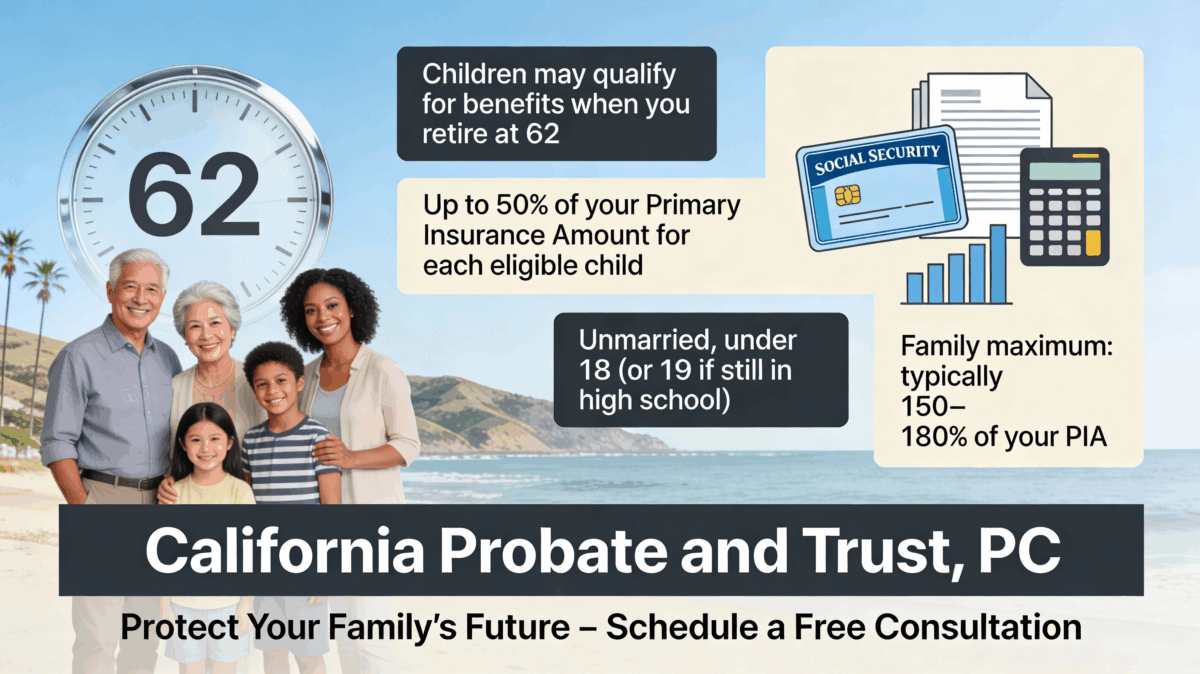
Who This Article Is For: California residents planning early retirement who have minor children and want to understand how Social Security dependent benefits work. If you’re retiring at 62 (or any age before your full retirement age) and wondering whether your children can receive benefits based on your work record, this guide answers your most pressing questions.
The Short Answer: Yes, Your Children May Qualify
When you begin collecting Social Security retirement benefits, your eligible dependent children can receive benefits based on your work record. This applies even if you retire early at age 62. Here’s what you need to know:
How Does Early Retirement at 62 Affect My Children’s Benefits?
Here’s where it gets interesting—and where many California families planning retirement get confused:
Real-World Example:
Let’s say your full retirement age benefit (PIA) would be $3,000 per month at age 67. If you retire at 62:
Understanding the Family Maximum Benefit
The Social Security Administration applies a family maximum that limits the total amount your family can receive. This is crucial for families with multiple children:
Example Calculation:
Using the scenario above with a $3,000 PIA and family maximum of 180%:
How Long Will My Children Receive Benefits?
Your children’s eligibility ends when they:
For 11-year-old twins, this means approximately 7 years of benefits—potentially tens of thousands of dollars in additional family income during critical growing years.
How to Apply for Children’s Benefits
To claim dependent benefits for your children when you retire:
Common Questions California Families Ask
Can my children receive benefits if I’m still working after 62?
Yes, but the Social Security earnings test applies. If you earn above the annual limit ($22,320 in 2024), your benefits—and your children’s benefits—may be temporarily reduced. Once you reach full retirement age, this earnings test no longer applies.
What if I’m divorced?
Children can receive benefits on a parent’s record regardless of marital status, as long as the parent is receiving retirement or disability benefits.
Do my children’s benefits affect my retirement benefit amount?
No. Your children’s benefits are auxiliary benefits that don’t reduce what you receive.
What happens if one twin turns 18 before the other?
The remaining eligible child may receive a higher benefit amount, as the family maximum will now be divided among fewer people.
Estate Planning Considerations for California Families
When planning early retirement with minor children, Social Security benefits are just one piece of your financial picture. California families should also consider:
Many California residents don’t realize that retiring early can create estate planning complications. For example, if you pass away while your children are still minors, they may be eligible for survivor benefits instead of dependent benefits—often a higher amount. Having proper legal documents in place ensures their financial future is protected.
Why California Families Choose Professional Guidance
Navigating Social Security rules, retirement planning, and estate protection simultaneously can feel overwhelming. That’s why many California families work with experienced professionals who understand both the federal benefit system and California-specific estate laws.
At California Probate and Trust, PC, we help families create comprehensive plans that coordinate Social Security strategies with proper estate planning documents. Our team has helped thousands of California residents protect their families through:
Take the Next Step: Protect Your Family’s Future
If you’re planning to retire at 62 with minor children, now is the time to ensure your family is fully protected. Don’t leave money on the table or your children’s future to chance.
Schedule your free consultation with California Probate and Trust, PC today. Our experienced Sacramento-based attorneys will:
📞 Call (866) 674-1130 to schedule your FREE consultation
🌐 Visit cpt.law to learn more
With offices in Fair Oaks, Sacramento, and San Francisco, we serve California families throughout the state who value transparency, family protection, and expert guidance during life’s major transitions.

About the Author: Dustin MacFarlane, Esq.
California Licensed Attorney | Estate Planning Specialist
Dustin MacFarlane is the founder of California Probate and Trust, PC, with over 15 years of experience in estate planning, probate administration, and trust law. Licensed by the California State Bar, Dustin has helped thousands of California families protect their assets and plan for the future.
CA Bar License: Active | Practice Areas: Estate Planning, Probate, Trust Administration | Location: Granite Bay, CA