
California Legal Implications: Constitutional Rights in Mental Health Conservatorships
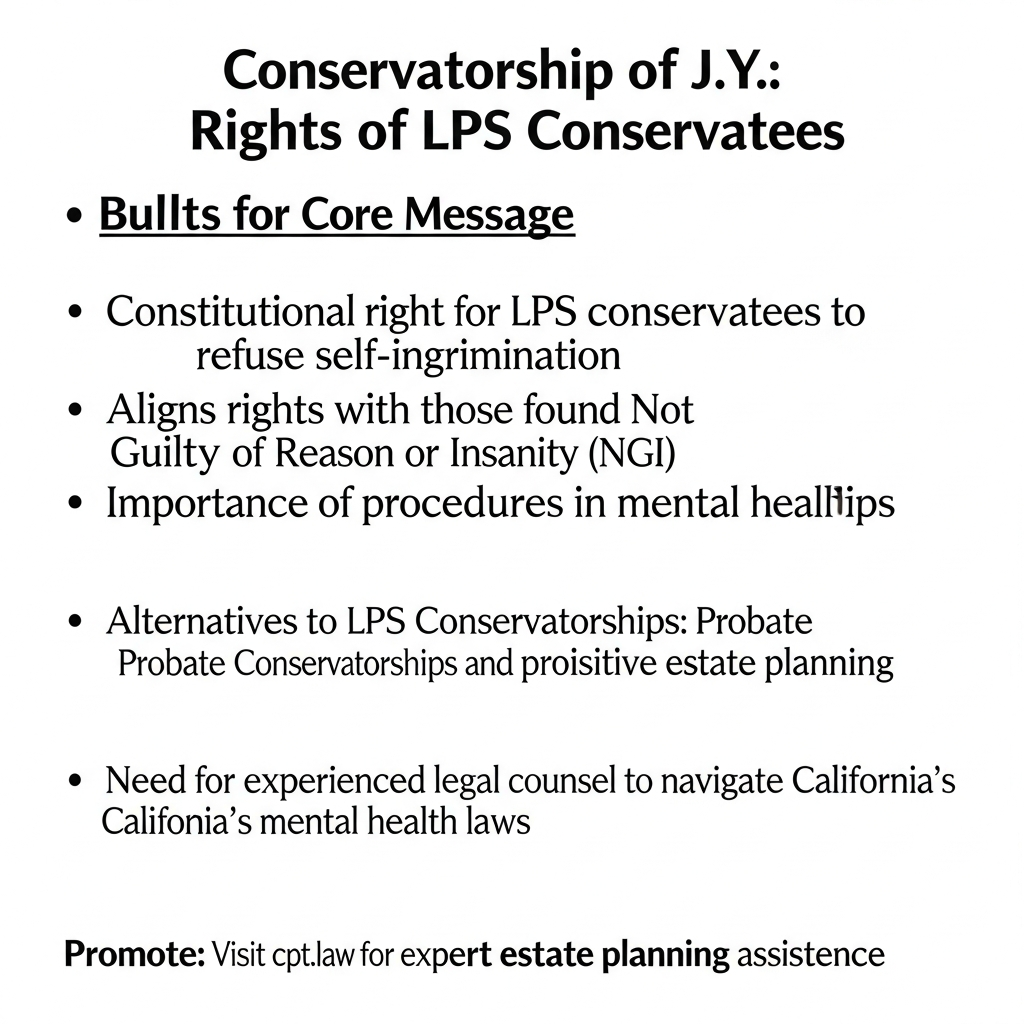
A significant ruling in the California Court of Appeal has established that individuals subject to Lanterman-Petris-Short (LPS) conservatorships possess a constitutional equal protection right to refuse to testify against themselves. As detailed in the court opinion for Conservatorship of J.Y., this decision aligns the rights of LPS conservatees with those found Not Guilty by Reason of Insanity (NGI), ensuring higher procedural protections in California mental health proceedings., this decision aligns the rights of LPS conservatees with those found Not Guilty by Reason of Insanity (NGI), ensuring higher procedural protections in California mental health proceedings.
Understanding LPS Conservatorships
In California, conservatorships generally fall into two categories: Probate Conservatorships (typically for the elderly or those with cognitive impairments like dementia) and LPS Conservatorships. The latter, established under the Lanterman-Petris-Short Act, is specifically designed for individuals determined to be gravely disabled due to a mental health disorder. due to a mental health disorder.
Because an LPS Conservatorship can lead to involuntary confinement in a locked psychiatric facility, the courts treat these proceedings with strict scrutiny to protect the civil liberties of the conservatee. This case highlights that while the state has an interest in caring for those who cannot care for themselves, it cannot bypass constitutional protections during legal proceedings. can lead to involuntary confinement in a locked psychiatric facility, the courts treat these proceedings with strict scrutiny to protect the civil liberties of the conservatee. This case highlights that while the state has an interest in caring for those who cannot care for themselves, it cannot bypass constitutional protections during legal proceedings.
The Right Against Compelled Testimony
The core legal issue in *Conservatorship of J.Y.* was whether a proposed conservatee could be forced to take the stand and testify during their own trial. In criminal cases, the Fifth Amendment protects defendants from self-incrimination. However, conservatorships are technically civil proceedings, not criminal ones.
The court ruled that because LPS conservatees face the possibility of “unbroken and indefinite period of state-sanctioned confinement,” they are similarly situated to individuals in NGI cases. Since NGI defendants have a statutory right not to be compelled to testify, the principles of Equal Protection dictate that LPS conservatees must be afforded that same right. dictate that LPS conservatees must be afforded that same right.
Impact on California Estate Planning and Families
For families navigating the complex world of mental health law and estate planning, this ruling underscores several critical points:
* Procedural Rigor: The courts are increasingly viewing conservatorships through the lens of civil rights. Petitioners must ensure all evidence is gathered properly without relying on the compelled testimony of the impaired individual.
* Estate Planning Alternatives: While LPS Conservatorships are initiated by the county/state, families often look to Probate Conservatorships or proactive estate planning tools. Implementing a robust Advanced Healthcare Directive and Power of Attorney before a crisis occurs can sometimes mitigate the need for restrictive court intervention.
* Legal Representation: Whether you are a family member concerned about a loved one or an individual facing a conservatorship petition, having experienced legal counsel is vital to navigate the distinct rules of the California Probate Code and the Welfare and Institutions Code. and the Welfare and Institutions Code.
About This Case
Source: Conservatorship of J.Y.: Do LPS Conservatees Have a Right Not to Testify in California?
California Probate and Trust, PC Can Help
* Free consultations: (866)-674-1130
* Experienced California estate planning
* Schedule consultation
* Learn more: cpt.law
Legal Disclaimer
This article is for informational purposes only. Consult with a qualified California estate planning attorney for advice specific to your situation.

About the Author: Dustin MacFarlane, Esq.
California Licensed Attorney | Estate Planning Specialist
Dustin MacFarlane is the founder of California Probate and Trust, PC, with over 15 years of experience in estate planning, probate administration, and trust law. Licensed by the California State Bar, Dustin has helped thousands of California families protect their assets and plan for the future.
CA Bar License: Active | Practice Areas: Estate Planning, Probate, Trust Administration | Location: Granite Bay, CA
Why Estate Planning Matters in California
California has unique estate planning laws that differ significantly from other states. Without proper planning, your assets may not pass according to your wishes, and your family could face unnecessary probate court proceedings.
A comprehensive California estate plan typically includes:
- A revocable living trust to avoid probate
- Pour-over will as a safety net
- Advance health care directive
- Durable power of attorney for finances
- Beneficiary designations on retirement accounts and life insurance
How Trusts Work in California
California’s trust law (Probate Code Division 9) governs how trusts are created, administered, and terminated. Understanding these rules is essential for effective estate planning.
Key benefits of California trusts:
- Avoid probate: Assets in a properly funded trust bypass California’s lengthy probate process
- Privacy: Unlike wills (which become public in probate), trusts remain private
- Control: You maintain control during your lifetime and direct distribution after death
- Incapacity planning: Your successor trustee manages assets if you become incapacitated
- Tax planning: Trusts can help minimize estate and income taxes
Need Expert Estate Planning Guidance?
California estate planning law is complex and constantly evolving. Don’t navigate it alone.
California Probate and Trust, PC has helped thousands of California families protect their assets and plan for the future.
📞 Call us today:
- Main Office: 866-400-0058
- Direct: 916-963-9968