
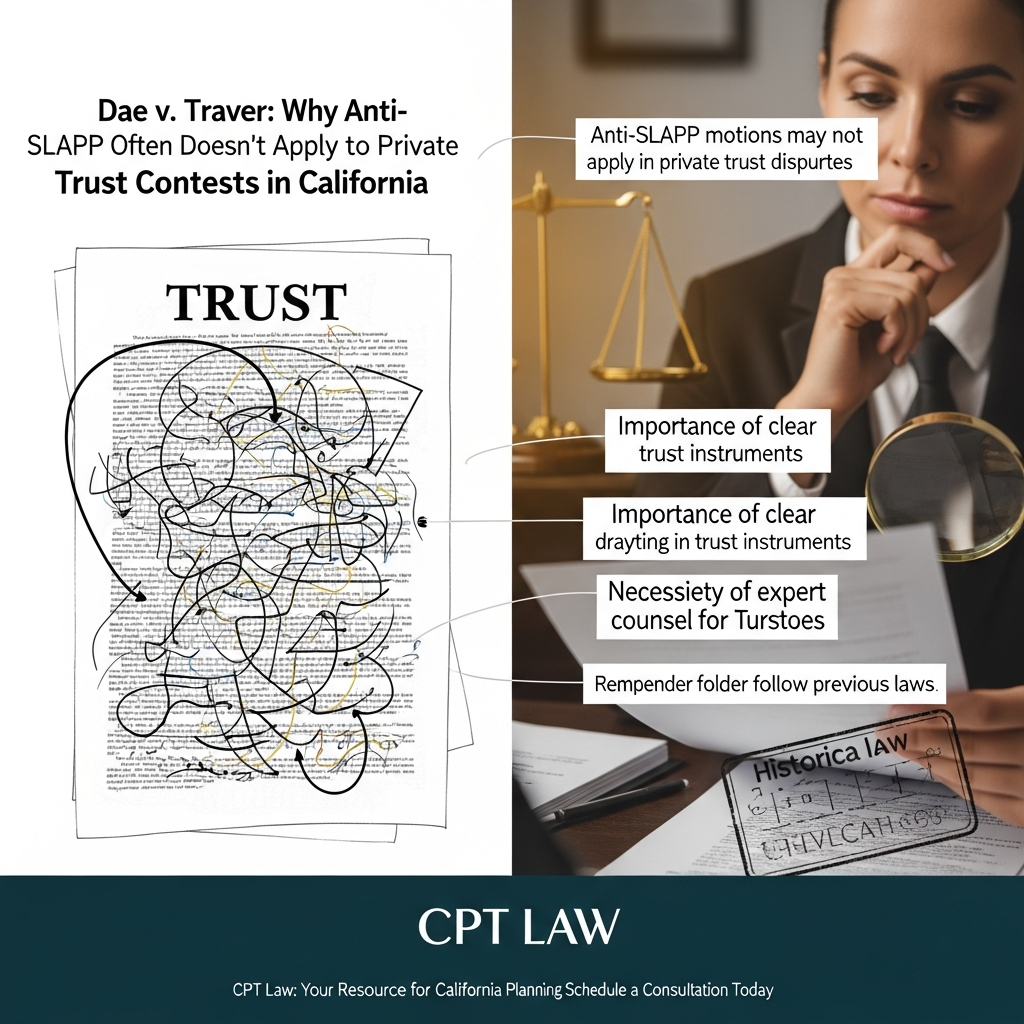
California Legal Implications: Anti-SLAPP Motions and Trust Contests
The California Court of Appeal decision in *Dae v. Traver* highlights the complexities involved when beneficiaries challenge a trustee’s actions and the procedural hurdles faced during litigation. As detailed in the summary from Sheppard Mullin, the court affirmed that a trustee’s petition to enforce a no contest clause had sufficient merit to survive an anti-SLAPP motion filed by a beneficiary. filed by a beneficiary.
For California families and trustees, this case underscores a critical reality: probate litigation is distinct from other civil matters, and procedural tools designed to dismiss lawsuits early, such as anti-SLAPP statutes, may not always apply in private trust disputes. When a beneficiary challenges the investment decisions of a trustee, they risk triggering a no contest clause, potentially jeopardizing their inheritance. Conversely, trustees must understand that their administrative decisions, even when made with expert advice, may still be subject to scrutiny and litigation., potentially jeopardizing their inheritance. Conversely, trustees must understand that their administrative decisions, even when made with expert advice, may still be subject to scrutiny and litigation.
Understanding Anti-SLAPP in the Probate Context
The anti-SLAPP statute (Strategic Lawsuit Against Public Participation) is a California law designed to protect individuals from lawsuits intended to silence their exercise of free speech or right to petition the government. In probate litigation, a party—often a beneficiary—might file an anti-SLAPP motion to dismiss a trustee’s claim, arguing that their challenge to the trust is a protected legal activity. to dismiss a trustee’s claim, arguing that their challenge to the trust is a protected legal activity.
However, as *Dae v. Traver* illustrates, prevailing on such a motion is difficult. The court utilizes a two-prong test:
1. Protected Activity: The moving party must show the claim arises from protected activity (e.g., filing a petition in court).
2. Minimal Merit: The responding party (the Trustee in this case) must only demonstrate that their claim has “minimal merit” to proceed. The responding party (the Trustee in this case) must only demonstrate that their claim has “minimal merit” to proceed.
Because the bar for “minimal merit” is relatively low, trustees can often defeat these motions by showing that a beneficiary’s actions arguably violated the trust’s terms, specifically regarding fiduciary discretion and no contest clauses..
The Evolution of No Contest Law
A crucial aspect of the *Dae v. Traver* decision was the application of California’s former no contest law. Because the trust in question became irrevocable prior to 2001, the court applied older, stricter standards. Under that regime, challenging a trustee’s business or investment decisions could more easily be interpreted as an attempt to impair the provisions of the trust.. Because the trust in question became irrevocable prior to 2001, the court applied older, stricter standards. Under that regime, challenging a trustee’s business or investment decisions could more easily be interpreted as an attempt to impair the provisions of the trust.
Current California law (for instruments becoming irrevocable after January 1, 2010) has narrowed the enforceability of no contest clauses. Today, these clauses generally only apply to:
– Direct contests brought without probable cause.
– Specific pleadings expressly identified in the no contest clause.
– Creditor claims..
– Specific pleadings expressly identified in the no contest clause.
– Creditor claims.
Despite these changes, the *Dae* case serves as a reminder that older trusts are still governed by the laws in effect at the time they became irrevocable. Trustees and beneficiaries dealing with long-standing family trusts must determine which version of the Probate Code applies to their specific situation.
Trustee Discretion and Investment Powers
The central dispute in this case involved “split dollar” life insurance arrangements and the trustee’s authority to manage assets. The trustee utilized specific trust provisions to engage in complex financial planning to minimize estate taxes. The court found that the beneficiary’s attack on these decisions could be seen as an attempt to subvert the trustor’s intent, which granted the trustee broad discretion., which granted the trustee broad discretion.
For California estate planning, this reinforces the importance of:
– Clear Drafting: Trust instruments should explicitly outline the scope of a trustee’s powers regarding investments and business entities.
– Expert Counsel: Trustees should seek professional legal and financial advice before entering into complex transactions like split dollar agreements to demonstrate they are acting reasonably and in good faith. Trustees should seek professional legal and financial advice before entering into complex transactions like split dollar agreements to demonstrate they are acting reasonably and in good faith.
About This Case
Source: Dae v. Traver: Why Anti-SLAPP Often Doesn’t Apply to Private Trust Contests in California
California Probate and Trust, PC Can Help
– Free consultations: (866)-674-1130
– Experienced California estate planning
– Schedule consultation
– Learn more: cpt.law
Legal Disclaimer
This article is for informational purposes only. Consult with a qualified California estate planning attorney for advice specific to your situation.

About the Author: Dustin MacFarlane, Esq.
California Licensed Attorney | Estate Planning Specialist
Dustin MacFarlane is the founder of California Probate and Trust, PC, with over 15 years of experience in estate planning, probate administration, and trust law. Licensed by the California State Bar, Dustin has helped thousands of California families protect their assets and plan for the future.
CA Bar License: Active | Practice Areas: Estate Planning, Probate, Trust Administration | Location: Granite Bay, CA