
California Legal Implications: Why Technical Details Matter in Estate Planning
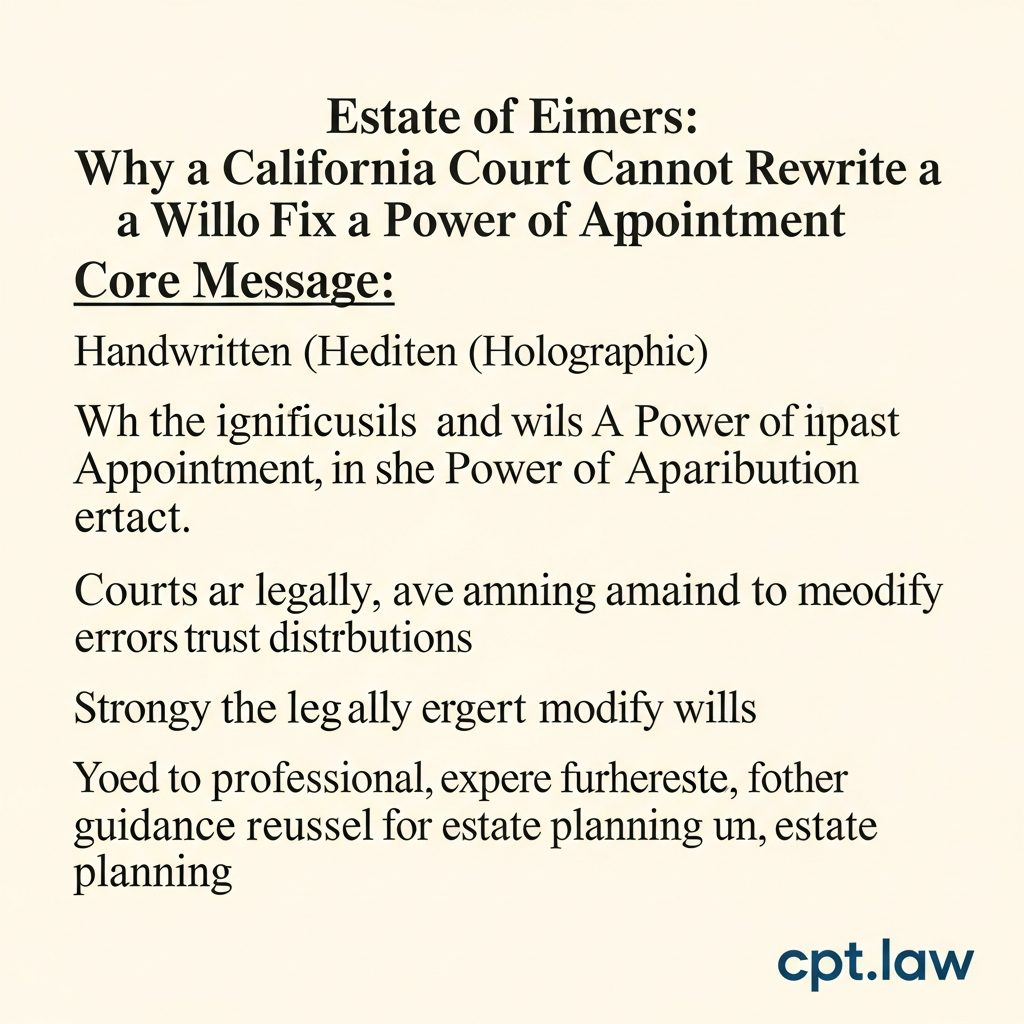
A recent ruling by the California Court of Appeal highlights a critical lesson for anyone relying on handwritten wills or attempting to exercise rights granted by a family trust without professional guidance. In *Estate of Eimers*, a court ruled that it could not rewrite a will to validate a gift when the deceased failed to follow specific instructions regarding a Power of Appointment..
As detailed in the court opinion from Estate of Eimers, the decedent attempted to leave his share of a family trust to specific individuals using a holographic will (a handwritten will). However, the original trust document required that any distribution of those shares must specifically reference the Power of Appointment. Because the decedent’s will failed to include this specific legal language, the court refused to “reform” (amend) the will to fix the mistake, causing the gift to fail.. Because the decedent’s will failed to include this specific legal language, the court refused to “reform” (amend) the will to fix the mistake, causing the gift to fail.
Understanding the Power of Appointment
In California estate planning, a Power of Appointment is a legal authority granted to a beneficiary within a trust. It allows that beneficiary to designate who will receive certain assets upon their death. However, the original creators of the trust often place strict requirements on how this power must be used to ensure it is done intentionally and not accidentally. is a legal authority granted to a beneficiary within a trust. It allows that beneficiary to designate who will receive certain assets upon their death. However, the original creators of the trust often place strict requirements on how this power must be used to ensure it is done intentionally and not accidentally.
A common requirement is that the beneficiary must execute a will that specifically refers to the Power of Appointment. A general statement such as “I leave all my property to John Doe” is often insufficient to exercise this power if the trust demands specific reference. This safeguards the original grantors’ assets from being distributed via a standard residuary clause without the beneficiary’s explicit intent.. A general statement such as “I leave all my property to John Doe” is often insufficient to exercise this power if the trust demands specific reference. This safeguards the original grantors’ assets from being distributed via a standard residuary clause without the beneficiary’s explicit intent.
Why Courts Cannot Always Fix Mistakes
California courts generally have the power to reform a will—meaning they can correct mistakes to ensure the document reflects the testator’s true intent. However, *Estate of Eimers* establishes a significant boundary to this power.
The court held that it could not reform the will to include the missing reference to the Power of Appointment. Doing so would essentially nullify the requirements set by the California Probate Code and the original trust instrument. The court determined that even though the decedent clearly intended to give the assets to his friends, his failure to follow the strict technical requirements of the trust meant the court could not intervene to save the gift.. Doing so would essentially nullify the requirements set by the California Probate Code and the original trust instrument. The court determined that even though the decedent clearly intended to give the assets to his friends, his failure to follow the strict technical requirements of the trust meant the court could not intervene to save the gift.
The Risks of Holographic Wills
This case serves as a stark warning against the use of holographic wills. While handwritten wills are legal in California if they meet specific criteria, they are frequently drafted by individuals without legal training who are unaware of complex interactions between different estate planning instruments.. While handwritten wills are legal in California if they meet specific criteria, they are frequently drafted by individuals without legal training who are unaware of complex interactions between different estate planning instruments.
When a layperson writes their own will, they often miss:
– Specific language required by pre-existing trusts.
– Statutory requirements for exercising powers.
– The distinction between probate assets and trust assets.
To ensure your assets go to your intended beneficiaries, it is vital to coordinate your Last Will and Testament with any existing trusts under the guidance of a qualified attorney. with any existing trusts under the guidance of a qualified attorney.
About This Case
Source: Estate of Eimers: Why a California Court Cannot Rewrite a Will to Fix a Power of Appointment
California Probate and Trust, PC Can Help
– Free consultations: (866)-674-1130
– Experienced California estate planning
– Schedule consultation
– Learn more: cpt.law
Legal Disclaimer
This article is for informational purposes only. Consult with a qualified California estate planning attorney for advice specific to your situation.

About the Author: Dustin MacFarlane, Esq.
California Licensed Attorney | Estate Planning Specialist
Dustin MacFarlane is the founder of California Probate and Trust, PC, with over 15 years of experience in estate planning, probate administration, and trust law. Licensed by the California State Bar, Dustin has helped thousands of California families protect their assets and plan for the future.
CA Bar License: Active | Practice Areas: Estate Planning, Probate, Trust Administration | Location: Granite Bay, CA