
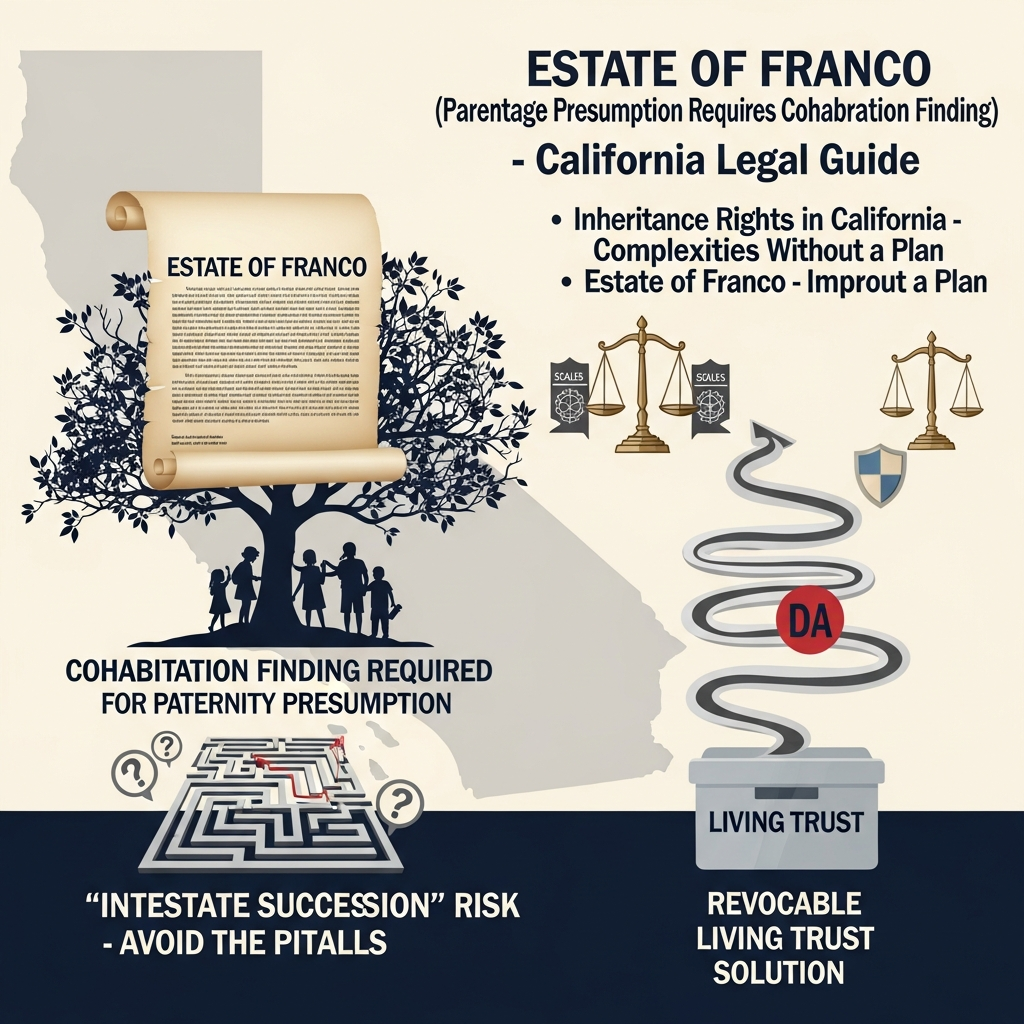
California Legal Implications: Establishing Paternity and Inheritance Rights
A recent appellate decision, *Estate of Franco*, highlights the complexities surrounding inheritance rights when an individual passes away without a comprehensive estate plan. This case serves as a crucial reminder for California families about the importance of establishing clear beneficiary designations to avoid lengthy litigation regarding biological versus legal parentage.
In the *Estate of Franco*, summarized from the Court of Appeal decision, a claimant named Bertuccio sought to establish that the decedent was his biological father in order to inherit as an heir. The trial court initially blocked Bertuccio from making this claim. The court reasoned that because Bertuccio’s mother was married to another man at the time of his birth, and that husband was named on the birth certificate, Bertuccio was legally presumed to be the child of the husband, not the decedent., a claimant named Bertuccio sought to establish that the decedent was his biological father in order to inherit as an heir. The trial court initially blocked Bertuccio from making this claim. The court reasoned that because Bertuccio’s mother was married to another man at the time of his birth, and that husband was named on the birth certificate, Bertuccio was legally presumed to be the child of the husband, not the decedent.
However, the Appellate Court reversed this decision. They clarified that under California Family Code Section 7540, the “conclusive presumption” that a husband is the father of a child born during the marriage only applies if the spouses were actually cohabitating (living together) at the time of conception and birth. Because the trial court never factually established that the mother and her husband were living together, the presumption should not have automatically barred Bertuccio from proving the decedent was his father. (living together) at the time of conception and birth. Because the trial court never factually established that the mother and her husband were living together, the presumption should not have automatically barred Bertuccio from proving the decedent was his father.
The Risks of Intestate Succession
This case illustrates the dangers of relying on intestate succession. When a person dies without a Will or Trust, California law dictates who inherits their assets. These laws rely on strict statutory definitions of “heir,” “child,” and “parent.”. When a person dies without a Will or Trust, California law dictates who inherits their assets. These laws rely on strict statutory definitions of “heir,” “child,” and “parent.”
As seen in *Estate of Franco*, determining who qualifies as a “child” can become legally murky when biological realities conflict with legal presumptions. Without a specific document naming beneficiaries, the court must rely on default rules that may exclude intended loved ones or require expensive litigation to prove biological connections.
Presumptions of Parentage in California
California law places a high value on the integrity of the family unit. Consequently, there are legal presumptions intended to protect children born into a marriage. The presumption of parentage generally assumes that a child born to a married woman is the child of her husband. generally assumes that a child born to a married woman is the child of her husband.
However, as the appellate court noted, this presumption is not absolute without specific factual findings, such as cohabitation. For families with complex dynamics—such as stepchildren, children born out of wedlock, or situations involving separation without legal divorce—relying on these default legal definitions is risky.. For families with complex dynamics—such as stepchildren, children born out of wedlock, or situations involving separation without legal divorce—relying on these default legal definitions is risky.
How Estate Planning Avoids Litigation
The litigation in *Estate of Franco* likely could have been avoided entirely with a properly drafted Revocable Living Trust. Unlike intestate succession, a Trust allows an individual to specifically name their beneficiaries.. Unlike intestate succession, a Trust allows an individual to specifically name their beneficiaries.
If the decedent had created a Trust naming Bertuccio as a beneficiary, the court generally would not have needed to determine biological paternity or analyze the cohabitation status of the mother’s marriage. The Trust document would have served as the controlling instruction, bypassing the restrictive statutory definitions of an intestate heir.
Why You Need a Comprehensive Plan
To ensure your assets are distributed according to your wishes and to prevent your loved ones from enduring years of court battles to prove their relationship to you, it is vital to execute a comprehensive estate plan. A robust plan typically includes:
– Revocable Living Trust: To manage and distribute assets without probate.
– Pour-Over Will: To catch any assets left out of the trust.
– Advance Health Care Directive: To make medical decisions if you are incapacitated.: To make medical decisions if you are incapacitated.
For more information on how to protect your legacy, visit cpt.law..
About This Case
Source: Estate of Franco (Parentage Presumption Requires Cohabitation Finding)
California Probate and Trust, PC Can Help
– Free consultations: (866)-674-1130
– Experienced California estate planning
– Schedule consultation
– Learn more: cpt.law
– Free consultations: (866)-674-1130
– Experienced California estate planning
– Schedule consultation
– Learn more: cpt.law
Legal Disclaimer
This article is for informational purposes only. Consult with a qualified California estate planning attorney for advice specific to your situation.

About the Author: Dustin MacFarlane, Esq.
California Licensed Attorney | Estate Planning Specialist
Dustin MacFarlane is the founder of California Probate and Trust, PC, with over 15 years of experience in estate planning, probate administration, and trust law. Licensed by the California State Bar, Dustin has helped thousands of California families protect their assets and plan for the future.
CA Bar License: Active | Practice Areas: Estate Planning, Probate, Trust Administration | Location: Granite Bay, CA