
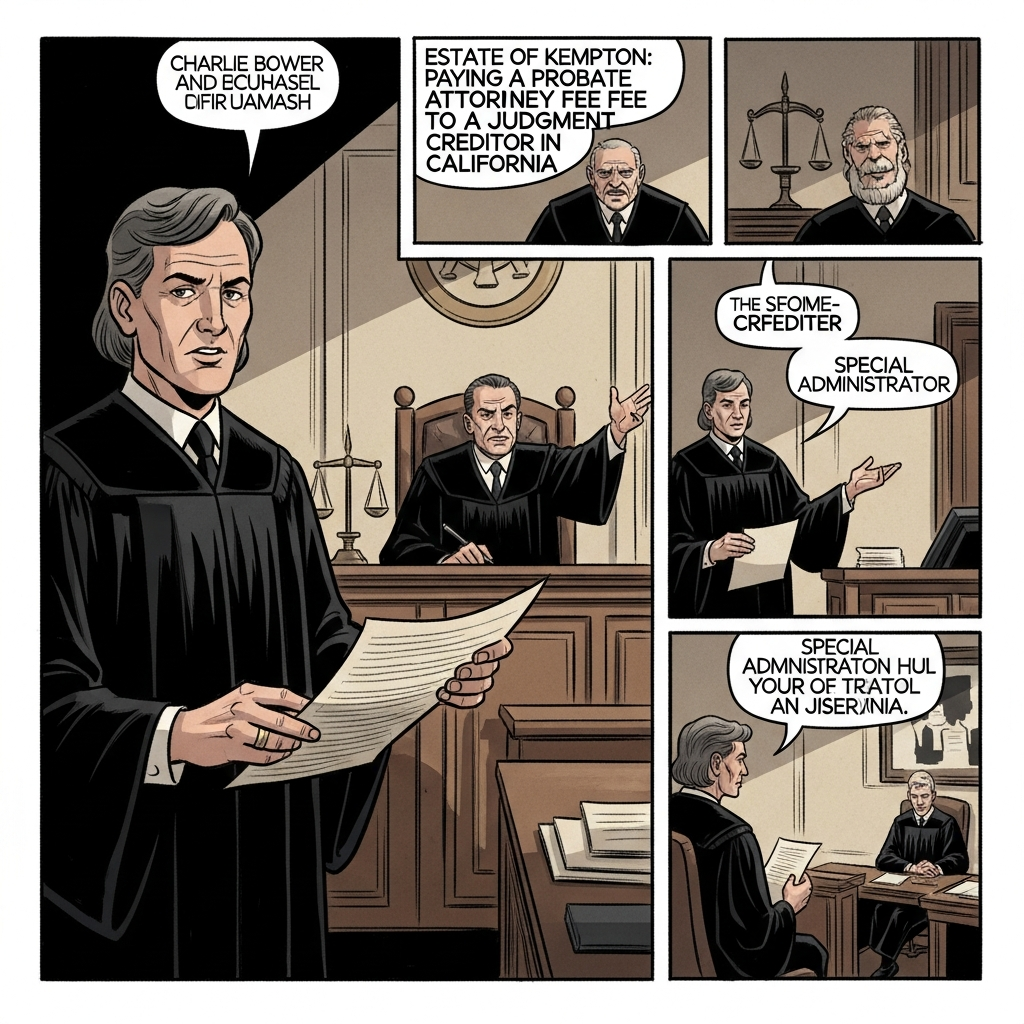
California Legal Implications: Probate Court Discretion Over Fees and Debts
A recent decision by the California Court of Appeal, *Estate of Kempton*, highlights the broad authority probate courts possess regarding the distribution of funds and the payment of fees. In this case, detailed in the opinion filed by the First District Court of Appeal, the court affirmed that a Special Administrator had the discretion to pay statutory fees earned by an attorney directly to a third-party judgment creditor to satisfy the attorney’s debts, rather than paying the attorney himself. earned by an attorney directly to a third-party judgment creditor to satisfy the attorney’s debts, rather than paying the attorney himself.
For California families and trustees, this case serves as a crucial reminder of the complexity of probate administration and the importance of professional oversight. It demonstrates that the probate court’s power extends beyond simply passing assets to heirs; the court also ensures that financial obligations, including valid judgment liens, are addressed properly during the proceedings., are addressed properly during the proceedings.
Understanding Statutory Fees in California
In California, the fees paid to the personal representative (administrator or executor) and their attorney are not arbitrary. They are set by law under the California Probate Code and are known as statutory fees. These fees are calculated as a percentage of the value of the estate assets accounted for:
– 4% on the first $100,000
– 3% on the next $100,000
– 2% on the next $800,000
– 1% on the next $9,000,000. These fees are calculated as a percentage of the value of the estate assets accounted for:
– 4% on the first $100,000
– 3% on the next $100,000
– 2% on the next $800,000
– 1% on the next $9,000,000
While these fees are guaranteed by statute for ordinary services, the court retains the final authority to approve payment. As seen in *Estate of Kempton*, if the recipient of the fee (in this case, the former attorney) owes money due to a legal judgment, the court may authorize diverting those funds to pay the creditor.
The Role of the Special Administrator
This case also illustrates the function of a Special Administrator. When a regular administrator or executor is removed—often due to delays or mismanagement, as occurred in the *Kempton* estate—the court appoints a Special Administrator to take immediate charge of the estate. to take immediate charge of the estate.
The Special Administrator’s duty is to protect the estate’s assets and finalize the accounting. In *Kempton*, the Special Administrator acted prudently by recognizing a valid abstract of judgment against the former attorney. Instead of ignoring the debt, the administrator requested court authority to pay the attorney’s $1,000 fee directly to the lienholder. The appellate court confirmed that because the probate court has the power to deny fees entirely, it also has the discretion to approve payment to a third party entitled to the money. against the former attorney. Instead of ignoring the debt, the administrator requested court authority to pay the attorney’s $1,000 fee directly to the lienholder. The appellate court confirmed that because the probate court has the power to deny fees entirely, it also has the discretion to approve payment to a third party entitled to the money.
Risks of Frivolous Litigation
The *Kempton* decision also serves as a warning against filing frivolous appeals. The attorney in question had a history of baseless lawsuits, leading to his disbarment. When he appealed the probate court’s decision to pay his fee to his creditor, the appellate court not only rejected his arguments but also directed the probate court to award sanctions against him. against him.
For beneficiaries and administrators, this underscores the value of hiring ethical, competent estate planning attorneys. Engaging in meritless litigation drains estate resources and can result in severe financial penalties from the court.. Engaging in meritless litigation drains estate resources and can result in severe financial penalties from the court.
About This Case
Source: Estate of Kempton (A164148)
California Probate and Trust, PC Can Help
Navigating probate court, statutory fees, and creditor claims requires experienced legal guidance. We help families manage complex estate administration efficiently and ethically.
– Free consultations: (866)-674-1130
– Experienced California estate planning
– Schedule consultation
– Learn more: cpt.law
Legal Disclaimer
This article is for informational purposes only. Consult with a qualified California estate planning attorney for advice specific to your situation.

About the Author: Dustin MacFarlane, Esq.
California Licensed Attorney | Estate Planning Specialist
Dustin MacFarlane is the founder of California Probate and Trust, PC, with over 15 years of experience in estate planning, probate administration, and trust law. Licensed by the California State Bar, Dustin has helped thousands of California families protect their assets and plan for the future.
CA Bar License: Active | Practice Areas: Estate Planning, Probate, Trust Administration | Location: Granite Bay, CA