
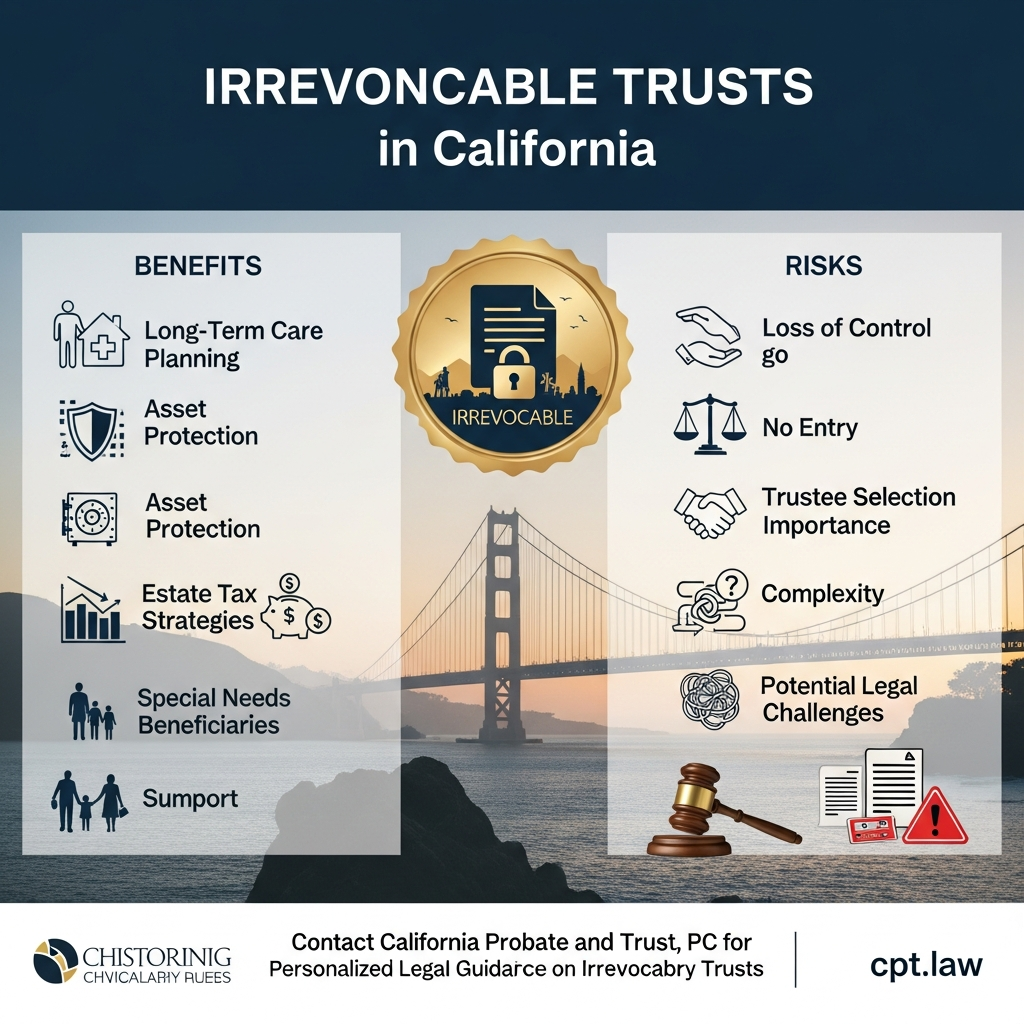
Irrevocable Trusts in California: What They Are, When They Help, and the Risks to Know
If you are a California resident thinking about protecting a home, planning for long-term care, or leaving an inheritance without conflict, it is normal to feel overwhelmed by the number of “trust” options and the fear of making an irreversible mistake.
This article is for California residents, trustees, and families who are weighing whether an irrevocable trust is the right tool, what it can and cannot do, and when it is time to talk to a lawyer before signing anything.
For background context, see this overview source: 6A Irrevocable Trusts – California Estate Planning – CEB.
Quick answer: key takeaways
What is an irrevocable trust? (Plain-English definition)
An irrevocable trust is a legal arrangement where assets are transferred to a trust and managed by a trustee for the benefit of one or more beneficiaries, under terms that generally cannot be changed by the person who created it.
Who is involved?
What makes it “irrevocable”?
In most cases, once the trust is signed and funded, the settlor cannot:
There are exceptions and workarounds in some situations, but they depend on the document’s language, consent requirements, court involvement, and the specific kind of irrevocable trust.
Why Californians use irrevocable trusts
Irrevocable trusts are not the default for most families. A revocable living trust is usually the “standard” probate-avoidance tool.
Irrevocable trusts are typically used when the goal is something a revocable trust cannot do well, such as moving assets out of the settlor’s estate or protecting assets from certain risks.
1. Long-term care planning and Medi-Cal concerns
A common scenario is an older California homeowner who:
Some irrevocable trust strategies can be used in long-term care planning, but the rules are highly fact-specific. Transfers can have waiting periods and consequences. The “right” approach depends on income, assets, health, and timing.
2. Asset protection planning (in the real world)
People sometimes consider irrevocable trusts when they worry about:
California has rules and public policy limits around fraudulent transfers and creditor rights. An “asset protection trust” that is done too late or done incorrectly can fail and can also create additional problems.
3. Estate tax and advanced family wealth planning
For higher net worth families, irrevocable trusts may support:
Even when taxes are part of the plan, California-specific property issues, community property, and real estate transfer details matter.
4. Protecting a beneficiary (special needs, addiction, or creditor risk)
An irrevocable trust can help protect a beneficiary who:
In these cases, the “irrevocable” structure can be a feature, not a bug, because it limits impulsive changes and reduces pressure on the family.
What an irrevocable trust does not do (common misconceptions)
It is not a guaranteed way to “avoid probate” by itself
Probate avoidance depends on proper titling and beneficiary designations. If you do not actually transfer the asset into the trust, the trust may not help.
It is not a guaranteed shield from creditors
Creditor protection depends on the timing of transfers, the type of trust, who is a beneficiary, and whether the transfer is considered fraudulent.
It does not automatically eliminate taxes
Trust tax rules are complex. Some irrevocable trusts are taxed at compressed trust tax brackets. Some are “grantor trusts” where the settlor pays the tax. Tax results depend on structure.
What assets can be put into an irrevocable trust in California?
It depends on the trust purpose and your overall plan, but commonly:
Special caution: California real estate
Transferring California real estate may trigger:
This is a major reason families should not “DIY” trust funding for real estate.
How irrevocable trusts work day to day
The practical experience of an irrevocable trust usually comes down to two questions:
A realistic mini-scenario
Imagine a San Diego parent who owns a condo and has an adult child who is financially responsible but recently married. The parent wants the condo’s value to help the child long-term, but does not want the condo exposed to a future divorce.
An irrevocable trust might be designed so that:
Whether this works depends on careful drafting and consistent administration.
Risks and downsides of irrevocable trusts
1. Loss of control
Once assets are transferred, the settlor cannot usually use them like personal property. That is the point, and it is also the biggest downside.
2. Trustee selection can make or break the plan
A trustee has duties and significant authority. If you choose the wrong trustee, the trust may:
3. Irrevocable does not always mean “simple”
Irrevocable trusts often require:
4. The plan can backfire if the trust is not funded correctly
If assets are left outside the trust, the family might still face:

About the Author: Dustin MacFarlane, Esq.
California Licensed Attorney | Estate Planning Specialist
Dustin MacFarlane is the founder of California Probate and Trust, PC, with over 15 years of experience in estate planning, probate administration, and trust law. Licensed by the California State Bar, Dustin has helped thousands of California families protect their assets and plan for the future.
CA Bar License: Active | Practice Areas: Estate Planning, Probate, Trust Administration | Location: Granite Bay, CA