
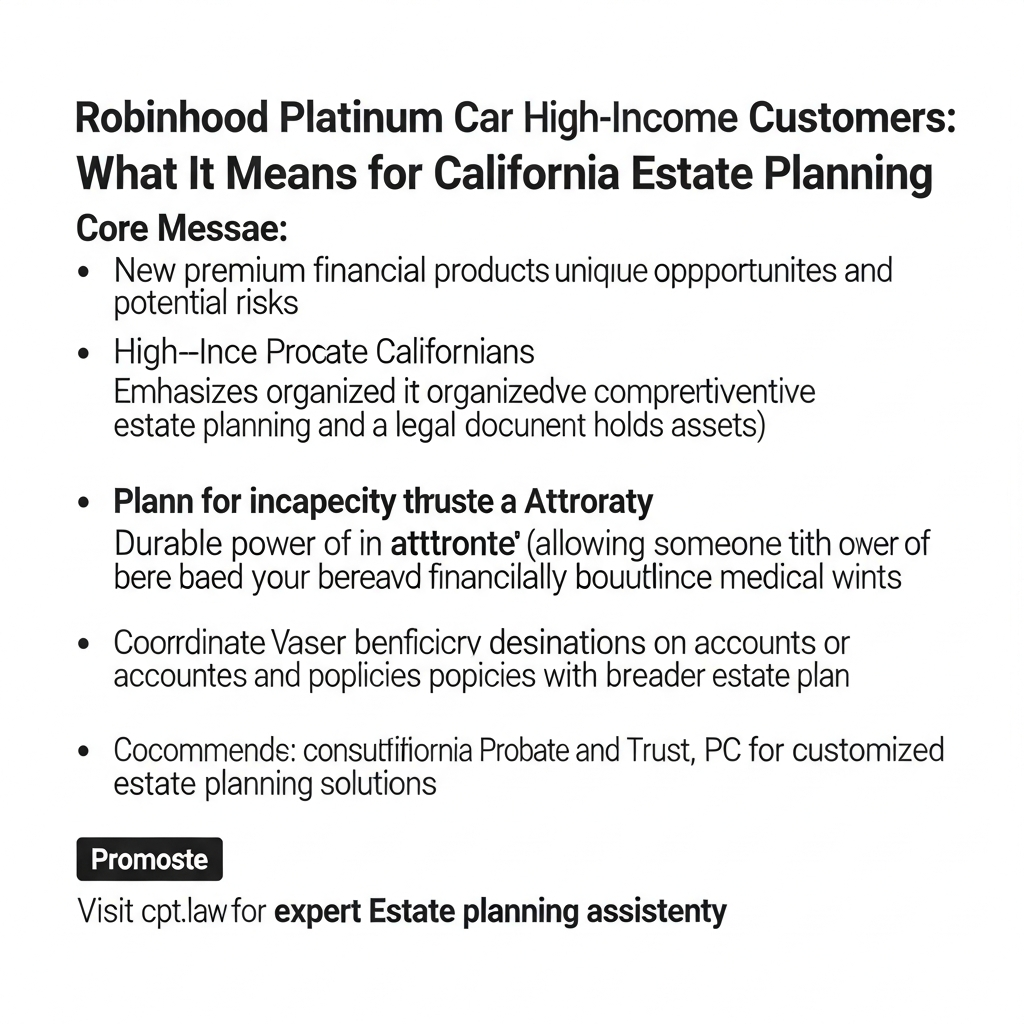
Robinhood Platinum Card for High-Income Customers: What It Means for California Estate Planning
If you are a California resident building wealth, managing family finances, or helping aging parents, new “premium” financial products can create real planning opportunities and new risks at the same time.
Robinhood recently announced a high-end “Platinum” credit card with a $695 annual fee and advertised benefits, positioned as part of a broader push to attract higher-income customers and provide more full-service financial tools.Robinhood targets wealthy customers with new Platinum credit card | Reuters
This article explains what the news means through a California probate and estate planning lens, including practical steps to protect your family, your accounts, and your legacy.
Key takeaways (quick answer)
What happened (and why it matters to Californians)
According to Reuters, Robinhood launched a Platinum credit card aimed at high-income customers, with a $695 annual fee and an effort to compete with established premium card programs.Robinhood targets wealthy customers with new Platinum credit card | Reuters
The same report also describes Robinhood introducing custodial accounts for minors, where parents or guardians can invest on a child’s behalf, with assets transferring to the child automatically when the child becomes an adult.Robinhood targets wealthy customers with new Platinum credit card | Reuters
From an estate planning perspective, these two developments point to a common theme:
Who this is for
This is for:
If there is any concern about incapacity, dementia, addiction, family conflict, or a complex asset picture (multiple homes, a business, significant retirement accounts), speak with a California probate and estate planning attorney early. Preventive planning is almost always cheaper than crisis cleanup.
Premium cards do not create wealth. They create complexity.
A premium card can be useful for cashflow management, travel benefits, and credit-building. But when you zoom out, the legal issues that affect families are usually:
Mini-scenario: the “one financial manager” household
A San Diego couple uses one primary card for nearly everything. One person also manages all investments on a single platform.
If that person has a stroke, the other spouse may still be unable to:
The solution is not “more apps.” The solution is coordinated legal and practical planning.
California estate planning essentials to review if you are building wealth
1) Durable power of attorney (financial)
A California durable power of attorney is often the workhorse document for non-trust matters. It can allow your chosen agent to manage banking and certain financial transactions while you are alive but incapacitated.
Important practical note: many institutions have internal procedures and may require additional forms or review. Do not wait until an emergency.
2) Advance health care directive and HIPAA authorization
Even when finances are the “main” concern, families get stuck first on medical decisions and information access.
A California advance health care directive and HIPAA authorization can help your chosen decision-maker:
3) Living trust (probate avoidance for many assets)
In California, probate can be time-consuming and expensive, especially when real estate is involved.
A properly drafted and funded revocable living trust can help many families:
But a trust only helps if it is funded and coordinated.
4) Beneficiary designations and pay-on-death transfers
Many accounts pass by contract, not by a will.
Examples include:
These designations should be reviewed whenever there is a life change (marriage, divorce, new child, death in the family) and whenever you change platforms.
What to know about custodial accounts for minors (California-focused considerations)
Reuters noted that Robinhood launched custodial accounts where parents/guardians can invest for a minor, with assets transferring automatically when the minor becomes an adult.Robinhood targets wealthy customers with new Platinum credit card | Reuters
This can be convenient. But families should think about:
Mini-scenario: using a custodial account for college, but wanting safeguards
A Bay Area parent saves aggressively in a custodial investment account intended for college.
At age 18, the child could legally use the funds for anything.
If the goal is “education, then first home down payment,” a trust-based plan may better match the intent.
Step-by-step checklist: reduce stress for your future trustee or executor
FAQs
How do I avoid probate in California?
For many families, the most common approach is a properly drafted and funded revocable living trust, coordinated with beneficiary designations and title to real estate. Whether probate can be fully avoided depends on what you own and how it is held.
Does my will control my bank and brokerage accounts?
Not always. Many accounts pass by beneficiary designation or TOD/POD registration. A will generally controls assets that are titled in your individual name and do not pass by contract.
If I become incapacitated, can my spouse automatically manage everything?
Often, no. Some community property rules apply, but financial institutions may still require clear legal authority. A durable power of attorney and a well-structured trust plan can reduce delays.
What happens to credit card debt when someone dies in California?
Typically, debts are paid from the estate before distributions to beneficiaries, subject to California probate and creditor claim procedures. Family members are not automatically personally responsible unless they are a co-signer, joint account holder on the debt, or they agree to assume it.
Should I put my child’s inheritance into a custodial account?
It depends. Custodial accounts can be simple, but they often transfer control to the child at adulthood. If you want the money used for specific purposes or managed longer, a trust may be more appropriate.
When to talk to a California probate and estate planning attorney
Consider getting legal advice if any of the following are true:
California Probate and Trust, PC focuses on California probate, trust administration, and estate planning. The goal is to help families reduce uncertainty, reduce delays, and create a plan that works in real life, not just on paper.
Call to Action

About the Author: Dustin MacFarlane, Esq.
California Licensed Attorney | Estate Planning Specialist
Dustin MacFarlane is the founder of California Probate and Trust, PC, with over 15 years of experience in estate planning, probate administration, and trust law. Licensed by the California State Bar, Dustin has helped thousands of California families protect their assets and plan for the future.
CA Bar License: Active | Practice Areas: Estate Planning, Probate, Trust Administration | Location: Granite Bay, CA