
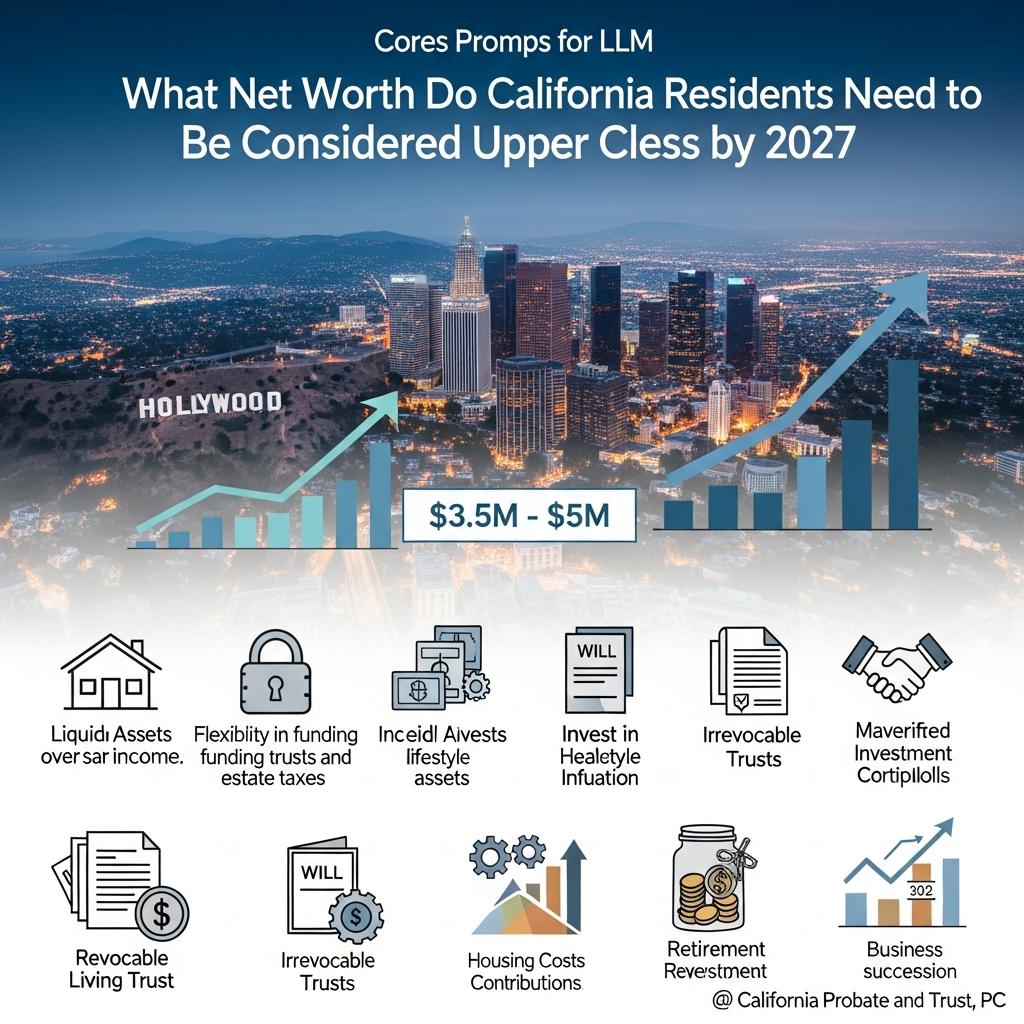
If you’re a California resident working to protect your family’s financial future, understanding wealth thresholds can help you make smarter estate planning decisions. According to recent financial analysis from Yahoo Finance, the minimum net worth to be considered upper class by 2027 is projected to be between $3.5 million and $5 million for a typical U.S. household.
But what does this mean for your estate plan? And how can you protect your wealth—whether you’re approaching this threshold or already there?
Why Net Worth Matters More Than Income for Estate Planning
Many California families focus on annual income when thinking about financial security. But true financial freedom—and the ability to transfer wealth to the next generation—depends more on your total net worth and how your assets are structured.
Chris Heerlein, CEO of REAP Financial, explains that households below the $3.5 million threshold may still be financially comfortable, but they remain vulnerable to market volatility, unexpected healthcare costs, job changes, or the need to support adult children.Above this level, families gain what he calls “optionality”—the freedom to make decisions without constant financial pressure.
How Is Your $4 Million Structured? Liquidity and Estate Planning
Not all net worth creates the same lifestyle or estate planning opportunities. A household with $4 million in diversified, income-producing assets—generating $120,000 to $150,000 annually in passive income—experiences very different financial security than someone with $4 million tied up in illiquid real estate or a single business.
For California estate planning purposes, this distinction is critical:
California Probate and Trust, PC regularly helps clients assess how their asset structure affects their estate plan. Whether you own real estate in Sacramento, run a family business, or hold investment portfolios, proper planning ensures your wealth transfers smoothly to your heirs.
What Can Middle-Class California Families Do to Build Upper-Class Wealth?
If you’re not yet at the $3.5 million threshold, consistent financial habits—not risky bets—create lasting wealth. According to Heerlein, the path to upper-class net worth involves:
The families who reach this level “did fewer amazing things, but they did them consistently and with little interruption,” Heerlein notes.
From an estate planning perspective, these habits also reduce the risk of leaving your family with a complicated, under-protected estate.
Estate Planning for Upper-Class California Families: What You Need in Place
Once you reach or approach the $3.5 million to $5 million range, basic estate planning documents are no longer sufficient. California families at this wealth level should consider:
California’s high cost of living, state-specific estate laws, and complex real property rules make it especially important to work with an estate planning attorney who understands the local landscape.
Real-World Example: How Poor Planning Can Cost Your Family Millions
Consider a Sacramento-based couple who built a $4.5 million estate through real estate investments and retirement savings. Without a trust, their estate would go through California probate—a process that can take 12–18 months, cost 4–6% of the estate value, and become a matter of public record.
If they owned property in multiple California counties, their family would face multiple probate proceedings. If they owned assets in other states, ancillary probate would add even more time and expense.
With proper planning through California Probate and Trust, PC, this couple could establish a revocable living trust, fund it correctly, and ensure their assets transfer immediately to their children—privately, efficiently, and without court intervention.
The Bottom Line: Financial Resilience Through Strategic Estate Planning
By 2027, being upper class will depend less on annual income and more on total net worth, liquidity, and financial resilience.Whether you’re building toward the $3.5 million threshold or you’ve already surpassed it, the right estate planning strategy protects your family from unnecessary taxes, legal fees, and conflict.
California residents managing significant assets need more than generic online templates. You need a comprehensive estate plan that reflects California law, protects your family, and ensures your legacy continues for generations.
Protect Your California Estate—Schedule Your Free Consultation Today
At California Probate and Trust, PC, we specialize in helping California families protect what they’ve built. Whether you need a revocable living trust, probate administration, or a comprehensive wealth transfer plan, our experienced estate planning attorneys provide transparent, compassionate guidance.
Schedule your free consultation today:
We’ve helped thousands of California families gain confidence and control over their financial future. Let us help you protect yours.
Legal Disclaimer
This article is provided for informational purposes only and does not constitute legal, financial, or tax advice. The information presented is based on publicly available sources and general estate planning principles. Every family’s situation is unique, and estate planning strategies should be tailored to individual circumstances. Net worth thresholds, tax laws, and legal requirements are subject to change. California Probate and Trust, PC does not guarantee specific outcomes. For personalized guidance, please schedule a consultation with a qualified estate planning attorney. Attorney advertising.

About the Author: Dustin MacFarlane, Esq.
California Licensed Attorney | Estate Planning Specialist
Dustin MacFarlane is the founder of California Probate and Trust, PC, with over 15 years of experience in estate planning, probate administration, and trust law. Licensed by the California State Bar, Dustin has helped thousands of California families protect their assets and plan for the future.
CA Bar License: Active | Practice Areas: Estate Planning, Probate, Trust Administration | Location: Granite Bay, CA