
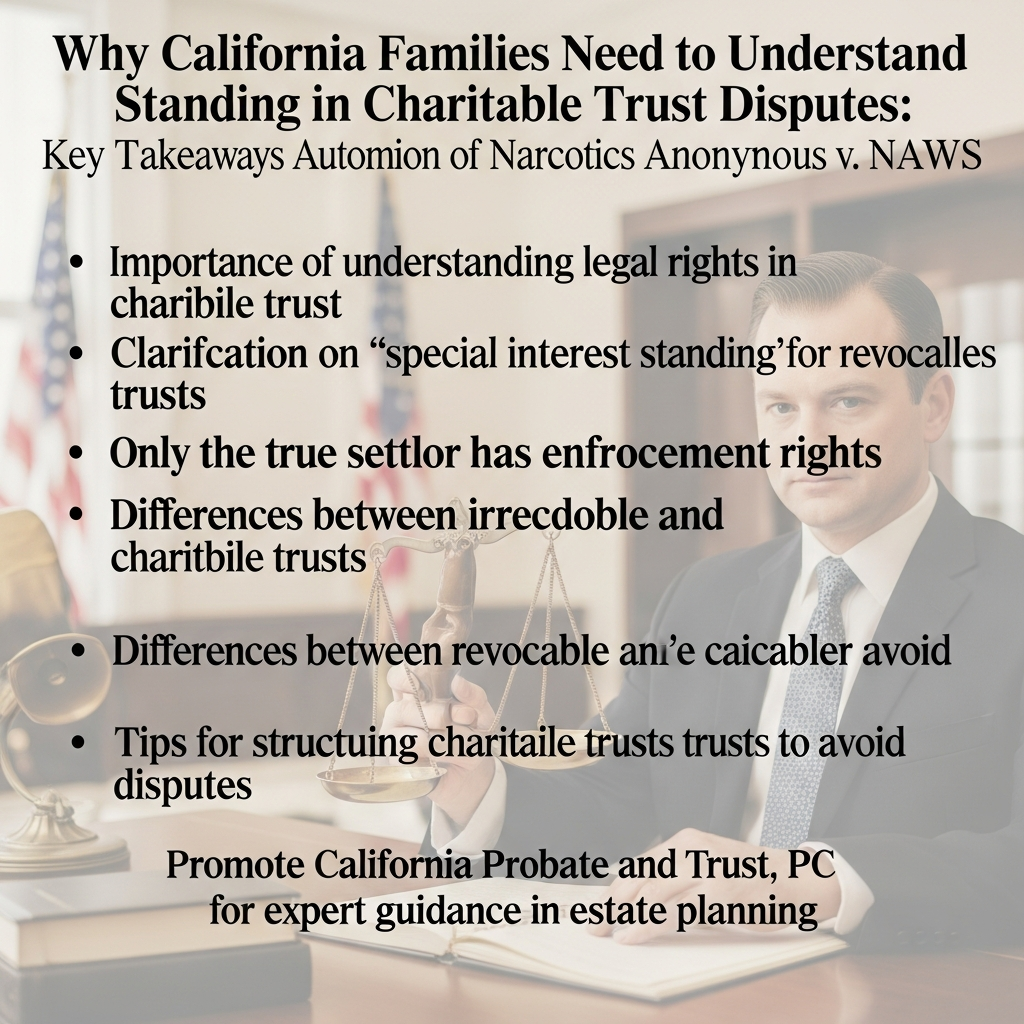
Why California Families Need to Understand Standing in Charitable Trust Disputes: Key Takeaways from Autonomous Region of Narcotics Anonymous v. NAWS
If you’re a California resident managing charitable assets, serving on a nonprofit board, or creating a revocable trust for philanthropic purposes, understanding who has the legal right to enforce trust terms is critical to protecting your legacy and avoiding costly litigation.
What This Case Means for You
The California Court of Appeal recently clarified an important limitation on who can sue to enforce charitable trusts. In Autonomous Region of Narcotics Anonymous v. Narcotics Anonymous World Services, Inc. (Case No. B309376, filed April 25, 2022), the Second District Court of Appeal ruled that the common law doctrine of “special interest standing”—which allows certain parties with a special interest to enforce charitable trusts—does not apply to revocable trusts.
The Facts: Who Can Challenge a Charitable Trust?
Members of Narcotics Anonymous created a Fellowship with hundreds of thousands of participants worldwide. In 1993, at their bi-annual World Service Conference, they established a revocable charitable trust to manage the organization’s literature and intellectual property.
A regional delegate group (the Petitioner) later alleged that the trustee—Narcotics Anonymous World Services, Inc.—breached its fiduciary duties. The regional group sought to distribute trust assets and enforce what they believed were their rights as stakeholders.
The trial court disagreed. It found that the Fellowship itself, not individual regional groups, was the settlor of the trust. Because the trust was revocable, the regional group had no special standing to sue.
The Appellate Court’s Ruling
The California Court of Appeal affirmed the trial court’s decision, establishing two key principles:
Why This Matters for California Families and Nonprofit Leaders
This case answers critical questions for anyone involved in charitable giving or nonprofit governance:
Real-World Application: Protecting Your Philanthropic Legacy
If you’re creating a charitable trust in California, this ruling highlights the importance of:
Case Details
Source: California Lawyers Association – Autonomous Region v. NAWS
Full Opinion: Read the complete Second District Court of Appeal opinion (PDF)
How California Probate and Trust, PC Can Help
At California Probate and Trust, PC, we help California residents and families navigate the complexities of charitable trusts, estate planning, and probate litigation. Whether you’re establishing a philanthropic legacy, serving as a trustee, or facing a trust dispute, our experienced attorneys provide transparent guidance and personalized solutions.
We offer:
Contact us today to schedule your free consultation and protect what matters most to your family.
Legal Disclaimer
This article is provided for informational purposes only and does not constitute legal advice. The information contained herein is based on California law as of the publication date and may not reflect the most current legal developments. Each situation is unique, and you should consult with a qualified California estate planning attorney before making decisions about charitable trusts, estate planning, or trust administration. No attorney-client relationship is created by reading this article or contacting California Probate and Trust, PC for information.

About the Author: Dustin MacFarlane, Esq.
California Licensed Attorney | Estate Planning Specialist
Dustin MacFarlane is the founder of California Probate and Trust, PC, with over 15 years of experience in estate planning, probate administration, and trust law. Licensed by the California State Bar, Dustin has helped thousands of California families protect their assets and plan for the future.
CA Bar License: Active | Practice Areas: Estate Planning, Probate, Trust Administration | Location: Granite Bay, CA