
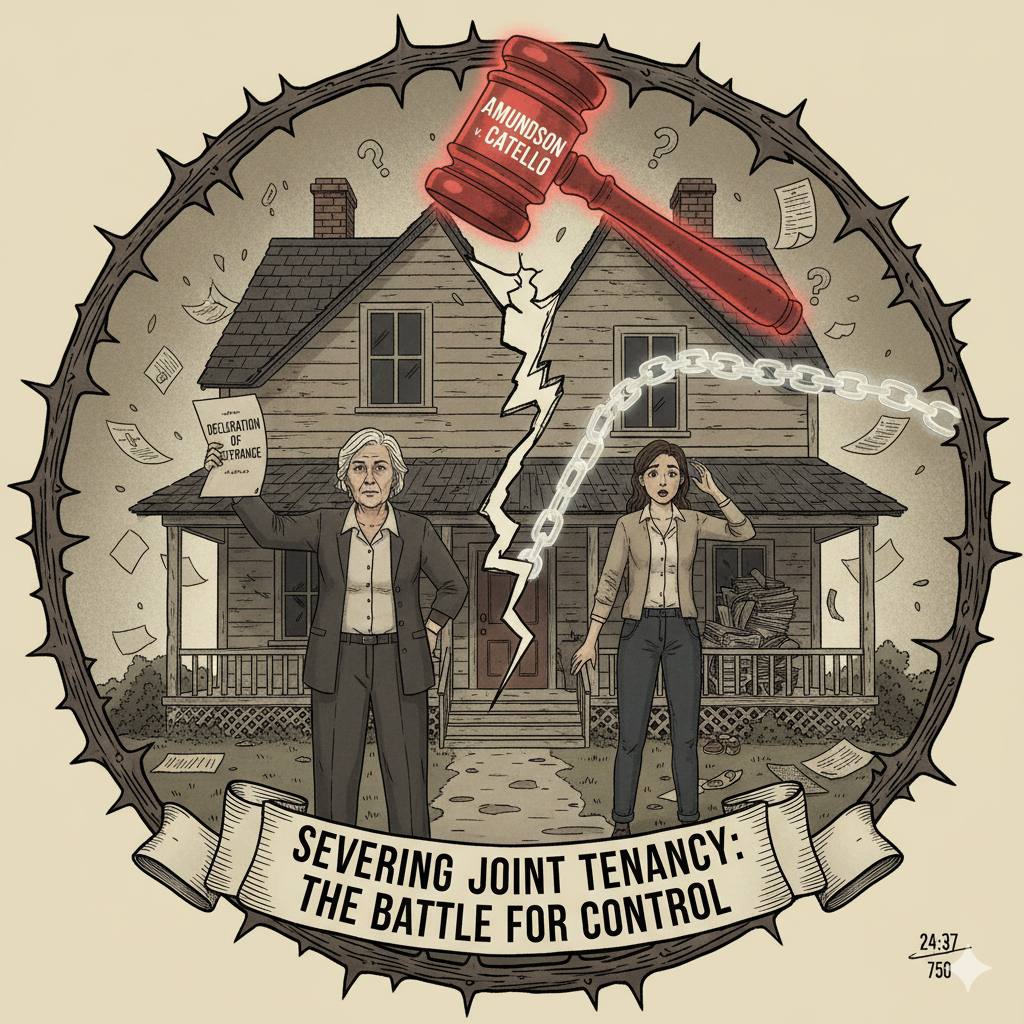
If you co-own California real estate with someone as joint tenants with rights of survivorship, understanding how—and when—that arrangement can change is critical to protecting your family’s inheritance. A recent case highlights how a simple quitclaim deed can dramatically alter property ownership and survivor rights.
What Happened in Amundson v. Catello?
Leslie Knoles and Ruth Catello originally co-owned real property as joint tenants with rights of survivorship. This arrangement typically means that when one owner dies, the surviving owner automatically inherits the deceased owner’s share—without going through probate.
However, just a few weeks before her death, Leslie Knoles recorded a quitclaim deed that she had granted to herself. If this deed is valid, it severed the joint tenancy and converted the ownership structure to a tenancy in common—eliminating the right of survivorship entirely.
Why Does This Matter for California Property Owners?
This case answers a question many California residents face: Can one co-owner unilaterally change joint tenancy ownership without the other owner’s consent?
The answer is yes—through a properly executed and recorded quitclaim deed. This legal mechanism allows a co-owner to:
- Sever joint tenancy and create a tenancy in common
- Eliminate automatic survivorship rights
- Ensure their share of the property passes according to their estate plan rather than automatically to the co-owner
Real-World Implications: When Joint Tenancy Becomes a Problem
Joint tenancy with rights of survivorship is often established with good intentions—usually between spouses, parents and children, or siblings. But family dynamics change. Here are common scenarios where severing joint tenancy becomes necessary:
- Blended families: You remarry and want to ensure your children from a previous marriage inherit your property share
- Strained relationships: Your relationship with the co-owner deteriorates, and you no longer want them to automatically inherit your portion
- Estate planning goals: You want your property share to pass through your trust or will rather than bypassing your estate plan entirely
- Tax and creditor protection: You need to restructure ownership for asset protection or tax planning purposes
How Can You Protect Your Property Rights in California?
If you’re a California resident concerned about how your real property is titled or how it will pass to your heirs, consider these steps:
- Review your current property deeds. Determine whether you hold property as joint tenants, tenants in common, or through another ownership structure.
- Understand your estate planning goals. Does your current ownership arrangement align with how you want your assets distributed?
- Consider recording a quitclaim deed. If you want to sever joint tenancy, work with an experienced California estate planning attorney to ensure the deed is properly prepared, executed, and recorded.
- Update your estate plan. Once ownership is converted to tenancy in common, make sure your will or trust clearly addresses how your property share should be distributed.
What Makes a Quitclaim Deed Valid in California?
For a quitclaim deed to effectively sever joint tenancy in California, it must be:
- Properly executed according to California law
- Recorded with the county recorder’s office where the property is located
- Done during the grantor’s lifetime (deeds executed shortly before death, as in this case, may face additional scrutiny)
Why Timing Matters: The Amundsen v. Catello Lesson
The fact that Leslie Knoles recorded her quitclaim deed just weeks before her deathraises important questions about capacity, intent, and undue influence—issues that frequently arise in California probate litigation. If you’re considering severing joint tenancy, acting sooner rather than later can help avoid:
- Challenges based on mental capacity
- Claims of undue influence or fraud
- Family disputes and costly probate litigation
Get Expert Guidance on California Property Ownership and Estate Planning
At California Probate and Trust, PC, we help California residents navigate complex property ownership issues and create comprehensive estate plans that protect their families. Whether you’re worried about how your real estate will pass to your heirs, need to restructure property ownership, or want to ensure your estate plan reflects your current wishes, our experienced attorneys provide transparent guidance tailored to your unique situation.
Schedule your free consultation today and gain confidence that your property and legacy are protected according to your wishes—not left to outdated ownership structures or automatic legal rules.
Source: California Lawyers Association – Amundson v. Catello

About the Author: Dustin MacFarlane, Esq.
California Licensed Attorney | Estate Planning Specialist
Dustin MacFarlane is the founder of California Probate and Trust, PC, with over 15 years of experience in estate planning, probate administration, and trust law. Licensed by the California State Bar, Dustin has helped thousands of California families protect their assets and plan for the future.
CA Bar License: Active | Practice Areas: Estate Planning, Probate, Trust Administration | Location: Granite Bay, CA