
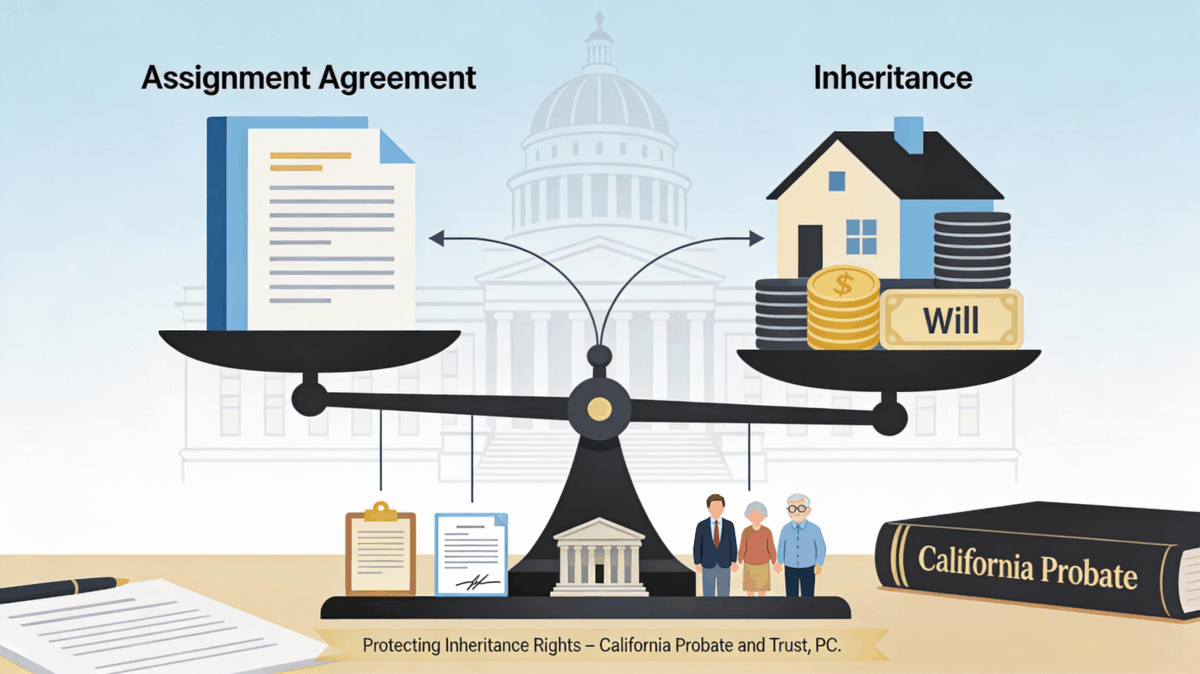
# Estate of Flores: Understanding Assignment Rights in California Probate – What Heirs and Assignees Need to Know
If you’re a California resident navigating probate proceedings or concerned about how estate distributions work when rights are assigned to another party, a recent California appellate court decision offers crucial clarity. The Estate of Flores case (Case No. B320383) addresses a common question: Can an assignee lose their rights to an estate distribution by not asserting those rights early in the probate process?
The short answer: No. This ruling protects assignees and provides important guidance for families dealing with estate assignments in California.
## Who This Article Is For
This legal update is essential reading for:
## What Happened in Estate of Flores?
The case began when an heir-hunter firm informed Donald that he was the heir of a nephew he never knew existed. Believing the interest to be worthless, Donald assigned any rights he might have in the estate to his brother, John.
John then filed a petition for determination of entitlement to distribution under California Probate Code section 11700, and obtained a determination that he and Donald were each entitled to a 50 percent share of the estate. The estate administrator later sought a final distribution order that would account for Donald’s assignment of his rights to John. Donald objected, arguing that the earlier order determining entitlement was binding and conclusive.
The trial court sided with the administrator, and Donald appealed.
## The Court’s Ruling: Assignment Rights Are Protected
The California Court of Appeal, Second District, Division Three, affirmed the trial court’s decision on January 2, 2024. The court held that:
## Why This Matters for California Families
This decision answers critical questions that often arise in estate planning and probate administration:
Can I assign my inheritance rights to a family member or third party?
Yes. California law recognizes the validity of estate assignment agreements, and this ruling reinforces that these assignments will be honored by probate courts.
What if the assignee doesn’t participate in the initial probate proceedings?
The Estate of Flores decision makes clear that an assignee’s rights are not automatically lost simply because they weren’t asserted during the section 11700 proceeding that determines heirs and their shares.
How does this protect my family’s interests?
For California families navigating probate, this ruling provides reassurance that valid assignment agreements will be enforced, even if procedural steps weren’t perfectly followed early in the process. This promotes fairness and honors the intent of parties who entered into legitimate assignments.
## Key Takeaways for Heirs and Assignees
## How California Probate and Trust, PC Can Help
Navigating probate proceedings—especially when assignment rights are involved—requires experienced legal guidance. At California Probate and Trust, PC, we help California residents protect their interests throughout every stage of estate administration and probate litigation.
Our services include:
We understand that probate can be overwhelming, especially when family dynamics and legal technicalities intersect. Our compassionate team provides transparent guidance and fights to protect your rightful share of estate distributions.
Schedule Your Free Consultation Today
If you’re dealing with a probate matter involving assigned rights, or if you need guidance on how to properly assign or protect your inheritance, contact California Probate and Trust, PC for a free consultation. Our experienced attorneys serve clients throughout California from our offices in Fair Oaks, Sacramento, and San Francisco.
Call us at (866) 674-1130 or visit cpt.law to schedule your free estate planning consultation.
## Case Information
Sources:
Legal Disclaimer: This article is provided for informational purposes only and does not constitute legal advice. The information contained herein is based on the Estate of Flores case and general principles of California probate law as of the date of publication. Every estate matter involves unique facts and circumstances. For specific legal advice regarding your situation, please consult with a qualified California probate attorney. Nothing in this article creates an attorney-client relationship between the reader and California Probate and Trust, PC. Past results do not guarantee future outcomes.

About the Author: Dustin MacFarlane, Esq.
California Licensed Attorney | Estate Planning Specialist
Dustin MacFarlane is the founder of California Probate and Trust, PC, with over 15 years of experience in estate planning, probate administration, and trust law. Licensed by the California State Bar, Dustin has helped thousands of California families protect their assets and plan for the future.
CA Bar License: Active | Practice Areas: Estate Planning, Probate, Trust Administration | Location: Granite Bay, CA