Categories
California Probate Estate Planning Trusts

What California Families Need to Know About Doe v. Kachru: Understanding Elder Abuse Claims in Estate Disputes

Elder Abuse Act demands both a high level of culpability and sufficiently detailed allegations demonstrating it.

Source: California Lawyers Association – Doe v. Kachru

What California Families Need to Know About Doe v. Kachru: Understanding Elder Abuse Claims in Estate Disputes

If you’re managing the estate of an elderly family member in California and suspect financial abuse or neglect, understanding recent case law is critical. The December 2025 ruling in Doe v. Kachru (2025) 115 Cal.App.5th 175clarifies exactly what you need to prove when filing an elder abuse claim—and why general allegations won’t be enough.

Who This Matters For

This case is essential reading for California residents who are:

  • Serving as trustees or executors of an elderly family member’s estate
  • Concerned about financial exploitation of aging parents or relatives
  • Considering legal action against caregivers, advisors, or family members for elder abuse
  • Managing probate or trust administration where abuse allegations have surfaced
  • The Core Legal Principle: High Culpability + Specific Allegations

    The California Court of Appeal made clear that bringing an elder abuse claim under the Elder Abuse and Dependent Adult Civil Protection Act requires two essential elements:

  • High level of culpability: You must demonstrate egregious conduct—not just negligence or poor judgment, but behavior that rises to recklessness, oppression, fraud, or malice
  • Detailed factual allegations: General statements like “financial abuse occurred” are insufficient. Your complaint must include specific facts showing how, when, and why the abuse happened
  • What This Means in Practice

    Consider this real-world scenario: An elderly parent’s financial advisor transfers significant assets without proper documentation or consent. To successfully pursue an elder abuse claim, you would need to provide:

  • Specific dates and amounts of unauthorized transfers
  • Evidence the advisor knew or should have known the transfers were improper
  • Documentation showing the elder was vulnerable or lacked capacity
  • Clear connection between the advisor’s conduct and financial harm
  • Why Vague Allegations Fail

    The Doe v. Kachru rulingreinforces that California courts will dismiss elder abuse claims that rely on conclusory statements. Saying someone “took advantage of” or “exploited” an elderly person without backing it up with concrete facts won’t survive a demurrer or motion to dismiss.

    How to Protect Your Elder Abuse Claim

    If you’re considering legal action to protect an elderly family member’s estate, take these steps:

  • Gather documentation early: Bank statements, medical records, correspondence, and witness statements are crucial
  • Document the timeline: Create a detailed chronology of suspicious transactions or behavior
  • Establish the relationship: Show how the alleged abuser had access, authority, or influence over your loved one
  • Demonstrate vulnerability: Medical evaluations, cognitive assessments, or evidence of isolation strengthen your case
  • Work with experienced counsel: Elder abuse claims require sophisticated legal strategy and detailed pleading
  • The Stakes for California Families

    Elder abuse cases often involve enhanced remedies, including attorney fees and double damages. However, the higher burden of proof means that families must be prepared to build a comprehensive evidentiary record from the outset. A rushed or poorly documented claim can be dismissed before you ever get to present your evidence.

    Get Experienced Legal Guidance

    If you’re facing potential elder abuse issues in a California estate or trust matter, the attorneys at California Probate and Trust, PC can help you understand your options. We work with families throughout California to protect vulnerable loved ones and preserve family legacies through strategic estate planning and trust administration.

    Our team takes a transparency-first approach, helping you understand both the legal requirements and the practical steps needed to build a strong case. Whether you’re dealing with ongoing probate litigation or want to put protections in place before problems arise, we offer a free consultation to assess your situation and outline your path forward.

    Schedule Your Free Consultation

    Don’t wait until it’s too late to protect your family. Contact California Probate and Trust, PC today for a no-obligation consultation about elder abuse claims, trust disputes, or comprehensive estate planning that safeguards your loved ones.

    Source: California Lawyers Association – Doe v. Kachru

    Categories
    California Probate Estate Planning Long Term Care Planning

    How the new $6,000 senior tax deduction could affect millions of Americans over 65

    New $6,000 Senior Tax Deduction: What California Residents Over 65 Need to Know for 2025

    If you’re a California resident age 65 or older—or if you’re helping a parent or loved one manage their finances—you may be eligible for a significant new tax benefit that could put hundreds or even thousands of dollars back in your pocket. Here’s what you need to know about the new senior tax deduction and how it might affect your family’s financial planning.

    Source: CBS News – Senior Tax Deduction Impact

    How Much Could You Save With the New Senior Tax Deduction?

    The new $6,000 tax deduction for Americans 65 and older could boost refunds for millions of older taxpayers, with an average benefit of approximately $670 this year. However, the actual savings depend on your tax bracket and income level.

    For California residents in the 22% tax bracket—typically those earning between $44,000 and the deduction’s $75,000 income cap—the savings could be as much as $1,320 per person. For married couples where both spouses qualify, that means potential tax savings of up to $2,640.

    According to Bill Sweeney, AARP’s senior vice president of government affairs, “The bonus deduction will run through 2028—that is four years of immediate relief at a time when older Americans are facing really high costs.”

    Who Qualifies for the $6,000 Senior Deduction in California?

    Understanding eligibility is crucial for California residents planning their tax strategy. Here are the specific requirements:

    Age Requirement:

  • You must have turned 65 by December 31, 2025 to qualify for this tax year
  • Income Limits:

  • Single filers: Full $6,000 deduction if modified adjusted gross income was below $75,000
  • Married couples filing jointly: Full $12,000 deduction if income was below $175,000
  • The deduction reduces by six cents for every dollar above these thresholds
  • Completely phases out at $175,000 for singles and $250,000 for married couples
  • Other Requirements:

  • Must have a work-authorized Social Security number
  • Can You Claim This Deduction With the Standard Deduction?

    Yes—this is one of the most valuable aspects of the new senior tax deduction. You can claim it whether you itemize your deductions or take the standard deduction.

    For the 2025 tax year, the standard deduction is $15,750 for single filers and $31,500 for married couples filing jointly. The new $6,000 senior deduction comes on top of an existing $2,000 deduction for seniors.

    This means:

  • Single filers 65+ can deduct a total of $23,750
  • Married couples where both qualify can deduct up to $46,700
  • Does This Mean Your Social Security Benefits Won’t Be Taxed?

    This is a common source of confusion. The $6,000 deduction does not specifically exempt Social Security benefits from federal income taxes—those benefits remain subject to taxation.

    However, the deduction still provides substantial value by lowering your overall taxable income, which means more of your total income is shielded from federal income taxes. Importantly, you can claim this deduction even if you aren’t yet receiving Social Security benefits.

    Why This Matters for California Families Managing Estate Planning and Probate

    Many California seniors are working longer than they planned due to rising costs of medicine, food, and other essentials. As Nancy LeaMond, AARP’s chief advocacy and engagement officer, notes: “Sometimes in the world we live in, $600 doesn’t sound like a lot, but we can tell you, based on conversations with our members, that it is a very, very significant help to them.”

    For families managing probate cases or planning estates, this deduction represents an opportunity to:

  • Reduce immediate tax burdens for aging parents or family members
  • Preserve more assets within the family unit
  • Free up resources that might otherwise go to taxes, allowing for better long-term financial planning
  • Provide relief during the challenging period of managing a loved one’s affairs
  • AARP officials have expressed concern that many eligible seniors may miss out on this benefit simply because they’re unaware of it. The IRS began accepting tax filings on January 26, 2026, so there’s still time to claim this deduction for the 2025 tax year.

    How California Probate and Trust, PC Can Help

    Navigating tax deductions, estate planning, and probate matters can feel overwhelming—especially when you’re already dealing with the emotional challenges of managing a loved one’s affairs or planning for your family’s future.

    At California Probate and Trust, PC, we understand that California residents need more than just legal advice—they need a trusted partner who can handle both the legal structure and financial management aspects of estate planning and probate administration. Whether you’re currently facing probate proceedings or want to ensure your family is protected through proper estate planning, our team provides the transparency and comprehensive support you deserve.

    Ready to protect your family’s financial future? Contact California Probate and Trust, PC today to discuss how we can help you maximize tax benefits like the new senior deduction while ensuring your estate plan is optimized for your family’s unique needs. Visit cpt.law or call us to schedule a consultation.

    Legal Disclaimer

    This article is provided for informational purposes only and does not constitute legal or tax advice. Tax laws are complex and subject to change, and individual circumstances vary significantly. The information presented here is based on current tax law as of the publication date and may not reflect the most recent legal developments. You should consult with a qualified tax professional or attorney regarding your specific situation before making any decisions based on this information. California Probate and Trust, PC does not provide tax preparation services, and nothing in this article should be construed as creating an attorney-client relationship. For personalized legal advice regarding probate, estate planning, or trust administration matters in California, please contact our office directly.

    Categories
    News

    Understanding LPS Conservatorship Jury Trial Deadlines: What California Families Need to Know About Conservatorship of M.M.

    # Understanding LPS Conservatorship Jury Trial Deadlines: What California Families Need to Know About Conservatorship of M.M.

    ## Can Missing a Conservatorship Jury Trial Deadline Terminate the Case?

    If you’re a California resident navigating the conservatorship process for a loved one with mental health challenges, you may be wondering: what happens if a jury trial doesn’t start within the statutory deadline? The California Court of Appeal’s decision in Conservatorship of M.M. provides critical clarity for families and conservators across the state.

    ### Key Takeaway: LPS Act Jury Trial Deadlines Are Not Mandatory

    The court ruled that statutory time limits for jury trials in LPS (Lanterman-Petris-Short Act) conservatorships are directory, not mandatory. This means that even if a trial starts beyond the 25-day statutory window, the conservatorship does not automatically terminate or expire early.

    ## Who This Ruling Affects

    This decision is essential for:

  • California families seeking conservatorships for loved ones with severe mental illness who refuse treatment
  • Public Guardians and conservators managing LPS conservatorship proceedings
  • Estate planning and probate attorneys advising clients on conservatorship timelines and procedural rights
  • Proposed conservatees and their legal counsel concerned about trial scheduling and procedural protections
  • ## The Facts: What Happened in Conservatorship of M.M.

    M.M. was diagnosed with schizophrenia and psychotic disorders and was unwilling to accept psychiatric treatment or voluntary medications. The Public Guardian initiated LPS conservatorship proceedings and was appointed as temporary conservator.

    On August 16, 2018, M.M. demanded a jury trial. Under the LPS Act, trials must commence no later than 25 days after such a demand. However, due to:

  • M.M.’s counsel’s scheduling conflicts and requested continuance
  • M.M.’s request for a court-appointed expert evaluation
  • Judge unavailability
  • The trial did not begin until 61 days after the jury demand—36 days beyond the statutory deadline.

    M.M. did not object to the delay at trial. The jury ultimately found M.M. gravely disabled, and the court granted the conservatorship for approximately one year.

    ## M.M.’s Appeal: Can a Late Trial End the Conservatorship Early?

    M.M. appealed, arguing solely that the court violated his right to a jury trial within 25 days of his demand. He sought termination of the conservatorship 36 days earlier than the court ordered.

    ### The Court’s Decision

    The California Court of Appeal affirmed the conservatorship. The court held that:

  • M.M. forfeited his objection by failing to raise it in the lower court
  • Most continuances were requested by M.M.’s own counsel, and his attorney agreed to the later trial date based on the judge’s availability
  • The LPS Act’s jury trial deadlines are directory, not mandatory, meaning that missing the deadline does not provide grounds to terminate the conservatorship earlier than it would otherwise expire
  • ## What Does “Directory” vs. “Mandatory” Mean for California Conservatorships?

    Understanding this distinction is crucial for families and attorneys:

  • Mandatory deadlines: If missed, they automatically invalidate the proceeding or result in dismissal
  • Directory deadlines: These are guidelines meant to encourage timely action, but missing them does not automatically void the case
  • In Conservatorship of M.M., the appellate court confirmed that LPS Act trial timing provisions fall into the latter category. This provides procedural flexibility when legitimate scheduling conflicts arise—especially when delays are caused by the proposed conservatee’s own requests or counsel’s availability.

    ## Practical Implications for California Families Facing Conservatorship

    ### For Families Seeking Conservatorship:

  • Don’t panic if trial scheduling extends beyond 25 days due to legitimate reasons like expert evaluations or attorney availability
  • The conservatorship will not automatically terminate early due to trial delays
  • Work closely with the Public Guardian or your probate attorney to ensure all procedural steps are properly documented
  • ### For Proposed Conservatees and Their Counsel:

  • If you believe a trial delay violates your rights, you must object in the trial court or risk forfeiting the issue on appeal
  • Be strategic about continuance requests—they may extend timelines without providing grounds for dismissal later
  • ### For Probate and Estate Planning Attorneys:

  • Advise clients that LPS conservatorship trial deadlines are flexible under California law
  • Document all reasons for continuances, especially those requested by the proposed conservatee
  • Ensure objections to procedural delays are raised contemporaneously to preserve appellate rights
  • ## Why This Case Matters for Estate Planning and Family Protection

    Conservatorships are often an emotionally difficult but necessary step to protect loved ones who cannot care for themselves due to severe mental illness. The Conservatorship of M.M. ruling provides reassurance that procedural technicalities—particularly those caused by the conservatee’s own requests—will not undermine legitimate protections.

    For California residents managing family estates or planning for incapacity, understanding conservatorship procedures is essential. This case demonstrates the courts’ commitment to balancing procedural rights with the practical realities of complex legal proceedings.

    ## Case Details

  • Case Name: Conservatorship of M.M.
  • Case Number: B293676
  • Court: California Court of Appeal, Second District
  • Filed: August 29, 2019
  • Author: Golnaz Yazdchi, Sheppard Mullin Richter & Hampton LLP
  • Legal Issues: LPS Conservatorships, Statutory Time Limitations for Jury Trials, Waiver
  • Source: California Lawyers Association – Conservatorship of M.M.

    Full Opinion: Second District Opinion PDF

    ## Get Expert Guidance on California Conservatorships and Estate Planning

    Navigating conservatorships, probate, and estate planning in California requires experienced legal counsel who understands both the law and the emotional weight these decisions carry.

    At California Probate and Trust, PC, we provide compassionate, transparent guidance for California residents and families managing complex conservatorship proceedings and estate plans. Whether you’re facing conservatorship now or planning ahead to protect your loved ones, our team offers personalized solutions tailored to your family’s unique needs.

    Schedule your FREE consultation today at cpt.law to discuss your conservatorship, probate, or estate planning questions with our experienced Sacramento-based attorneys.

    Categories
    California Probate News

    Conservatorship of Eric B.: What California Families Need to Know About Testifying Rights in LPS Conservatorship Case

    LPS conservatees are similarly situated to persons found not guilty by reason of insanity for purposes of the right against compelled testimony.

    Eric was diagnosed with schizophrenia, unable or unwilling to accept treatment voluntarily, and unable to meet his needs for food and clothing without support. Eric was compelled to testify over his objection at the trial on the public guardian’s LPS conservatorship petition. The public guardian called two other witnesses, a psychiatrist who had evaluated Eric, and a therapist that served as Eric’s case manager, both of whom testified that Eric was unable to care for himself or manage his own financial resources. After a jury trial, Eric was found to be gravely disabled, and placed under an LPS conservatorship. Eric challenged the order on appeal, and the appellate court held that LPS conservatees are similarly situated to persons found not guilty by reason of insanity (NGIs) for the purpose of the right against compelled testimony, but that the trial court’s error was harmless.

    The California Supreme Court affirmed. LPS conservatees are similarly situated to NGIs, who are not compelled to testify against themselves, so equal protection principles require the government to justify its disparate treatment of LPS conservatees. Both groups risk the potential loss of liberty by being subject to physical confinement and the loss of many personal rights (the rights to drive, vote, enter contracts, and make decisions about treatment). Both also share the goal of treatment, not punishment. The fact that LPS conservatees can be committed involuntarily for an indefinite period of time through the filing of successive petitions, resulting in deprived civil liberties, makes them similarly situated to NGIs. Nonetheless, no one challenged the appellate court’s conclusion that the trial court’s error in compelling Eric’s testimony was harmless because two other witnesses familiar with Eric provided testimony sufficient for the court to find that Eric was unable to care for himself due to mental illness. Thus, because the error was harmless, the question of whether the government can justify its differential treatment of LPS conservatees with regard to the testimonial privilege—as well as the question of what level of scrutiny applies—must await a decision in another case.

    Case Details:

  • Cite as: S261812
  • Filed: April 28, 2022
  • Court: California Supreme Court
  • Author: Golnaz Yazdchi, Sheppard Mullin Richter & Hampton LLP
  • Headnote: LPS Conservatorships – Compelling Testimony of Proposed Conservatee
  • Source: California Lawyers Association – Conservatorship of Eric B.

    Full Opinion: California Supreme Court Opinion PDF

    Conservatorship of Eric B.: What California Families Need to Know About Testifying Rights in LPS Conservatorship Cases

    If you’re a California resident navigating the conservatorship process for a loved one with mental illness, you may be wondering: Can someone be forced to testify against themselves in an LPS conservatorship hearing? A landmark 2022 California Supreme Court case provides critical guidance on this question—and what it means for protecting your family member’s rights.

    Who This Information Is For

    This article is essential reading if you are:

  • A family member seeking an LPS conservatorship for someone with severe mental illness who cannot care for themselves
  • A California resident concerned about the legal rights of conservatees during court proceedings
  • Someone managing legal matters for a loved one who is gravely disabled due to mental health challenges
  • Anyone who values transparency in the conservatorship process and wants to understand how California law protects (or doesn’t protect) testifying rights
  • The Case: Conservatorship of Eric B.

    In April 2022, the California Supreme Court decided a case that clarified important rights for people facing LPS (Lanterman-Petris-Short Act) conservatorship. The case involved Eric, a man diagnosed with schizophrenia who was unable or unwilling to accept treatment and could not meet his basic needs for food and clothing without support.

    During Eric’s conservatorship trial, he was compelled to testify over his objection. The public guardian also called two other witnesses—a psychiatrist and a therapist—who both testified that Eric could not care for himself or manage his finances. A jury found Eric gravely disabled and placed him under an LPS conservatorship.

    The Legal Question: Can LPS Conservatees Be Forced to Testify?

    Eric challenged the conservatorship order, arguing that forcing him to testify violated his rights. The key legal issue was whether LPS conservatees should have the same protection against compelled testimony as persons found not guilty by reason of insanity (NGIs).

    What the California Supreme Court Decided

    The Court ruled that LPS conservatees and NGIs are similarly situated when it comes to testifying rights. Here’s why this matters:

  • Both groups face loss of liberty: LPS conservatees can lose the right to drive, vote, enter contracts, and make treatment decisions—just like NGIs who may be physically confined
  • Both focus on treatment, not punishment: The goal in both situations is mental health treatment and support
  • Indefinite commitment is possible: LPS conservatees can be committed involuntarily for extended periods through successive petitions, significantly impacting their civil liberties
  • Because of these similarities, the Court held that equal protection principles require the government to justify treating LPS conservatees differently than NGIs regarding the right against compelled testimony.

    The Practical Impact: What This Means for Your Family

    While the Court established this important principle, it also found that the error in Eric’s case was “harmless” because two other witnesses provided sufficient testimony to support the conservatorship finding. This meant the Court didn’t need to decide what level of scrutiny applies or whether the government can justify the different treatment.

    Key Takeaways for California Families:

  • LPS conservatees should have similar protections against forced testimony as other individuals facing loss of liberty
  • Courts must consider equal protection principles when compelling testimony in conservatorship cases
  • However, if other witnesses provide sufficient evidence, forcing testimony may be considered a harmless error
  • The full legal standard for these cases is still developing and may be clarified in future court decisions
  • Real-World Application: Questions This Case Answers

    If you’re considering an LPS conservatorship for a family member, this case helps answer:

  • “What rights does my loved one have during the conservatorship hearing?”
  • “Can the court force them to testify if they don’t want to?”
  • “How can I ensure the process respects their dignity while still getting the care they need?”
  • Case Details

  • Case Number: S261812
  • Date Filed: April 28, 2022
  • Court: California Supreme Court
  • Legal Topic: LPS Conservatorships – Compelling Testimony of Proposed Conservatee
  • Additional Resources

    Read the full case summary from the California Lawyers Association

    View the complete California Supreme Court opinion (PDF)

    How California Probate and Trust Can Help

    Conservatorship proceedings are complex, emotionally challenging, and require careful navigation of California law to protect both your loved one’s rights and their wellbeing. At California Probate and Trust, PC, our experienced attorneys understand the anxiety California families face when dealing with mental health conservatorships.

    We provide:

  • Free consultations to assess your situation and explain your options
  • Clear guidance through LPS conservatorship procedures
  • Compassionate representation that respects your family member’s dignity while ensuring they receive necessary care
  • Transparent pricing so you know what to expect throughout the process
  • Whether you’re just beginning to consider conservatorship or are already in the middle of proceedings, our Sacramento-based team has helped thousands of California families protect their loved ones.

    Schedule your free consultation today by calling (866) 674-1130 or visiting cpt.law.

    This article is for informational purposes only and does not constitute legal advice. Conservatorship law is complex and fact-specific. For guidance on your particular situation, please consult with a qualified California attorney.

    Categories
    News

    Understanding LPS Conservatorships in California: What the Conservatorship of D.C. Case Means for Your Rights

    LPS Conservatee’s appeal of denial of right to jury trial deemed untimely and substantial evidence supported order for involuntary medication.

    In August 2017, the Los Angeles Public Guardian petitioned for an LPS conservatorship over the person and estate of D.C. Supporting declarations by physicians stated that D.C. had been diagnosed with schizophrenia and was unable to accept voluntary treatment or provide for her personal needs for food, clothing, and shelter. At the first hearing, D.C. was present in court, and her counsel represented that D.C. would submit on the petition. The court found that D.C. was gravely disabled as a result of a mental disorder and had waived her right to a jury trial. In an October 4, 2017 Order the court granted the petition and appointed the Public Guardian. The court also imposed legal disabilities against D.C.’s right to operate a motor vehicle, to possess a firearm, to choose or refuse medical treatment, and to contract. In January 2018, D.C. filed a demand for a jury trial and petitioned for rehearing. The Court denied rehearing. Following the jury trial, on April 25, 2018, the court ordered D.C. to remain in a conservatorship and maintained all prior orders in effect. D.C. appealed.

    The court of appeal affirmed. D.C.’s failure to timely appeal the October 4, 2017 order rendered the denial of a timely jury trial in the first proceeding unreviewable, and that Order could not be reviewed on the subsequent appeal because the first order was independently reviewable. Further, both the October 2017 and April 2018 orders for involuntary medication were supported by substantial evidence because of ample evidence that D.C. lacked insight about her mental condition, was unable to voluntarily accept meaningful treatment, and required medications to treat her schizophrenia. However, the court recommended that in future proceedings trial courts should make specific findings supporting involuntary medication orders, or other orders imposing disabilities on conservatees.

    Case Details:

  • Cite as: B290408
  • Filed: August 29, 2019
  • Court: Second District
  • Author: Daniel C. Kim, Weintraub Tobin Chediak Coleman Grodin Law Corporation
  • Headnote: LPS Conservatorship – Appealability of Right to Jury Trial – Orders for Involuntary Medication
  • Source: California Lawyers Association – Conservatorship of D.C.

    Full Opinion: Second District Opinion PDF

    Understanding LPS Conservatorships in California: What the Conservatorship of D.C. Case Means for Your Rights

    If you’re a California resident dealing with a loved one’s mental health crisis, navigating involuntary conservatorship, or managing assets for someone unable to care for themselves, understanding your legal rights is critical. The Conservatorship of D.C. case from California’s Second District Court of Appeal provides essential insights into LPS conservatorships, jury trial rights, and involuntary medication orders—issues that directly impact families facing these challenging situations.

    Who This Article Is For

    This article is designed for:

  • California families dealing with a loved one’s mental health crisis who may be gravely disabled
  • Individuals facing potential LPS conservatorship proceedings
  • Family members or public guardians managing conservatorship cases
  • Anyone seeking to understand their rights regarding jury trials and involuntary medication in California conservatorship law
  • What Is an LPS Conservatorship?

    An LPS conservatorship is a legal mechanism in California that allows a court to appoint a conservator for individuals who are “gravely disabled” due to a mental disorder. This means the person cannot provide for their basic needs—food, clothing, or shelter—or cannot accept treatment voluntarily.

    The term “LPS” comes from the Lanterman-Petris-Short Act, California’s landmark mental health law that balances protecting vulnerable individuals with preserving their civil rights.

    Key Questions This Case Answers

    Can I appeal if I missed the deadline for requesting a jury trial in an LPS conservatorship?

    In the Conservatorship of D.C. case, the conservatee failed to timely appeal the October 4, 2017 order that denied her jury trial rights. The appellate court ruled that this failure made the denial unreviewable in later proceedings.This highlights a critical procedural point: timing matters in conservatorship appeals. If you believe your rights were violated, you must act quickly within the legal deadlines.

    What evidence supports involuntary medication orders?

    The court affirmed that involuntary medication orders must be supported by substantial evidence. In D.C.’s case, medical declarations showed she was diagnosed with schizophrenia, lacked insight into her condition, was unable to voluntarily accept treatment, and required medication to address her mental disorder.

    The court found this evidence sufficient to justify both the October 2017 and April 2018 involuntary medication orders.

    What legal disabilities can be imposed in LPS conservatorships?

    When the court appointed the Public Guardian as conservator, it imposed several legal disabilities on D.C., including restrictions on her ability to:

  • Operate a motor vehicle
  • Possess a firearm
  • Choose or refuse medical treatment
  • Enter into contracts
  • These restrictions are significant and affect fundamental rights, which is why proper legal representation and understanding procedural timelines is essential.

    What the Court Recommended for Future Cases

    Importantly, the appellate court made a forward-looking recommendation: trial courts should provide specific findings when issuing involuntary medication orders or imposing legal disabilities on conservatees.This recommendation aims to improve transparency and ensure that conservatees and their families understand the basis for these serious restrictions.

    Case Background: Timeline of Events

  • August 2017: Los Angeles Public Guardian petitioned for LPS conservatorship over D.C.
  • October 4, 2017: Court granted petition, appointed Public Guardian, and imposed legal disabilities
  • January 2018: D.C. filed demand for jury trial and petition for rehearing
  • April 25, 2018: Following jury trial, court ordered D.C. to remain in conservatorship
  • August 29, 2019: Second District Court of Appeal affirmed the lower court’s decisions
  • Why This Matters for California Families

    LPS conservatorship cases involve some of the most vulnerable individuals in our society. Understanding procedural rights—like when to request a jury trial and how to appeal—can mean the difference between protecting someone’s autonomy and unnecessarily restricting their freedoms.

    For families navigating these complex proceedings, having experienced legal counsel is not just helpful—it’s essential. The stakes are high: these cases determine whether someone can make their own medical decisions, manage their own finances, and maintain basic civil liberties.

    How California Probate and Trust, PC Can Help

    At California Probate and Trust, PC, we understand that conservatorship proceedings are emotionally challenging and legally complex. Our experienced team provides compassionate, transparent guidance for California residents dealing with:

  • LPS conservatorship proceedings
  • Probate conservatorships
  • Estate planning to avoid future conservatorship needs
  • Advance healthcare directives and powers of attorney
  • Trust administration and asset protection
  • We offer a one-stop-shop approach that addresses both the legal structure and financial management aspects of protecting your family. Whether you’re facing a conservatorship proceeding now or want to create an estate plan that protects your loved ones in the future, we’re here to help.

    Take Action: Schedule Your Free Consultation Today

    Don’t navigate these complex legal waters alone. Contact California Probate and Trust, PC for a free consultation. We’ll walk you through your options, explain your rights, and develop a personalized strategy to protect you and your family.

    Call us at (866) 674-1130 or visit cpt.law to schedule your free estate planning consultation.

    Case Details

  • Case Citation: B290408
  • Filing Date: August 29, 2019
  • Court: California Court of Appeal, Second District
  • Author: Daniel C. Kim, Weintraub Tobin Chediak Coleman Grodin Law Corporation
  • Sources:

  • California Lawyers Association – Conservatorship of D.C.
  • Full Opinion (PDF)
  • Categories
    News Trusts

    When Can You Recover Double Damages in California Trust Disputes? Understanding Undue Influence and Bad Faith

    A finding of bad faith is a prerequisite to an award of double damages under Probate Code section 859 based on a theory of undue influence.

    Robert Levin amended his trust at various times before his death in 2015, including in 2008 and 2012. The latter amendments largely benefited his surviving spouse, Debra, at the expense of his daughter from a prior marriage, Elizabeth. Elizabeth sued to invalidate those amendments on the grounds that they were procured as a result of Debra’s undue influence, and sought an order to compel Debra to return property distributed to her under the disputed 2012 amendment and for double damages under Probate Code section 859. The court found that Debra failed to rebut the presumption of undue influence, as it applied to the 2012 amendment, given Robert’s significant mental decline by that point of time. The court invalidated that amendment, and ordered Debra to return to the trust property that she had obtained under that amendment and a related deed. The court found that Robert had executed the 2008 amendment of his own free will and volition. Elizabeth appealed. She contended that the court erred by not awarding double damages under the elder abuse statutes given the finding of undue influence, by upholding the validity of the 2008 amendment, and by voiding the entire 2012 amendment instead of just those portions that benefited Debra.

    Affirmed. Double damages under Probate Code section 859 are available in undue influence cases only when the court finds bad faith. Although undue influence may give rise to liability for financial elder abuse, which provides enhanced remedies, double damages under section 859 require an additional showing of bad faith. Not all instances of undue influence entail bad faith. The court acknowledged the ambivalence of the relevant statutes but concluded that because all other bases for double damages under section 859 require bad faith, double damages for elder abuse based on undue influence also required bad faith. The court also held that the entire 2012 amendment was tainted by undue influence, and it would be impossible to invalidate only the portions benefiting Debra without upending Robert’s well-established testamentary intent to strike a balance between his wife and his daughter. Finally, substantial evidence existed to support the court’s findings as to the validity of the 2008 amendment.

    Case Details:

  • Cite as: G056353
  • Filed: September 13, 2019
  • Court: California Court of Appeal, Third District
  • Author: Golnaz Yazdchi, Sheppard Mullin Richter & Hampton LLP
  • Headnote: Trusts and Estates – Undue Influence – Double Damages
  • Source: California Lawyers Association – Elizabeth Levin v. Debra Winston-Levin

    Full Opinion: Third District Opinion PDF

    When Can You Recover Double Damages in California Trust Disputes? Understanding Undue Influence and Bad Faith

    If you’re a California resident managing a loved one’s estate or trust—or planning your own—you may wonder: What happens when someone manipulates a family member into changing their trust? Can you recover more than just what was taken?

    A landmark 2019 California Court of Appeal case, Elizabeth Levin v. Debra Winston-Levin, clarifies a critical point: proving undue influence alone is not enough to claim double damages under California Probate Code section 859. You must also prove bad faith.

    This distinction matters for families navigating trust disputes, elder financial abuse claims, and probate litigation in California.

    What Happened in the Levin Case?

    Robert Levin amended his trust twice before his death in 2015—once in 2008 and again in 2012. The 2012 amendment heavily favored his second wife, Debra, at the expense of his daughter from a prior marriage, Elizabeth.

    After Robert’s death, Elizabeth filed a lawsuit arguing that Debra used undue influence to manipulate her father during a period of significant mental decline. She sought to:

  • Invalidate the 2012 trust amendment
  • Force Debra to return assets distributed under that amendment
  • Recover double damages under Probate Code section 859
  • The trial court agreed that Debra’s influence over the 2012 amendment was undue, given Robert’s declining mental state. It voided the entire 2012 amendment and ordered Debra to return the property. However, it did not award double damages.

    Elizabeth appealed, arguing that undue influence should automatically trigger double damages under California’s elder abuse statutes.

    The Court’s Ruling: Bad Faith Is Required

    The California Court of Appeal affirmed the trial court’s decision. It held that double damages under Probate Code section 859 require a separate finding of bad faith—even in cases involving undue influence.

    Here’s why this matters:

  • Undue influence can occur without intentional wrongdoing or malice
  • California law treats undue influence and bad faith as distinct legal concepts
  • All other grounds for double damages under section 859 require bad faith, so undue influence cases should too
  • The court acknowledged that while undue influence can lead to financial elder abuse claims with enhanced remedies, double damages specifically demand proof that the wrongdoer acted in bad faith.

    Why the Entire 2012 Amendment Was Voided

    Elizabeth also argued that only the portions of the 2012 amendment benefiting Debra should be invalidated—not the whole thing.

    The court disagreed. It ruled that the entire 2012 amendment was tainted by undue influence, and selectively removing only Debra’s benefits would contradict Robert’s long-standing intent to balance provisions for both his wife and daughter.

    The 2008 amendment, however, was upheld as valid because substantial evidence showed Robert executed it freely and voluntarily.

    What This Means for California Families

    If you’re dealing with a trust dispute or suspect a loved one was manipulated into changing their estate plan, this case offers important lessons:

  • Undue influence claims can succeed—but they require strong evidence of pressure, manipulation, or exploitation during a vulnerable time
  • Double damages are not automatic—you must prove the wrongdoer acted in bad faith, not just that influence was exerted
  • Entire amendments may be voided—courts won’t cherry-pick provisions if doing so would distort the decedent’s intent
  • Timing matters—amendments made during periods of mental decline are more vulnerable to challenge
  • How California Probate and Trust, PC Can Help

    At California Probate and Trust, PC, we understand how overwhelming it is to navigate probate litigation, trust disputes, and elder abuse claims—especially when family relationships are at stake.

    Whether you’re:

  • Challenging a suspicious trust amendment
  • Defending an estate plan you helped create
  • Seeking to recover assets taken through undue influence
  • Planning your own estate to prevent future disputes
  • We provide transparent, compassionate guidance tailored to California residents and those managing California-based assets. Our team handles both the legal structure and financial management aspects—so you have a true one-stop-shop for probate and estate planning.

    Contact us today at cpt.law to schedule a consultation and protect what matters most: your family and your legacy.

    Case Details

  • Case Name: Elizabeth Levin v. Debra Winston-Levin
  • Case Number: G056353
  • Court: California Court of Appeal, Third District
  • Date Filed: September 13, 2019
  • Legal Issue: Trusts and Estates – Undue Influence – Double Damages
  • Source: California Lawyers Association – Elizabeth Levin v. Debra Winston-Levin

    Full Opinion: Third District Opinion PDF

    Categories
    News Trusts

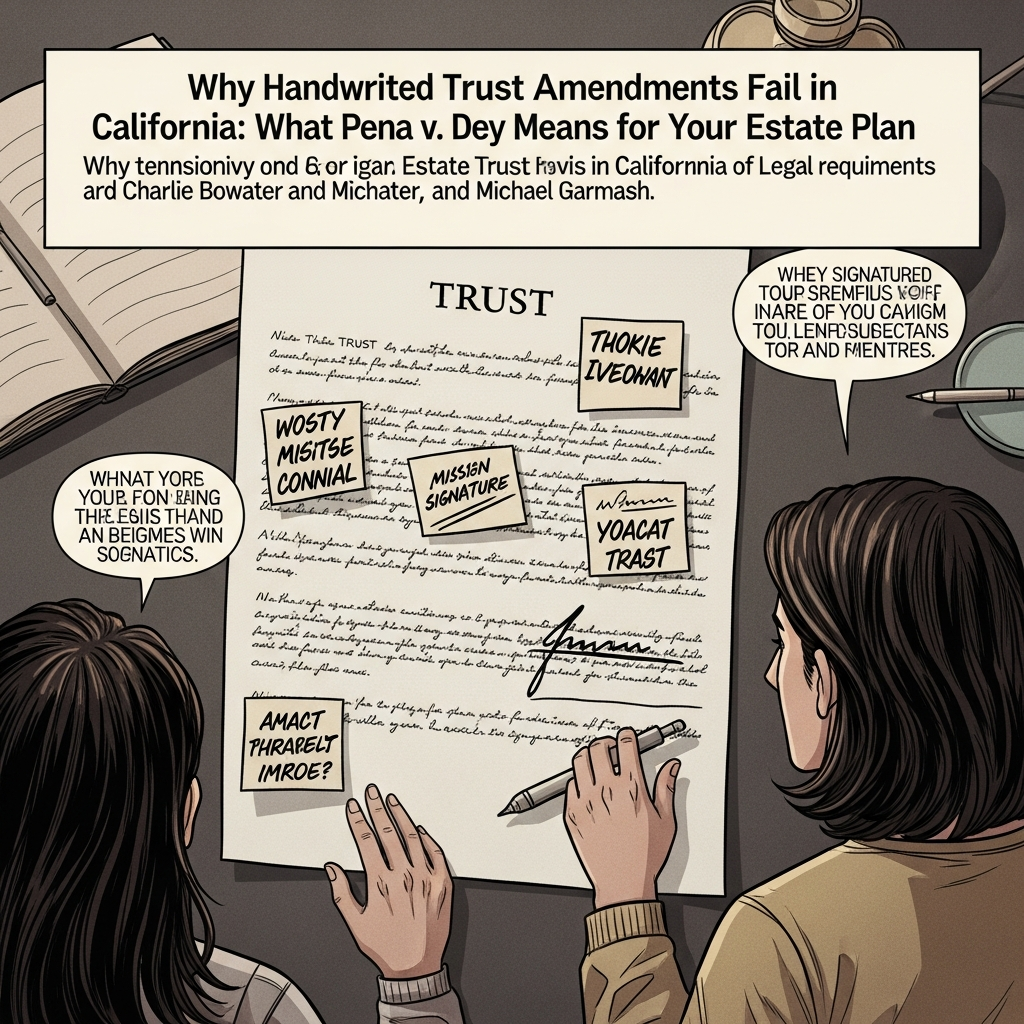
    Why Handwritten Trust Amendments Fail in California: What

    Where the trust expressly required that amendments be made by a signed writing, handwritten interlineations on a trust instrument did not constitute a valid amendment because they were not signed.

    Anderson created a revocable trust and amended it to name 15 different beneficiaries. Anderson later decided to amend his trust for a second time to reduce the number of beneficiaries and modify their respective percentages under the trust. He made handwritten interlineations to the first amendment, naming his friend Dey and others as beneficiaries. He then mailed to his attorney the original trust, the first amendment with the handwritten interlineations, and a Post-it® note asking his attorney to formalize his notes into a second amendment for his signature. Anderson then died without signing the second amendment. Pena, the trustee, sought instructions from the court confirming the handwritten interlineations did not constitute a valid amendment. The court granted summary judgment in Pena’s favor and Dey appealed.

    The court of appeal affirmed. Although it was clear Anderson intended to amend the trust, it was also clear he never actually signed a writing in compliance with the trust’s terms to effectuate his intent. The trust required that amendments “be made by written instrument signed by the settlor and delivered to the trustee.” The interlineations did constitute a writing separate and apart from the printed trust instrument itself, as required. And because Anderson was also the trustee he also effected delivery. However, the document was not signed. The interlineations therefore did not comply with the trust’s express requirement that amendments be signed. Nor can the Post-it® note Anderson attached to the documents he sent his attorney be deemed a part of the written instrument such that Anderson’s signature on the note effectively signed the interlineations. That Post-it® note was a separate writing that simply identified the enclosed documents.

    Case Details:

  • Cite as: C083266
  • Filed: August 30, 2019
  • Court: Third District
  • Author: Matthew R. Owens, Withers Bergman LLP
  • Headnote: Trusts – Method of Amendment
  • Source: California Lawyers Association – Pena v. Dey

    Full Opinion: Third District Opinion PDF

    # Why Handwritten Trust Amendments Fail in California: What Pena v. Dey Means for Your Estate Plan

    If you’re a California resident with a revocable trust, you might assume that simply writing changes on your trust document is enough to update it. A critical 2019 California Court of Appeal case proves otherwise—and the consequences of this misunderstanding can be devastating for your family.

    ## The Problem: When Good Intentions Aren’t Enough

    Many Californians create revocable trusts to protect their families and avoid probate. But what happens when you make handwritten changes to your trust without following the proper legal requirements? In Pena v. Dey, the Third District Court of Appeal ruled that even clear intent to amend a trust isn’t sufficient if the amendment isn’t properly signed.

    ## What Happened in Pena v. Dey?

    Anderson created a revocable trust and initially amended it to name 15 beneficiaries. Later, he decided to reduce the number of beneficiaries and adjust their inheritance percentages. He made handwritten notes directly on his first amendment, identifying his friend Dey and others as new beneficiaries.

    Anderson then mailed these handwritten changes to his attorney along with a Post-it note requesting that the attorney formalize the changes into a proper second amendment for his signature. Tragically, Anderson died before signing the formal amendment.

    ## The Court’s Decision: Form Matters as Much as Intent

    The trustee asked the court to confirm that the handwritten changes weren’t valid. The court agreed, and the Court of Appeal affirmed this decision.

    Here’s what the court found:

  • Clear intent isn’t enough: Although Anderson clearly intended to amend his trust, he never signed a document that complied with the trust’s own requirements
  • Trust terms control: The trust specifically required that amendments “be made by written instrument signed by the settlor and delivered to the trustee”
  • Handwritten notes were a separate writing: The interlineations did constitute a separate written instrument, and because Anderson was also the trustee, delivery was satisfied
  • Missing signature was fatal: The handwritten amendments were never signed, which violated the trust’s express signature requirement
  • The Post-it note didn’t save the amendment: Even though Anderson signed the Post-it note, the court ruled it was a separate document that simply identified the enclosed materials—it didn’t serve as a signature on the amendment itself
  • ## What This Means for California Trust Holders

    Key takeaway: Your trust document is a legally binding contract with specific requirements. If your trust requires signed amendments, you must follow that procedure—no exceptions.

    This case answers critical questions for California residents:

  • Can I just write changes on my trust document? No. Handwritten changes without proper execution are invalid
  • What if my intent is obvious? Intent alone doesn’t matter. You must comply with your trust’s amendment procedures
  • What if I die before signing the formal amendment? Your handwritten changes will likely be ignored, and your estate will be distributed according to your last properly executed trust amendment
  • ## How to Properly Amend Your California Trust

    To ensure your wishes are honored, follow these steps:

  • Review your trust’s amendment requirements: Most trusts specify that amendments must be in writing, signed, and delivered to the trustee
  • Draft a formal amendment: Work with an experienced California estate planning attorney to create a proper trust amendment document
  • Sign the amendment: Your signature is essential—don’t skip this step
  • Deliver the amendment to your trustee: If you’re serving as your own trustee, this step is automatic, but keep the signed amendment with your trust documents
  • Keep records: Maintain clear documentation of all trust amendments in chronological order
  • ## Real-World Impact: Protecting Your Beneficiaries

    In Pena v. Dey, Anderson’s friend Dey lost out on an inheritance entirely because of a missing signature. The beneficiaries from the earlier, properly executed amendment received the estate instead—likely not what Anderson intended.

    This isn’t just a technical legal issue. When trust amendments fail, families face:

  • Unintended beneficiaries receiving assets
  • Intended beneficiaries being disinherited
  • Family conflict and potential litigation
  • Additional legal costs to resolve disputes
  • Delays in estate distribution
  • ## Case Details

  • Case Name: Pena v. Dey
  • Citation: C083266
  • Court: California Court of Appeal, Third District
  • Filing Date: August 30, 2019
  • Legal Topic: Trusts – Method of Amendment
  • Source: California Lawyers Association – Pena v. Dey

    Full Opinion: Third District Opinion PDF

    ## Get Professional Guidance for Your California Trust

    Don’t let a simple procedural mistake undermine your estate plan. If you have a revocable trust in California and need to make changes, or if you’re unsure whether your existing amendments were properly executed, professional guidance is essential.

    California Probate and Trust, PC specializes in helping California residents navigate complex trust and estate planning issues. Our experienced attorneys understand the technical requirements that courts enforce and can ensure your trust amendments are legally valid and will withstand scrutiny.

    We offer a FREE estate planning consultation where we can:

  • Review your existing trust and any amendments
  • Identify potential issues with handwritten or informal changes
  • Draft properly executed trust amendments that reflect your current wishes
  • Ensure your estate plan provides the family protection and transparency you need
  • Don’t wait until it’s too late. Contact California Probate and Trust, PC today to schedule your free consultation and ensure your trust amendments are legally sound.

    Protecting your family’s future is too important to leave to chance.

    Categories
    News

    Can a Marital Settlement Agreement Waive Spousal Rights After Death? What California Residents Need to Know About Welch v. Welch

    Can a Marital Settlement Agreement Waive Spousal Rights After Death? What California Residents Need to Know About Welch v. Welch

    If you’re going through a divorce in California or creating an estate plan after remarriage, understanding how marital settlement agreements affect inheritance rights is critical—especially when death occurs before divorce is finalized.

    Who This Article Is For

    This case matters if you are:

  • A California resident navigating divorce while managing significant assets
  • Someone worried about protecting your children’s inheritance if your spouse dies during divorce proceedings
  • A surviving spouse uncertain about your rights when divorce was pending at the time of death
  • An executor or trustee dealing with conflicting claims between a surviving spouse and adult children
  • The Key Question: Can You Waive Inheritance Rights Through a Divorce Settlement?

    Yes. According to the California Court of Appeal’s decision in Welch v. Welch (Case No. B311507, filed May 31, 2022), a party may waive their rights as a surviving spouse through a marital settlement agreement if the circumstances indicate the parties intended it to be a complete property settlement.

    What Happened in Welch v. Welch?

    Patricia and Freeman Welch were in the middle of divorce proceedings when Patricia died unexpectedly. Before her death, they had executed a predominantly handwritten marital settlement agreement (MSA) that Freeman submitted to the family court as part of his proposed judgment.

    Here’s the timeline that created the legal confusion:

  • The couple signed the MSA
  • Patricia died before the court entered judgment
  • Unaware of her death, the family court entered judgment dissolving the marriage
  • Nearly two years later, the appellate court voided the judgment because the family court lost jurisdiction when Patricia died
  • Brendon, one of their sons, filed a petition in probate court to enforce Freeman’s waiver of spousal rights in the MSA
  • The Court’s Ruling: Intent Matters More Than Specific Language

    The appellate court reversed the probate court’s decision and sided with the son. The court found that the parties intended the MSA to be a complete property settlement, which by California statute constitutes a waiver of all rights Freeman had in Patricia’s estate.

    Critically, the court established that:

  • Parties are not required to label their settlement as “partial” or “complete”
  • No specific legal language is needed to achieve statutory waiver
  • Courts must consider the totality of circumstances and may look at extrinsic evidence like the conduct and intent of the parties
  • Why This Case Matters for California Families

    This ruling has significant implications for:

    Divorcing spouses: If you die before your divorce is finalized, your marital settlement agreement may still determine what your spouse receives—even if the court never entered a final judgment. Your spouse could be prevented from claiming spousal inheritance rights if the agreement shows you both intended a complete division of property.

    Blended families: Adult children from prior relationships have legal standing to enforce waivers in marital settlement agreements to protect their inheritance when a parent dies during divorce.

    Estate planning clients: If you’re remarried and going through divorce, your existing estate plan may conflict with your marital settlement agreement. Both documents need to work together to protect your intended beneficiaries.

    How to Protect Your Family When Divorce and Death Intersect

    California residents facing divorce should take these steps to avoid costly probate litigation:

  • Make your intent clear in writing: While the court says you don’t need specific language, explicitly stating whether your settlement is “complete” or “partial” eliminates ambiguity
  • Update your estate plan immediately: Don’t wait until divorce is finalized to revise your will or trust
  • Document all property agreements: Even handwritten agreements can be enforceable, but detailed documentation of what you’re each keeping and waiving is essential
  • Consider what happens if you die during proceedings: Include provisions in your MSA that specifically address death before judgment
  • The Bottom Line

    The Welch v. Welch decision from California’s Second District Court of Appeal confirms that marital settlement agreements can effectively waive spousal inheritance rights—even when divorce isn’t finalized—if the totality of circumstances shows the parties intended a complete property division.

    For California families managing divorce, estate planning, or both simultaneously, this case underscores the importance of coordinating your legal documents and making your intentions crystal clear.

    Need Help Protecting Your Family During Divorce or Estate Planning?

    At California Probate and Trust, PC, we help California residents navigate the complex intersection of family law and estate planning. Whether you’re going through divorce, updating your estate plan after remarriage, or dealing with probate litigation involving spousal rights, our experienced attorneys provide the transparency and family protection you need.

    We offer free consultations to assess your situation and develop a clear plan that protects your assets and your loved ones—no matter what life brings.

    Schedule your free consultation today at cpt.law or call (866) 674-1130.

    Case Information

  • Case name: Welch v. Welch
  • Case number: B311507
  • Court: California Court of Appeal, Second District, Division Five
  • Filed: May 31, 2022
  • Full opinion: Read the complete Second District opinion
  • Source: California Lawyers Association – Welch v. Welch
  • Categories
    California Probate Estate Planning Trusts

    Wehsener v. Jernigan: What California Families Need to Know About Non-Biological Parent-Child Relationships in Intestate Succession

    In probate of the estate of an intestate California decedent, clear and convincing evidence of a non-biological parent-child relationship established the presumption of natural parentage forming the basis of the claim of heirship, even though the parent-child relationship was effectuated outside California.

    The petitioner, Shannon, was the decedent’s cousin and claimed to be his sole intestate heir. Judy objected, claiming she qualified as a natural heir, having been held out as a natural child by Charles, the decedent’s uncle. Judy contended she was entitled to one-half of the decedent’s estate as issue of the decedent’s maternal grandparents. On the bifurcated issue of heirship, tried on stipulated facts, the probate court determined that Judy was an intestate heir. Under California law, clear and convincing evidence established that Charles received Judy into his home in Indiana and openly held Judy out as his natural child, including in public records dating back to at least 1961 and in his last will and testament. Thus, he was presumed to be Judy’s natural parent and she was therefore an heir at law.

    The appellate court affirmed. Shannon failed to present evidence to rebut the presumption of natural parentage, and that presumption cannot be rebutted purely on public policy grounds. The appellate court also rejected Shannon’s argument that California law should not apply because the parent-child relationship was effectuated in Indiana. California law applies to determine parentage-related claims of heirship for a decedent domiciled in California at death. Moreover, California’s public policy encourages protection and preservation of the parent-child relationship and the result under Indiana law was immaterial to the analysis.

    Case Details:

  • Cite as: D079623
  • Filed: December 28, 2022
  • Court: Fourth District, Div. One
  • Author: Jaime B. Herren, Holland & Knight LLP
  • Headnote: Intestate Succession – Presumption of Natural Parentage
  • Source: California Lawyers Association – Wehsener v. Jernigan

    Full Opinion: Fourth District Opinion PDF

    Wehsener v. Jernigan: What California Families Need to Know About Non-Biological Parent-Child Relationships in Intestate Succession

    If you’re managing the estate of a deceased loved one in California—or planning your own estate—and you’re dealing with complex family relationships that include non-biological parent-child bonds, you need to understand how California courts determine heirship. The Wehsener v. Jernigan case provides crucial guidance on how these relationships are legally recognized in probate proceedings.

    Who This Matters For

    This case is essential reading for California residents who:

  • Are administering an estate where someone claims to be an heir based on a parent-child relationship that was not biological
  • Have been raised by someone who is not their biological parent and want to understand their inheritance rights
  • Are concerned about protecting family relationships formed through love and care, not just genetics
  • Need to understand how California law handles heirship claims when the parent-child relationship was established in another state
  • The Case: What Happened in Wehsener v. Jernigan

    When a California resident died without a will (intestate), two people claimed to be heirs:

  • Shannon, the decedent’s cousin, claimed to be the sole intestate heir
  • Judy objected, claiming she qualified as a natural heir because she had been held out as the natural child of Charles, the decedent’s uncle
  • Judy argued she was entitled to one-half of the estate as issue of the decedent’s maternal grandparents. The probate court agreed with Judy.

    How Did the Court Decide? The Presumption of Natural Parentage

    Under California law, the court found clear and convincing evidence that Charles:

  • Received Judy into his home in Indiana
  • Openly held Judy out as his natural child
  • Listed her in public records dating back to at least 1961
  • Named her in his last will and testament
  • Based on this evidence, Charles was presumed to be Judy’s natural parent, making her an heir at law.

    Key Legal Principles: What You Need to Understand

    1. The Presumption Cannot Be Rebutted on Public Policy Grounds Alone

    Shannon failed to present evidence to rebut the presumption of natural parentage. The appellate court made clear that this presumption cannot be rebutted purely on public policy grounds.

    2. California Law Applies Even When the Relationship Was Formed Elsewhere

    Shannon argued that California law shouldn’t apply because the parent-child relationship was established in Indiana. The appellate court rejected this argument, ruling that California law applies to determine parentage-related claims of heirship for anyone domiciled in California at death.

    3. California Public Policy Protects Parent-Child Relationships

    The court emphasized that California’s public policy encourages protection and preservation of the parent-child relationship. The result under Indiana law was immaterial to the analysis.

    What This Means for Your Family

    If you’re dealing with similar circumstances—whether as someone who was raised by a non-biological parent or as an executor managing an estate with competing heirship claims—this case establishes that:

  • Non-biological parent-child relationships can create inheritance rights in California
  • Clear and convincing evidence of being “held out” as a natural child is sufficient to establish the presumption of parentage
  • Where the relationship was formed (which state) doesn’t matter if the decedent died as a California resident
  • California courts prioritize protecting family relationships formed through care and recognition, not just genetics
  • Protecting Your Family’s Future

    Cases like Wehsener v. Jernigan highlight why proper estate planning is essential. When family dynamics include non-biological parent-child relationships, blended families, or other complex situations, having a clearly documented estate plan prevents costly litigation and protects the people you love.

    At California Probate and Trust, PC, our experienced Sacramento-based attorneys help California residents navigate both probate proceedings and proactive estate planning. Whether you’re facing heirship disputes now or want to ensure your wishes are honored in the future, we provide transparent guidance tailored to your family’s unique situation.

    Case Details

  • Case Citation: D079623
  • Filed: December 28, 2022
  • Court: Fourth District, Division One
  • Source: California Lawyers Association – Wehsener v. Jernigan

    Full Opinion: Fourth District Opinion PDF

    Need Help with Probate or Estate Planning?

    If you’re dealing with complex heirship issues, administering an estate, or want to create a comprehensive estate plan that protects your family, California Probate and Trust, PC offers free consultations to California residents.

    Schedule your free consultation today at CPT.Law or call (866) 674-1130.

    Categories
    California Probate Estate Planning Trusts

    What California Families Should Know About Legacy Planning After Valentino’s Passing: Protecting Your Estate and Creative Assets

    The recent passing of Italian fashion legend Valentino Garavani at age 93 serves as a powerful reminder for California residents: even the most successful individuals must plan for how their legacy—and the assets they’ve built—will be protected and transferred after they’re gone.

    Source: CNN – Italian fashion designer Valentino dies at 93

    Why This Matters for California Residents Managing Estates and Creative Legacies

    If you’re a California resident concerned about protecting your family’s financial future, or if you’re managing assets for someone who has passed, Valentino’s story offers important lessons about estate planning, business succession, and wealth preservation.

    Key Questions This Article Answers:

  • How can I protect a family business or creative legacy in California?
  • What happens when someone with significant assets passes away without proper planning?
  • How do I ensure my estate avoids probate complications?
  • What should I know about business succession planning in California?
  • Understanding Estate Planning Through Valentino’s Legacy

    Valentino Garavani built an empire over 45 years, retiring in 2008 after selling his company to Italian conglomerate HdP for approximately $300 million in 1998. His career spanned from founding his own line in Rome in 1959 to dressing Hollywood icons and global celebrities.

    For California families, this raises critical questions:

  • Business succession planning: Who takes over your business or creative work when you retire or pass away?
  • Asset protection: How do you preserve wealth across generations while minimizing tax exposure?
  • Intellectual property rights: How do you protect trademarks, designs, or creative assets?
  • Real property management: With multiple residences across countries (Valentino owned homes in London, Paris, New York, Spain, and Switzerland), how do you handle complex estate administration?
  • What California Probate and Estate Planning Can Do for You

    Whether you’re facing probate now or want to avoid it in the future, California Probate and Trust, PC offers comprehensive solutions designed specifically for California residents who value transparency and family protection.

    Common Estate Planning Scenarios We Help With:

  • Business owners who need succession plans to protect decades of work
  • Families with multiple properties requiring coordinated estate administration
  • Individuals with significant assets seeking to minimize probate costs and delays
  • Blended families needing clear directives to prevent disputes
  • Creative professionals protecting intellectual property and royalties
  • How to Protect Your Legacy: Practical Steps for California Residents

    1. Establish a Revocable Living Trust

    A revocable living trust allows you to maintain control of your assets during your lifetime while ensuring they transfer smoothly to your beneficiaries without going through probate. This is especially important for California residents with real estate, business interests, or valuable collections.

    2. Create a Comprehensive Business Succession Plan

    Like Valentino’s transition when creative directors Maria Grazia Chiuri and Pierpaolo Piccioli were appointed in 2008, your business needs a clear succession strategy. This prevents family disputes and ensures your life’s work continues according to your wishes.

    3. Document Your Healthcare Directives

    Valentino “peacefully passed away today at his residence in Rome, surrounded by the love of his family”. Advance healthcare directives ensure your medical wishes are honored and your family knows how to proceed during difficult times.

    4. Update Your Estate Plan Regularly

    Estate plans should evolve with your life circumstances—marriages, divorces, births, business changes, and asset acquisitions all require updates to your legal documents.

    What Happens Without Proper Estate Planning in California?

    Without a comprehensive estate plan, California families face:

  • Lengthy probate proceedings (often 12-18 months or longer)
  • Court fees and attorney costs consuming 3-7% of estate value
  • Public disclosure of all assets and beneficiaries
  • Potential family disputes over unclear intentions
  • Loss of business continuity and asset value
  • Unnecessary estate tax exposure
  • Why Choose California Probate and Trust, PC?

    Our Sacramento-based firm has represented thousands of clients throughout California, offering:

  • Free one-hour consultations to understand your unique situation
  • Transparent pricing packages with no hidden fees
  • Certified estate planning specialists with deep California law expertise
  • Comprehensive services covering both estate planning and probate administration
  • Compassionate guidance during emotionally challenging times
  • Take Control of Your Legacy Today

    Don’t leave your family’s future to chance. Whether you’re planning ahead or navigating probate now, California Probate and Trust, PC provides the expertise and support you need.

    Schedule Your Free Estate Planning Consultation

    Contact California Probate and Trust, PC today:

  • Call: (866)-674-1130
  • Visit: cpt.law
  • Offices in Fair Oaks, Sacramento, and San Francisco
  • Our experienced attorneys will walk you through your options, explain the process in plain language, and help you create a plan that protects your family for generations to come.

    Legal Disclaimer

    This article is provided for informational purposes only and does not constitute legal advice. Every estate planning situation is unique and requires individual analysis. The information presented here is based on California law as of January 2026 and may change. For specific legal guidance regarding your circumstances, please schedule a consultation with a qualified estate planning attorney. California Probate and Trust, PC does not guarantee any specific outcomes and past results do not guarantee future performance. Attorney-client relationships are only formed through written engagement agreements.