
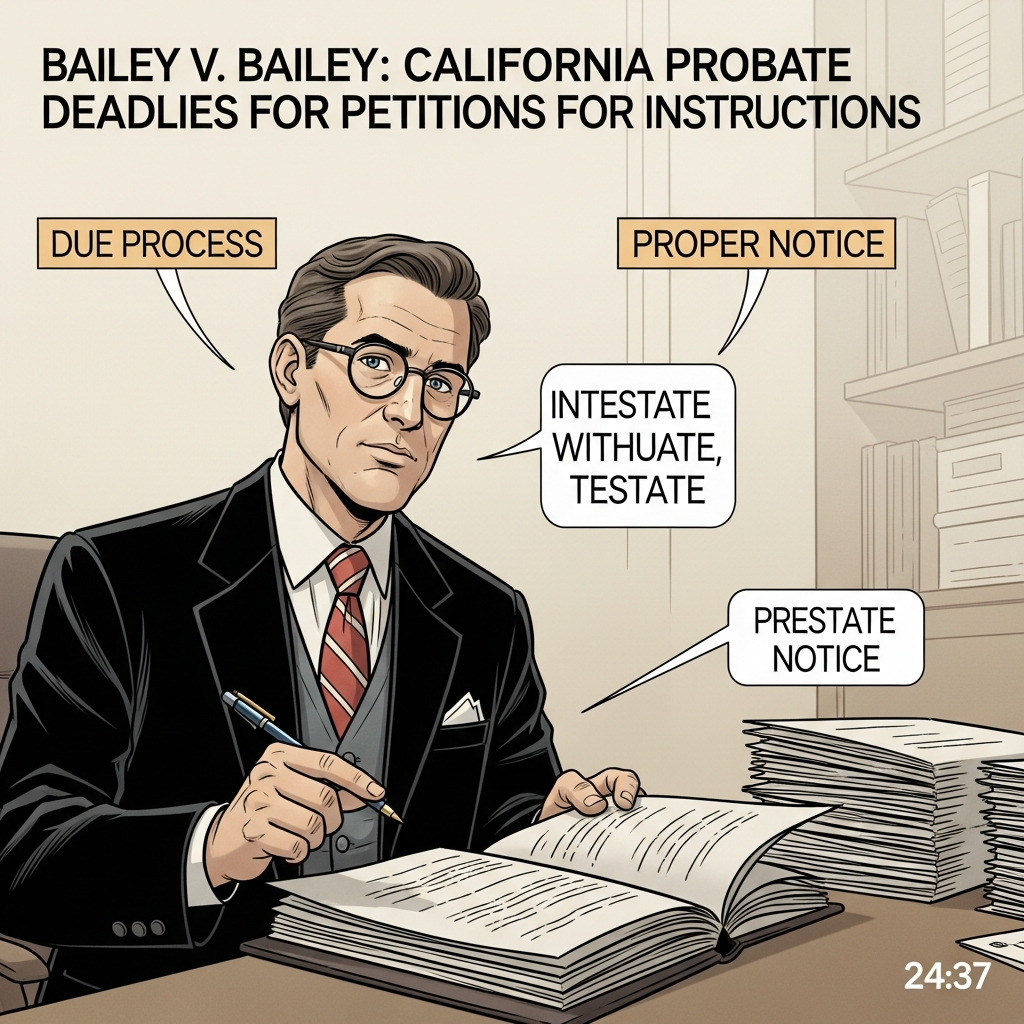
California Probate Deadlines and Due Process: The Bailey v. Bailey Decision
California Legal Implications: The Importance of Proper Notice in Probate
In the recent California appellate case of *Bailey v. Bailey* (B320664), the court addressed a critical issue regarding the timelines for probating a Will versus administering an estate without one (intestate). As detailed in the court opinion, the case serves as a stark reminder of the complexities inherent in the probate process and the strict requirements for due process in California courts. in California courts.
The dispute arose when a petitioner, George, filed to administer his brother’s estate alleging there was no Will (intestate). George later found a Will but only notified potential beneficiaries *after* the court had already granted him authority to administer the estate. When a beneficiary named Olan later attempted to probate the Will, another family member objected, claiming Olan had missed the statutory deadline under Probate Code section 8226(c)..
The appellate court ruled in favor of Olan, establishing that the strict time limits to petition for probate do not apply if the proponent of the Will did not receive pre-hearing notice of the initial competing petition. This decision highlights that efficient administration cannot supersede a beneficiary’s right to proper legal notice. For California families, this underscores the uncertainty and potential for litigation involved in probate, which can often be avoided through comprehensive estate planning. of the initial competing petition. This decision highlights that efficient administration cannot supersede a beneficiary’s right to proper legal notice. For California families, this underscores the uncertainty and potential for litigation involved in probate, which can often be avoided through comprehensive estate planning.
Understanding Probate Code Section 8226(c)
Generally, in California, a petition to probate a Will can be filed at any time. However, exceptions exist to ensure estates are settled in a reasonable timeframe. Probate Code section 8226(c) typically bars a proponent from filing a Will if they fail to do so within specific timeframes (60 to 120 days) after receiving notice of a competing petition. typically bars a proponent from filing a Will if they fail to do so within specific timeframes (60 to 120 days) after receiving notice of a competing petition.
The *Bailey* decision clarifies that this statutory clock does not start ticking unless the beneficiary receives notice *before* the initial probate hearing. The court emphasized that exceptions to the general rule permitting the probate of a Will must be strictly construed. This ensures that beneficiaries are not unfairly penalized for failing to act on proceedings they were not properly notified of in advance.
The Difference Between Intestate and Testate Succession
This case also illustrates the confusion that occurs when it is unclear if a decedent left a Will.
– Intestate Succession: When someone dies without a Will, California law dictates who inherits the assets.
– Testate Succession: When a valid Will exists, it directs the distribution of assets.: When a valid Will exists, it directs the distribution of assets.
In *Bailey*, the estate began as an intestate proceeding but shifted once a Will was discovered. This “stop-and-go” nature of probate can drain estate assets through legal fees and delay distribution to heirs.
Avoiding Probate Litigation with a Living Trust
The procedural hurdles seen in *Bailey v. Bailey*—filing deadlines, notice requirements, and appellate litigation—are unique to the probate court system. A comprehensive Revocable Living Trust is often the most effective tool for California residents to avoid these issues entirely. is often the most effective tool for California residents to avoid these issues entirely.
Unlike a Will, which must be admitted to probate court to be effective, a Trust is administered privately. This means:
– No Court Hearings: There is no need to file petitions for instructions or wait for court dates.
– Privacy: The details of the estate are not a matter of public record.
– Immediate Authority: A Successor Trustee can usually step in immediately to manage assets, rather than waiting for “Letters of Administration.”: A Successor Trustee can usually step in immediately to manage assets, rather than waiting for “Letters of Administration.”
By utilizing a Trust, families can bypass the rigid statutory deadlines of the Probate Code and reduce the risk of the type of family litigation seen in the *Bailey* case.
About This Case
Source: Bailey v. Bailey: B320664
California Probate and Trust, PC Can Help
– Free consultations: (866)-674-1130
– Experienced California estate planning
– Schedule consultation
– Learn more: cpt.law
Legal Disclaimer
This article is for informational purposes only. Consult with a qualified California estate planning attorney for advice specific to your situation.

About the Author: Dustin MacFarlane, Esq.
California Licensed Attorney | Estate Planning Specialist
Dustin MacFarlane is the founder of California Probate and Trust, PC, with over 15 years of experience in estate planning, probate administration, and trust law. Licensed by the California State Bar, Dustin has helped thousands of California families protect their assets and plan for the future.
CA Bar License: Active | Practice Areas: Estate Planning, Probate, Trust Administration | Location: Granite Bay, CA