
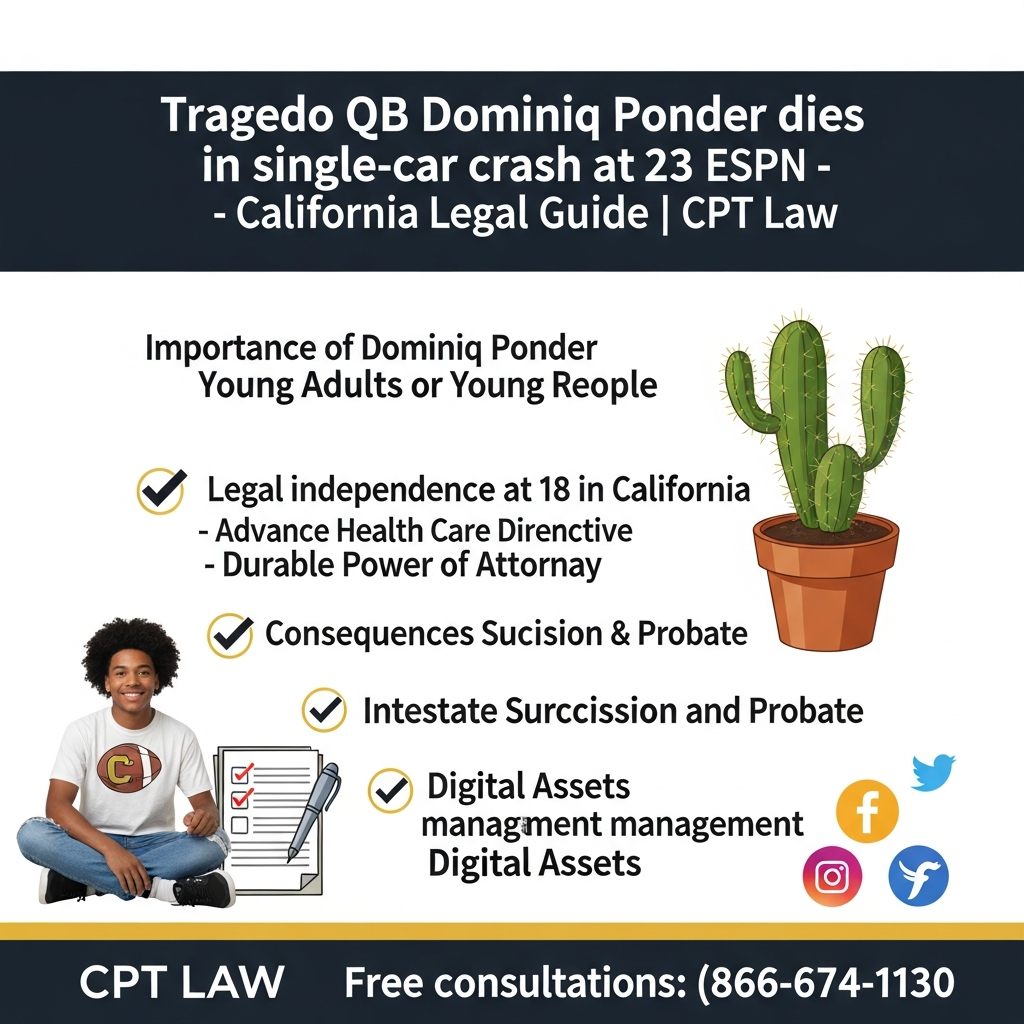
California Legal Implications: The Necessity of Estate Planning for Young Adults
The sports world is mourning the tragic loss of University of Colorado quarterback Dominiq Ponder, who passed away at the age of 23 in a single-car accident early Sunday morning. As reported by ESPN, the young athlete lost control of his vehicle in Boulder County. While the community grieves this sudden loss, such tragedies serve as a somber reminder for California families that estate planning is not strictly for the elderly; it is a critical necessity for every legal adult, regardless of age or health., the young athlete lost control of his vehicle in Boulder County. While the community grieves this sudden loss, such tragedies serve as a somber reminder for California families that estate planning is not strictly for the elderly; it is a critical necessity for every legal adult, regardless of age or health.
The Legal Reality of Turning 18 in California
Many families operate under the assumption that parents retain the legal authority to make decisions for their children as long as they are young or in college. However, under California law, once an individual turns 18, they are considered an independent legal adult. Without proper documentation, parents lose the automatic right to access medical records, make healthcare decisions, or manage finances—even in the event of a catastrophic emergency.
Essential Documents for Young Adults
To protect young adults and ensure families can step in during a crisis, California residents should consider the following legal instruments:
Advance Health Care Directive
If a young adult is involved in an accident and becomes incapacitated, doctors are legally restricted by privacy laws (HIPAA) from sharing information with parents without written authorization. An Advance Health Care Directive designates an agent—usually a parent—to make medical decisions and receive health information if the individual cannot speak for themselves. designates an agent—usually a parent—to make medical decisions and receive health information if the individual cannot speak for themselves.
Durable Power of Attorney
In the event of incapacity or death, accessing a young adult’s financial accounts can be legally difficult without a Durable Power of Attorney. This document grants a designated agent the authority to handle banking, pay bills, and manage financial obligations, preventing the need for a costly and public court-supervised conservatorship..
Intestate Succession and Probate
When a young adult passes away without a Will or Trust, their estate is distributed according to California’s laws of intestate succession. While most young adults may not have vast real estate portfolios, they often possess significant personal property, vehicles (such as the Tesla noted in the report), and bank accounts.. While most young adults may not have vast real estate portfolios, they often possess significant personal property, vehicles (such as the Tesla noted in the report), and bank accounts.
If the total value of these assets exceeds California’s small estate threshold, the family may be forced to go through probate court to settle the estate. This process is public, expensive, and time-consuming. A simple Will or Revocable Living Trust can ensure that assets are transferred efficiently to loved ones without government interference. can ensure that assets are transferred efficiently to loved ones without government interference.
Digital Assets and Legacy
The news report highlights the outpouring of support on social media from teammates and coaches. In the modern era, a young adult’s “estate” includes digital assets—social media accounts, cryptocurrency, emails, and cloud storage. California law allows individuals to designate a fiduciary to manage these digital assets through their estate plan. Without this designation, families may face significant hurdles recovering photos, memories, or important digital files.
About This Case
Source: Colorado QB Dominiq Ponder dies in single-car crash at 23 – ESPN
California Probate and Trust, PC Can Help
– Free consultations: (866)-674-1130
– Experienced California estate planning
– Schedule consultation
– Learn more: cpt.law
Legal Disclaimer
This article is for informational purposes only. Consult with a qualified California estate planning attorney for advice specific to your situation.
Why Estate Planning Matters in California
California has unique estate planning laws that differ significantly from other states. Without proper planning, your assets may not pass according to your wishes, and your family could face unnecessary probate court proceedings.
A comprehensive California estate plan typically includes:
- A revocable living trust to avoid probate
- Pour-over will as a safety net
- Advance health care directive
- Durable power of attorney for finances
- Beneficiary designations on retirement accounts and life insurance
How Trusts Work in California
California’s trust law (Probate Code Division 9) governs how trusts are created, administered, and terminated. Understanding these rules is essential for effective estate planning.
Key benefits of California trusts:
- Avoid probate: Assets in a properly funded trust bypass California’s lengthy probate process
- Privacy: Unlike wills (which become public in probate), trusts remain private
- Control: You maintain control during your lifetime and direct distribution after death
- Incapacity planning: Your successor trustee manages assets if you become incapacitated
- Tax planning: Trusts can help minimize estate and income taxes
Need Expert Estate Planning Guidance?
California estate planning law is complex and constantly evolving. Don’t navigate it alone.
California Probate and Trust, PC has helped thousands of California families protect their assets and plan for the future.
📞 Call us today:
- Main Office: 866-400-0058
- Direct: 916-963-9968

About the Author: Dustin MacFarlane, Esq.
California Licensed Attorney | Estate Planning Specialist
Dustin MacFarlane is the founder of California Probate and Trust, PC, with over 15 years of experience in estate planning, probate administration, and trust law. Licensed by the California State Bar, Dustin has helped thousands of California families protect their assets and plan for the future.
CA Bar License: Active | Practice Areas: Estate Planning, Probate, Trust Administration | Location: Granite Bay, CA