
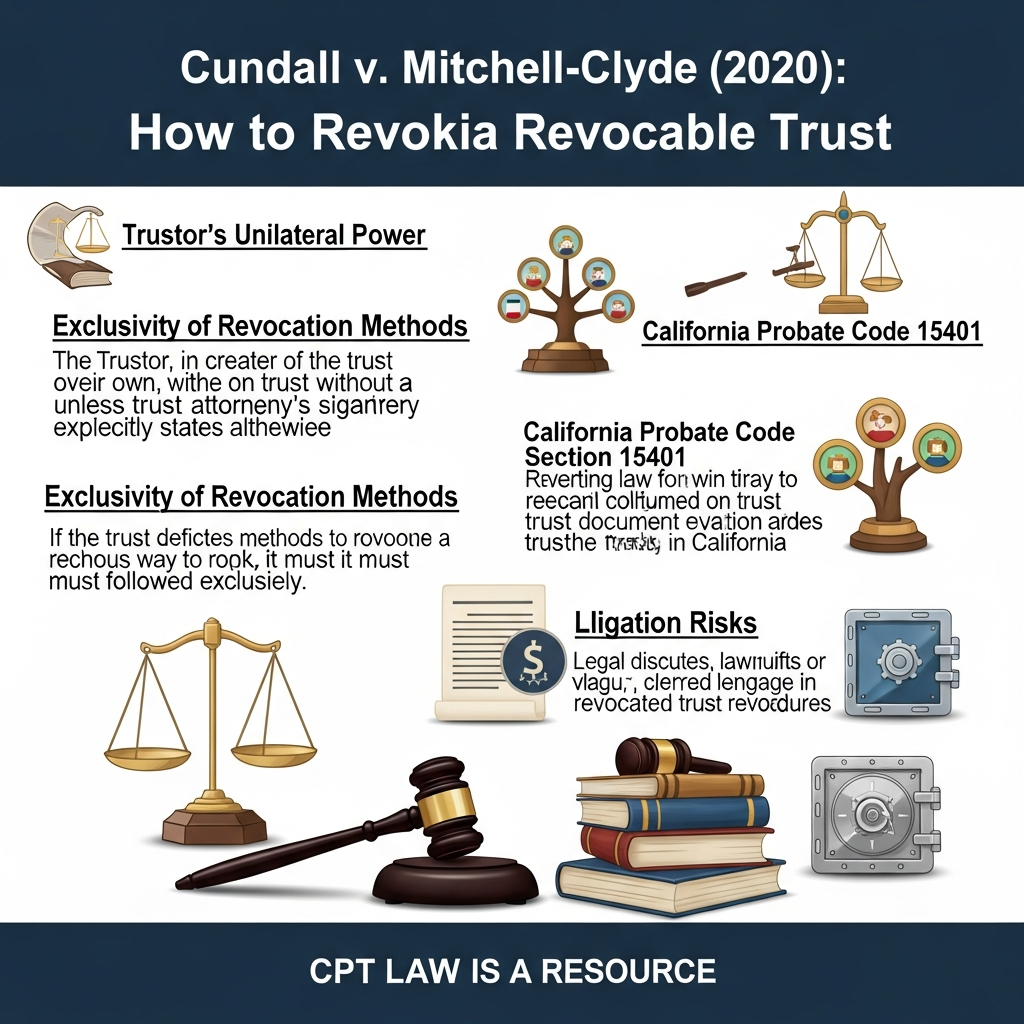
California Legal Implications: Trust Revocation Protocols and Estate Litigation
A significant appellate decision, *Cundall v. Mitchell-Clyde*, clarifies how a Trustor (the person who creates a trust) may legally revoke their trust when the document includes specific instructions. In this case, summarized from the original court opinion, a trustor named John Martin established a Revocable Trust that contained a specific clause regarding revocation: it stated the trust could be revoked by delivering a document signed by the trustor *and* his estate planning attorney. that contained a specific clause regarding revocation: it stated the trust could be revoked by delivering a document signed by the trustor *and* his estate planning attorney.
Later, Martin revoked that trust and created a new one without obtaining his attorney’s signature. The disgruntled beneficiary of the original trust argued the revocation was invalid because Martin failed to follow the specific steps outlined in the document. The court disagreed, ruling that because the trust did not explicitly state that its specific method was the *exclusive* means of revocation, Martin was free to use the standard statutory method provided by California law. For California families and trustees, this ruling emphasizes that unless a trust strictly limits revocation methods, state law provides a default path to modify or cancel an estate plan.
Understanding Statutory Revocation Under Probate Code Section 15401
In California, Probate Code Section 15401 governs the revocation of trusts. This statute provides two distinct ways to revoke a trust: governs the revocation of trusts. This statute provides two distinct ways to revoke a trust:
1. By complying with any method provided in the trust instrument.
2. By a writing, other than a will, signed by the settlor (trustor) and delivered to the trustee during the settlor’s lifetime. during the settlor’s lifetime.
The ruling in *Cundall* affirms that these methods are generally independent. Even if a trust document lists a complex procedure—such as requiring a third party or Trust Protector to sign off on the revocation—the settlor can often bypass this by utilizing the second method (the statutory method), provided the trust language is not restrictive enough to forbid it. to sign off on the revocation—the settlor can often bypass this by utilizing the second method (the statutory method), provided the trust language is not restrictive enough to forbid it.
The Requirement of Exclusivity
The pivotal takeaway for estate planning is the concept of “exclusivity.” If a Settlor intends to create barriers to revocation—perhaps to prevent themselves from acting impulsively or under undue influence in their later years—the trust document must be drafted with precision. in their later years—the trust document must be drafted with precision.
To prevent the use of the statutory revocation method, the trust instrument must explicitly state that the method described within the document is the *exclusive* method of revocation. Without the word “exclusive” or similar language indicating that the statutory method is barred, the courts will likely allow the trustor to revoke the trust simply by delivering a signed writing to the trustee, rendering the specific internal procedures optional.
Clarity in Drafting Prevents Litigation
Litigation regarding the validity of a trust amendment or revocation can deplete estate assets and destroy family relationships. The dispute in *Cundall* arose because the language in the trust was ambiguous regarding whether the attorney’s signature was a mandatory requirement or merely a suggested method.
When establishing an estate plan, it is vital to discuss with a qualified attorney how flexible or rigid the Trust should be. If the goal is maximum flexibility, the standard statutory powers are usually sufficient. However, if the goal is to protect the Settlor from potential financial abuse or hasty decisions, the drafting attorney must explicitly ensure the revocation clause is exclusive, thereby closing the “back door” provided by the Probate Code. from potential financial abuse or hasty decisions, the drafting attorney must explicitly ensure the revocation clause is exclusive, thereby closing the “back door” provided by the Probate Code.
About This Case
Source: Cundall v. Mitchell-Clyde (2020): How to Revoke a California Revocable Trust
California Probate and Trust, PC Can Help
– Free consultations: (866)-674-1130
– Experienced California estate planning
– Schedule consultation
– Learn more: cpt.law
Legal Disclaimer
This article is for informational purposes only. Consult with a qualified California estate planning attorney for advice specific to your situation.

About the Author: Dustin MacFarlane, Esq.
California Licensed Attorney | Estate Planning Specialist
Dustin MacFarlane is the founder of California Probate and Trust, PC, with over 15 years of experience in estate planning, probate administration, and trust law. Licensed by the California State Bar, Dustin has helped thousands of California families protect their assets and plan for the future.
CA Bar License: Active | Practice Areas: Estate Planning, Probate, Trust Administration | Location: Granite Bay, CA