
California Legal Implications: Beneficiary Rights After Death
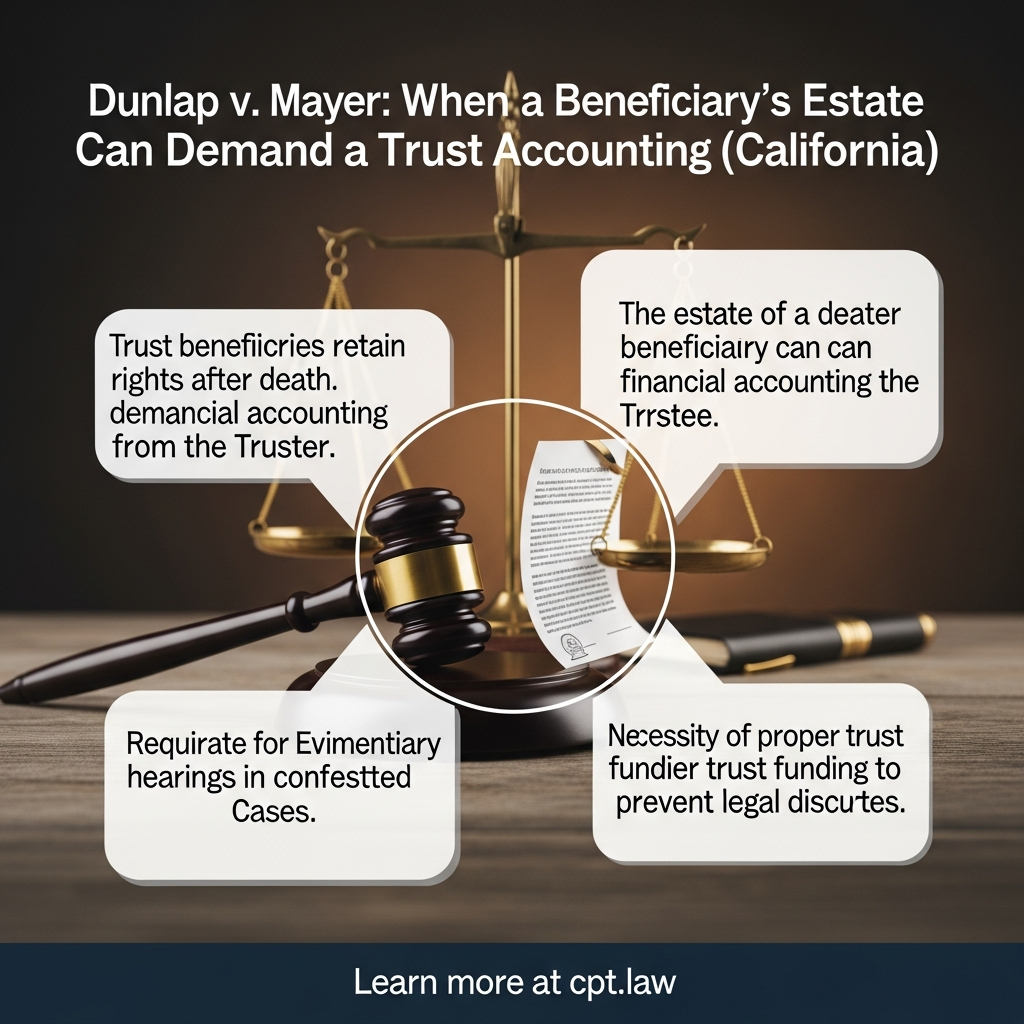
In the complex world of California estate planning, the rights of a trust beneficiary do not necessarily end when that beneficiary passes away. A recent legal development, Dunlap v. Mayer, highlights a critical protection for families: the estate of a deceased beneficiary has standing to demand a financial accounting from a trustee. to demand a financial accounting from a trustee.
In this specific case, a dispute arose regarding a Marital Trust established after a husband’s death. His widow was the sole income beneficiary, and his daughter served as the trustee. After the widow passed away, her estate requested a trust accounting to ensure she had received what she was owed during her lifetime. The daughter (trustee) argued the trust was never funded and the underlying businesses were defunct, leading the lower court to dismiss the request without a full hearing. The appellate court reversed this decision, affirming that the widow’s estate had the legal right to demand answers and that disputed facts require an evidentiary hearing..
For California families, this underscores the importance of proper trust administration and the enduring nature of fiduciary duties. and the enduring nature of fiduciary duties.
Understanding Standing to Request an Accounting
Under the California Probate Code, a trustee is generally required to keep beneficiaries reasonably informed about the trust and its administration. This includes providing an accounting, which is a detailed report of the trust’s assets, liabilities, income, and disbursements., which is a detailed report of the trust’s assets, liabilities, income, and disbursements.
The *Dunlap* case clarifies that if a beneficiary was entitled to an accounting while alive, that right acts as a property interest that passes to their own estate upon death. This ensures that a trustee cannot run out the clock; they remain accountable for their actions during the beneficiary’s lifetime, even after that beneficiary has died.
The Necessity of Evidentiary Hearings
One of the key takeaways from this ruling is the protection of due process in probate court. The trial court initially dismissed the petition based on the trustee’s unverified claims that the trust was empty. The appellate court ruled that when there are contested issues of fact—such as whether a trust was funded or if assets existed—a court cannot simply dismiss the case based on one party’s word. in probate court. The trial court initially dismissed the petition based on the trustee’s unverified claims that the trust was empty. The appellate court ruled that when there are contested issues of fact—such as whether a trust was funded or if assets existed—a court cannot simply dismiss the case based on one party’s word.
Instead, an evidentiary hearing is required. This is a legal proceeding where:
– Witnesses may be called.
– Documents are reviewed.
– Discovery (the exchange of information) is allowed to proceed. (the exchange of information) is allowed to proceed.
This prevents trustees from evading their fiduciary duties simply by claiming a trust has no assets without providing proof. simply by claiming a trust has no assets without providing proof.
The Importance of Proper Trust Funding
This case also serves as a cautionary tale regarding trust funding. The dispute arose partly because the trustee claimed the trust was never funded with the business assets as originally intended. To avoid costly litigation like *Dunlap v. Mayer*, it is essential that:
– Assets are formally retitled into the name of the trust.
– Trustees maintain accurate, contemporaneous records.
– Beneficiaries are kept informed throughout the life of the trust.. The dispute arose partly because the trustee claimed the trust was never funded with the business assets as originally intended. To avoid costly litigation like *Dunlap v. Mayer*, it is essential that:
– Assets are formally retitled into the name of the trust.
– Trustees maintain accurate, contemporaneous records.
– Beneficiaries are kept informed throughout the life of the trust.
When a trust is properly funded and administered, it reduces the likelihood of confusion and suspicion among heirs, preserving family relationships and estate assets.
About This Case
Source: Dunlap v. Mayer: When a Beneficiary’s Estate Can Demand a Trust Accounting
California Probate and Trust, PC Can Help
– Free consultations: (866)-674-1130
– Experienced California estate planning
– Schedule consultation
– Learn more: cpt.law
Legal Disclaimer
This article is for informational purposes only. Consult with a qualified California estate planning attorney for advice specific to your situation.

About the Author: Dustin MacFarlane, Esq.
California Licensed Attorney | Estate Planning Specialist
Dustin MacFarlane is the founder of California Probate and Trust, PC, with over 15 years of experience in estate planning, probate administration, and trust law. Licensed by the California State Bar, Dustin has helped thousands of California families protect their assets and plan for the future.
CA Bar License: Active | Practice Areas: Estate Planning, Probate, Trust Administration | Location: Granite Bay, CA