
California Legal Implications: The High Bar for Proving “Insane Delusion” in Trust Contests
A recent decision by the California Court of Appeal, *Eyford v. Nord*, highlights the difficulty of challenging a trust based on the mental state of the settlor. In this case, summarized from the court opinion, a grandmother disinherited her granddaughters in favor of a charity. The granddaughters contested the trust, arguing their grandmother lacked testamentary capacity because she suffered from an “insane delusion.” Specifically, the grandmother falsely believed the granddaughters were stealing from her and trying to harm her. because she suffered from an “insane delusion.” Specifically, the grandmother falsely believed the granddaughters were stealing from her and trying to harm her.
Despite these false beliefs, the court upheld the trust. The court reasoned that because the grandmother’s beliefs were derived from actual facts—such as the granddaughters assisting with document shredding and closing bank accounts—they did not meet the legal definition of a delusion, even though her interpretation of those facts was irrational. This ruling serves as a crucial reminder for California families about the complexities of trust litigation and the specific legal standards required to prove incapacity. and the specific legal standards required to prove incapacity.
Understanding Testamentary Capacity in California
Under the California Probate Code, a person is generally presumed to have the capacity to create a will or trust. To successfully invalidate an estate plan based on a lack of capacity, a petitioner must prove that at the time the document was signed, the individual did not understand the nature of the act, the extent of their property, or their relationship to living descendants., a person is generally presumed to have the capacity to create a will or trust. To successfully invalidate an estate plan based on a lack of capacity, a petitioner must prove that at the time the document was signed, the individual did not understand the nature of the act, the extent of their property, or their relationship to living descendants.
A specific subset of incapacity involves insane delusions. A person may generally understand their assets but still lack capacity if they suffer from a mental health disorder involving delusions that directly result in the disinheritance of a loved one.. A person may generally understand their assets but still lack capacity if they suffer from a mental health disorder involving delusions that directly result in the disinheritance of a loved one.
Delusion vs. False Belief: The Legal Distinction
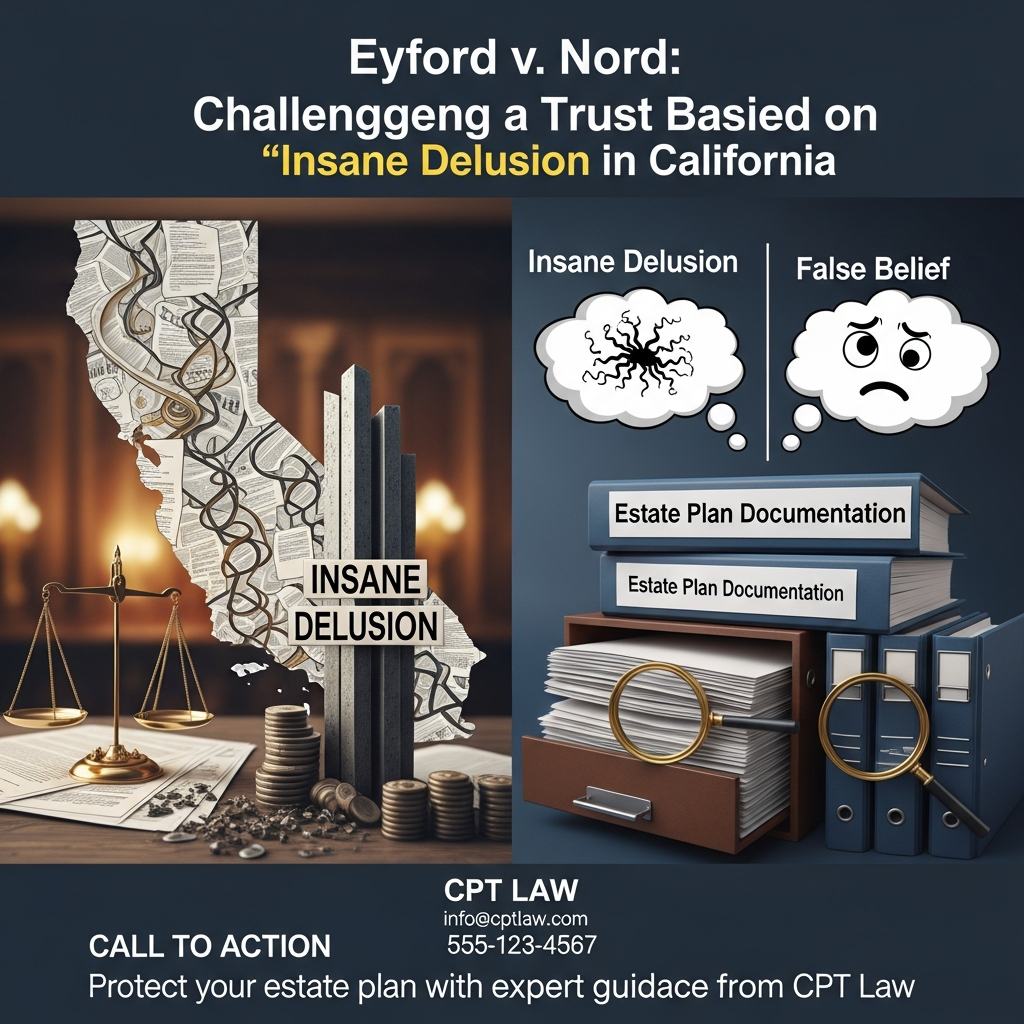
The *Eyford* case illustrates a critical distinction in estate planning law: the difference between a medical delusion and a mere false belief. law: the difference between a medical delusion and a mere false belief.
* Insane Delusion: This is a belief that is not susceptible to reason or evidence and has no basis in reality. It is a symptom of a mental health disorder.
* False Belief/Mistake of Fact: If a belief is based on *any* evidence, however slight or misinterpreted, it is generally not considered an insane delusion in the eyes of the court. If a belief is based on *any* evidence, however slight or misinterpreted, it is generally not considered an insane delusion in the eyes of the court.
In the *Eyford* case, the grandmother believed her granddaughters were stealing. While untrue, the belief was “tethered” to the fact that they had access to her accounts and handled her paperwork. Because the belief had a factual starting point, it was not considered a product of a delusional disorder, but rather a misinterpretation of reality.
Protecting Your Estate Plan
For those creating an estate plan, this case emphasizes the importance of documentation. If you are making significant changes to your Revocable Living Trust, particularly if you are disinheriting close family members, it is vital to ensure your capacity is well-documented., particularly if you are disinheriting close family members, it is vital to ensure your capacity is well-documented.
* Attorney Notes: An experienced estate planning attorney will take detailed notes regarding the client’s state of mind and reasons for specific bequests.
* Medical Evaluation: In some cases, obtaining a contemporaneous medical evaluation confirming capacity can prevent future litigation.
* Clarity: Explicitly stating reasons for disinheritance (without resorting to potentially libelous statements) can sometimes help clarify intent. Explicitly stating reasons for disinheritance (without resorting to potentially libelous statements) can sometimes help clarify intent.
About This Case
Source: Eyford v. Nord: Challenging a Trust Based on “Insane Delusion” in California
California Probate and Trust, PC Can Help
If you are concerned about the validity of a loved one’s trust, or if you wish to create a robust estate plan that can withstand a contest, contact us today.
– Free consultations: (866)-674-1130
– Experienced California estate planning
– Schedule consultation
– Learn more: cpt.law
Legal Disclaimer
This article is for informational purposes only. Consult with a qualified California estate planning attorney for advice specific to your situation.

About the Author: Dustin MacFarlane, Esq.
California Licensed Attorney | Estate Planning Specialist
Dustin MacFarlane is the founder of California Probate and Trust, PC, with over 15 years of experience in estate planning, probate administration, and trust law. Licensed by the California State Bar, Dustin has helped thousands of California families protect their assets and plan for the future.
CA Bar License: Active | Practice Areas: Estate Planning, Probate, Trust Administration | Location: Granite Bay, CA