
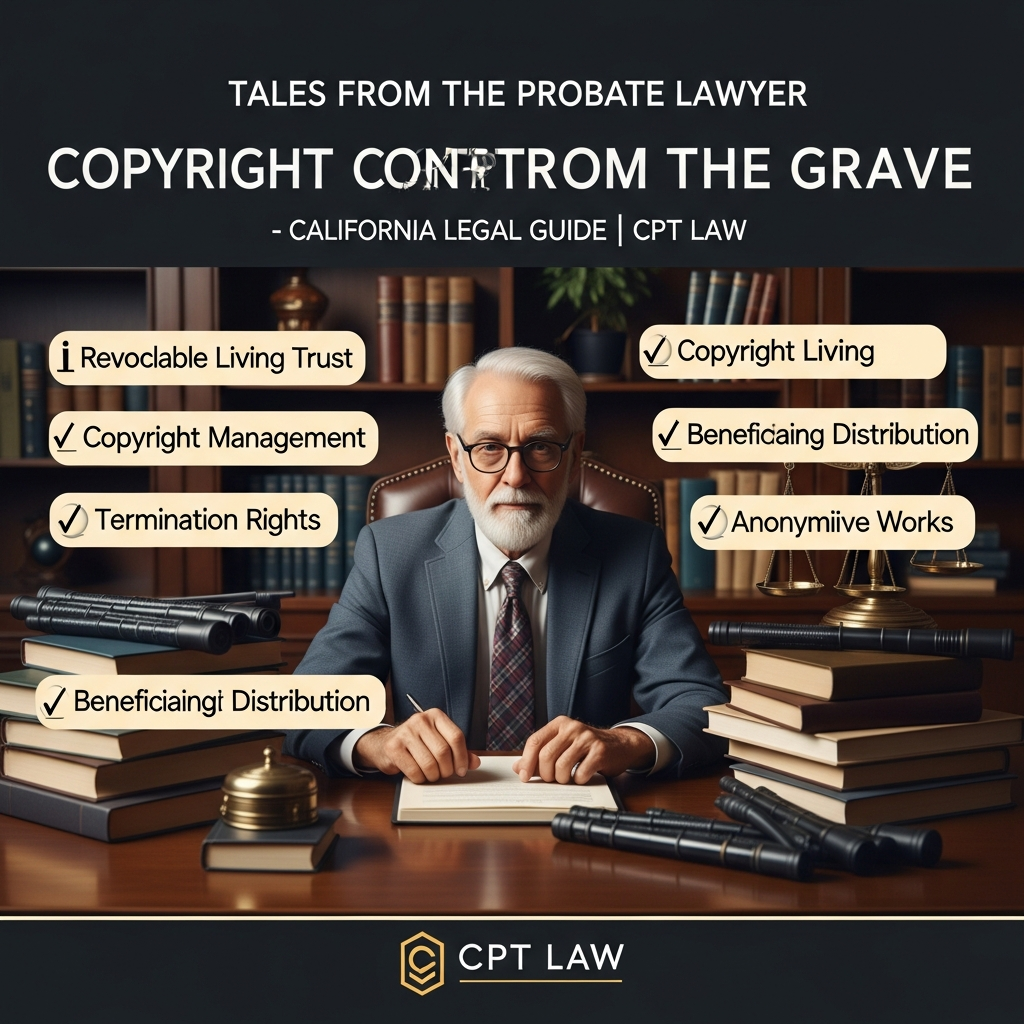
California Legal Implications: Protecting Your Creative Legacy with Estate Planning
The original article, “Tales from the Probate Lawyer: Copyright Control from the Grave,” presents a compelling fictional narrative about author Samuel Knight seeking to protect his extensive catalog of horror novels and short stories through estate planning. Knight’s primary goal is to ensure his copyrights are managed according to his specific wishes after his death, preventing misuse and directing financial proceeds appropriately. While a fictional tale, this scenario vividly illustrates critical, real-world considerations for authors, artists, musicians, and any individual in California holding valuable intellectual property. For creators, their copyrights often represent significant assets, both financial and personal, requiring careful planning to ensure their legacy is preserved and their beneficiaries are protected. In California, effective estate planning for copyright holders involves understanding federal copyright law in conjunction with state-specific mechanisms like trusts to achieve lasting control and benefit. to achieve lasting control and benefit.
Key Estate Planning Tools for Copyright Holders in California
For California residents with valuable copyrights, strategic estate planning is paramount. The primary tool for achieving the level of control Mr. Knight sought is a carefully drafted Revocable Living Trust.
– A Living Trust allows the creator (the settlor) to transfer ownership of their copyrights into the trust during their lifetime. This avoids probate, a potentially lengthy and public court process, ensuring a smoother and more private transition of control.
– Within the trust instrument, the settlor can provide explicit and detailed instructions for their designated trustee regarding the management of these copyrights. This could include directives on:
– How royalties and licensing fees are distributed to beneficiaries.
– Limitations or permissions for adaptations, sequels, or derivative works.
– Instructions regarding unfinished works or those the author was not satisfied with, such as prohibiting posthumous publication or dictating who may complete them.
– Directing proceeds from specific works to particular charities or causes, as Mr. Knight considered for his book “Cajun.”
– Alongside a trust, a comprehensive estate plan typically includes a pour-over will, which ensures any assets (including newly acquired copyrights or those unintentionally omitted) not formally transferred into the trust during life are directed into it upon death.
– A Durable Power of Attorney is also essential, granting a trusted agent the authority to manage the creator’s copyrights and other assets if they become incapacitated during their lifetime. and other assets if they become incapacitated during their lifetime.
Understanding Copyright Duration and Your Estate Plan
The duration of a copyright is a complex but crucial factor in estate planning. The length of protection dictates how long a creator’s legacy can generate income for their heirs or chosen causes. The original article highlights several categories of copyright duration under federal law, which directly impact California estate plans:
– Works with original statutory copyright on or after January 1, 1978: Generally protected for the author’s life plus 70 years. For joint authors, the 70-year term runs from the last surviving author’s date of death. These are generally not renewable.
– Anonymous or Pseudonymous Works and Works for Hire (on or after January 1, 1978): Protected for 95 years from first publication or 120 years from creation, whichever expires first. These are also not renewable.
– Works in their first (not renewed) copyright term on January 1, 1978: Protected for 28 years from the first copyright date, renewable for an additional 67 years (totaling 95 years).
– Works in a renewal term on October 27, 1998: Protected for 95 years from the date of the original copyright..
A key point from the article is the potential strategic use of disclosing the true author’s identity for anonymous or pseudonymous works. If an author’s identity is recorded with the U.S. Copyright Office, the term often reverts to “life plus 70 years,” which could, in certain scenarios, extend the duration of the copyright beyond the 95 or 120-year term. An author can include instructions in their California trust to have their trustee make such disclosures posthumously, demonstrating the power of a well-structured estate plan to actively manage and potentially enhance intellectual property assets from the grave. assets from the grave.
Termination Rights and Estate Planning
The article also touches upon termination rights, which allow authors or their heirs to reclaim copyrights that were previously transferred or licensed. These rights are crucial for estate planning because they can ensure that valuable copyrights revert to the author’s family or trust after a certain period, allowing for renegotiation of terms or new agreements.
– For copyrights created on or after January 1, 1978, the author’s right to terminate transfers and licenses begins 35 years after the date of the grant.
– For copyrights in existence on January 1, 1978, termination rights may be exercised 56 years after the original copyright date.
– For works in a renewal term on October 27, 1998, for which the termination right had expired, transfers and licenses may be terminated after 75 years with respect to the last 20 years of the copyright term. term.
These termination rights automatically pass to the author’s spouse, children, and grandchildren. Proper estate planning in California can guide these heirs on how and when to exercise these rights, ensuring the long-term benefit and control of the copyrights. Without clear instructions, heirs might overlook these valuable opportunities, potentially losing out on significant future income or creative control.. Without clear instructions, heirs might overlook these valuable opportunities, potentially losing out on significant future income or creative control.
Protecting Your Creative Legacy with a California Trust
Ultimately, for authors and creators in California, a trust is not just about distributing money; it’s about preserving a legacy. By carefully articulating your wishes within a trust instrument, you can:
– Dictate how your creative works are managed, promoted, and adapted.
– Ensure financial benefits flow to your desired beneficiaries or charitable organizations.
– Protect your body of work from decisions by heirs that might not align with your artistic vision.
– Maintain a degree of anonymity if desired, while also planning for strategic posthumous disclosures to maximize copyright duration.
– Provide for the management of unpublished or unfinished works, preventing their release or ensuring their completion by approved individuals. duration.
– Provide for the management of unpublished or unfinished works, preventing their release or ensuring their completion by approved individuals.
The story of Samuel Knight highlights that copyrights are a unique asset class requiring specialized attention within an estate plan. California Probate and Trust, PC specializes in helping creators integrate their intellectual property into a robust estate plan, providing peace of mind that their artistic and financial legacy will endure., providing peace of mind that their artistic and financial legacy will endure.
About This Case
Source: Tales from the Probate Lawyer: Copyright Control from the Grave https://research.ceb.com/posts/tales-from-the-probate-lawyer-copyright-control-from-the-grave
California Probate and Trust, PC Can Help
– Free consultations: (866)-674-1130
– Experienced California estate planning
– Schedule consultation
– Learn more: cpt.law
Legal Disclaimer
This article is for informational purposes only. Consult with a qualified California estate planning attorney for advice specific to your situation.

About the Author: Dustin MacFarlane, Esq.
California Licensed Attorney | Estate Planning Specialist
Dustin MacFarlane is the founder of California Probate and Trust, PC, with over 15 years of experience in estate planning, probate administration, and trust law. Licensed by the California State Bar, Dustin has helped thousands of California families protect their assets and plan for the future.
CA Bar License: Active | Practice Areas: Estate Planning, Probate, Trust Administration | Location: Granite Bay, CA