
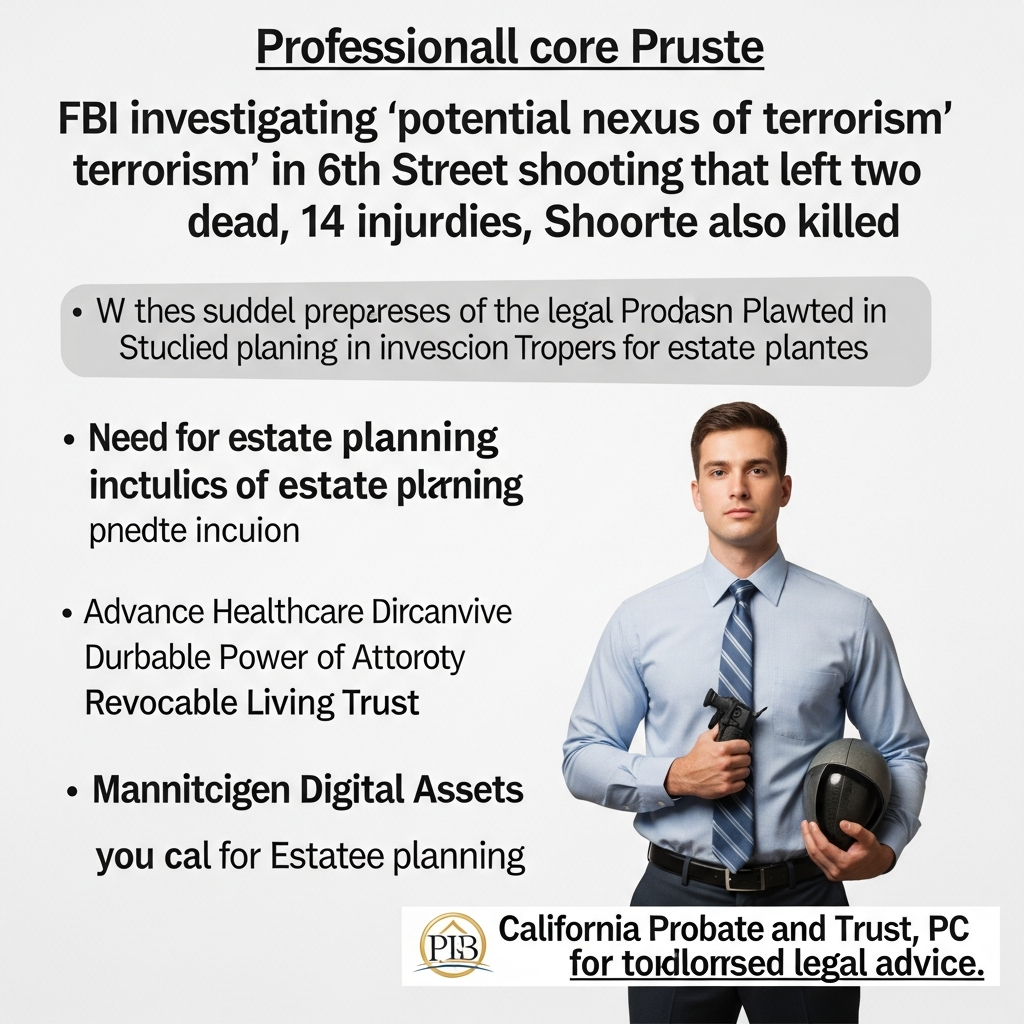
California Legal Implications: Estate Planning for Sudden Tragedy
A recent tragedy in Austin, Texas, where a gunman killed two people and injured 14 others in a busy entertainment district, highlights the unpredictable nature of life. As reported by KVUE, the FBI is currently investigating a potential nexus to terrorism regarding the shooter, who was also killed by police. While this heartbreaking event occurred in Texas, it serves as a stark reminder for California residents about the importance of legal preparedness., the FBI is currently investigating a potential nexus to terrorism regarding the shooter, who was also killed by police. While this heartbreaking event occurred in Texas, it serves as a stark reminder for California residents about the importance of legal preparedness.
Unexpected violence or accidents can leave individuals incapacitated or lead to sudden death. For California families, having a comprehensive estate plan is not just about asset distribution; it is about ensuring that medical decisions can be made immediately and that loved ones are protected from the complexities of Probate Court during a crisis. during a crisis.
Incapacity Planning: Protecting the Injured
The news report indicates that 14 people were injured, with three in critical condition. When an adult is suddenly hospitalized and unable to communicate due to trauma, medical privacy laws (HIPAA) prevent doctors from sharing information with family members unless specific legal documents are in place.
In California, two critical documents address this scenario:
* Advance Healthcare Directive: This allows you to appoint an agent to make medical decisions on your behalf if you become incapacitated. It ensures your treatment preferences are known and respected.
* Durable Power of Attorney: This designates an agent to manage your financial affairs—such as paying bills or accessing bank accounts—if you are unable to do so.: This designates an agent to manage your financial affairs—such as paying bills or accessing bank accounts—if you are unable to do so.
Without these documents, family members may be forced to petition the court for a Conservatorship, a public, time-consuming, and expensive legal process to gain the authority to make decisions for their injured loved one., a public, time-consuming, and expensive legal process to gain the authority to make decisions for their injured loved one.
Probate Avoidance and Sudden Death
For the victims who tragically lost their lives, the absence of an estate plan can lead to significant legal hurdles for their surviving family members. If a California resident passes away without a Will or Trust, they are considered to have died intestate..
Under Intestate Succession laws, the state of California dictates how the deceased’s assets are distributed, which may not align with their wishes. Furthermore, assets held in the individual’s name generally must go through Probate, a court-supervised process that can take 12 to 18 months or longer in California., a court-supervised process that can take 12 to 18 months or longer in California.
Establishing a Revocable Living Trust is the most effective way to ensure that, in the event of a sudden tragedy, assets can be transferred to beneficiaries privately and quickly, without court intervention. is the most effective way to ensure that, in the event of a sudden tragedy, assets can be transferred to beneficiaries privately and quickly, without court intervention.
Digital Assets and Privacy
The FBI investigation mentioned in the report involves digital forensics, and police noted that victims left personal items, including phones, at the scene. In the modern era, estate planning must also account for Digital Assets..
California law allows you to designate a fiduciary to access or manage your digital accounts (email, social media, banking apps) upon death or incapacity. Including specific language regarding digital assets in your estate plan ensures your family can retrieve sentimental photos or access critical financial information without violating terms of service agreements or federal privacy laws.
About This Case
California Probate and Trust, PC Can Help
– Free consultations: (866)-674-1130
– Experienced California estate planning
– Schedule consultation
– Learn more: cpt.law
Legal Disclaimer
This article is for informational purposes only. Consult with a qualified California estate planning attorney for advice specific to your situation.
Why Estate Planning Matters in California
California has unique estate planning laws that differ significantly from other states. Without proper planning, your assets may not pass according to your wishes, and your family could face unnecessary probate court proceedings.
A comprehensive California estate plan typically includes:
- A revocable living trust to avoid probate
- Pour-over will as a safety net
- Advance health care directive
- Durable power of attorney for finances
- Beneficiary designations on retirement accounts and life insurance
How Trusts Work in California
California’s trust law (Probate Code Division 9) governs how trusts are created, administered, and terminated. Understanding these rules is essential for effective estate planning.
Key benefits of California trusts:
- Avoid probate: Assets in a properly funded trust bypass California’s lengthy probate process
- Privacy: Unlike wills (which become public in probate), trusts remain private
- Control: You maintain control during your lifetime and direct distribution after death
- Incapacity planning: Your successor trustee manages assets if you become incapacitated
- Tax planning: Trusts can help minimize estate and income taxes
Need Expert Estate Planning Guidance?
California estate planning law is complex and constantly evolving. Don’t navigate it alone.
California Probate and Trust, PC has helped thousands of California families protect their assets and plan for the future.
📞 Call us today:
- Main Office: 866-400-0058
- Direct: 916-963-9968

About the Author: Dustin MacFarlane, Esq.
California Licensed Attorney | Estate Planning Specialist
Dustin MacFarlane is the founder of California Probate and Trust, PC, with over 15 years of experience in estate planning, probate administration, and trust law. Licensed by the California State Bar, Dustin has helped thousands of California families protect their assets and plan for the future.
CA Bar License: Active | Practice Areas: Estate Planning, Probate, Trust Administration | Location: Granite Bay, CA